
What Astronomy Reveals About the Cosmos Astronomy is the scientific study of objects and events beyond Earth. It explores planets, moons, stars, galaxies, black holes, and the vast structure of the universe. By observing light and other forms of radiation, scientists investigate how celestial bodies form, change, and interact. Astronomy also helps place Earth in […]
What Astronomy Reveals About the Cosmos
Astronomy is the scientific study of objects and events beyond Earth. It explores planets, moons, stars, galaxies, black holes, and the vast structure of the universe. By observing light and other forms of radiation, scientists investigate how celestial bodies form, change, and interact. Astronomy also helps place Earth in context, showing that our planet is part of a much larger and constantly evolving cosmic environment.
Modern astronomers use ground-based observatories, space telescopes, computer models, and data collected by robotic missions. These tools allow researchers to study objects that are too distant, faint, or dangerous to visit directly. Careful measurement and repeated observation are essential because astronomical discoveries often depend on evidence gathered over many years.
Exploring the Solar System
The solar system includes the Sun, eight planets, dwarf planets, moons, asteroids, comets, and smaller bodies. The inner planets—Mercury, Venus, Earth, and Mars—are rocky worlds, while Jupiter, Saturn, Uranus, and Neptune are much larger and dominated by gases or ices. Each planet has a different atmosphere, temperature, geological history, and collection of moons.
Studying our planetary neighborhood helps scientists understand how worlds develop. The Moon provides a nearby example of planetary history, while missions to Mars, the outer planets, and small bodies reveal the diversity of environments beyond Earth.
Stars, Galaxies, and Black Holes
Stars are enormous spheres of hot plasma that produce energy through nuclear fusion. Their mass determines how they evolve, how long they remain active, and how they end. Some stars leave behind white dwarfs, while massive stars can collapse into neutron stars or black holes.
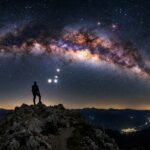
Stars are grouped into galaxies containing gas, dust, and often billions of stellar systems. Our galaxy, the Milky Way, is one of countless galaxies in the observable universe. Black holes are regions where gravity is so strong that, beyond the event horizon, even light cannot escape.
How to Begin Observing the Sky
Stargazing can begin without specialized equipment. Learning major constellations, tracking the Moon, and identifying bright planets are accessible first steps. A pair of binoculars can reveal lunar craters and star clusters, while a telescope provides more detailed views when used under dark, clear skies.