
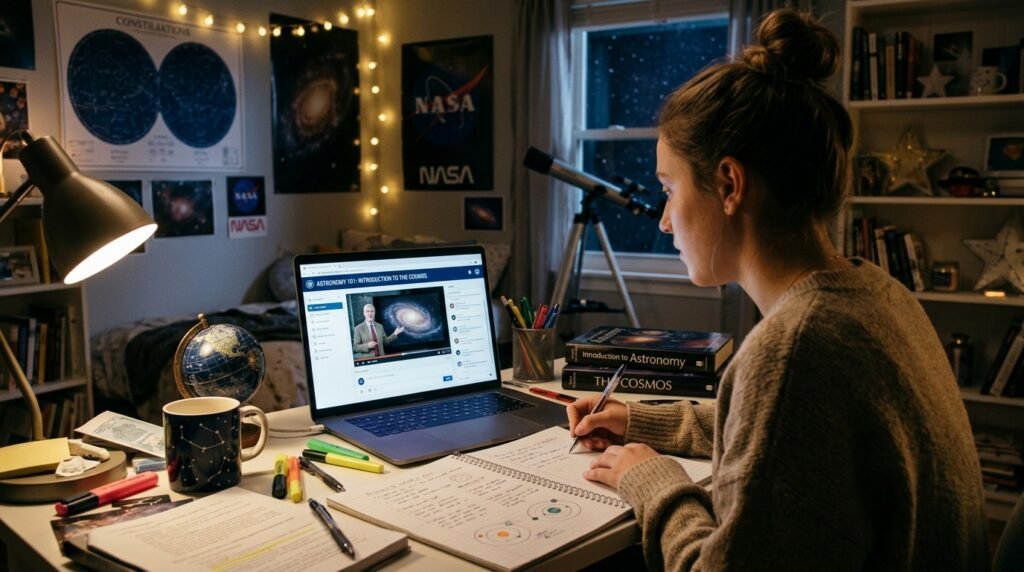
Astronomy 101 Online: Your Complete Beginner’s Guide to Learning the Universe from Home
The first time you stand under a truly dark sky, far from city lights, something shifts. The sky stops looking like a flat black ceiling and starts looking like what it really is: depth. Thousands of stars. The pale, cloudy band of the Milky Way. A few bright points that don’t twinkle the way stars do — those are planets. Most of us have had that moment. Then we go back inside, because nobody ever explained what we were looking at.
That is exactly what an astronomy 101 course is for. It is the classic introductory college class on the universe, and taking it online means you can learn the whole thing — why the Moon changes shape, why we have seasons, how stars are born and die, what galaxies actually are — from your couch, mostly for free, and entirely at your own pace.
This guide covers what an astronomy 101 online course really teaches, which courses are worth your time, the free tools that make learning easier, and how to take your first real look at the night sky tonight. No advanced math. No telescope required. Just curiosity.

A spiral galaxy rises over a mountaintop observatory — the kind of view that starts most people’s astronomy journey.
What Is Astronomy 101 Online?
An astronomy 101 online course is the internet version of the standard introductory college astronomy class. Same subject matter — the Solar System, stars, galaxies, and cosmology — delivered through video lessons, readings, and quizzes instead of a lecture hall. Most are designed for complete beginners, and many assume no science background beyond high school.
There are really two flavors, and picking the right one matters:
- College-credit courses (like Study.com’s Astronomy 101) are built to transfer into degree programs. They come with proctored exams, structured assignments, and a transcript you can send to a university. They cost money, but far less than a semester of tuition.
- Learn-for-fun courses (like the big Coursera, edX, and Khan Academy offerings) are about understanding, not credentials. Many are free to audit, and you work through them at whatever speed suits your life.
If you just want to understand the universe, start free. If you need the credit on a transcript, pay for the credit-bearing option. Either way, the core content is nearly identical — which is why one good guide like this can serve both groups.
What You’ll Actually Learn: The Full Astronomy 101 Syllabus
Whether online or on a campus, an intro astronomy course almost always follows the same arc: start close to home, then zoom out until your brain hurts a little. Here is that journey, in order.
1. The Night Sky and How It Moves
Everything starts with looking up. You learn why stars appear to rise in the east and set in the west (Earth rotates), why different constellations appear in different seasons (Earth orbits the Sun), and why the North Star barely moves while everything else wheels around it. You’ll meet the celestial sphere — an imaginary globe around Earth that astronomers use as a map — and learn the handful of bright constellations, like Orion and Ursa Major, that act as landmarks for everything else.
This section quietly kills a few misconceptions. The Big Dipper is not a constellation (it’s an asterism, part of Ursa Major). The “Man in the Moon” is just dark lava plains. And the stars in a constellation are usually not near each other at all — they only line up from our viewpoint.
2. Our Solar System, Up Close
Next comes the neighborhood: the Sun, the eight planets, Earth’s Moon, and the leftover rubble — asteroids, comets, and dwarf planets like Pluto. This is where you finally get straight answers to questions you have probably wondered about for years:
- Why do we have seasons? Because Earth’s axis is tilted about 23.5 degrees — not because we’re closer to the Sun in summer. (In fact, Earth is slightly closest to the Sun in January.)
- Why does the Moon change shape? The Moon doesn’t change at all. We just see different amounts of its sunlit half as it orbits Earth.
- What causes eclipses? A solar eclipse happens when the Moon passes directly between Earth and the Sun; a lunar eclipse when Earth passes between the Sun and the Moon, casting its shadow on the lunar surface.

The eight planets in order from the Sun — the cast of characters for the first third of any astronomy 101 course.
A quick tour of the planets, the way an intro course frames them:
| Planet | Type | The one thing to remember |
|---|---|---|
| Mercury | Rocky | Smallest planet; wild temperature swings between day and night |
| Venus | Rocky | Hottest planet — a runaway greenhouse effect, not closeness to the Sun, did it |
| Earth | Rocky | The only confirmed home of life; liquid water on the surface |
| Mars | Rocky | Home to Olympus Mons, the tallest volcano in the Solar System |
| Jupiter | Gas giant | More massive than all other planets combined; the Great Red Spot is a centuries-old storm |
| Saturn | Gas giant | Rings made of countless ice and rock particles, some as small as dust |
| Uranus | Ice giant | Rotates on its side — likely knocked over by an ancient collision |
| Neptune | Ice giant | The windiest world we know, with supersonic storms |
3. Light and Telescopes: How We Know What We Know
This is the section most beginners skip in their heads and later wish they hadn’t, because it answers the best question in all of astronomy: how do we know any of this? Nobody has visited a star. Everything astronomers know comes from light.
You’ll learn that visible light is one thin slice of the electromagnetic spectrum, which stretches from radio waves to gamma rays, and that different telescopes “see” different slices — which is why the James Webb Space Telescope, working in infrared, can peer through dust clouds that block visible light. You’ll learn how a prism-like instrument called a spectrograph splits starlight into a rainbow barcode that reveals a star’s temperature, composition, and motion. And you’ll learn the difference between refracting telescopes (lenses) and reflecting telescopes (mirrors) — the design nearly all serious observatories use.
4. The Sun and the Lives of Stars
Our Sun is the only star we can study up close, so it gets its own chapter: a ball of plasma about 1.4 million kilometers across, fusing roughly 600 million tons of hydrogen into helium every second in its core. That fusion is the engine of starlight everywhere.
Then the course zooms out to all stars. You’ll learn the spectral classes — O, B, A, F, G, K, M, remembered by generations of students with the phrase “Oh Be A Fine Girl/Guy, Kiss Me” — which rank stars from hottest and bluest to coolest and reddest. You’ll meet the Hertzsprung–Russell diagram, a simple plot of brightness versus temperature that turned out to encode the entire life story of stars. And you’ll learn that stars are born inside cold clouds of gas and dust called nebulae, where gravity slowly squeezes a collapsing clump until its core ignites.
5. How Stars Die: White Dwarfs, Neutron Stars, and Black Holes
A star’s death is decided by its mass, and this is where astronomy 101 gets dramatic. A star like our Sun will swell into a red giant, shed its outer layers, and leave behind a hot, Earth-sized ember called a white dwarf that cools for billions of years.
Heavier stars go out violently. Their cores collapse in seconds and rebound in explosions called supernovae — briefly outshining entire galaxies — leaving behind either a neutron star (a city-sized ball denser than an atomic nucleus, spinning hundreds of times per second) or, for the most massive stars, a black hole: a region where gravity is so strong that nothing, not even light, can escape once it crosses the boundary called the event horizon.
6. Galaxies and the Expanding Universe
The final zoom-out. Our Sun is one of an estimated 100 to 400 billion stars in the Milky Way, a barred spiral galaxy roughly 100,000 light-years across. You’ll learn the main galaxy types — spirals, ellipticals, and irregulars — and how galaxies collide and merge over billions of years.
Then comes cosmology: the study of the universe as a whole. In the 1920s, Edwin Hubble discovered that distant galaxies are racing away from us, and the farther they are, the faster they recede. Run that expansion backward and everything converges about 13.8 billion years ago — the Big Bang. The course usually ends at the frontier: dark matter and dark energy, the invisible majority of the cosmos that scientists are still working to understand. A good course is honest here — these are active research areas, not settled facts.
The Best Astronomy 101 Courses You Can Take Online
There are dozens of options, but these are the ones that consistently come up as genuinely good — free where possible, with honest notes on what each is best for.
| Course | Platform | Cost | Best for |
|---|---|---|---|
| Astronomy: Exploring Time and Space | Coursera (University of Arizona) | Free to audit | A true college-level survey, about 11 weeks, from a real university astronomy department |
| Cosmology & Astronomy | Khan Academy | Free | Short, clear video lessons with practice exercises; ideal first stop for total beginners |
| Astronomy 101: Intro to Astronomy | Study.com | Paid subscription | Earning transferable college credit (3 semester hours) on a self-paced schedule |
| Introductory astrophysics MOOCs | edX | Free to audit | Going a level deeper with university-made courses; optional paid certificates |
| Astronomy 101 Complete Lessons | Cursa | Free | Bite-size lessons with quizzes and a free completion certificate |
| Crash Course Astronomy | YouTube | Free | Fast, entertaining 10-minute episodes hosted by astronomer Phil Plait — great supplement |
| Astronomy textbook | OpenStax (Rice University) | Free | The open-licensed textbook used in many college Astro 101 classes; perfect for readers |
How to choose? Ask yourself one question: do you need credit? If yes, look at Study.com or a similar credit-bearing provider — and confirm with your academic advisor before paying that your school will accept the transfer. If no, start with Khan Academy for the basics, then move to the Coursera course for the full university experience. The OpenStax textbook pairs beautifully with either, since it’s the same material in written form, free forever.
Free Tools That Make Learning Astronomy Easier
A course teaches you the ideas; these tools connect the ideas to the actual sky above you.
- Stellarium — free, open-source planetarium software for your computer. Type in your location and it shows exactly what’s in your sky right now, or on any date, past or future. Many beginners say this one tool taught them more than any single lesson.
- A stargazing app — Sky Guide, Night Sky, or SkySafari turn your phone into a “point at the sky and identify it” device. Hold it up and it labels constellations, planets, and satellites in real time.
- NASA’s Astronomy Picture of the Day — one stunning space image every day with a short explanation written by professional astronomers. Five minutes a day, and your visual vocabulary of the universe grows fast.
- Heavens-Above — a free website that predicts when the International Space Station and bright satellites will pass over your exact location. Seeing the ISS glide overhead on your first try is a small thrill that hooks a lot of people.
- A local astronomy club — most cities have one, many host free public “star parties” where members set up telescopes and invite strangers to look through them. It is the fastest way to see Saturn’s rings with your own eyes.
How to Start Stargazing Tonight: A 5-Step Plan
You don’t need to finish a course before looking up. Do this tonight:
- Get away from bright lights. Even a few blocks from the brightest streetlights helps. A park, a rooftop, or a friend’s backyard on the edge of town works. Check a light-pollution map if you want to find truly dark skies near you.
- Give your eyes 20 to 30 minutes. Your eyes need time to switch to night vision. Avoid looking at your phone — or use a red-light mode, which preserves night vision far better than white light.
- Start with the Moon. It’s the easiest, most rewarding first target. A first-quarter Moon (half-lit) is actually better than a full Moon, because the shadows along the terminator — the line between light and dark — make craters and mountains pop.
- Learn two or three constellations. Don’t try to memorize the whole sky. Find the Big Dipper, follow its pointer stars to Polaris, or spot Orion’s unmistakable belt of three stars. Everything else gets easier once you have landmarks.
- Use binoculars before buying a telescope. Any old pair of binoculars will show you Jupiter’s four largest moons, the craters of the Moon, and star clusters invisible to the naked eye. They are also how you learn the sky well enough to know what telescope you actually want later.

A stargazer and a telescope under the Milky Way — the setup for step one of your astronomy journey.
5 Mistakes Almost Every Beginner Makes
1. Buying a telescope first. The classic error. An expensive telescope you don’t know how to aim is a very heavy paperweight. Learn the sky with your eyes and binoculars first; the telescope comes later, and you’ll choose a better one.
2. Expecting Hubble-like views. Those jaw-dropping nebula photos are long exposures through giant telescopes, often in wavelengths your eyes can’t see. Through a backyard telescope, galaxies look like faint gray smudges — and honestly, knowing you’re seeing light that traveled millions of years makes the smudge thrilling anyway.
3. Trying to learn everything at once. Astronomy 101 courses are a semester long for a reason. Pick one topic a week — the Moon this week, constellations next — and let it accumulate.
4. Ignoring the Moon’s phase. A bright full Moon washes out faint stars and galaxies. The best deep-sky observing happens during the new Moon. Check the phase before planning a stargazing night.
5. Giving up after one cloudy night. Weather ruins more astronomy plans than anything else. The people who stick with it aren’t luckier — they just check the forecast and try again next week.
Frequently Asked Questions
For most people, no. Introductory astronomy is concept-heavy, not math-heavy — you need basic arithmetic and a little algebra at most. The challenge is the scale of the ideas, not the equations.
Yes. Khan Academy, Coursera’s audit track, edX’s audit track, Crash Course on YouTube, the OpenStax textbook, and Stellarium are all free, and together they cover more than a typical semester. You only need to pay if you want formal college credit or a verified certificate.
Self-paced courses typically take 4 to 12 weeks at a few hours per week. University-style MOOCs run about 8 to 11 weeks. There’s no deadline pressure in most free options — finishing slowly still counts.
No. Naked-eye observing plus binoculars will carry you through your entire first year. Many professional astronomers will tell you that learning the constellations by eye is the single most valuable skill a beginner can build.
Astronomy is the scientific study of the universe — testable, evidence-based, and constantly revised as new data arrives. Astrology is a belief system claiming celestial positions influence human lives; it makes no testable predictions and isn’t supported by evidence. An astronomy 101 course covers only the science.
Credit-bearing courses like Study.com’s are designed to transfer as 3 semester hours of science credit, and thousands of colleges accept them — but policies vary by school. Always confirm with your academic advisor before enrolling.
Follow what excited you most: planetary science if you loved the Solar System, stellar astrophysics if stars hooked you, cosmology if the Big Bang blew your mind — or astrophotography if you just want to photograph what you’ve learned to find.
The Sky Is Waiting
Here’s the quiet secret of astronomy 101: the course doesn’t give you the universe. It gives you the vocabulary for a universe you already live under. Once you know why the Moon has phases, what that bright “star” near sunset really is (probably Venus or Jupiter), and that the smudge in Andromeda is an entire galaxy of a trillion stars, the night sky stops being background and becomes a place you know.
So pick a free course, download Stellarium, and step outside tonight. The first lesson of astronomy has always been free, and it starts the moment you look up.

1 Comment