
1. Scale, Morphology & Classification (SBbc Barred Spiral)
The Milky Way is a giant barred spiral galaxy, classified on the Hubble Sequence as SBbc (a barred spiral with moderately loose, winding arms). It measures approximately 100,000 light-years in diameter (with recent stellar surveys suggesting diffuse outer stellar disc boundaries stretching up to 150,000 light-years) and hosts between 100 and 400 billion stars.
Because our Solar System is embedded directly within the mid-plane of the galactic disc, viewing our galaxy from the inside presents an enormous observational challenge—comparable to attempting to map the floor plan of an immense mansion while confined to a chair in one small room. Only through space-based astrometry missions (like ESA’s Gaia spacecraft, which mapped 1.8 billion stars in 3D) have astronomers accurately unraveled our galaxy’s full architecture.
If the Milky Way were scaled down to the size of a standard vinyl phonograph record (30 cm in diameter), its thin stellar disc would be thinner than a sheet of paper, while our entire Solar System out to Pluto would be smaller than a single microscopic bacterium.
2. The Four Structural Components of the Milky Way
Astrophysicists divide the Milky Way into four primary morphological zones:
1. The Thin Disc: A flattened disc about 1,000 light-years thick containing 85% of the galaxy's light, rich in gas, interstellar dust, and young, metal-rich Population I stars (like our Sun).
2. The Thick Disc: A broader, more diffuse disc spanning ~3,000 light-years in thickness, populated by older, metal-poor stars born during the galaxy’s turbulent early youth.
3. The Central Bulge & Bar: A peanut-shaped central concentration of older Population II stars spanning 10,000 light-years across, crossed by a prominent linear stellar bar 27,000 light-years long.
4. The Stellar Halo: A vast, nearly spherical envelope surrounding the entire disc, sparsely populated by ancient globular star clusters (some over 12 billion years old).
3. The Spiral Arms & Lin-Shu Density Wave Theory
A classic puzzle in galactic astronomy was the "Winding Problem": if spiral arms were rigid collections of stars, differential galactic rotation (where stars closer to the center complete orbits faster than stars further out) would tightly wind the spiral arms into indistinguishable coils after just a few hundred million years.
In 1964, C.C. Lin and Frank Shu resolved this with Density Wave Theory: spiral arms are not fixed material structures. Rather, they are traffic jams of gravity—ripples of higher density that rotate around the galaxy at a different speed than individual stars and gas clouds.
As cold gas clouds plow into the gravitational traffic jam, they are compressed, triggering rapid collapses and sparking waves of brilliant, short-lived blue O and B stars. These bright stars illuminate the density crest before dying, making the spiral wave prominently visible.
The Milky Way features two major spiral arms (Scutum-Centaurus and Perseus) and two minor arms (Norma and Sagittarius).
4. Our Cosmic Address: The Orion-Cygnus Spur
Our Solar System resides about 26,000 light-years (8,000 parsecs) from the galactic core, situated within a minor spiral structure known as the Orion-Cygnus Arm (or the Local Spur).
Our Sun orbits the center of the Milky Way at an orbital velocity of approximately 220 km/s (nearly 800,000 km/h). Even at this staggering speed, the scale of our galaxy is so colossal that it takes the Sun roughly 230 million years to complete one single galactic lap—a span termed a "Cosmic Year" (or Galactic Year). The last time Earth was in its current galactic position, early dinosaurs were just beginning to walk on the supercontinent Pangaea.
5. The Galactic Center: Sagittarius A* and the S-Stars
At the exact gravitational center of the Milky Way, concealed behind dense clouds of interstellar dust in the constellation Sagittarius, sits Sagittarius A* (Sgr A*): a supermassive black hole containing 4.3 million solar masses.
For over two decades, teams led by Andrea Ghez (UCLA) and Reinhard Genzel (Max Planck Institute) used infrared adaptive optics to track the orbits of individual stars (the S-stars) darting around this invisible anchor. In 2020, Ghez and Genzel received the Nobel Prize in Physics after proving that star S2 whips around Sgr A* at 7,700 km/s (nearly 3% of the speed of light) within a tiny periastron of 17 light-hours—proving beyond doubt that only a supermassive black hole could pack such mass into that volume.
In May 2022, the Event Horizon Telescope released the first direct radio image of the glowing accretion ring framing Sgr A*.
6. Galactic Rotation Curves & The Invisible Dark Matter Halo
According to Newtonian mechanics and Keplerian laws, stars far out in the galactic disc should orbit much slower than stars close to the mass-concentrated center—just as Neptune orbits the Sun far slower than Mercury.
In the 1970s, astronomer Vera Rubin measured the orbital speeds of hydrogen gas in the outer discs of spiral galaxies and discovered that galactic rotation curves do not drop off; instead, they remain flat. Stars at the very edge of the Milky Way orbit at virtually the same 220 km/s as stars near the core.
This flat rotation curve proved that the visible stars, gas, and dust account for only 10% to 15% of the galaxy’s total gravitational mass. The remaining 85% to 90% is an invisible, non-baryonic Dark Matter Halo extending out to hundreds of thousands of light-years.
7. The Great Cosmic Merger: Milkomeda in 4.5 Billion Years
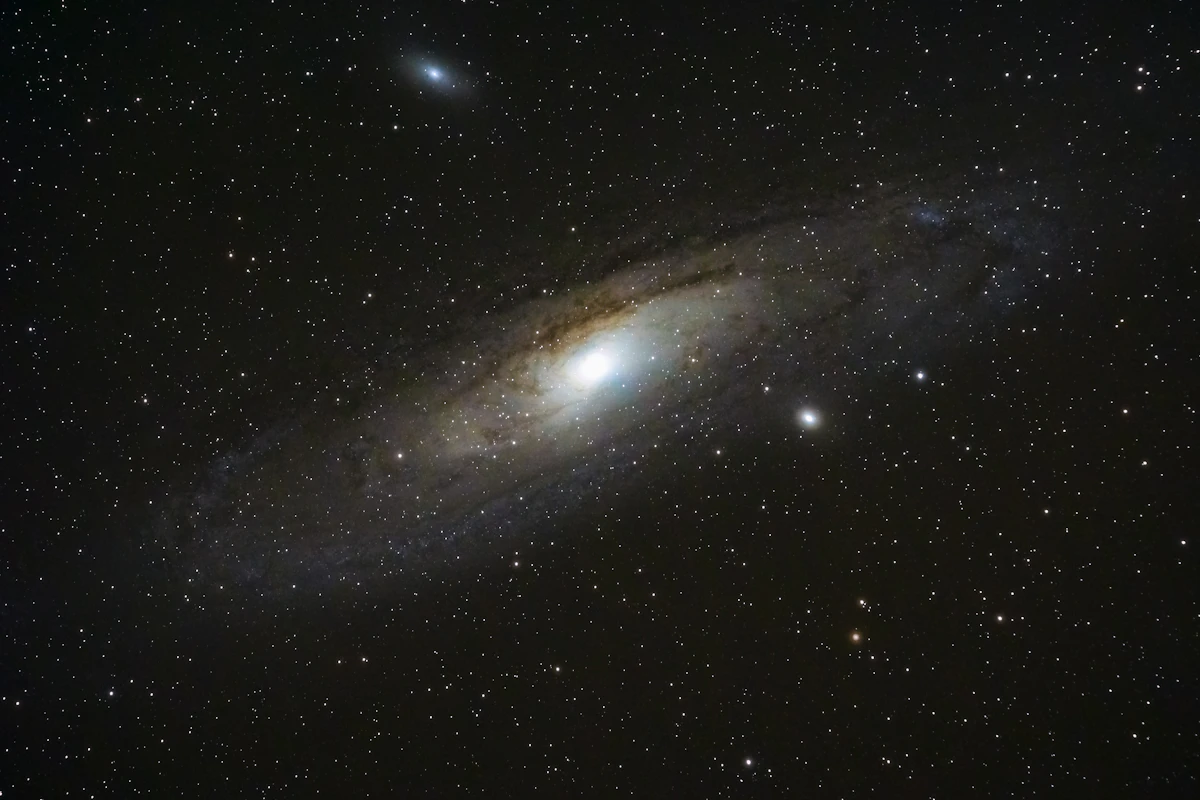
The Milky Way does not exist in isolation; it is the second-largest member of the Local Group of galaxies, dominated by the Andromeda Galaxy (Messier 31).
Radial velocity measurements prove that Andromeda is currently barreling toward the Milky Way at 110 km/s (400,000 km/h). In approximately 4.5 billion years, the two giant spirals will collide and merge. Because the physical distances between individual stars are immense compared to stellar diameters, almost no stars will physically collide. Instead, gravitational tides will distort both galaxies into graceful tidal tails, ignite a massive burst of star formation, and ultimately settle into a titanic giant elliptical galaxy informally nicknamed "Milkomeda."
Frequently Asked Questions
Why does the Milky Way appear as a milky band across our sky?
Because we are looking edge-on through the flattened stellar disc of our galaxy. The light from hundreds of millions of unresolved, distant stars blends together into a continuous glowing ribbon, divided in places by dark silhouettes of interstellar dust lanes (the Great Rift).
Are there other galaxies orbiting the Milky Way?
Yes! The Milky Way is orbited by dozens of dwarf satellite galaxies, the largest being the Large and Small Magellanic Clouds (visible from the Southern Hemisphere), plus the Sagittarius Dwarf Spheroidal Galaxy, which is currently being gravitationally torn apart and absorbed by the Milky Way.