
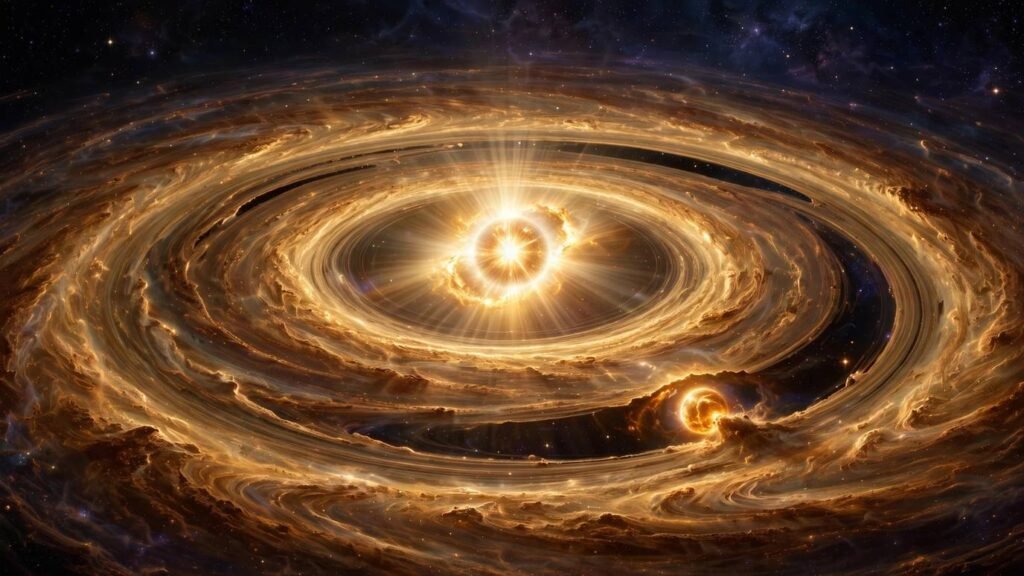
How do planets form? Every world you have ever heard of — Earth, Mars, Jupiter, and every exoplanet that makes the news — started out as something almost embarrassingly ordinary: dust. Not even interesting dust. Just tiny, drifting specks floating in a cold, dark cloud, each one lighter than the flour in your kitchen.
And yet, out of that nothing much, the universe builds planets. Mountains. Oceans. Storms wider than continents. Skies where it rains methane. The recipe looks surprisingly simple from a distance — gravity, time, and a lot of collisions — but the details took astronomers more than a century to work out, and a few of them are still being argued over today.
This guide walks through the whole story the way scientists understand it now: how a cloud becomes a star wrapped in a spinning disk, how dust clumps into worlds, why some planets end up rocky and others gaseous, how long the whole thing takes, and what modern telescopes have actually caught in the act. No equations. No jargon without a translation. Just the story of how planets get made.
The short answer: Planets form inside a rotating disk of gas and dust around a newborn star. Dust grains collide and stick, growing into pebbles, then kilometer-sized planetesimals, then Moon-to-Mars-sized protoplanets. Rocky planets assemble by stacking up these solid building blocks, while giant planets grow cores of around ten Earth masses that then pull in huge envelopes of gas. The whole process takes anywhere from a few million to about a hundred million years — and telescopes like ALMA have photographed it happening around young stars such as HL Tau.
It All Starts With a Cloud: The Nebular Hypothesis
The leading explanation for planet formation is called the nebular hypothesis, and it is old — it goes back to the 18th century, to the philosopher Immanuel Kant and the mathematician Pierre-Simon Laplace. They never saw a protoplanetary disk, of course. They were working from logic: the planets of our solar system all orbit the Sun in the same direction, they all lie in roughly the same flat plane, and the Sun itself spins the same way. That cannot be a coincidence. It looks exactly like what you would get if everything condensed out of one giant spinning cloud.
Modern observations have turned that old idea into something far more solid. The story begins with a giant molecular cloud — a vast, cold region of gas (mostly hydrogen and helium, with traces of heavier elements) and fine dust, sometimes spanning dozens of light-years. These clouds sit quietly for ages until something disturbs them: the shockwave from a nearby supernova, a collision with another cloud, or simply their own gravity finally winning out over the pressure holding them up.
Once collapse begins, it accelerates. And because the original cloud was slowly rotating, conservation of angular momentum — the same physics that makes a spinning ice skater speed up when she pulls her arms in — spins the collapsing material faster and faster. The cloud cannot fall straight inward anymore, so it flattens into a disk with a dense, hot center. That center will become a star. Everything else, the leftover crumbs swirling around it, is the raw material of planets.
What Exactly Is a Protoplanetary Disk?
The flattened disk of gas and dust around a newborn star is called a protoplanetary disk, and it is the construction site where every planet in that system gets built. Picture a pancake of material, thicker near the star and thinning out toward the edges, stretching billions of kilometers across. In the case of our own solar system, this disk is sometimes called the solar nebula.
Disks like this are not rare or theoretical. Astronomers have photographed them around young stars all over the galaxy. Some are smooth, some show sharp rings and gaps — and those gaps turn out to be one of the most exciting clues in the whole field, because they are most likely the shadows of planets being born (more on that later).
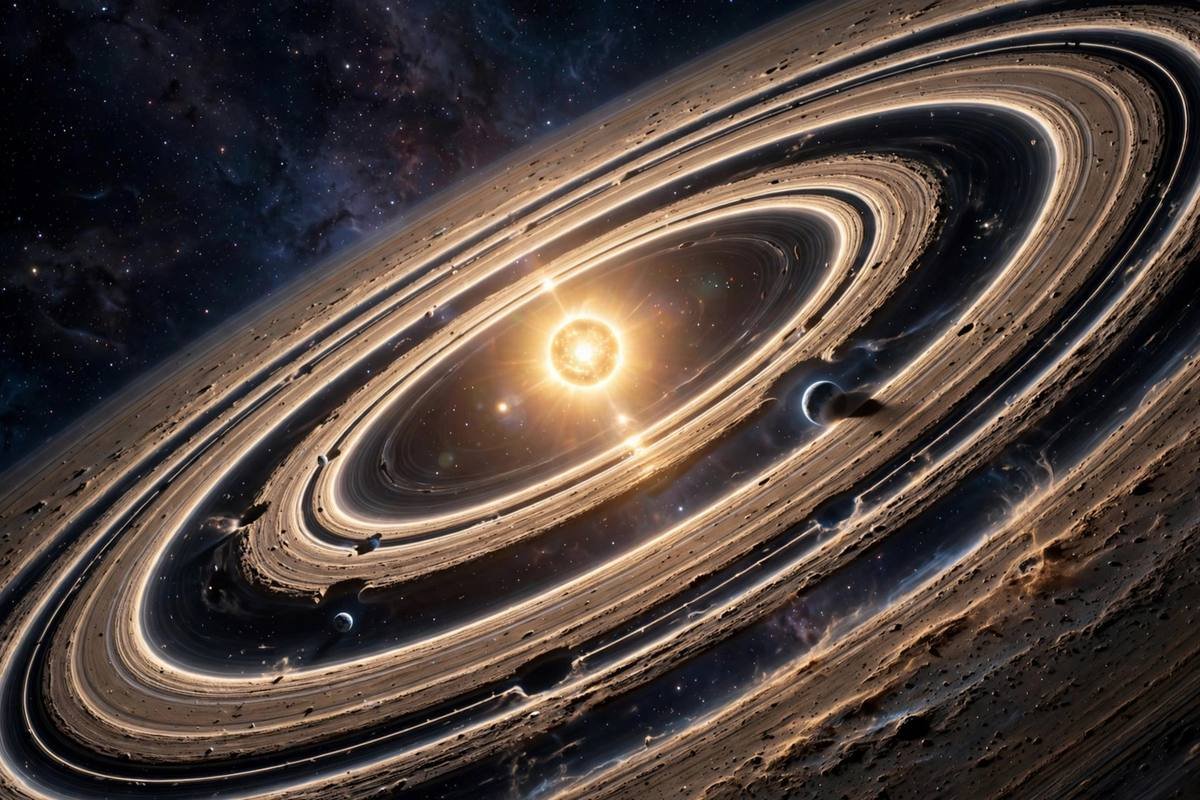
The center of the disk keeps contracting and heating until it ignites into a protostar, and eventually, nuclear fusion switches on and a true star is born. While that is happening, out in the cooler parts of the disk, something much quieter is underway: dust is beginning to stick together. And that is where planets come from.
From Dust to Planets: The Step-by-Step Assembly Line
Nobody has watched a single planet grow from start to finish — the process takes millions of years. But astronomers have pieced together the sequence from telescope observations, laboratory experiments on dust grains, and computer simulations. It goes roughly like this.
1. Dust Grains Bump and Stick Together
It starts microscopically. Dust grains in the disk — specks smaller than a grain of sand — drift around, bump into each other, and stick together through gentle electrostatic forces, the same static cling that makes dust gather on a television screen. Grain becomes clump, clump becomes a fluffy aggregate. This stage is slow and fragile; the aggregates are barely held together.
2. Pebbles, Boulders, and the Meter-Size Barrier
The clumps keep growing into pebble-sized and then boulder-sized objects. Here the process hits a famous problem scientists call the “meter-size barrier.” Objects around a meter across are in an awkward middle ground: too big to drift gently with the gas, too small for gravity to help them much, and moving fast enough relative to the gas that collisions tend to shatter them rather than merge them. For years this looked like a fatal flaw in the whole theory.
The likely escape route is a newer idea called pebble accretion. Instead of boulders smashing into boulders, a growing body sweeps up a constant rain of small pebbles, which are slowed by gas drag just enough to spiral inward and be captured. Simulations suggest pebble accretion can build planetary cores up to a thousand times faster than boulder-on-boulder collisions alone.
3. Planetesimals: The Kilometer-Sized Building Blocks
Once objects reach roughly a kilometer across, they earn a new name: planetesimals. At this size, gravity finally becomes the dominant force. A planetesimal can pull in nearby material with its own gravitational attraction, not just rely on lucky collisions. The early disk ends up populated with millions of these bodies, ranging from the size of a small town to the size of a small moon.
4. Runaway Growth and the Oligarchic Phase
Now the rich get richer. The biggest planetesimals have the strongest gravity, so they grow fastest — a phase astronomers call runaway growth. Eventually a handful of dominant bodies emerge, each gravitationally controlling its own neighborhood of the disk. This is the oligarchic phase: a few “oligarchs” hoovering up everything in their orbital zone while the smaller fry get scattered or absorbed.
5. Protoplanets: Worlds Under Construction
The survivors of this gravitational feeding frenzy are protoplanets — bodies roughly the size of the Moon or Mars, with enough internal heat from collisions and radioactive decay to melt and differentiate, so that heavy metals like iron sink to form a core while lighter rock floats toward the surface. In the final stages, these protoplanets collide with each other in titanic impacts over tens of millions of years, merging into the full-sized planets we know today. Earth itself is thought to have gained its Moon from one such giant impact late in its formation.
Two Rival Theories: Core Accretion vs. Disk Instability
Scientists agree on the broad outline above, but there are two competing models for how the largest planets — the gas giants — manage to form, and the debate is one of the liveliest in planetary science.
| Core Accretion | Disk Instability | |
|---|---|---|
| How it works | A solid core of around 10 Earth masses forms first, then its gravity pulls in a massive envelope of hydrogen and helium gas | A massive, unstable disk of gas collapses directly under its own gravity, forming a giant planet in one step |
| Speed | Slow — millions of years; the gas must still be around when the core is ready | Fast — thousands of years |
| Disk needed | Works in relatively low-mass disks | Needs a very massive, cold disk |
| Best explains | Jupiter and Saturn; the enriched heavy-element cores of gas giants; the link between planet formation and host-star metallicity | Some giant planets on very wide orbits, far from their stars |
| Status | Considered the leading, most widely supported model | A viable alternative for special cases |
The core accretion model — sometimes called the nucleated instability model — is currently thought to be the dominant mechanism. Surveys of exoplanets have found that stars richer in heavy elements are more likely to host giant planets, which is exactly what core accretion predicts: more heavy elements in the star means more solid building material in its disk, so cores form more easily. Disk instability probably still happens in some systems, particularly where giant planets sit on extremely wide orbits that core accretion struggles to explain. The universe may well use both recipes.
Why the Inner Planets Are Rocky and the Outer Ones Are Gaseous
One of the neatest predictions of planet formation theory is the layout of our own solar system: small rocky worlds close to the Sun (Mercury, Venus, Earth, Mars), and giant planets farther out (Jupiter, Saturn, Uranus, Neptune). This is no accident. It comes down to temperature.
Close to the newborn Sun, it was simply too hot for lightweight substances like water, ammonia, and methane to freeze into solids. Only materials with very high melting points — metals and rocky minerals — could condense into solid grains. So the inner disk had relatively little solid material to build with, and the planets that formed there stayed small and rocky.
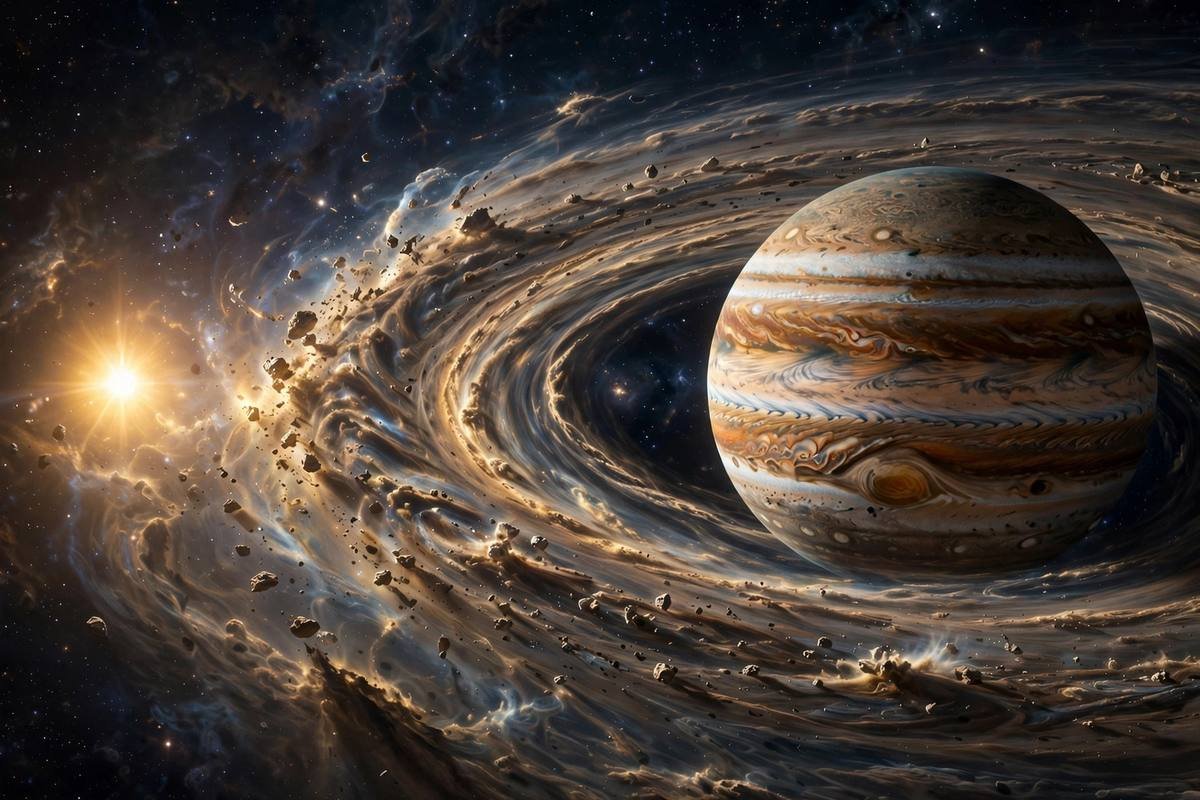
Farther out, beyond a boundary called the frost line (or snow line), temperatures dropped low enough for water and other volatiles to freeze solid. Suddenly there was far more solid material available — ices outnumbered rock by roughly four to one — so planetary cores could grow much bigger, fast enough to reach the critical mass needed to gravitationally capture enormous atmospheres of hydrogen and helium before the disk’s gas dispersed.
| Rocky Planets | Gas and Ice Giants | |
|---|---|---|
| Where they form | Inside the frost line, close to the star | Beyond the frost line, far from the star |
| Building materials | Metals and silicate rock | Rock and metal cores plus vast amounts of ice, hydrogen, and helium |
| Typical sizes | Smaller (Earth is the largest) | Much larger (Jupiter is over 1,300 times Earth’s volume) |
| Examples | Mercury, Venus, Earth, Mars | Jupiter, Saturn, Uranus, Neptune |
| Why | Only heat-resistant materials could solidify; less material available | Ices added huge amounts of solid mass, letting cores grow fast enough to capture gas |
This temperature-sorted architecture shows up in other planetary systems too, though exoplanet surveys have also found plenty of weird exceptions — which is exactly what keeps the field interesting.
How Long Does It Take to Build a Planet?
Planet formation is not quick by human standards, but it is fast by cosmic ones. The whole construction project has a hard deadline: the gas in the protoplanetary disk does not last forever. Radiation and winds from the young star gradually blow the gas away, and observations of young stars suggest the average gaseous disk lasts only about 10 million years. Any giant planet that wants an atmosphere of hydrogen and helium has to finish its core before the gas is gone.
Here is the rough timeline scientists work with:
- First few hundred thousand years: the cloud collapses, the protostar forms, and the disk settles into shape.
- First 1–3 million years: dust grows into planetesimals; runaway growth produces Moon-sized and larger bodies. (Remember HL Tau: its star is only about a million years old and its disk already shows gaps that look like forming planets.)
- 3–10 million years: giant planet cores reach critical mass and rapidly accrete gas; the disk’s gas disperses.
- 10–100 million years: the gas is gone, but the rocky planets are still under construction — protoplanets collide and merge in giant impacts, orbits settle, and the final architecture of the system takes shape. Earth’s Moon-forming impact happened in this late, violent chapter.
Our solar system is about 4.6 billion years old, so the entire planet-building era was over in roughly the first 2 percent of its history. Everything since — the rise of life on Earth included — has been the long, quiet aftermath.
Planets Don’t Always Stay Where They’re Born: Migration
Here is a twist the early theorists never expected: planets move. A planet forming inside a gas disk exchanges gravitational tugs with the surrounding material, and those tugs can drag it inward or outward over millions of years. Astronomers call this planetary migration, and it explains some of the strangest exoplanets ever found — including “hot Jupiters,” giant planets orbiting scorchingly close to their stars, in places far too hot for them to have formed. They must have been born farther out and wandered in.
Our own solar system probably migrated too. One influential proposal, the Grand Tack hypothesis, suggests that young Jupiter drifted inward toward the Sun and then back outward again — like a sailboat tacking against the wind — gravitationally sculpting the inner solar system as it went. This wandering may explain why Mars is so small (Jupiter’s passage could have scattered away much of its building material) and why the asteroid belt looks the way it does. Another model, the Nice model, proposes that the giant planets shifted orbits much later, flinging asteroids and comets around the system in the process.
Migration is a reminder that the calm, clockwork solar system we see today is the survivor of a much more chaotic youth.
Are Planets Still Forming Right Now?
Yes — and we have the pictures to prove it. The most famous is HL Tau, a star only about a million years old and roughly 450 light-years away. In 2014, the ALMA observatory in Chile captured an astonishingly sharp image of its disk: a set of bright concentric rings separated by dark gaps. Those gaps are almost certainly carved by infant planets sweeping their orbits clear of dust — the first time astronomers had ever seen what looked like a planetary system mid-construction. Later studies confirmed the gaps sit in a stable, resonant arrangement, strengthening the case that young planets made them.
Even more direct evidence comes from PDS 70, a young star with a disk that hosts two confirmed protoplanets, PDS 70b and PDS 70c. The first was directly imaged in 2018 and its sibling in 2019 by the European Southern Observatory’s Very Large Telescope; later observations with the Keck Observatory confirmed both are genuine newborn giant planets still embedded in their birth disk, glowing from the heat of infalling material. It is the first known multi-planet system caught in the act of forming.
Surveys like DSHARP have since imaged dozens of other young disks, and most of them show rings, gaps, or spirals — the fingerprints of planet formation appear to be everywhere astronomers look. Planet birth is not some rare event from the distant past. It is happening all over the galaxy, right now.
What Does Planet Formation Tell Us About Finding Other Earths?
Understanding how planets form is not just about the past — it is the roadmap for finding life elsewhere. A few practical payoffs:
- Where to look: because giant planets seem to form more easily around stars rich in heavy elements, planet hunters can prioritize those stars when searching for systems likely to host planets.
- What to expect: formation models predict which kinds of planets should be common (small rocky worlds, it turns out, are everywhere) and which architectures are stable, helping telescopes spend their precious observing time wisely.
- How Earth got its water: Earth’s oceans probably did not come from the planet’s original building materials — it formed inside the frost line, where water could not condense. The leading idea is that water arrived later, delivered by icy asteroids and comets flung inward from the outer solar system. Understanding that delivery chain matters for judging whether other rocky planets could be habitable too.
Every exoplanet discovered — now numbering in the thousands — is another test of these theories. So far, the broad picture holds up remarkably well, even as the details keep surprising everyone.
Frequently Asked Questions
How do planets form in simple terms?
Planets form when dust and gas around a newborn star clump together. Tiny dust grains stick into pebbles, pebbles grow into kilometer-sized planetesimals, and those collide and merge into ever-larger bodies until full planets remain. Rocky planets are built from these solid collisions; giant planets additionally capture huge atmospheres of gas once their cores grow massive enough.
What is the nebular hypothesis?
The nebular hypothesis is the leading theory of solar system formation, first proposed in the 18th century. It states that the Sun and planets all condensed from a single giant, rotating cloud of gas and dust. The cloud’s collapse formed the Sun at the center and a spinning disk around it, from which the planets assembled. It elegantly explains why all the planets orbit in the same direction and in nearly the same plane.
How long does it take for a planet to form?
Giant planets must largely finish forming within about 10 million years, because that is roughly how long the gas in a protoplanetary disk lasts. Rocky planets take longer — Earth and its neighbors were assembled through giant collisions over tens of millions of years, with the final major impacts occurring up to around 100 million years after the solar system began.
What are planetesimals?
Planetesimals are kilometer-sized rocky or icy bodies that serve as the fundamental building blocks of planets. They form when dust and pebbles in a protoplanetary disk clump together, and once they reach this size, their own gravity takes over, letting them sweep up surrounding material and grow into protoplanets.
Why are some planets rocky and others gaseous?
It comes down to temperature and location. Inside the frost line, close to the young star, only metals and rock could solidify, so planets stayed small and rocky. Beyond the frost line, water and other compounds froze into ice, providing far more solid material — about four times as much — so cores grew big enough to capture massive atmospheres of hydrogen and helium.
Can we actually see planets forming today?
Yes. The ALMA telescope’s 2014 image of the young star HL Tau shows a disk with gaps almost certainly carved by forming planets, and the PDS 70 system contains two directly imaged protoplanets, PDS 70b (2018) and PDS 70c (2019), still embedded in their birth disk. Surveys have found similar ring-and-gap structures in dozens of other young disks.
Did our solar system form the same way as other planetary systems?
The broad strokes appear universal: a collapsing cloud, a protoplanetary disk, dust growing into planetesimals, and planets assembling through collisions and gas capture. But the details vary enormously — exoplanet surveys have found hot Jupiters, tightly packed super-Earth systems, and planets on wildly tilted orbits that look nothing like our solar system. The same recipe, it seems, produces very different cakes.
Final Thoughts
The next time you look up at Jupiter shining steadily in the night sky, consider what you are actually seeing: the survivor of a construction project that began as microscopic dust in a collapsing cloud 4.6 billion years ago. Every planet is a kind of fossil — a record of the disk it was born in, the collisions it survived, and the migrations it endured.
And the story is far from finished. New telescopes keep catching planet formation in the act around young stars, and every discovery sharpens — or occasionally rewrites — our understanding of how worlds come to be. We are living in the golden age of watching planets get built. The dust, it turns out, was only the beginning.
If you enjoy long-form science explainers like this one, 9bio.co.uk (https://9bio.co.uk/) publishes deep dives on science, tech and culture that are worth browsing.
Read Also: BMW X3 (2026 Guide): Specs, Prices, Trims & Honest Review Explained Simply
