
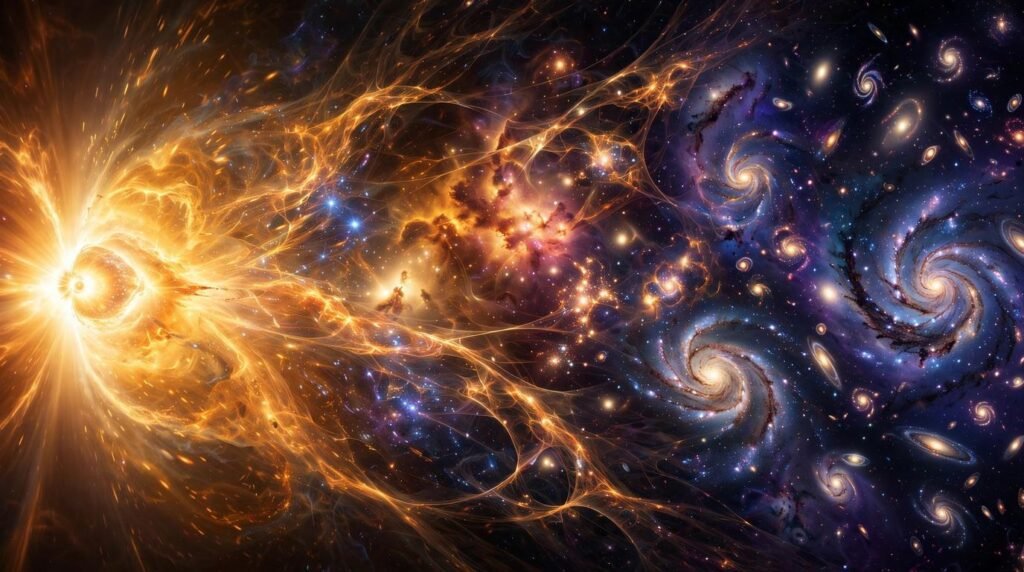
Stand outside on a truly dark night and look up. Every star you see is shining with old light — light that left its star years, centuries, or millennia ago. Galaxies are worse: their light has been traveling toward you for millions or even billions of years. So here’s a question that sounds almost absurd to ask about something that vast: how old is the universe itself?
The answer scientists give is 13.8 billion years. Not “billions and billions, who knows” — 13.8, with an uncertainty of only a few tens of millions of years. That is roughly one part in a thousand precision on a measurement of everything that has ever happened.
That number didn’t come from one lucky observation. It falls out of three separate lines of evidence — the cooling of space, the stretching of space, and the aging of the oldest stars — that all converge on the same answer. This guide walks through how cosmologists actually measured the age of everything, why the number is probably right, and the one genuine controversy that keeps researchers up at night.
The short answer: The universe is about 13.8 billion years old. The most precise measurement comes from the European Space Agency’s Planck satellite, whose 2018 data give 13.787 ± 0.020 billion years. That figure assumes our standard model of cosmology is correct — and an unresolved disagreement over the universe’s expansion rate could shift it slightly, though not dramatically.
What Does “the Age of the Universe” Actually Mean?
Before the number means anything, it helps to be clear about what is being counted. The age of the universe is the time elapsed since the Big Bang — the hot, dense beginning from which space, time, matter, and energy all emerged and began expanding.
That sounds straightforward, but there’s a subtlety worth knowing. Cosmologists don’t measure the age with a cosmic stopwatch. They measure the expansion history of the universe — how fast space has been stretching at different times — and then run that history backward to the moment when everything was compressed together. The “age” is where that backward calculation hits zero size.
Why “age” and “lookback time” aren’t the same thing
You will often hear two related but different numbers:
- The age of the universe: 13.8 billion years — the full span of cosmic history.
- Lookback time: how long light has been traveling to reach us from a distant object. Light from the cosmic microwave background has a lookback time of nearly 13.8 billion years, because it was emitted when the universe was just 380,000 years old.
Both numbers describe the same history from different ends. Keep them distinct and a lot of apparent paradoxes — like the observable universe being 93 billion light-years across — disappear, as we’ll see below.
How Do Scientists Measure the Age of the Universe?
There are three main approaches, and the reason cosmologists trust the 13.8-billion-year figure is that they agree. Here’s how each one works.
Method 1: Measure the expansion and rewind it
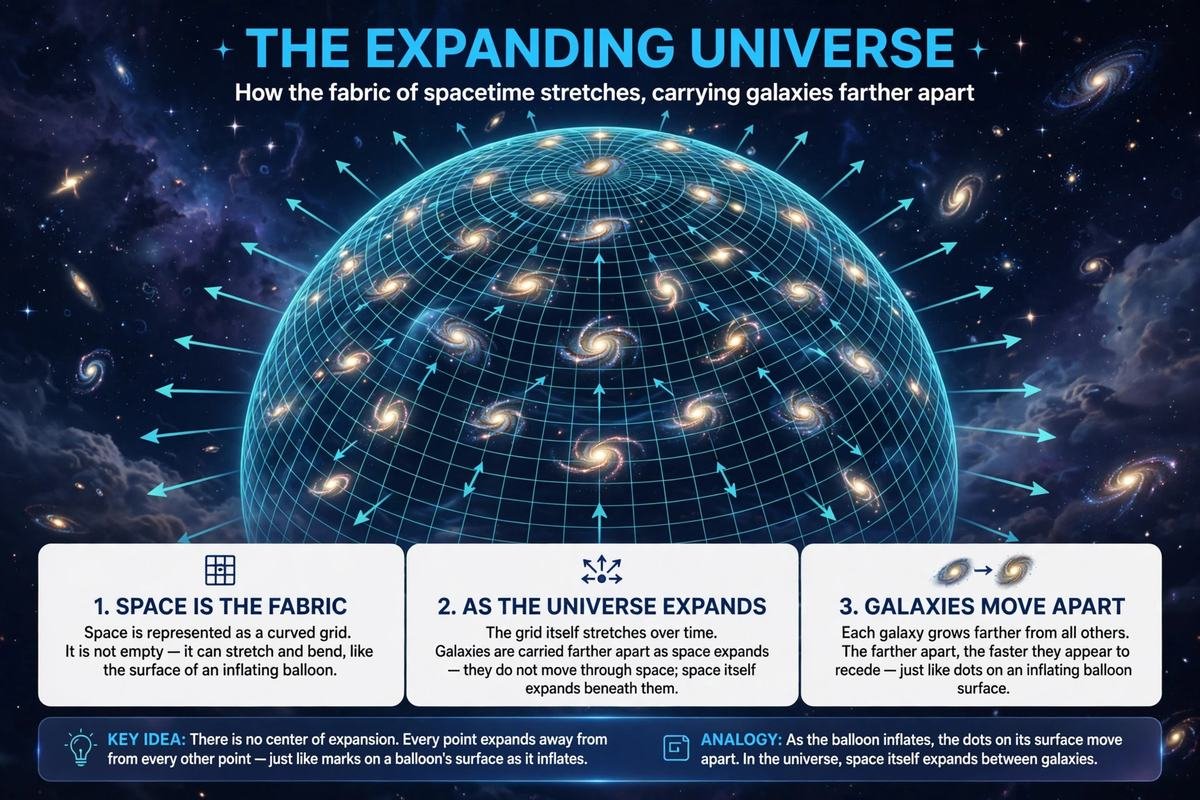
In the 1920s, Edwin Hubble discovered that distant galaxies are moving away from us, and that the farther away a galaxy is, the faster it recedes. Space itself is expanding. If you know how fast space is expanding now — and how that expansion rate has changed over time — you can run the clock backward and find when everything was together. That gives you an age.
The tricky part is that the expansion hasn’t been constant. Gravity slowed it down for billions of years, then a mysterious push called dark energy took over and started speeding it up again. Getting the age right meant measuring this expansion history precisely — which is exactly what modern surveys of distant supernovae and galaxies have been doing for the past three decades.
Method 2: Read the baby photo — the cosmic microwave background
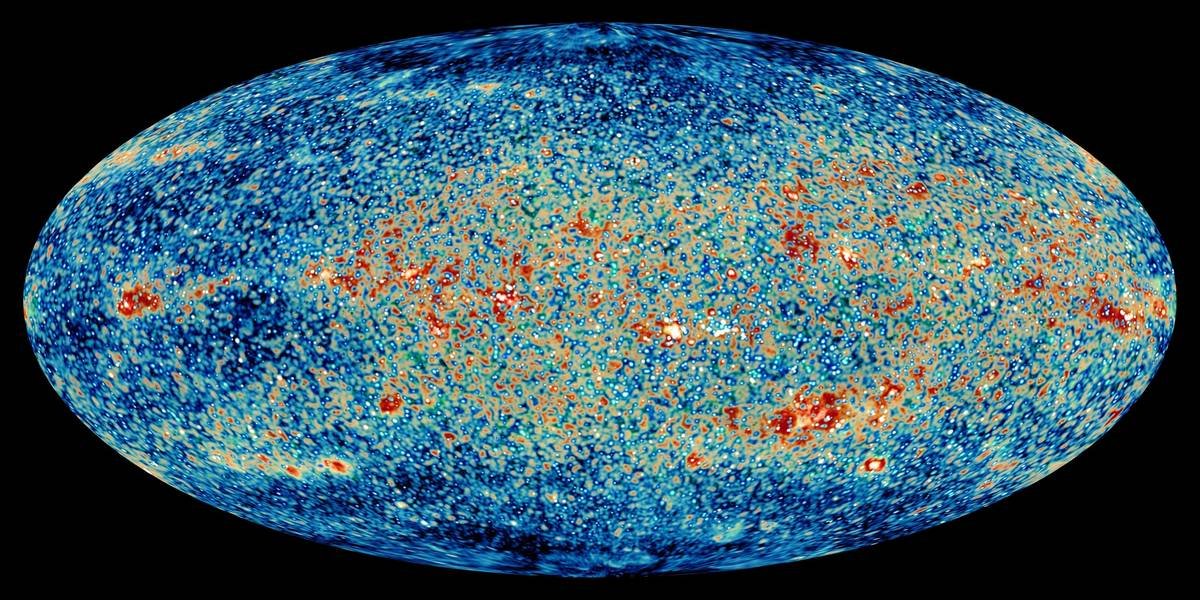
The most precise method uses the oldest light in existence: the cosmic microwave background, or CMB. About 380,000 years after the Big Bang, the universe had cooled enough for atoms to form and for light to travel freely for the first time. That light still fills space today, stretched by 13.8 billion years of expansion into faint microwaves at about 2.7 degrees above absolute zero.
The CMB isn’t perfectly smooth. It carries tiny temperature fluctuations — about one part in 100,000 — that are the seeds from which galaxies eventually grew. The sizes and patterns of those fluctuations encode what the universe contains and how fast it expands. Feed that pattern into the standard model of cosmology, and the age pops out: roughly 13.8 billion years, with an uncertainty of a fraction of a percent. The Planck satellite’s 2018 analysis pinned it down to 13.787 ± 0.020 billion years.
Method 3: Date the oldest stars
Stars age the way we do — measurably. The oldest known stars sit in globular clusters, dense spherical swarms of hundreds of thousands of stars orbiting galaxies. By studying how these stars burn their fuel and matching them to stellar evolution models, astronomers can estimate their ages: around 12 to 13 billion years.
That sets a firm lower limit. The universe must be at least as old as its oldest stars. And 13.8 billion years clears that bar comfortably, which is a reassuring independent check — if the CMB said the universe was 10 billion years old, we’d know something was badly wrong, because we’d be looking at stars older than everything.
| Method | What it measures | Result |
|---|---|---|
| Expansion history (supernovae, galaxies) | How fast space has stretched over time | ~13.8 billion years |
| Cosmic microwave background (Planck) | Fluctuation pattern in the universe’s first light | 13.787 ± 0.020 billion years |
| Oldest stars (globular clusters) | Ages of the most ancient known stars | 12–13 billion years (lower bound) |
What Is the Cosmic Microwave Background, and Why Does It Matter So Much?
The CMB deserves its own section, because it is the single most important piece of evidence behind the age number. Its story starts in 1965, when Arno Penzias and Robert Wilson, using a horn antenna built for satellite communications, kept picking up a faint hiss coming from every direction in the sky. They checked every component of their equipment and found nothing wrong. The noise was real, and it was cosmic.
Theorists at nearby Princeton University realized what it was: radiation left over from a hot early universe, predicted years earlier by physicists who had worked through what the Big Bang’s leftover heat should look like. Penzias and Wilson shared the 1978 Nobel Prize in Physics for the discovery.
Since then, three generations of satellites have mapped the CMB in ever-finer detail — NASA’s COBE in the 1990s, WMAP in the 2000s, and ESA’s Planck satellite, launched in 2009, whose final 2018 data gave us the current gold-standard age. Each mission has refined the number without overturning it: WMAP’s nine-year analysis (2012) gave 13.772 ± 0.059 billion years, Planck’s 2015 analysis gave 13.813 ± 0.038 billion, and Planck’s final 2018 analysis settled at 13.787 ± 0.020 billion. Different instruments, same answer — that consistency is why cosmologists trust it.
What Does the Hubble Constant Have to Do With the Universe’s Age?
The Hubble constant, written H₀, is the number that describes how fast the universe is expanding right now. Conceptually, the age of the universe and H₀ are linked by a simple idea: if you know how fast space is expanding today, and you know how that rate has changed, you can work out how long expansion has been going on.
In the simplest possible model — one where the expansion rate never changed — the age would just be 1/H₀, roughly 14 billion years. Real cosmology is messier, because the expansion rate has changed: matter slowed it down, dark energy is speeding it up. But the principle holds. The age calculation needs a value for H₀, and this is where cosmology’s most famous current headache lives.
What Is the Hubble Tension — and Does It Change the Answer?
Here is the honest complication. Two excellent measurement techniques give two different values for the Hubble constant:
- From the early universe (Planck CMB data, run forward through the standard model): about 67.4 km/s/Mpc — meaning a galaxy a megaparsec away recedes at roughly 67 kilometers per second.
- From the local universe (Cepheid variable stars and Type Ia supernovae, measured directly): about 73 km/s/Mpc.
The gap between them is far larger than the measurement uncertainties allow, and it has survived a decade of better instruments and better calibrations, including checks with the James Webb Space Telescope. This is the “Hubble tension,” and it is one of the biggest unsolved problems in cosmology.
What does it mean for the age? A higher expansion rate (73) would imply a slightly younger universe; the lower rate (67) gives the 13.8-billion-year figure. So the tension introduces some genuine fuzziness — maybe a few hundred million years of wiggle room, depending on which value (or what new physics) turns out to be right. What it does not do is threaten the answer in any dramatic sense. Nobody’s model puts the universe at 5 billion or 50 billion years. The debate is over the fine print, and most cosmologists expect the resolution will be either a subtle measurement issue or genuinely new physics — either way, an exciting result.
Could the Universe Be Older Than 13.8 Billion Years?
Every few years, a headline suggests some object is older than the universe itself, and it’s worth understanding why these stories keep appearing — and why they keep not holding up.
The most famous case is the so-called “Methuselah star,” HD 140283, a nearby star whose age was once estimated at around 14.5 billion years — older than the universe. That estimate came with a large uncertainty, though: roughly ±0.8 billion years, and later refinements to its distance measurement brought the central value down. Once you account for the error bars, the star’s age is perfectly consistent with a 13.8-billion-year-old universe. It’s a reminder that individual stellar ages are hard to pin down, and a single uncertain measurement doesn’t overturn a concordance of independent evidence.
More recently, the James Webb Space Telescope has found surprisingly large, mature-looking galaxies in the very early universe, earlier than some models expected. This is a real puzzle researchers are actively working on — but it’s a puzzle about how fast galaxies could assemble, not evidence that the universe is older. The CMB age measurement stands independently of galaxy-formation theory.
Could future discoveries push the age up? In principle, yes — the 13.8-billion-year figure assumes the standard cosmological model is correct, and if the model needs revision, the age could shift by a few percent. But the three independent methods agreeing as they do makes a large revision very unlikely.
Why Isn’t the Observable Universe Just 13.8 Billion Light-Years Across?
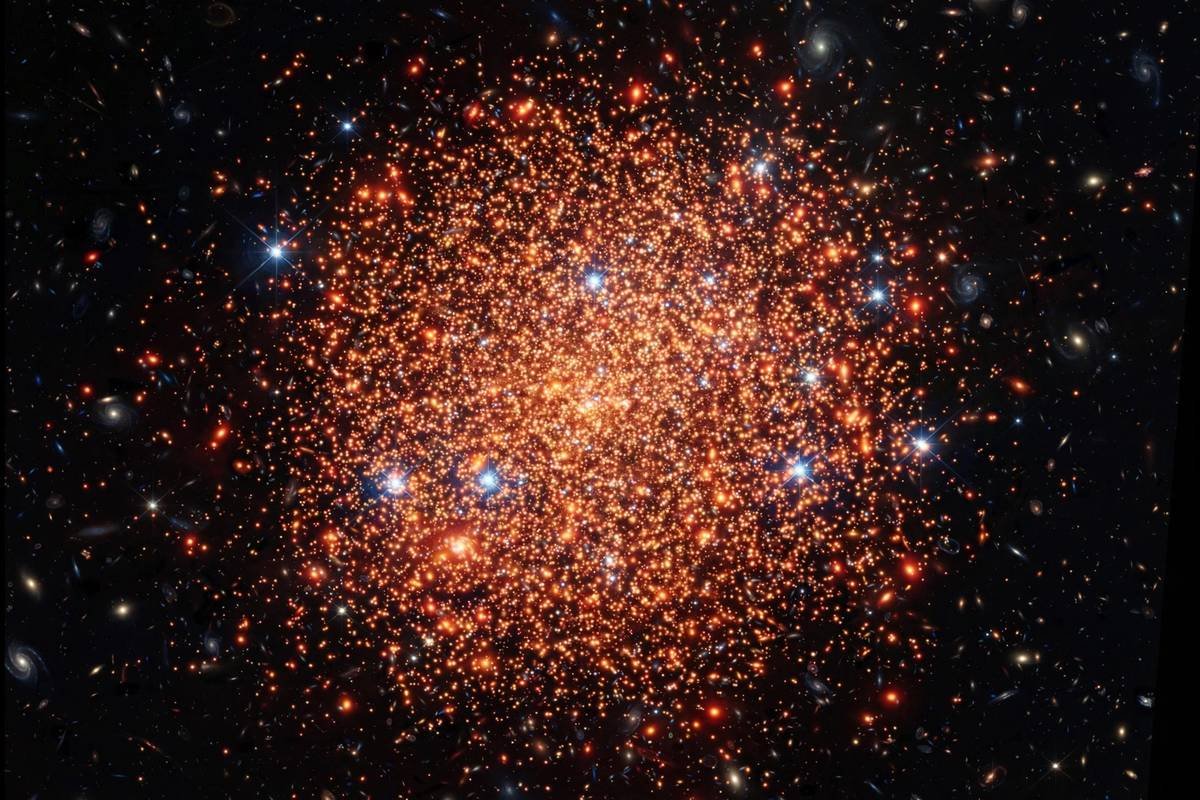
This is the question that trips up almost everyone, and it has a beautiful answer. The observable universe is about 93 billion light-years in diameter — roughly 46.5 billion light-years in every direction. How can that be, if the universe is only 13.8 billion years old and nothing travels faster than light?
Because space has been expanding the whole time. The light from the most distant galaxies we can see left them nearly 13.8 billion years ago, when they were much closer to us. While that light was traveling, space kept stretching, and those galaxies were carried much farther away. Today, on a present-day cosmic map, they sit about 46 billion light-years out.
Think of it like a runner on a moving walkway: the runner (light) moves at a fixed speed relative to the walkway, but the walkway (space) is stretching underneath, so the total distance covered on the airport map is far larger than the runner’s speed times the travel time. Age is a duration measured along cosmic history; the 93-billion-light-year diameter is a distance on today’s expanded map. They’re different quantities, and there’s no contradiction.
| Quantity | Value | What it means |
|---|---|---|
| Age of the universe | 13.8 billion years | Time since the Big Bang |
| Oldest light (CMB) lookback time | ~13.8 billion years | How long that light has traveled |
| Observable universe diameter | ~93 billion light-years | Size of the region we can see today |
| Observable universe radius | ~46.5 billion light-years | Maximum present-day distance of visible objects |
What Was There Before the Big Bang?
The honest answer: we don’t know, and the question itself may not quite make sense. The Big Bang wasn’t an explosion in space — it was the beginning of space and time themselves. Asking what came “before” time began is like asking what’s north of the North Pole.
That said, physicists have ideas. Some propose an eternally inflating multiverse, where our Big Bang was one of many. Others suggest cyclic models, where the universe expands and contracts forever, with each Big Bang following a previous collapse. Quantum cosmology explores the possibility that the universe tunneled into existence from a quantum state with no “before” at all.
None of these are established. They are active research programs, not answers. When scientists say the universe is 13.8 billion years old, they mean 13.8 billion years of this expansion — the history described by our evidence. Whatever came before, if anything, lies beyond what current science can test.
A note on how confident to be
It’s worth being precise about what the uncertainty means. When cosmologists quote 13.787 ± 0.020 billion years, that ±0.020 is the statistical uncertainty within the standard model. It assumes the model’s ingredients are right: general relativity, the measured amounts of ordinary matter (~4.9%), dark matter (~26.8%), and dark energy (~68.3%), and a universe that looks the same in all directions on large scales. If the model is incomplete — and the Hubble tension hints it might be, in some detail — the true age could differ by a few percent. What it can’t be, given everything we know, is wildly different. Three independent methods converging on the same neighborhood is about as solid as cosmology gets.
Will the Answer Ever Change?
Probably, in the fine details — and that’s a good thing. Science refines its numbers; it doesn’t usually overturn them. The Hubble tension may resolve into a calibration fix or into new physics, and either outcome will sharpen the age estimate. Upcoming missions and surveys — more precise CMB measurements, gravitational-wave “standard sirens” as a completely independent distance method, and better local calibrations — will keep tightening the constraints.
What won’t change is the framework: the universe had a hot, dense beginning about 13.8 billion years ago, it has been expanding and cooling ever since, and multiple independent lines of evidence agree on the timeline. That is one of the most remarkable achievements in the history of science — measuring the age of everything, to better than one percent, from faint microwaves and dying stars.
Final Thoughts
The universe is about 13.8 billion years old — a number measured three independent ways, anchored by the Planck satellite’s map of the universe’s first light, and consistent with the expansion of space and the ages of the oldest stars. The Hubble tension adds a genuine wrinkle, a disagreement between early-universe and late-universe measurements of the expansion rate that could nudge the number by a few hundred million years once it’s resolved.
But the big picture is settled: everything you can see, and everything you can’t, began roughly 13.8 billion years ago. Every atom in your body was forged in stars that lit up long after that beginning, in a universe that has been expanding the entire time. Knowing the universe’s age doesn’t just satisfy curiosity — it gives us our place in the story.
FAQ
How do we know the Big Bang happened?
Three independent observations support it: galaxies are moving apart (the universe is expanding, so it was once compact), the cosmic microwave background exists (the cooled leftover heat of the hot early universe, at 2.7 degrees above absolute zero), and the abundances of light elements like hydrogen and helium match what Big Bang nuclear physics predicts. Any one of these would be suggestive; all three together are conclusive.
What is the oldest thing we can directly observe?
The cosmic microwave background — light released about 380,000 years after the Big Bang, which we detect as faint microwaves coming from every direction. It is the oldest light in existence and the most direct baby picture of the universe we will ever get.
Is the universe infinite?
We don’t know. We know the observable universe is about 93 billion light-years across, because light beyond that hasn’t had time to reach us. Beyond our cosmic horizon, the universe could go on forever, or it could be finite but far larger than what we can see. The age of the universe tells us about time, not about total size.
How fast is the universe expanding?
That depends on the measurement method — which is exactly the Hubble tension. The Planck satellite’s data imply about 67.4 km/s/Mpc; direct local measurements using supernovae give about 73 km/s/Mpc. Either way, the expansion is also accelerating, driven by dark energy. A galaxy a megaparsec away is receding at roughly 70 kilometers every second — and one twice as far away recedes twice as fast.
What is dark energy?
Dark energy is the name for whatever is causing the expansion of the universe to accelerate. It makes up about 68% of everything in the universe, yet we don’t know what it is — the leading idea is that it’s a property of empty space itself (the cosmological constant), but it could be something more exotic. Understanding it is one of the biggest goals in physics.
How old is the Earth compared to the universe?
Earth is about 4.54 billion years old — roughly one-third the age of the universe. The first stars ignited a few hundred million years after the Big Bang, galaxies assembled over billions of years, and our solar system formed from the recycled remains of earlier stars about 9 billion years into cosmic history.
Will scientists ever know the exact age of the universe?
“Exact” is probably the wrong word — every measurement has uncertainty. But the uncertainty is already tiny: Planck’s 2018 result is 13.787 ± 0.020 billion years, or about ±20 million years on a 13.8-billion-year history. Future measurements may shave that down further or shift the central value slightly if new physics is discovered, but the age won’t change by any amount that would surprise anyone following the field.
If you enjoy long-form science explainers like this one, homewaterinsights.com publishes deep dives worth browsing.
Read Also: What Is Blade Runner 2049 About? Story, Characters, Themes & Tech (2026 Guide)

1 Comment