
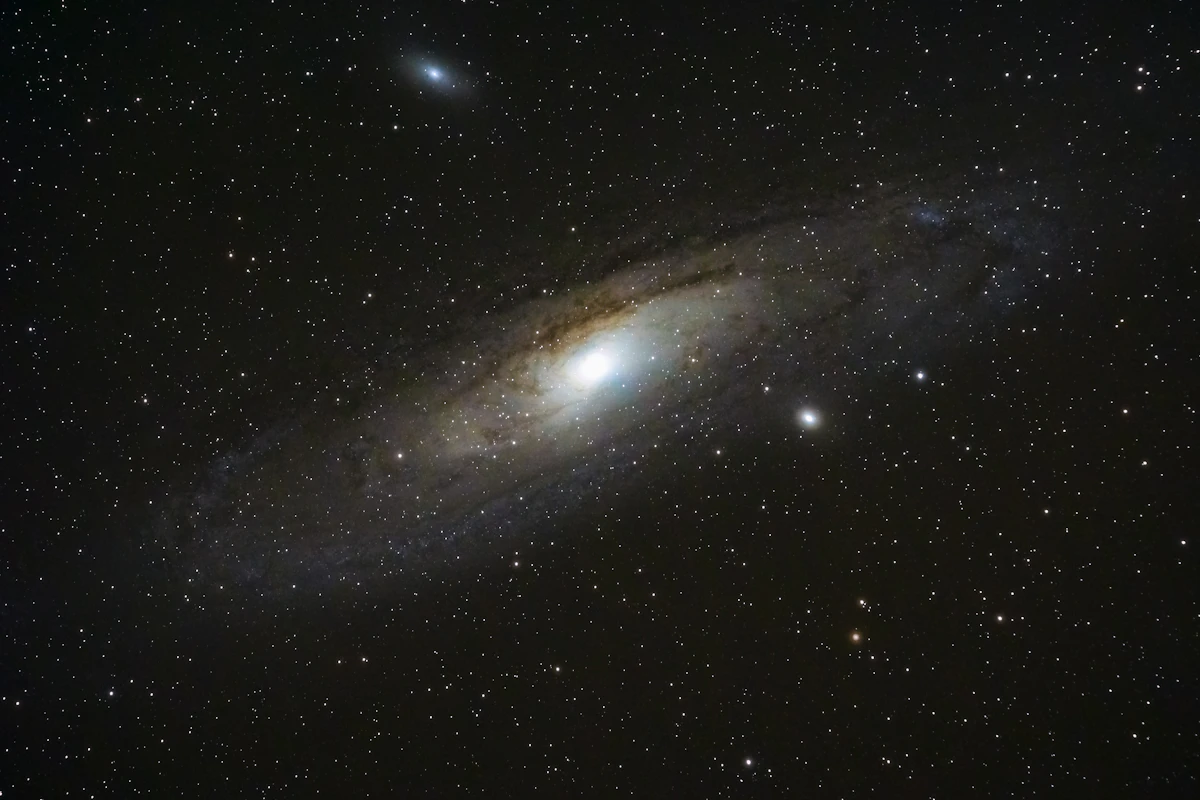
1. Giant Molecular Clouds: The Interstellar Nurseries
Star formation occurs deep within cold, dense interstellar structures known as Giant Molecular Clouds (GMCs). These colossal gas clouds span tens to hundreds of light-years and hold between 10,000 and one million times the mass of our Sun.
Critically, the temperature in these clouds hovers at a frigid 10 to 20 Kelvin (-263°C to -253°C). Extreme cold is essential: if the gas were warm, thermal kinetic pressure would cause particles to push apart and expand into the vacuum. Only in frigid conditions can gravity overcome internal thermal pressure and initiate collapse.
Interstellar clouds consist of approximately 74% hydrogen, 24% helium, and 1–2% heavier elements ("metals" in astronomical parlance) and microscopic microscopic silicate/carbon dust grains.
2. Gravitational Collapse & Protostellar Birth
When an external trigger—such as a shockwave from a nearby supernova explosion or an encounter with a galactic spiral density wave—ripples through a molecular cloud, gas fragments into dense pockets. If a clump’s mass exceeds the Jeans Mass threshold, gravity overcomes outward pressure, beginning runaway gravitational collapse.
As the pocket contracts, conservation of angular momentum causes it to spin faster and flatten into a circumstellar accretion disk with a glowing central protostar. The falling matter converts gravitational potential energy into heat. While the protostar is not yet conducting nuclear fusion, it shines brightly in infrared light as infalling matter impacts its surface.
3. Thermonuclear Ignition & Main-Sequence Stability
When the protostellar core temperature reaches approximately 10 million Kelvin, hydrogen protons gain sufficient kinetic energy to overcome mutual electrostatic repulsion (the Coulomb barrier) via quantum mechanical tunneling. Nuclear fusion ignites:
In stars of one solar mass or lower, hydrogen fuses into helium primarily via the Proton-Proton (P-P) Chain. In massive stars (greater than 1.3 solar masses), fusion proceeds via the catalytic CNO (Carbon-Nitrogen-Oxygen) cycle.
The energy released generates outward thermal radiation pressure that precisely balances the inward pull of gravity. This eternal cosmic truce is called hydrostatic equilibrium. The star officially enters the Main Sequence, where it spends 90% of its active lifetime.
4. The Hertzsprung-Russell Diagram & Stellar Lifespans
The lifespan of a star is strictly governed by its initial mass. Counterintuitively, the more massive a star is, the shorter its lifespan:
• Red Dwarfs (M-type, 0.08 – 0.5 solar masses): Cool, fully convective stars that burn through their hydrogen reserves so slowly their lifespans exceed trillions of years—longer than the current age of the universe.
• Solar-Type Stars (G-type, 1 solar mass): Spend roughly 10 billion years on the main sequence.
• Blue Supergiants (O-type, 20 – 100+ solar masses): Possess immense gravitational compression in their cores. They fuse hydrogen furiously at temperatures of 40,000K, exhausting their vast fuel stores in a fleeting 5 to 20 million years before detonating violently.
5. The Fate of Low-Mass Stars: Red Giants & White Dwarfs
When a star like our Sun exhausts hydrogen in its core, fusion halts and the core contracts under gravity. The heating core ignites hydrogen in a surrounding shell, causing the outer atmosphere to swell hundreds of times in radius and cool into a Red Giant.
Eventually, core temperatures reach 100 million Kelvin, triggering the "Helium Flash" where helium nuclei fuse into carbon and oxygen via the triple-alpha process. Unable to achieve the 600 million Kelvin required to fuse carbon, the dying star gently pulsates and sheds its outer gas envelopes into space, forming a luminous, glowing planetary nebula.
Left behind is the stellar core: an Earth-sized White Dwarf. Supported against further gravitational collapse entirely by electron degeneracy pressure (a quantum mechanical phenomenon governed by the Pauli Exclusion Principle), the white dwarf will slowly radiate away its residual thermal heat over trillions of years.
6. High-Mass Cataclysms: Core-Collapse Supernovae
For stars born with more than 8 times the mass of the Sun, the finale is catastrophic. Their immense gravitational pressure allows their cores to sequentially fuse heavier elements:
$$text{Hydrogen} rightarrow text{Helium} rightarrow text{Carbon} rightarrow text{Neon} rightarrow text{Oxygen} rightarrow text{Silicon} rightarrow text{Iron}$$
Each successive fusion phase burns faster: silicon fuses into iron in just a few days. The star develops an onion-like layered structure. However, Iron-56 has the highest nuclear binding energy per nucleon of any isotope; fusing iron absorbs energy rather than releasing it.
The moment iron forms in the core, nuclear energy production drops to zero. Within milliseconds, gravity wins. The core collapses inward at 25% of the speed of light, crushing protons and electrons together into neutrons. When the core reaches nuclear density, it stiffens and rebounds, sending a colossal shockwave outward. The resulting Core-Collapse Supernova (Type II or Type Ib/Ic) outshines entire galaxies of hundreds of billions of stars and synthesizes heavy elements via the rapid neutron-capture process (r-process).
7. Remnants: Neutron Stars, Pulsars & Stellar Black Holes
What remains after a supernova depends on the mass of the collapsed core:
• If the remnant core is between 1.4 and 2.16 solar masses (the Tolman-Oppenheimer-Volkoff limit), neutron degeneracy pressure arrests the collapse, creating a Neutron Star: a sphere just 20 km in diameter holding more mass than our Sun, with a density where a single teaspoon of matter weighs over 1 billion tons. Rapidly rotating magnetized neutron stars sweep beams of radio waves across space as Pulsars.
• If the remnant core exceeds roughly 3 solar masses, no force in known physics can halt gravitational collapse. The matter is crushed into an infinitesimal point of infinite density—a gravitational singularity enclosed by an event horizon: a Stellar-Mass Black Hole.
Frequently Asked Questions
What is the Chandrasekhar limit?
Calculated by Subrahmanyan Chandrasekhar in 1930, it is the maximum mass (approximately 1.44 solar masses) that electron degeneracy pressure can support against gravitational collapse in a white dwarf. If a white dwarf accretes matter from a binary companion exceeding this limit, it detonates completely in a Type Ia supernova.
Where do elements heavier than iron like gold and platinum come from?
Elements heavier than iron are forged during extreme cosmic collisions: predominantly kilonovae (the merger of binary neutron stars) and core-collapse supernovae, where neutron-rich environments allow rapid neutron-capture synthesis.