
Picture this: you step outside on a winter morning, pull your coat a little tighter, and wonder what real cold feels like. Not the kind of cold that makes you shiver for a few minutes, but cold so deep that the air itself would freeze solid, that methane drifts through the sky as ice crystals, and that a summer’s day is barely warmer than the darkest night. That is everyday weather on the outer edge of our solar system, and it raises a question that sounds simple but turns out to have a surprisingly two-sided answer.
Most people, when asked to name the coldest planet, blurt out Pluto without thinking. It is the farthest thing they can picture, the lonely world at the edge of everything, so it must be the coldest — right? There is just one problem with that answer: Pluto is not a planet at all anymore. Since 2006 it has been classed as a dwarf planet, which takes it out of the running entirely. And once Pluto is off the table, the real contest begins — between two blue-green giants that most of us barely think about.
The truth is that the coldest planet depends on exactly what you mean by “coldest.” If you mean the lowest average temperature, one planet wins. If you mean the single coldest temperature ever recorded in a planet’s atmosphere, a different planet wins. Both answers are honest, both are backed by real measurements, and understanding why they differ tells you a great deal about how planets work.
The short answer: Neptune is the coldest planet in the solar system on average, with temperatures around −214°C (−353°F). Uranus, however, holds the record for the coldest temperature ever measured in a planetary atmosphere, about −224°C (−371°F). Neptune wins the average; Uranus owns the record.
Why Do We Even Ask Which Planet Is Coldest?
There is something irresistible about extremes. We want to know the tallest mountain, the deepest ocean, the hottest desert — and the coldest planet. Part of it is curiosity, but part of it is that extremes teach us how things work. A planet’s temperature is not just a number on a chart; it is the result of everything about that world — how far it sits from the Sun, what its atmosphere is made of, whether it generates any heat of its own, and even the angle at which it spins.
The coldest-planet question also has a habit of tripping people up in quizzes and classrooms, because the obvious answer is wrong twice over. Pluto is not a planet, and the farthest planet is not always the coldest one at every moment. That twist is exactly what makes the question worth answering properly rather than with a single word.
What Makes a Planet Cold in the First Place?
Before naming a winner, it helps to understand what actually controls a planet’s temperature. Four factors do most of the work, and the outer planets are shaped by all of them.
Distance from the Sun. This is the big one. Sunlight spreads out as it travels, so by the time it reaches Neptune — roughly 30 times farther from the Sun than Earth — it is about 900 times weaker than the sunshine we enjoy. Less energy arriving means less warmth, full stop.
Atmosphere. A thick atmosphere can trap heat, like a blanket. Venus is the famous example: it is not the closest planet to the Sun, but its crushing carbon dioxide atmosphere traps so much heat that it is the hottest planet in the solar system. The ice giants, by contrast, have atmospheres that do a poor job of holding on to warmth.
Internal heat. Some planets still radiate heat left over from their formation, or generated deep inside them today. Jupiter, Saturn, and Neptune all give off more energy than they receive from the Sun. Uranus, strangely, gives off almost none — and that quirk is central to its record-breaking cold.
Axial tilt and seasons. A planet tilted on its side experiences extreme seasons, with each pole spending decades in darkness. Uranus is tilted by about 98 degrees, essentially rolling around the Sun on its side, which produces some of the strangest seasonal weather anywhere.
So, What Is the Coldest Planet in the Solar System?
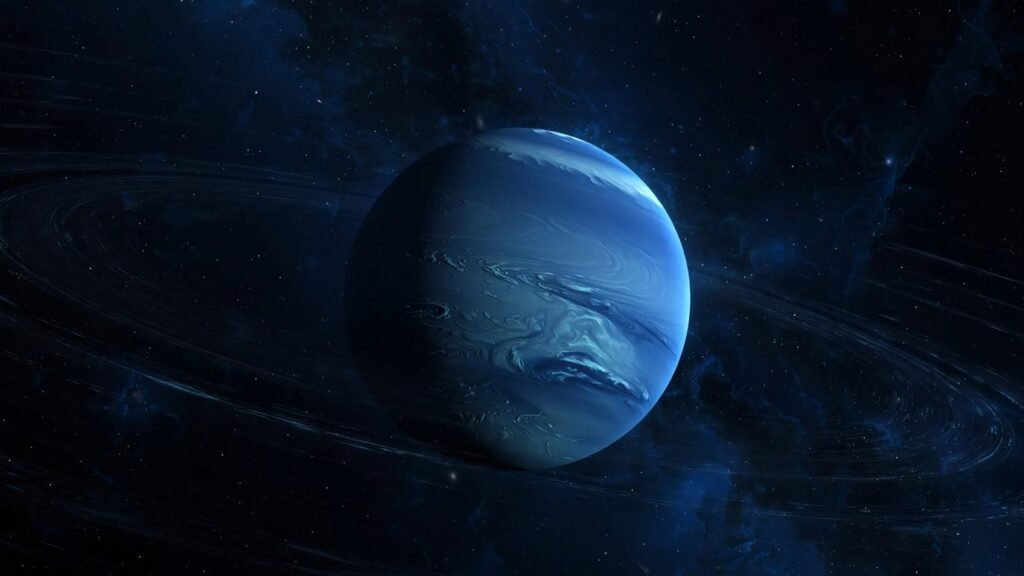
By the measure that matters most — average temperature across the whole planet — the answer is Neptune. As the eighth and farthest planet from the Sun, Neptune’s upper atmosphere averages around −214°C. Its clouds, made partly of methane ice, drift through skies that never see anything resembling warmth. Even at its “warmest,” Neptune remains colder than anywhere on Earth has ever been.
Neptune is an ice giant, a class of planet it shares only with Uranus. Despite the name, “ice” here does not mean frozen water sitting on a surface. Deep inside Neptune there is a hot, dense fluid of water, ammonia, and methane — the materials astronomers call “ices” because they freeze at relatively low temperatures compared with rock and metal. The visible atmosphere above is mostly hydrogen and helium, with a touch of methane that gives the planet its deep blue colour.
What is remarkable about Neptune is that it is not a dead, frozen world. It has the fastest winds in the solar system, reaching speeds of up to 2,100 kilometres per hour, and enormous dark storm systems that come and go over years. It generates its own internal heat, which helps drive that violent weather. So Neptune is both bitterly cold and surprisingly active — a combination that still puzzles planetary scientists.
Why Isn’t Pluto the Answer?
Pluto deserves a quick farewell here, because so many people still picture it as the coldest planet. Pluto is indeed frigid — its surface averages around −225°C, which is colder than either Neptune or Uranus on average. But since the International Astronomical Union redefined what counts as a planet in 2006, Pluto has been classified as a dwarf planet, along with Eris, Haumea, Makemake, and Ceres.
That reclassification was not a demotion handed out to be cruel; it reflected a real distinction. Planets clear their orbital neighbourhoods of other objects, while dwarf planets share their orbits with other bodies in the Kuiper Belt. So if the question is strictly about planets, Pluto is out — no matter how cold it gets. If you ever hear someone say Pluto is the coldest “world” in the solar system, they have a point. But as a planet, it no longer qualifies.
How Cold Is Neptune, Really?
Numbers like −214°C are hard to picture, so let us put Neptune’s cold into terms your body would understand. At that temperature, nitrogen — the gas that makes up most of the air you are breathing right now — would freeze solid. Methane, which on Earth is a gas used for cooking, falls through Neptune’s atmosphere as ice. Even the concept of “weather” changes: what we call clouds are crystals of frozen methane drifting through hydrogen skies.
Neptune’s temperature also barely changes with the seasons. The planet takes about 165 Earth years to complete a single orbit, so each season lasts more than 40 years, yet the temperature difference between its seasons is small. That is because sunlight is so weak out there that seasonal changes in sunlight barely register. Neptune is not cold because of winter; it is cold all the time, everywhere, all the way down — until you reach the deep interior, where pressure and internal heat make things very different indeed.
Does Neptune ever warm up?
Not in any sense you would notice. Neptune does radiate about 2.6 times more energy than it receives from the Sun, thanks to heat left over from its formation slowly leaking out. But that internal warmth is spread across an enormous planet and mostly drives winds and storms deep below the visible clouds, rather than raising the temperature of the upper atmosphere where measurements are taken. The cloud tops stay brutally cold no matter what is happening below.
Why Is Uranus Sometimes Colder Than Neptune?
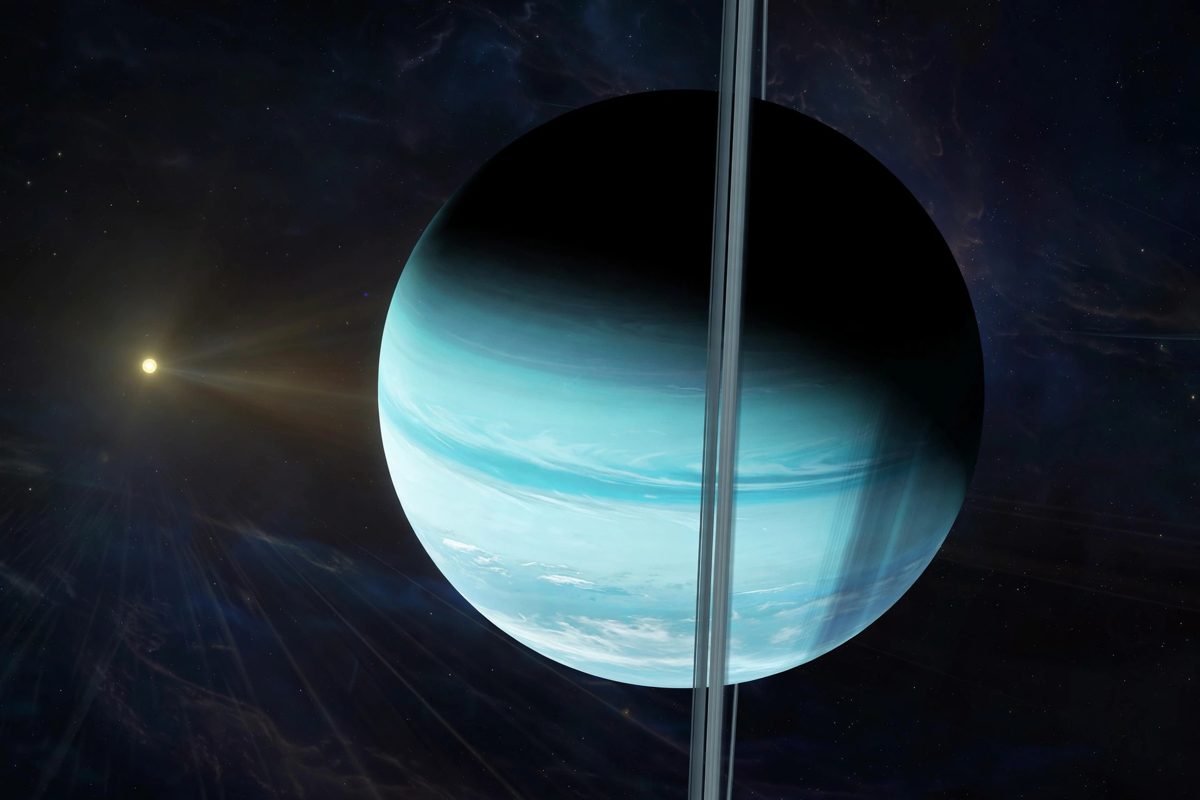
Here is where the story gets interesting. Uranus sits closer to the Sun than Neptune — about 19 times Earth’s distance, compared with Neptune’s 30 — so you would expect it to be warmer. And on average, it is: Uranus averages around −195°C to −205°C depending on how and where you measure, which is warmer than Neptune’s average. But in the 1980s, when Voyager 2 flew past Uranus, it measured a minimum atmospheric temperature of about −224°C — the lowest temperature ever recorded in any planetary atmosphere.
How can a closer planet get colder? The answer lies in Uranus’s missing internal heat. While Neptune, Jupiter, and Saturn all radiate significantly more energy than they receive from the Sun, Uranus radiates almost none extra. Scientists think a colossal collision early in its history may have knocked the planet on its side and possibly disturbed its interior in a way that stopped heat from escaping efficiently — or that its interior is layered in a way that traps heat deep inside. Either way, the result is a planet that has almost no warmth of its own to supplement the feeble sunlight it receives.
Then there is the tilt. Uranus rotates at an angle of about 98 degrees, so it essentially rolls around the Sun on its side. Each pole takes turns facing the Sun for about 21 Earth years at a time, followed by 21 years of darkness. During those long polar nights, with almost no internal heat to fall back on, temperatures in parts of the atmosphere can plunge to that record −224°C. It is a perfect recipe for extreme cold: weak sunlight, no internal backup heating, and decades of darkness.
Neptune vs Uranus: Which One Truly Deserves the Title?
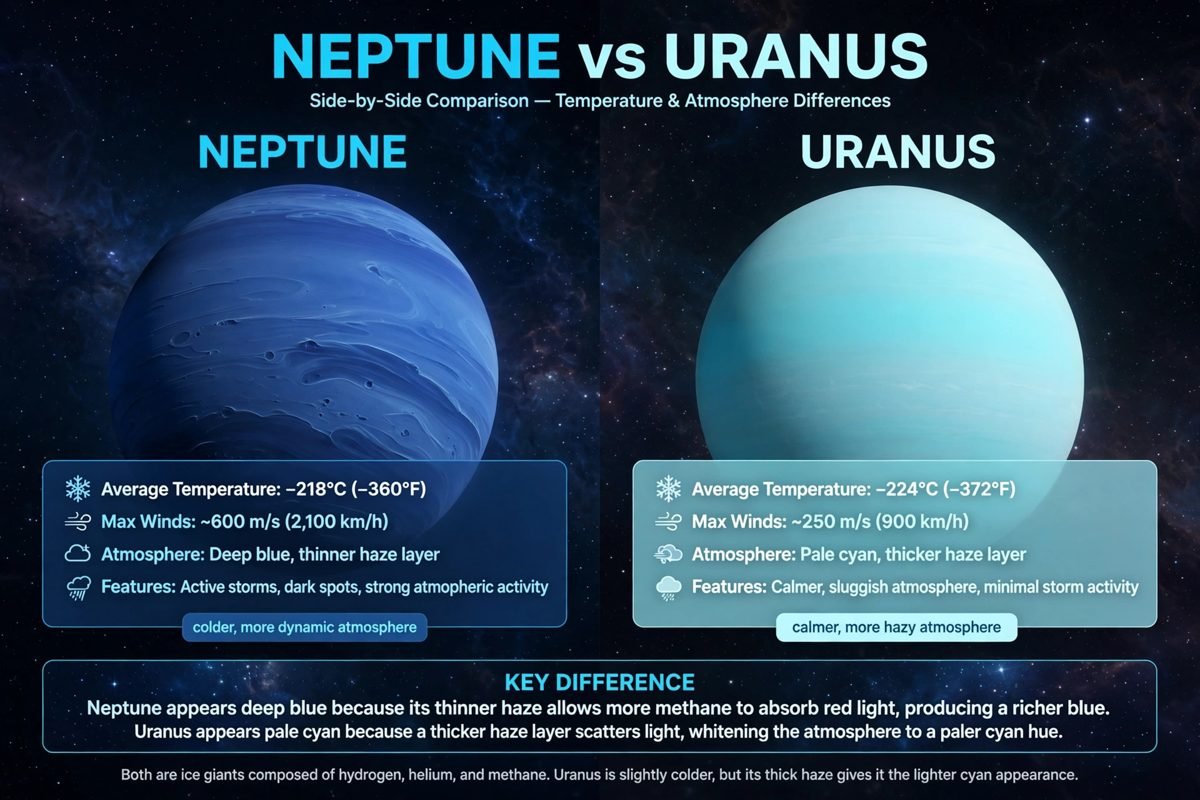
This is the part where you have to decide what “coldest” means to you — and the honest answer is that both planets have a fair claim.
| Neptune | Uranus | |
|---|---|---|
| Distance from the Sun | ~4.5 billion km (30 AU) | ~2.9 billion km (19 AU) |
| Average temperature | ~−214°C | ~−195°C to −205°C |
| Coldest recorded temperature | ~−218°C | ~−224°C (record low) |
| Internal heat | Radiates ~2.6× the energy it receives | Radiates almost no extra heat |
| Axial tilt | ~28° | ~98° (rolls on its side) |
| Year length | ~165 Earth years | ~84 Earth years |
If you ask an astronomer which planet is coldest, most will say Neptune, because average temperature is the standard way to compare planets. Averages smooth out local quirks and give you the fairest picture of a whole world. By that measure, Neptune wins clearly.
But if you ask which planet has experienced the coldest conditions ever measured, the answer is Uranus, and that record has stood since Voyager 2’s flyby in 1986. No spacecraft has found a colder spot in any planetary atmosphere since. So the complete, honest answer is: Neptune is the coldest planet on average, and Uranus holds the coldest single measurement. Any article that gives you only one name without the other is only telling you half the story.
What About the Other Planets — How Do They Compare?
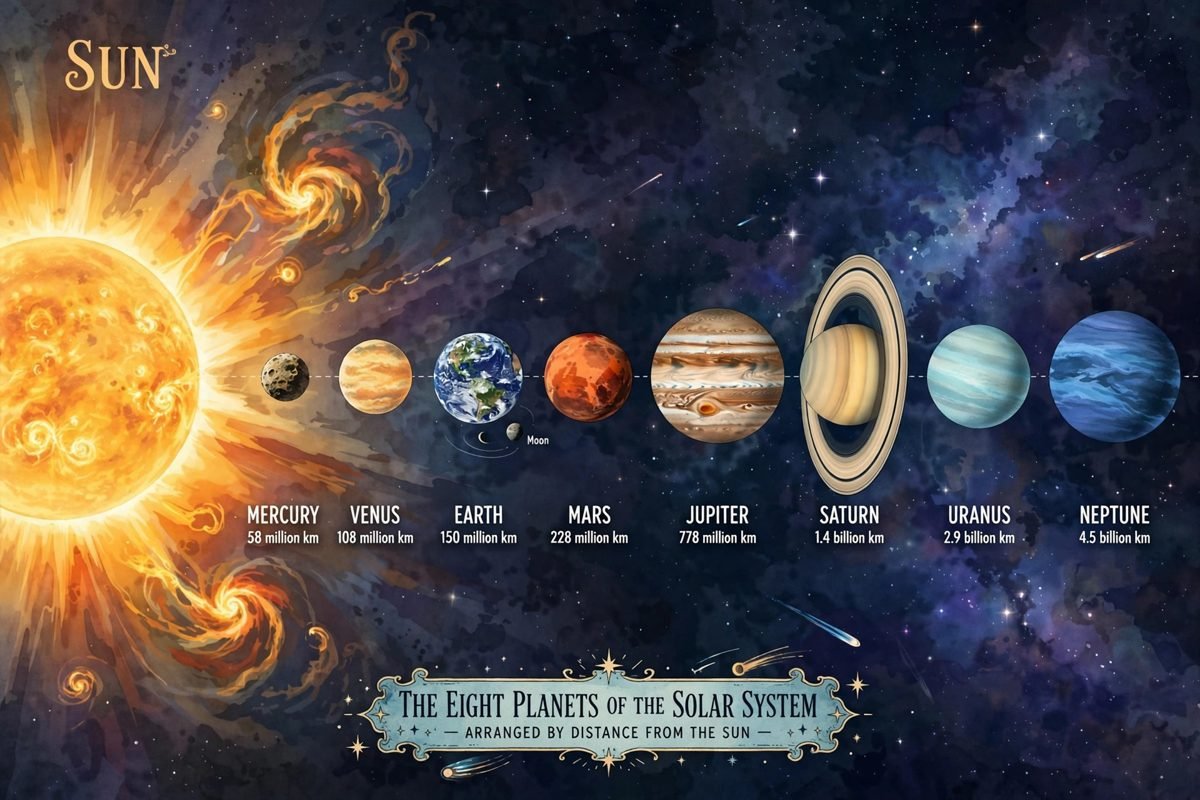
It is worth putting the ice giants in context, because the range of temperatures across the solar system is staggering. Mercury, the closest planet to the Sun, swings wildly between about 430°C in daytime and −180°C at night, because it has almost no atmosphere to even things out. Venus sits at a steady, crushing 465°C. Earth, comfortably placed, averages around 15°C. Mars averages about −63°C — cold, but practically tropical compared with the outer planets.
| Planet | Average temperature | Why |
|---|---|---|
| Mercury | ~167°C (huge day–night swing) | Almost no atmosphere |
| Venus | ~465°C | Thick CO₂ atmosphere traps heat |
| Earth | ~15°C | Balanced distance and atmosphere |
| Mars | ~−63°C | Thin atmosphere, farther from the Sun |
| Jupiter | ~−110°C | Gas giant, far from the Sun |
| Saturn | ~−140°C | Gas giant, even farther out |
| Uranus | ~−200°C | Ice giant, almost no internal heat |
| Neptune | ~−214°C | Ice giant, farthest planet |
The pattern is clear: the farther you go, the colder it gets — with Uranus as the fascinating exception that proves how much internal heat and tilt matter alongside distance.
How Do Scientists Measure Temperatures So Far Away?
You might wonder how anyone can know the temperature of a planet billions of kilometres away, when no thermometer has ever been placed there. The answer is a mix of clever remote sensing and one very brave spacecraft.
Most of what we know comes from infrared observations. Every object gives off infrared radiation depending on its temperature, and telescopes — both on Earth and in space — can measure that glow and work backwards to a temperature. Spectrometers split the light from a planet’s atmosphere into its component colours, revealing which gases are present and how warm they are at different depths.
Then there is Voyager 2, the only spacecraft ever to visit Uranus and Neptune, flying past Uranus in 1986 and Neptune in 1989. As it passed behind each planet, its radio signal travelled through the atmosphere to Earth, and the way that signal bent and weakened told scientists about the temperature and pressure at different altitudes. Those radio occultation measurements are where the famous −224°C figure for Uranus comes from, and they remain the gold standard because nothing has been back since.
Modern telescopes, including the James Webb Space Telescope, continue to refine these numbers from afar, watching how the ice giants’ atmospheres change over their long seasons. But until another spacecraft makes the long journey out there, Voyager 2’s measurements stand.
Could Any Planet Get Colder in the Future?
Over timescales we can meaningfully talk about, no. The planets’ orbits are stable, and the Sun’s output changes only very slowly. Neptune and Uranus will remain the coldest planets for as long as the solar system looks anything like it does today.
Over billions of years, though, the story changes. As the Sun ages, it will gradually brighten, and eventually swell into a red giant — a fate that will warm the outer planets dramatically, though by then Earth will long since have become uninhabitable. That is a story for the extremely distant future. For now, and for every generation that will read this article, Neptune and Uranus hold their frozen titles securely.
There is one more twist worth knowing: Uranus’s extreme tilt means its coldest regions shift over its 84-year orbit. As different poles take their turn in decades-long darkness, the record-low temperatures may occur in different places at different times. Future missions could conceivably measure even lower temperatures on Uranus during a polar winter. The record is not necessarily final — it is just the coldest we have measured so far.
What Would It Feel Like to Stand on Neptune?
Strictly speaking, you could never stand on Neptune — there is no solid surface. The atmosphere simply gets thicker and denser as you descend, until the pressure would crush any spacecraft long before you reached anything solid. But imagine descending in an impossibly strong capsule with a window. First you would see blue methane clouds racing past at supersonic speeds. The temperature outside would be around −214°C. There would be no sunlight worth the name — the Sun would look like just a bright star in a black sky.
As you sank deeper, things would paradoxically get hotter, not colder. The pressure would rise enormously, and the temperature would climb until the “ice” mixture of water, ammonia, and methane became a hot, dense, electrically conductive fluid. Scientists sometimes call this a “slushy” ocean, though it behaves like nothing in any earthly sea. So Neptune is cold on top and hot inside — a reminder that a single temperature never describes a whole planet.
For readers who enjoy exploring the stranger corners of science in plain language, The Modern Post (https://themodernpost.co.uk) covers curious topics like this alongside its other features, and 9Bio (https://9bio.co.uk) is another good stop for everyday science explainers written for general readers.
Frequently Asked Questions
Is Neptune or Uranus the coldest planet?
Neptune is the coldest planet on average, at around −214°C. Uranus holds the record for the single coldest temperature ever measured in a planetary atmosphere, about −224°C. Both statements are true; they just measure different things.
Why is Neptune colder than Uranus if Uranus holds the record?
Neptune is farther from the Sun, so it receives less solar energy overall, giving it a lower average temperature. Uranus’s record low happens in specific places and times — during long polar winters — because it has almost no internal heat to keep its atmosphere warm when sunlight disappears.
Is Pluto colder than Neptune?
Yes, Pluto’s surface averages around −225°C, which is colder than either ice giant. But Pluto is a dwarf planet, not a planet, so it does not count in the coldest-planet ranking.
What is the coldest temperature ever recorded on Earth?
The lowest natural temperature measured on Earth is about −89.2°C, recorded at Vostok Station in Antarctica in 1983. That is more than 130 degrees warmer than Uranus’s record low — a useful reminder of just how extreme the outer planets are.
Why are Neptune and Uranus blue?
Both planets contain methane in their atmospheres, which absorbs red light and reflects blue light back into space. Neptune’s deeper blue colour comes from a slightly different mix of atmospheric gases and haze, but methane is the key ingredient in both cases.
Has any spacecraft landed on Neptune or Uranus?
No. No spacecraft has ever orbited or landed on either ice giant. Voyager 2 flew past both in the 1980s, and everything since has been observed from afar with telescopes. Both planets are high on the wish list for future missions.
Will Neptune always be the coldest planet?
For the foreseeable future, yes. The planets’ orbits and the Sun’s output are stable on human timescales. Only in the extremely distant future, when the Sun brightens as it ages, would the outer planets warm significantly.
Final Thoughts
So, what is the coldest planet in the solar system? If you want one name, it is Neptune — the farthest planet, the coldest on average, a world of supersonic winds and methane ice where −214°C counts as normal. But the fuller answer, and the more interesting one, is that Uranus quietly holds the record for the coldest temperature ever measured, at about −224°C, because of its sideways spin and its missing internal heat.
That two-part answer is worth remembering, because it captures something true about science itself: the simplest question can have a layered answer, and the layer you choose changes the result. The next time someone asks you which planet is coldest, you can give them the one-word answer — and then the explanation that makes you the most interesting person in the room.

1 Comment