
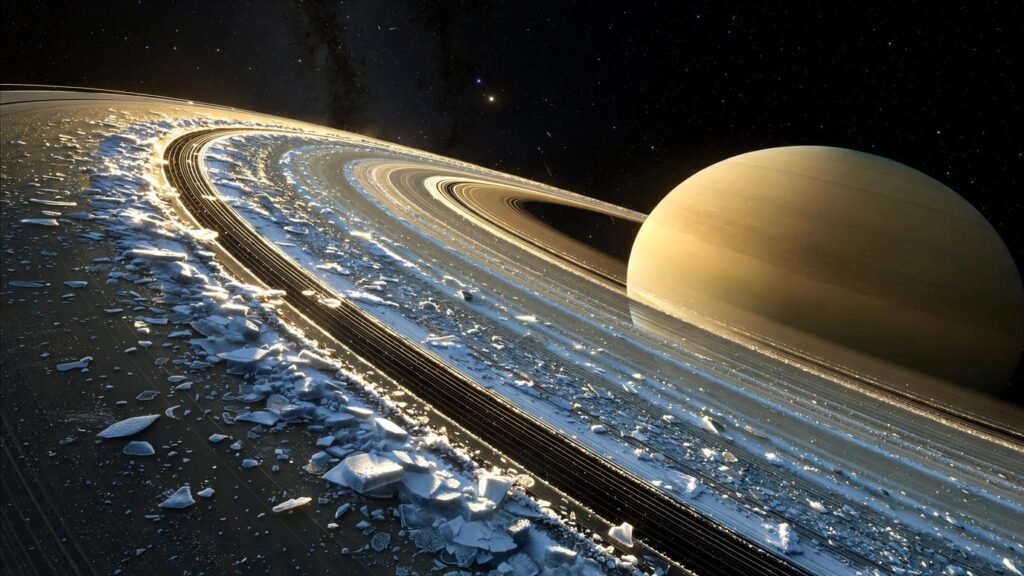
Point a small telescope at the night sky, find the pale golden dot of Saturn, and you will see something no other planet offers: a perfect, glowing disc sliced through the middle by rings. It is one of the most famous sights in astronomy, and it raises an obvious question. Four planets in our solar system have rings, so which planet has the largest rings?
The answer is not close. Saturn’s ring system is bigger, brighter and more complex than the other three combined, and the gap is so wide that astronomers do not really argue about it. But “largest” turns out to be a more interesting word than it first looks, because Saturn wins on almost every measure — width, brightness, mass and sheer beauty — while one of its own faint outer rings takes the title for the single biggest ring of all.
The short answer: Saturn has the largest rings of any planet. Its main ring system spans roughly 280,000 kilometres from edge to edge — about three-quarters of the distance from Earth to the Moon — yet the rings are astonishingly thin, averaging only around 20 metres thick. Jupiter, Uranus and Neptune all have rings too, but theirs are faint, narrow and dark by comparison.
A Brief History of Saturn’s Rings
Galileo Galilei was the first person to see Saturn’s rings, in 1610, but his small telescope could not resolve them properly. He thought he was looking at two “handles” or companion bodies attached to the planet, and he was baffled when they seemed to vanish a few years later as the rings turned edge-on to Earth.
It took until 1655 for Christiaan Huygens to correctly identify the “handles” as a flat ring around the planet, and until 1675 for Giovanni Cassini to spot the dark gap — now called the Cassini Division — that splits the rings into two broad bands. In 1859, James Clerk Maxwell proved mathematically that the rings could not be solid sheets; they had to be made of countless separate particles, each orbiting Saturn on its own. Modern spacecraft have confirmed he was exactly right.
What Are Saturn’s Rings Made Of?
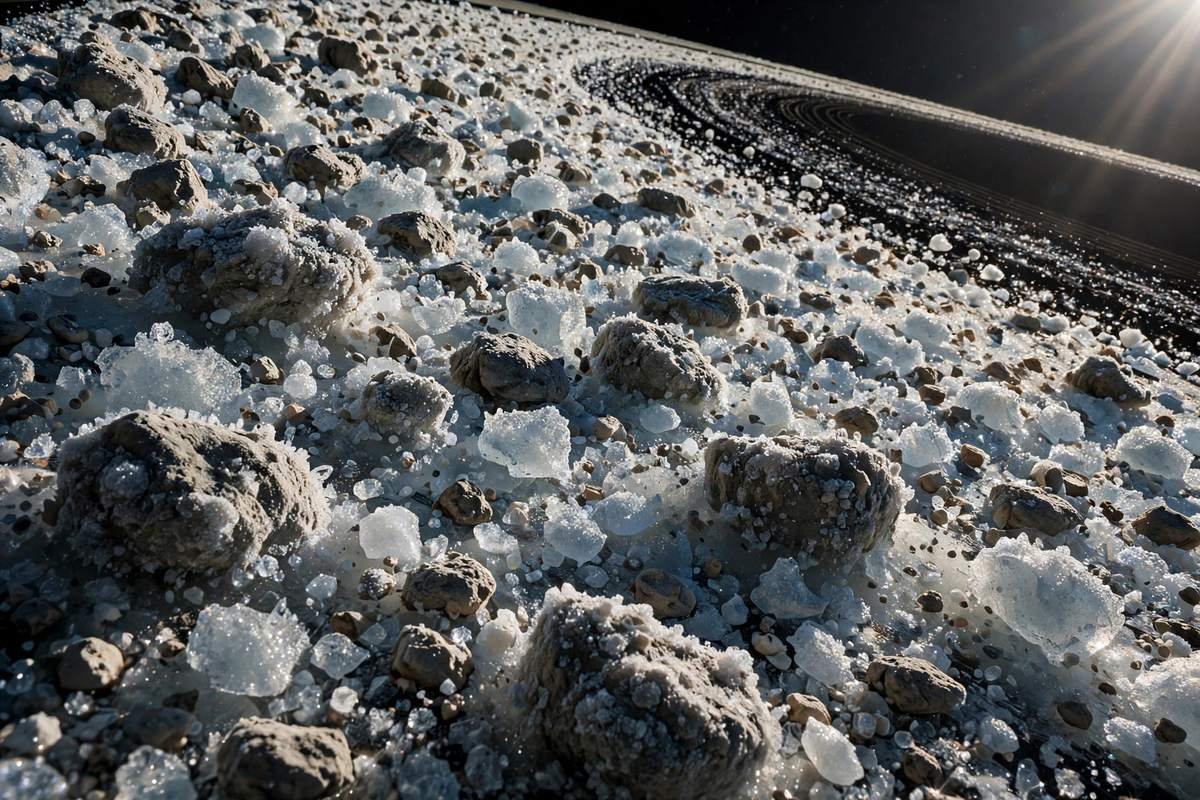
Almost entirely water ice. The particles range from grains of dust smaller than sand to chunks the size of houses, with a few boulders up to about 10 metres across. They are coated with a small amount of dark material — roughly 7 percent amorphous carbon, plus traces of reddish organic compounds called tholins — which gives the rings their subtle colour variations, from pale gold to soft grey and faint pink.
The rings are also surprisingly clean ice, especially the outer A ring, which is the purest water ice in the system. One reason for that purity is Enceladus, Saturn’s ice-spraying moon, whose geysers constantly feed fresh ice into the diffuse E ring. Other moons do similar housekeeping: shepherd moons like Pandora and Prometheus patrol the edges of the narrow F ring, their gravity keeping the ring’s particles corralled in a thin band.
How Big Are Saturn’s Rings, Really?
Numbers help here, because the scale is hard to picture. The main rings — the bright bands you see in photographs — stretch from about 6,630 kilometres above Saturn’s equator out to roughly 120,700 kilometres, giving the whole system a diameter of around 280,000 kilometres. Put another way, you could line up more than 20 Earths across them.
And yet the rings are almost impossibly thin. In most places they are only about 10 metres to a kilometre thick, averaging roughly 20 metres — about the length of two buses, stretched across a structure wider than the distance to the Moon. If you shrank the ring system to the size of a dinner plate, the rings would be thinner than a sheet of paper.
The rings are organised into seven main groups, named with letters in the order they were discovered rather than their order from the planet: D, C, B, A, F, G and E, from innermost to outermost. The B ring is the brightest and most massive, the A ring is the outermost of the bright rings, and the Cassini Division — a mostly empty gap about 4,800 kilometres wide — separates them.
The Phoebe Ring: Saturn’s Secret Giant
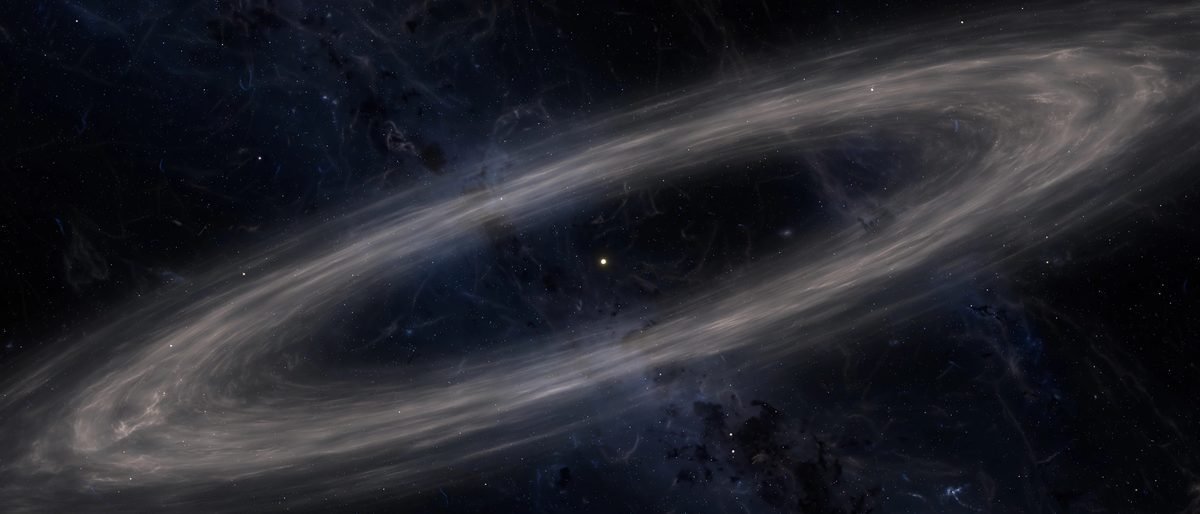
Here is a twist. The bright rings are not Saturn’s biggest ring. That honour belongs to the Phoebe ring, a vast, ghostly halo of dust and ice discovered in 2009 using NASA’s Spitzer Space Telescope. It orbits far beyond the main rings, tilted at 27 degrees to them, and it stretches out to roughly 12 million kilometres from Saturn — so wide that about 300 Saturns could fit across it, and so thick that around 20 Saturns could stack inside its height.
The Phoebe ring is far too faint to see with the eye or an ordinary telescope. It is made of dark dust knocked off Saturn’s outer moon Phoebe, and it orbits backwards, in the same retrograde direction as Phoebe itself. It even solves an old mystery: the moon Iapetus is black on one side and white on the other, because as it orbits, its leading hemisphere sweeps up dark dust from the Phoebe ring, while its trailing side stays bright.
How Do the Other Planets’ Rings Compare?
All four giant planets have rings, but the difference in scale is dramatic.
Jupiter: Faint Dust Rings
Jupiter’s rings were not discovered until 1979, when Voyager 1 flew past. They are made mostly of dark dust knocked off Jupiter’s small inner moons, and they are so faint that they are invisible from Earth under normal conditions. Jupiter has a main ring, a halo ring and two gossamer rings, but together they are a whisper next to Saturn’s shout.
Uranus: Narrow, Dark and Sideways
Uranus has 13 known rings, discovered in 1977 when the planet passed in front of a distant star and the starlight flickered as the rings crossed it. They are narrow, dark and made of ice mixed with organic material. Uranus itself rolls around the Sun on its side, so its rings stand nearly vertical from our point of view — a strange and beautiful sight, but a faint one.
Neptune: Faint Rings With Arcs
Neptune has five main rings — Galle, Le Verrier, Lassell, Arago and Adams — discovered in the 1980s and confirmed by Voyager 2 in 1989. They are faint and dusty, with one odd feature: the Adams ring is not uniform but clumped into bright arcs, as if the ring were unfinished. Neptune’s rings are thought to come from shattered moons or comets, and they are far too dim to see without a spacecraft.
Ring System Comparison
| Planet | Ring size and character | Brightness from Earth |
|---|---|---|
| Saturn | ~280,000 km across; 7 main groups; mostly water ice | Brilliant, visible in a small telescope |
| Jupiter | Thin dust rings, ~250,000 km across but extremely faint | Invisible to ordinary telescopes |
| Uranus | 13 narrow, dark rings | Very faint; needs large telescopes |
| Neptune | 5 faint, dusty rings with arcs | Invisible to ordinary telescopes |
Jupiter’s rings are technically wide, but width alone is misleading: they are so sparse and dark that calling them “larger” than Saturn’s would be like calling a wisp of smoke larger than a wall because it drifts further. On every measure that matters — mass, brightness, particle count and visual impact — Saturn wins outright.
How Old Are Saturn’s Rings?
This is one of the liveliest debates in planetary science. One camp argues the rings are ancient, nearly as old as Saturn itself at around 4.6 billion years, formed from leftover material that never became a moon. The other camp, supported by measurements from the Cassini spacecraft, argues the rings are much younger — perhaps only 100 million years old, formed when an icy moon wandered too close to Saturn and was torn apart by gravity.
Cassini found that the rings are losing material: ice particles rain down into Saturn’s atmosphere, and at the current rate the rings could disappear within another 100 million years or so. That sounds like a long time, but on cosmic timescales it is a blink. If the young-rings theory is right, we are lucky to live in the era when Saturn wears its finest jewellery — and a hundred million years from now, the ringed planet may be ringless.
Why Don’t the Rocky Planets Have Rings?
Mercury, Venus, Earth and Mars have no ring systems. Rings form when a moon or comet is shattered near a planet, or when material is left over from a planet’s formation — and they survive only where a planet’s gravity can hold debris in stable orbits. The rocky planets are small, close to the Sun, and their gravity wells are shallow; any debris is quickly swept away by sunlight or pulled into the planet. Earth briefly gains temporary “mini-moons” — small asteroids captured for a few months — but nothing that lasts long enough to form a ring.
Can You See Saturn’s Rings Yourself?
Yes, and it is easier than you might think. Saturn’s rings are visible through even a small telescope, and on a clear night they are unmistakable. Every 14 to 15 years, Saturn’s rings turn edge-on to Earth in an event called a ring plane crossing, and for a few weeks the rings seem to vanish entirely — the next one falls in the late 2030s, so there is no need to wait.
If you want to see the moons that live among those rings, our guide to which planet has the most moons explains why Saturn also rules that contest. And for a wider mix of guides — from space to everyday life — the team at dailyorvix.com publishes fresh explainers every day.
Frequently Asked Questions
Which planet has the largest rings?
Saturn. Its main ring system spans about 280,000 kilometres across, far larger and brighter than the ring systems of Jupiter, Uranus or Neptune.
What are Saturn’s rings made of?
Almost entirely water ice, with small amounts of rock dust, carbon and organic compounds. Particles range from dust grains to boulders about 10 metres wide.
How thick are Saturn’s rings?
Remarkably thin — averaging around 20 metres thick in most places, and never more than about a kilometre, despite spanning 280,000 kilometres across.
What is the largest single ring in the solar system?
Saturn’s Phoebe ring, a huge, faint dust ring reaching about 12 million kilometres from the planet, with a diameter equivalent to roughly 300 Saturns.
Do all planets have rings?
No. Only the four giant planets — Jupiter, Saturn, Uranus and Neptune — have ring systems. The rocky planets Mercury, Venus, Earth and Mars have none.
How many rings does Saturn have?
Saturn has seven main ring groups, lettered A through G in order of discovery, plus thousands of narrow ringlets within them and the vast, faint Phoebe ring far outside.
Will Saturn’s rings disappear?
Eventually, yes. Cassini data suggest the rings are slowly raining into Saturn and could vanish within about 100 million years — a short time on cosmic scales, though nothing to worry about in our lifetimes.
Final Thoughts
Saturn’s rings are the solar system’s great showpiece: 280,000 kilometres of glittering ice, thinner than a sheet of paper in proportion, and possibly young enough that we are catching them at their peak. The other giant planets have rings, but none of them comes close — and even Saturn’s own faint Phoebe ring dwarfs the bright bands we admire. If you ever get the chance to look through a telescope on a clear night, point it at Saturn. You will understand in one glance why this question has such a one-sided answer.
And the story does not end with the rings. Saturn’s system is full of surprises — from the moons hiding in the ring gaps to the geysers of Enceladus — and each one makes the ringed planet a little more remarkable.
Read Also: Iowa Men’s Basketball: History, Stars, and What’s Next
For more guides in the same plain, friendly style, visit the team at dailyorvix.com, and for everyday explainers on everything from tech to lifestyle, 9bio.co.uk is well worth a browse.
