
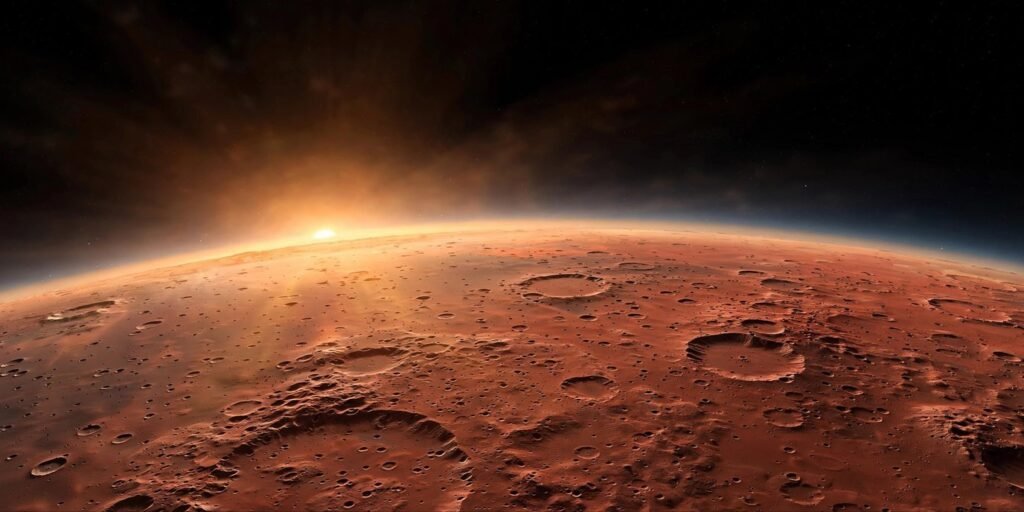
How long is a day on Mars? If you have ever pictured yourself standing on Mars, watching the Sun crawl across a dusty pink sky, you have probably wondered about something surprisingly ordinary: how long does a day actually last there? It is one of those questions that sounds simple until you try to answer it properly, because Mars, like Earth, has more than one kind of “day” depending on how you measure it.
The good news is that the headline number is easy to remember, and the reasons behind it are genuinely interesting. Mars turns at a pace that is close to Earth’s but not quite the same, and that small difference shapes everything from how NASA drives its rovers to how future astronauts will sleep, work, and keep their calendars straight.
The short answer: A day on Mars — called a sol — lasts 24 hours, 39 minutes, and 35 seconds in Earth time. That is about 39 minutes longer than an Earth day, which is why Mars mission teams slowly drift out of sync with normal Earth schedules.
What Is a Sol?
When people talk about a day on Mars, they almost always mean a sol. The word comes from “solar day,” and it is the standard unit of time used by everyone who works on Mars missions. One sol is the time it takes for the Sun to return to the same position in the Martian sky — noon to noon, or sunrise to sunrise.
The term was adopted by NASA during the Viking missions in the 1970s because engineers needed a clean way to talk about Mars days without confusing them with Earth days. Saying “the rover will do that on sol 412” is much clearer than saying “the rover will do that on day 412, Mars time.” Today, every Mars rover mission counts its days in sols, and fans following the missions do the same.
So when you ask how long a day on Mars is, the answer most people want is the length of a sol: 24 hours, 39 minutes, and 35 seconds. In decimal form, that is about 24.66 Earth hours.
Sol vs. Sidereal Day: Why Are There Two Numbers?
Here is where it gets slightly more technical, but it is worth understanding because you will see two different figures quoted for Mars’s rotation.
A solar day (a sol) measures the Sun’s return to the same spot in the sky. A sidereal day measures one full spin of the planet relative to the distant stars. On Mars, the sidereal day is 24 hours, 37 minutes, and 22 seconds — a couple of minutes shorter than a sol.
Why the difference? While Mars is spinning, it is also moving along its orbit around the Sun. After one full spin, the planet has moved a little further around its orbit, so it has to turn a tiny bit extra before the Sun lines up in the same place again. That extra turn takes about two minutes. The same effect happens on Earth, which is why our solar day (24 hours) is about four minutes longer than our sidereal day (23 hours, 56 minutes, and 4 seconds).
For everyday purposes, the sol is the number that matters. Nobody plans a Mars mission around sidereal days. But if you ever spot a slightly different figure for Mars’s day length in a textbook or a table, this is almost certainly why — one source is quoting the sidereal day and the other the solar day.
How Long Is a Day on Mars in Earth Hours?
Put simply, a Mars day is just under 24 hours and 40 minutes in Earth time. That is close enough to an Earth day that your body would probably cope, but different enough to cause real headaches over weeks and months.
Here is how Mars stacks up against Earth on the basics:
| Measurement | Earth | Mars |
|---|---|---|
| Solar day | 24 hours | 24 hours, 39 minutes, 35 seconds |
| Sidereal day | 23 hours, 56 minutes, 4 seconds | 24 hours, 37 minutes, 22 seconds |
| Year length | 365.25 days | 687 Earth days (668.6 sols) |
| Axial tilt | 23.4° | 25.2° |
| Rotation speed at equator | ~1,670 km/h | ~868 km/h |
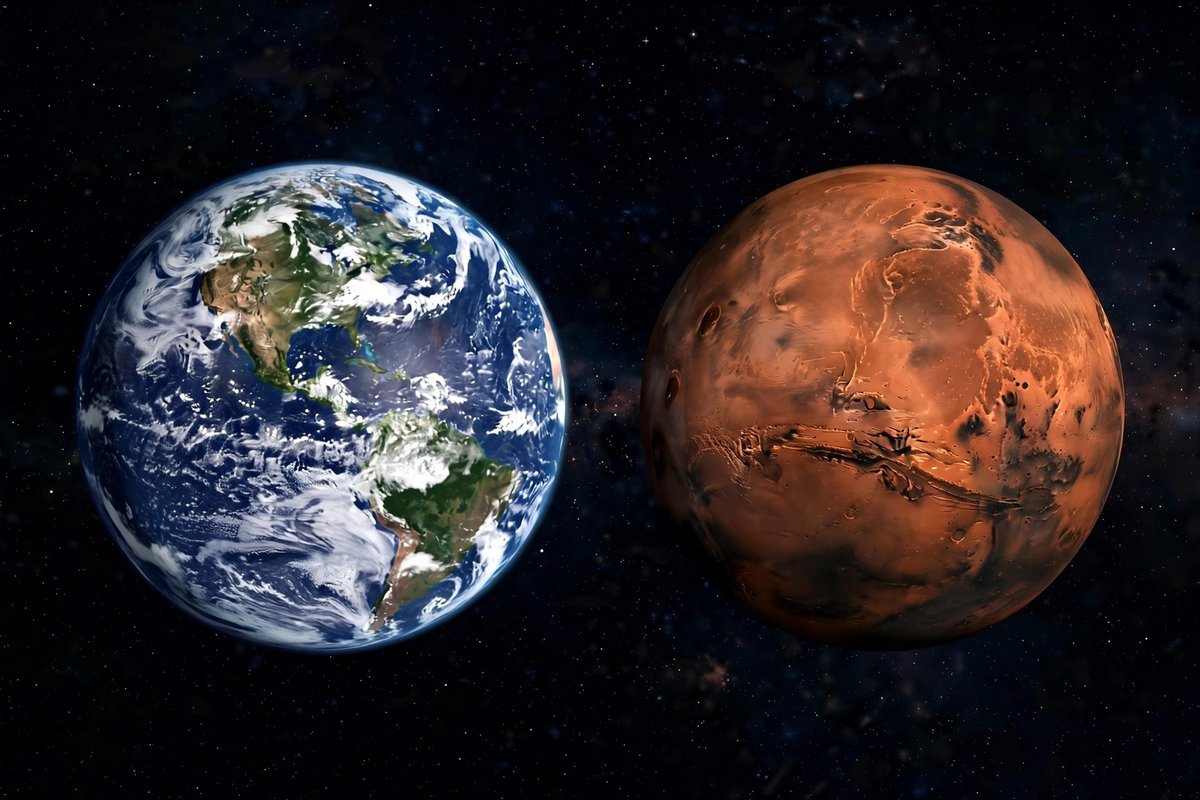
The 39-minute daily difference does not sound like much, but it adds up fast. After a week on Mars time, your schedule has shifted by more than four and a half hours compared with Earth. After a month, you are roughly 20 hours out of step — almost a full day. That drift is exactly what Mars rover teams live with, and it is one of the stranger challenges of working on another planet.
Why Is a Mars Day Longer Than Earth’s?
Mars spins more slowly than Earth does, and the reason comes down to the planet’s history and size. Earth is bigger and, thanks to its formation and the influence of the Moon, kept a faster spin. Mars, a smaller world with a different history of collisions and no large moon to trade momentum with, settled into a slower rotation.
It is worth noting that Mars’s day length is not unusual in the solar system. Mercury’s solar day lasts 176 Earth days, and Venus rotates backwards so slowly that its day is longer than its year. Compared with those extremes, Mars is remarkably Earth-like — its day is only about 2.7 percent longer than ours. That similarity is one of the reasons Mars feels like the most approachable planet for human exploration: its rhythm of light and dark is close to what our bodies already know.
How Many Sols Are in a Mars Year?
Because a Mars day is longer and its orbit is much wider, a Mars year stretches to 687 Earth days, which works out to about 668.6 sols. In other words, a year on Mars lasts nearly twice as long as a year on Earth, but it contains fewer days because each day is longer.
This matters for mission planning. A rover designed to last 90 sols, for example, is really being asked to survive about 92 Earth days. And when scientists talk about seasons on Mars, they usually count in sols — the southern summer solstice, for instance, falls around a specific sol number in the Mars calendar rather than a familiar month and date.
If humans ever settle on Mars, they will need a calendar built around sols. Researchers have proposed several, the best known being the Darian calendar, which divides a Mars year into 24 months of 27 or 28 sols. It has month names like Sagittarius and Taurus, borrowed from the constellations, and it is a fun reminder that even something as basic as “what day is it?” has to be reinvented on another world.
Seasons on Mars: The Tilt Connection
Mars has seasons for the same reason Earth does: its axis is tilted. At about 25.2 degrees, Mars’s tilt is actually close to Earth’s 23.4 degrees, so it experiences spring, summer, autumn, and winter in a familiar pattern — just stretched out over a much longer year.
There is one big difference, though. Mars’s orbit is far more elliptical than Earth’s, which makes its seasons uneven. When Mars is closest to the Sun, the southern hemisphere gets a short, intense summer, while the northern hemisphere’s summer, which happens when Mars is farther from the Sun, is longer and milder. The southern summer also stirs up the planet’s famous dust storms, some of which can grow large enough to wrap the whole planet in haze.
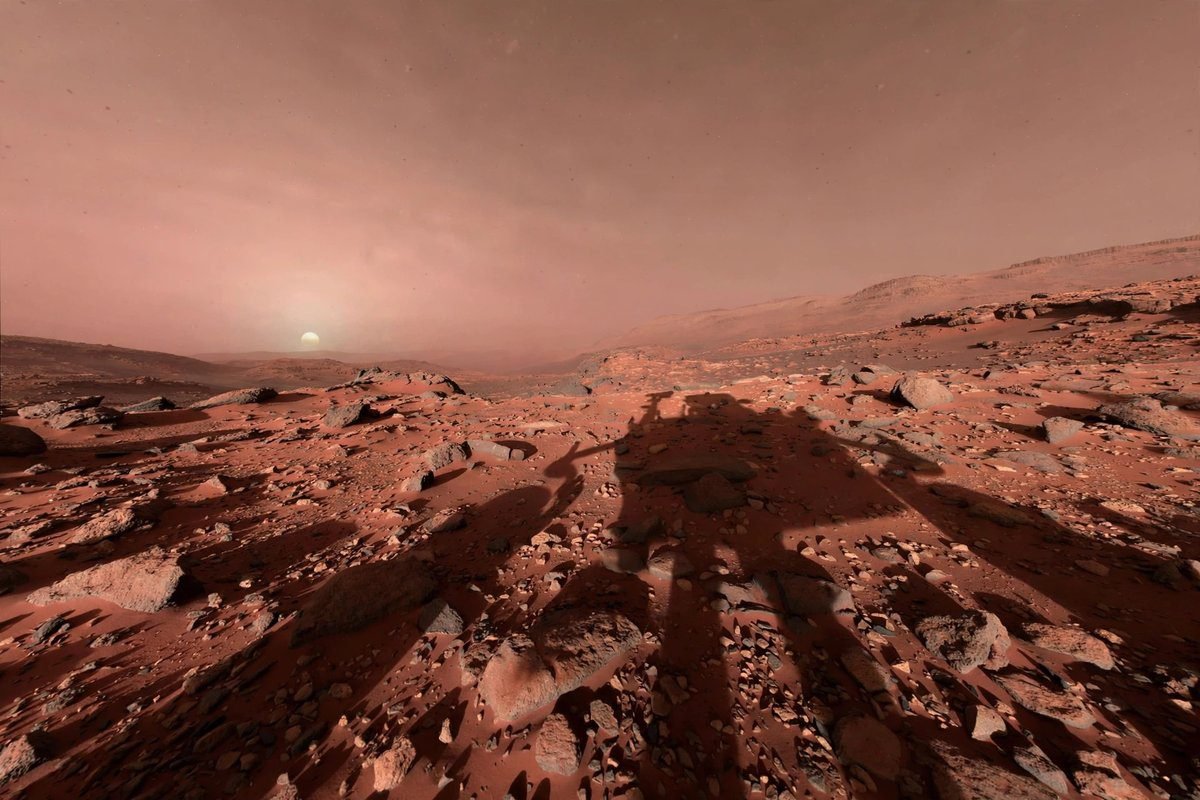
So a “day” on Mars is only part of the story. The length of daylight changes through the Martian year just as it does here, with long summer days and short winter ones — except each season lasts roughly twice as long as an Earth season.
How NASA Rovers Live by the Sol
No one understands the sol better than the teams driving NASA’s rovers. When Curiosity landed in 2012 and Perseverance followed in 2021, their operations were planned sol by sol. Each morning on Mars — or rather, each time the rover wakes up — the team uploads a plan for that sol: drive a certain distance, drill a rock, take photographs, and then send the results home before night falls.
Working on Mars time is famously exhausting for the humans back on Earth. Because each sol is 39 minutes longer than an Earth day, the start of the Mars workday slides later every Earth day. A team member who starts work at 2 p.m. one week might be starting at midnight a few weeks later. During the early months of the Spirit and Opportunity missions, engineers wore special watches calibrated to Mars time and lived on a Mars schedule, sleeping during Earth’s daytime and working through Earth’s nights. They called it “living on Mars time,” and it left many of them permanently jet-lagged.
Even the rovers’ daily routines are built around the sol. Solar-powered rovers like Opportunity had to budget their energy by the sol, charging during daylight and conserving power at night. Perseverance, which runs on nuclear power, has more flexibility, but its cameras, instruments, and driving are still organized around the rhythm of sunrise and sunset on Mars.
What a Sol Feels Like for Future Astronauts
For astronauts on a future Mars mission, the sol will be more than a scheduling curiosity — it will be the rhythm of their daily lives. Human circadian rhythms naturally run a little longer than 24 hours, and researchers have found that most people can adapt to a 24-hour-40-minute day without too much trouble. In fact, studies of people living in isolation without clocks have shown that the human body clock tends to settle at around 24 hours and 11 minutes, so a sol is not a huge stretch.
Still, it would not be seamless. Lighting inside a Mars habitat would need to mimic the Martian sunrise and sunset to keep crews healthy, and mission planners would have to decide whether the crew lives strictly on Mars time or keeps one foot on Earth time for communication. Since a radio signal takes anywhere from 4 to 24 minutes to travel between Earth and Mars depending on the planets’ positions, real-time conversation is impossible anyway, so a crew would largely live by its own clock.
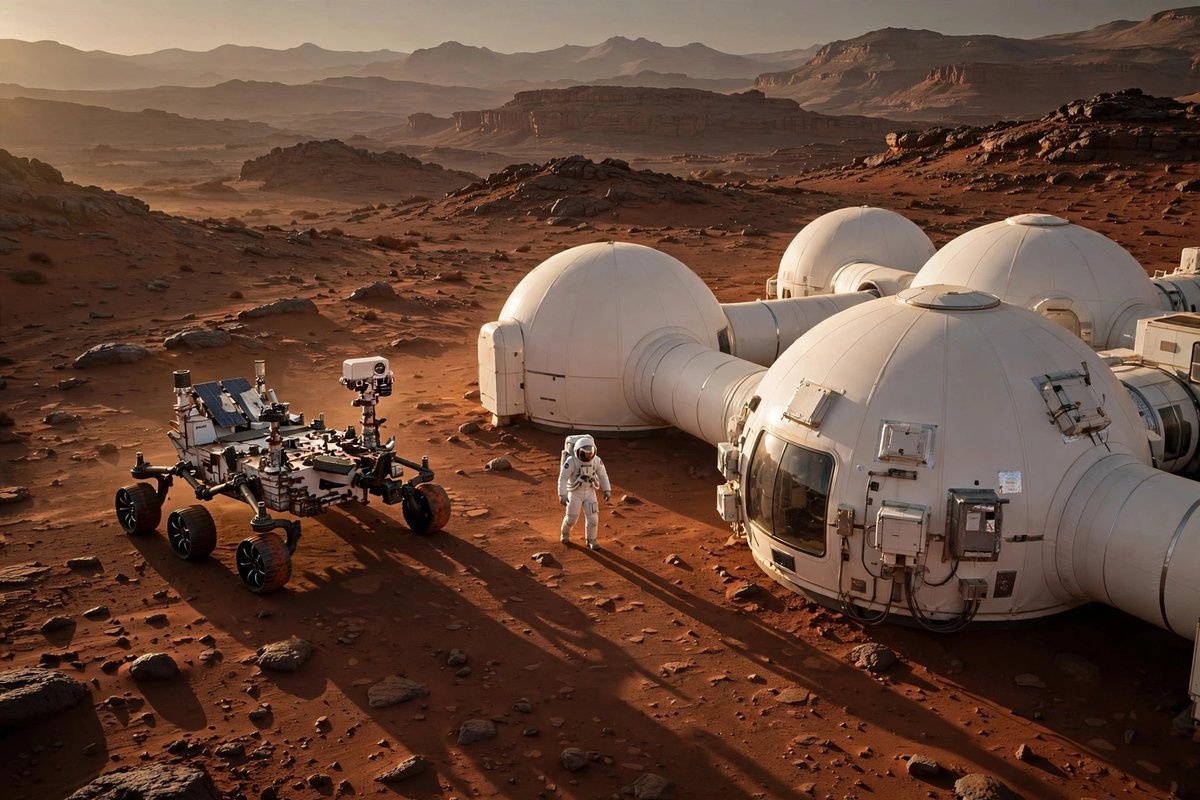
Sleep researchers are also interested in what months of sols would do to mood and alertness. Small shifts, repeated daily, can add up to real fatigue. That is why Mars analogue missions — crews living in sealed habitats in places like Hawaii or Utah — often test Mars-time schedules to see how people cope.
How Mars Time Is Tracked
Mars does not have time zones in the way Earth does, at least not officially. NASA missions track time using Local True Solar Time at the landing site, which is essentially a sundial reading: noon is when the Sun is highest in the sky at that location. Each rover keeps its own local solar time, and mission clocks count sols from landing.
Scientists have also proposed a planet-wide standard called Mars Coordinated Time (MTC), which would work like UTC does for Earth, giving every location on Mars a common reference. It is not in official use yet, but as more missions arrive — and especially once people do — some kind of standard Mars time will become necessary. Imagine trying to coordinate a landing, a supply drop, and a habitat crew all using different local solar times. A shared clock would be essential.
For now, if you want to know the time on Mars, the simplest answer is to count sols since a mission landed and check the local solar time at that site. It is delightfully low-tech for a space-age problem, but it works.
Mars Day FAQs
How long is a day on Mars in hours?
A Mars solar day, or sol, is 24.66 Earth hours — that is 24 hours, 39 minutes, and 35 seconds. Its sidereal day, measured against the stars, is slightly shorter at 24 hours, 37 minutes, and 22 seconds.
Is a day on Mars longer than a day on Earth?
Yes, by about 39 minutes. A sol is roughly 2.7 percent longer than an Earth day, which means Mars time drifts out of sync with Earth time by about 39 minutes every day.
What is a sol on Mars?
A sol is the name for one Mars solar day. It is the standard time unit used by NASA mission teams, who plan rover activities sol by sol and count mission days from landing.
How many sols are in a Mars year?
A Mars year lasts 687 Earth days, which equals about 668.6 sols. Because Mars orbits farther from the Sun, its year is nearly twice as long as Earth’s.
Does Mars have day and night like Earth?
Yes. Mars rotates on its axis just as Earth does, so it has a regular cycle of daylight and darkness. The length of daylight changes with the seasons, and Mars’s tilt of about 25.2 degrees gives it seasons similar in character to Earth’s.
Why do Mars missions use sols instead of days?
Using sols avoids confusion. If a team said “day 100” it would be unclear whether they meant Earth days or Mars days, and the 39-minute difference adds up quickly. Counting sols keeps everyone on the same Martian clock.
Could humans adjust to a Mars day?
Most evidence says yes. The human body clock naturally runs slightly longer than 24 hours, and studies suggest people can adapt to a 24-hour-40-minute cycle. Habitat lighting that mimics Martian sunrises and sunsets would help crews stay in rhythm.
Final Thoughts
A day on Mars is one of those facts that sounds like trivia until you realize how much depends on it. At 24 hours, 39 minutes, and 35 seconds, a sol is close enough to an Earth day to feel familiar, yet different enough to reshape how missions are planned, how rovers are driven, and how future astronauts will live. That 39-minute gap is the reason Mars teams wear Mars watches, why rover schedules slide through the Earth night, and why an entire Martian calendar will one day be needed.
The next time you hear a Mars mission described as being on “sol 1,000” or “sol 3,000,” you will know exactly what that means: a thousand or three thousand sunrises on a world whose days run just a little longer than our own.
Read Also: Which Planet Is Farthest From the Sun? Neptune Explained

1 Comment