
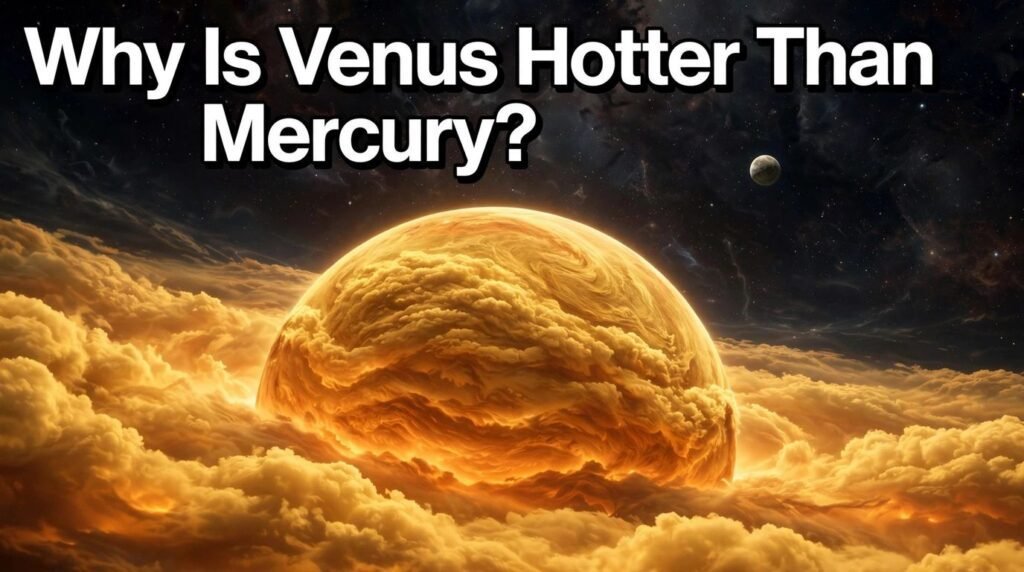
Why is venus hotter than mercury? It is a question that surprises almost everyone who first hears the answer, because the closest planet to the Sun is not the hottest one.
If you lined up the planets in order of distance from the Sun, you would expect the closest one to be the hottest. That is simple common sense, and it is also completely wrong. Mercury, the planet nearest the Sun, is not the hottest world in our solar system. Venus is — by a huge margin — and the reason has almost nothing to do with distance.
It is one of those facts that stops people mid-sentence when they first hear it. How can a planet that sits roughly 50 million kilometres farther from the Sun than Mercury end up so much hotter? The answer is a story about air, or rather, about far too much of it. Venus wrapped itself in a blanket it could never take off, and that blanket has been cooking the planet for billions of years.
The short answer: Venus is hotter than Mercury because of its atmosphere. Venus has a crushing, carbon-dioxide-rich atmosphere that traps heat in a runaway greenhouse effect, holding surface temperatures around 465°C day and night. Mercury has almost no atmosphere at all, so the heat it receives escapes straight back into space.
How Hot Are We Talking, Exactly?
The numbers make the puzzle real. Mercury’s daytime equator can reach about 430°C, which sounds impressive until you look at what happens at night. With no air to hold the warmth, temperatures on Mercury plunge to around -180°C after sunset. The planet swings through a range of more than 600 degrees.
Venus does not swing at all. Its surface sits at roughly 465°C everywhere — at the equator, at the poles, at noon, at midnight. That is hot enough to melt lead, hot enough that the Soviet Venera landers that touched down there in the 1970s and 80s survived for barely an hour or two before the heat and pressure destroyed them. Venus is not just a little hotter than Mercury’s average. It is hotter than Mercury’s hottest moment, all the time, all over.
| Mercury | Venus | |
| Distance from the Sun | ~58 million km | ~108 million km |
| Daytime high | ~430°C | ~465°C |
| Night-time low | ~-180°C | ~465°C |
| Atmosphere | Almost none | ~92 times Earth’s pressure |
| Main atmospheric gas | Traces of oxygen, sodium, hydrogen | ~96.5% carbon dioxide |
Why Isn’t Mercury the Hottest Planet?
Distance still matters, just not as much as people assume. Mercury does receive far more sunlight per square metre than Venus — about four times as much, in fact. If both planets were bare rock with no atmosphere, Mercury would win the heat contest easily.
But a planet’s temperature is not decided by how much sunlight arrives. It is decided by how much of that sunlight stays. Think of it like two houses on a cold night. One sits right next to a bonfire but has no roof and no walls. The other sits farther away but is sealed up tight with the heating on. The sealed house stays warm. The open one does not, no matter how close the fire is.
Mercury is the roofless house. Sunlight hits its grey, cratered surface, heats it up, and then that heat radiates straight back out into space because there is virtually nothing above the ground to catch it. Venus is the sealed house with the heating jammed on.
What Is the Greenhouse Effect, Really?
The greenhouse effect is one of those phrases everyone has heard and fewer people can actually picture. Here is the simplest version. Sunlight passes through a planet’s atmosphere fairly easily and warms the ground. The ground then tries to cool itself by giving off heat, but it gives it off as infrared radiation — a longer, slower kind of energy. Certain gases in the air are very good at absorbing infrared radiation, and when they absorb it, they warm up and send some of that heat back down toward the surface.
On Earth, this is a good thing, mostly. Without any greenhouse effect at all, our planet’s average temperature would sit around -18°C instead of the comfortable 15°C we enjoy. The problem only starts when the effect gets too strong. Add too much of the heat-trapping gas, and the blanket gets thicker, the surface gets hotter, and the whole system settles at a new, much higher temperature.
Venus is what happens when the blanket wins completely.
What Makes Venus’s Atmosphere So Extreme?
Venus’s air is not like Earth’s air with a bit extra carbon dioxide stirred in. It is a different beast entirely. Roughly 96.5% of it is carbon dioxide, the classic greenhouse gas, and it presses down on the surface with about 92 times the pressure of Earth’s atmosphere at sea level. Standing on Venus would feel like standing nearly a kilometre underwater — if the heat did not kill you first.
Above that crushing lower air sit thick clouds of sulphuric acid. These clouds are part of why Venus looks so beautiful and featureless through a telescope: they reflect about three-quarters of the sunlight that reaches the planet back into space. Venus actually absorbs less sunlight than Earth does. But the sunlight that does get through is trapped so effectively that almost none of the resulting heat escapes. The clouds bounce heat around, the carbon dioxide soaks it up, and the surface just keeps cooking.
There is another twist. Because the atmosphere is so thick and constantly churning, heat gets carried all around the planet. That is why Venus has almost no temperature difference between day and night, or between equator and poles. The whole planet is one even, furious oven.
How Did Venus End Up This Way?
Venus probably did not start out as a furnace. Billions of years ago, it may have been a much gentler world, possibly even with liquid water oceans on its surface. The trouble began when the planet warmed just enough that its oceans started to evaporate.
Water vapour is itself a powerful greenhouse gas. As more water evaporated, the atmosphere trapped more heat, which evaporated more water, which trapped more heat. Scientists call this a runaway greenhouse effect, and it is a feedback loop with no natural brake. Eventually the oceans boiled away entirely. Sunlight then split the water vapour high in the atmosphere, and the light hydrogen escaped into space, leaving Venus permanently dry.
With the water gone, carbon dioxide took over as the main heat trapper. On Earth, carbon dioxide gets locked away in rocks and oceans over geological time. On Venus, with no liquid water and no plate tectonics cycling material the way Earth does, there was nowhere for the carbon dioxide to go. It piled up in the sky, and the temperature climbed until it reached the scorching equilibrium we see today.
Why Can’t Mercury Trap Any Heat?
Mercury’s problem is the opposite of Venus’s. It is small, and it is close to the Sun, and those two facts together stripped it of any meaningful atmosphere long ago. The solar wind — the constant stream of charged particles blowing off the Sun — hits Mercury far harder than it hits any other planet, and Mercury’s gravity is too weak to hold on to gases against that battering.
What little atmosphere Mercury has is not really an atmosphere in the usual sense. It is a wispy exosphere, a thin scattering of atoms knocked off the surface by sunlight and micrometeorites: oxygen, sodium, hydrogen, helium, potassium. It is so thin that it cannot trap heat, slow wind, or soften the Sun’s glare. So Mercury lives the most extreme daily life of any planet, roasting by day and freezing by night, while Venus, nearly twice as far from the Sun, never cools down at all.
Could Earth Ever Become Like Venus?
This is the question that makes the Venus story more than a curiosity. Earth and Venus are near twins in size and composition, and for a long time astronomers have treated Venus as a cautionary tale — a version of Earth that took a wrong turn.
The honest answer is that a full Venus-style runaway is very unlikely for Earth any time soon. Our oceans, our active geology, and our distance from the Sun all give us buffers Venus lost. Carbon on Earth gets drawn down into limestone and buried in the crust, and our water cycle keeps the feedback loops in check.
But the word “unlikely” is doing a lot of work there. The deeper lesson of Venus is that a planet’s climate can have tipping points, places where warming feeds on itself and does not easily reverse. Venus passed one. The difference between a comfortable planet and an uninhabitable one turned out to be less about how far it sits from its star and more about what its atmosphere is made of — and what happens to it over billions of years.
How Do We Actually Know All This?
Nobody has stood on Venus and taken its temperature with a thermometer, but the evidence is solid and comes from several directions. The Soviet Venera programme landed probes on Venus between 1970 and 1985, and a few survived long enough to send back photographs of a bleak, orange-lit rocky surface and direct temperature readings of around 465°C. Later orbiters like NASA’s Magellan mapped the surface through the clouds with radar, and the European Venus Express studied the atmosphere in detail.
More recently, NASA’s Parker Solar Probe has flown past Venus several times on its way to study the Sun, snapping images of the planet’s glowing surface in the process. And two new missions are on the way: NASA’s VERITAS, which will map Venus’s surface in high detail, and DAVINCI, which will drop a probe through the atmosphere to sniff its gases directly. Each mission sharpens the same picture: a planet that cooked itself under its own sky.
What Would It Feel Like to Stand on Venus?
It would not last long, but imagine it for a second. The sky would glow a dim orange, not blue, because the thick clouds scatter sunlight so heavily. The ground underfoot would be dark volcanic rock. The air pressure would feel like being deep underwater. The heat would be beyond anything on Earth — ovens for firing pottery run cooler than the Venusian surface.
And there would be no breeze of relief, no cool night to wait for, no shade that helps. The temperature at midnight would be the same as at noon. That is the real difference between Venus and Mercury, and it is why astronomers call Venus the hottest planet: not because it gets the most Sun, but because it can never let the heat go.
Frequently Asked Questions
Is Venus hotter than Mercury even at night?
Yes. Mercury’s nights drop to around -180°C because it has no atmosphere to hold heat. Venus stays near 465°C all night because its thick carbon dioxide atmosphere traps heat around the clock.
What is the hottest planet in our solar system?
Venus, with an average surface temperature of about 465°C. It beats Mercury despite being much farther from the Sun, entirely because of its runaway greenhouse effect.
Why is Mercury so cold at night if it is closest to the Sun?
Mercury has almost no atmosphere. During the day, sunlight heats its surface directly, but at night that heat radiates straight back into space with nothing to slow it down, so temperatures crash.
What gas makes Venus so hot?
Mostly carbon dioxide, which makes up about 96.5% of Venus’s atmosphere. Carbon dioxide is extremely good at absorbing the infrared heat rising from the surface and sending it back down.
Does Venus get more sunlight than Mercury?
No — Mercury receives roughly four times as much sunlight per square metre as Venus. Venus’s clouds also reflect about 75% of incoming sunlight. Venus wins on heat because it keeps what little sunlight it absorbs.
Did Venus ever have oceans?
Scientists believe it probably did, billions of years ago. As the planet warmed, the oceans evaporated, water vapour amplified the greenhouse effect, and the hydrogen eventually escaped into space, leaving Venus dry.
Could Mercury ever develop an atmosphere and warm up?
Not realistically. Mercury’s gravity is weak and the solar wind near the Sun is fierce, so any gases it gains get stripped away quickly. It will stay a world of extremes.
Why is venus hotter than mercury?
To answer why is venus hotter than mercury in one line: Venus has a thick carbon dioxide atmosphere that traps heat, while Mercury has almost no atmosphere to hold any heat at all.
7 Shocking Facts About Venus’s Heat
Why is venus hotter than mercury? The short version is that Venus traps heat and Mercury does not. When people ask why is venus hotter than mercury, the answer is the runaway greenhouse effect. Understanding why is venus hotter than mercury helps explain why distance alone does not decide temperature. In short, why is venus hotter than mercury comes down to atmosphere: Venus holds heat in, Mercury lets it out. So why is venus hotter than mercury? Because Venus keeps its heat, while Mercury cannot.
- Venus stays at about 465 degrees Celsius day and night, hotter than Mercury’s daytime high.
- Mercury swings from about 430 degrees Celsius by day to about minus 180 degrees Celsius at night.
- Venus’s atmosphere is about 96.5 percent carbon dioxide and presses down about 92 times harder than Earth’s atmosphere.
- Mercury has almost no atmosphere, so its heat escapes straight into space.
- Mercury gets about four times as much sunlight as Venus, yet distance alone does not decide temperature.
- A runaway greenhouse effect boiled away Venus’s oceans and trapped ever more heat.
- Thick, churning air spreads Venus’s heat around the planet, so it has almost no day-night difference.
Final Thoughts
Venus hotter than Mercury is one of those facts that sounds like a trick question until you understand the mechanism, and then it reshapes how you think about planets. Distance from the Sun sets the starting point, but the atmosphere decides the ending. Mercury gets blasted with sunlight and throws it all away. Venus gets less sunlight and keeps nearly every scrap of warmth, until its whole surface glows at a temperature that melts metal.
Next time someone asks which planet is hottest, you will know the answer is not the one closest to the fire. It is the one that could never cool down.
So, why is venus hotter than mercury? Because Venus keeps its heat, while Mercury cannot.
It helps to keep asking why is venus hotter than mercury, because the question forces you to look past distance. Once you ask why is venus hotter than mercury in that way, the atmosphere becomes the obvious answer, not the distance from the Sun.
The same logic explains why is venus hotter than mercury even on its night side, where Mercury freezes. Thinking about why is venus hotter than mercury at night makes the greenhouse effect easier to picture, because Venus has no cold night at all.
For readers who are still turning the idea over, why is venus hotter than mercury is a good question to test against other planets. If you can explain why is venus hotter than mercury, you can explain why a thick atmosphere matters more than a short orbit.
In the end, why is venus hotter than mercury remains a favourite example for teachers and stargazers alike. The reason why is venus hotter than mercury stays simple: Venus traps heat, Mercury cannot, and that difference beats distance every time.
That is why is venus hotter than mercury is not a trick question, even though it sounds like one. The answer to why is venus hotter than mercury has been measured again and again, and it always comes back to the atmosphere.
Next time the question comes up, try starting with why is venus hotter than mercury, then point to the clouds. Once someone understands why is venus hotter than mercury, the rest of the solar system starts to make more sense.
Read Also: HMO vs PPO: Which Health Plan Fits You Best in 2026?

1 Comment