
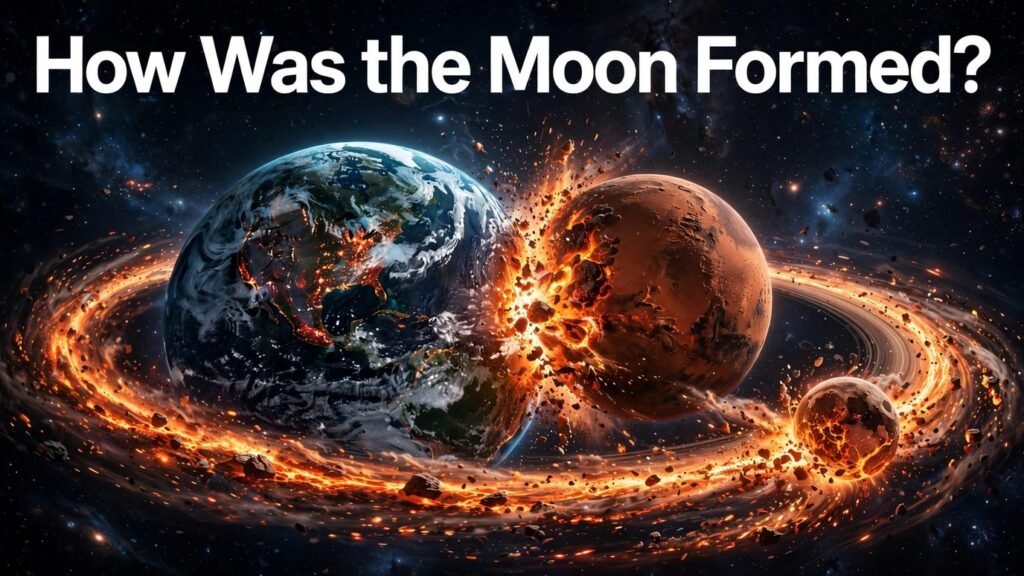
How was the Moon formed? Look up on a clear night and the Moon seems eternal, as if it has always hung there beside us. It has guided sailors, marked the months, and inspired more myths than almost any other object in the sky. Yet for all its familiarity, the Moon has a surprisingly dramatic origin story — one that begins not with a gentle birth, but with a collision so violent it nearly tore the young Earth apart.
For centuries, astronomers could only guess at how the Moon was formed. It was too big, relative to Earth, to fit neatly into the usual explanations. Then, in the twentieth century, rock samples brought back by Apollo astronauts gave scientists something they had never had before: pieces of the Moon itself to study. Those samples, combined with computer simulations, pointed to a single, startling answer.
Contents
- The short answer
- Why Does the Moon’s Origin Matter?
- How Was the Moon Formed? The Giant Impact Explained
- Who Was Theia?
- What Happened in the Collision?
- How Did the Debris Become the Moon?
- What Evidence Supports the Giant Impact Hypothesis?
- Why Is the Moon’s Core So Small?
- What Did Scientists Believe Before the Giant Impact?
- Why Is the Moon Slowly Moving Away from Earth?
- What We Still Don’t Know About the Moon’s Formation
- Frequently Asked Questions
- Conclusion
The short answer:
How was the Moon formed? The Moon formed about 4.5 billion years ago, when a Mars-sized body — now called Theia — collided with the young Earth. The impact threw a huge amount of debris into orbit around Earth, and over time that debris clumped together under its own gravity to form the Moon. This is known as the giant-impact hypothesis, and it is the explanation most planetary scientists accept today.
Why Does the Moon’s Origin Matter?
The Moon is not just decoration in our night sky. It steadies Earth’s tilt, drives the tides, and may even have helped make Earth a stable home for life. Understanding how the Moon was formed is therefore part of understanding why Earth turned out the way it did.
There is another reason the question matters so much. The Moon is, in a sense, a time capsule. Unlike Earth, whose surface has been constantly reshaped by weather, plate tectonics, and oceans, the Moon’s surface preserves a record of the early solar system. Its craters, its rocks, and its very composition carry clues about what conditions were like when the planets were still forming.
How Was the Moon Formed? The Giant Impact Explained
The giant-impact hypothesis goes like this. About 4.5 billion years ago, when the solar system was still young and crowded with leftover building blocks, a body roughly the size of Mars was travelling on an orbit that crossed Earth’s path. Scientists call this body Theia, after the mother of the Moon goddess in Greek mythology.
Theia struck the early Earth at an angle, in a glancing blow rather than a head-on crash. The energy released was almost beyond imagination. Much of Theia was destroyed, and a huge amount of material from Earth’s outer layers was blasted into space. A ring of hot debris soon circled the planet.
Within a relatively short time — possibly as little as a few hundred years, though estimates vary — that debris began to stick together. Gravity did the rest. The fragments collided, merged, and grew, until a single body had formed: the Moon. At first it orbited much closer to Earth than it does today, and it was a glowing ball of molten rock. Slowly, over millions of years, it cooled and its surface solidified.
Who Was Theia?
A Planet That No Longer Exists
Theia is one of the most fascinating characters in this story, partly because it no longer exists. It was a protoplanet, one of many rocky bodies that formed in the early solar system but never grew into a full planet. Had it not collided with Earth, it might have become a planet in its own right.
How Big Was Theia?
Theia is usually described as being roughly the size of Mars, which means it was a substantial world, not a mere asteroid. That size matters, because only an impactor that large could have thrown enough material into orbit to build a moon as large as ours.
What Happened in the Collision?
It helps to picture how the Moon was formed, in stages:
- Theia approached the young Earth, which was itself still hot and only partly solid.
- The collision struck at an angle, vaporising rock and throwing debris outward rather than simply burying the impactor in Earth’s interior.
- The cores of the two bodies largely merged, which is one reason Earth’s iron core is so large today.
- A disc of molten and vaporised rock settled into orbit around Earth, like a temporary ring.
One of the most striking details is that much of the Moon’s material came from Earth itself, not from Theia alone. That helps explain why the two bodies are so similar in composition — a point we will return to when we look at the evidence.
How Did the Debris Become the Moon?
The process is called accretion, and it is the same basic process that built the planets. Small particles collided and stuck together, forming larger and larger clumps. Gravity pulled the clumps toward each other, and within a geologically short time a single moon had taken shape. This is how the Moon was formed from the debris.
Early on, the Moon sat much closer to Earth — some estimates put it only a fraction of its current distance away. That closeness had dramatic effects. The tides on early Earth would have been enormous, and the Moon would have appeared far larger in the sky than it does now. Over billions of years, gravitational interactions have gradually pushed the Moon outward to its present distance, about 384,400 kilometres on average.
What Evidence Supports the Giant Impact Hypothesis?
A scientific idea earns its place by explaining the evidence better than its rivals. The giant-impact hypothesis does that on several fronts at once for how the Moon was formed.
Moon Rocks Look Like Earth’s Mantle
When Apollo astronauts brought lunar rocks back to Earth, scientists could compare them directly with Earth rocks. The Moon’s composition turned out to be remarkably similar to Earth’s mantle — the layer beneath the crust. That fits neatly with an impact that blasted mantle material into orbit. If the Moon had formed elsewhere and been captured by Earth’s gravity, we would expect its composition to be far more different.
The Moon Has a Surprisingly Small Iron Core
Earth has a large, dense iron core. The Moon’s core, by contrast, is small relative to its size. This makes sense if the Moon formed mostly from the lighter, rocky outer layers of Earth and Theia, while most of the iron from both bodies sank into Earth’s core during and after the collision.
The Earth-Moon System Has a Lot of Angular Momentum
The Earth and Moon together spin and orbit with a large amount of angular momentum — the rotational energy of the system. A giant glancing impact is a natural way to produce that much spin. Other explanations struggle to account for it.
Computer Simulations Reproduce the Result
Modern computer models of the early solar system can simulate a Mars-sized body striking the young Earth. When researchers run these simulations with the right impact angle and speed, a debris disc forms, and a moon-sized body grows from it. The fact that the physics works out on a computer, not just on paper, gives the hypothesis real weight.
| Evidence | What it shows | Why it fits the giant impact |
|---|---|---|
| Moon rocks resemble Earth’s mantle | The Moon’s material is similar to Earth’s outer layers | The Moon formed from debris blasted off Earth |
| Small lunar iron core | The Moon is low in iron compared with Earth | Iron sank into Earth during the collision |
| High angular momentum | The Earth-Moon system spins fast | A glancing giant impact adds spin |
| Apollo samples | Real lunar material to test against | Confirms the composition predictions |
Why Is the Moon’s Core So Small?
This point deserves a closer look because it is one of the strongest clues. When a rocky planet forms, heavy elements like iron sink toward the centre, forming a core, while lighter rock floats to the outside. Both Earth and Theia would already have had iron cores before they collided.
During the impact, the iron cores of the two bodies mostly merged and stayed with Earth, while the lighter rocky material was splashed into orbit. The Moon that grew from that orbiting material therefore ended up iron-poor, with only a small core. If the Moon had formed independently like a small planet, we would expect a proportionally larger core. Its small core is, in effect, a fingerprint of how the Moon was formed in the collision.
What Did Scientists Believe Before the Giant Impact?
The giant-impact hypothesis was not the first idea, and it is worth knowing what came before, because each older theory explains something but fails somewhere important.
| Older theory | The idea | The problem |
|---|---|---|
| Fission theory | The early Earth spun so fast it threw off a chunk that became the Moon | Earth could not have spun fast enough, and the composition does not quite match |
| Capture theory | The Moon formed elsewhere and was captured by Earth’s gravity | Capturing something as large as the Moon is very difficult, and the compositions are too similar |
| Co-accretion theory | Earth and the Moon formed side by side from the same material | It cannot easily explain the Moon’s small iron core or the system’s angular momentum |
The giant-impact hypothesis, first seriously developed in the 1970s and strengthened enormously by the Apollo samples, succeeded where these theories struggled because it explains all the main pieces of evidence at once.
Why Is the Moon Slowly Moving Away from Earth?
Here is a fact that surprises many people: the Moon is drifting away from us, by a few centimetres each year. This is not a sign that anything is wrong. It is a long-term consequence of the tides.
Earth’s oceans bulge toward the Moon, and because Earth rotates faster than the Moon orbits, that bulge is dragged slightly ahead of the Moon. The bulge’s gravity tugs the Moon forward, adding energy to its orbit and pushing it gradually outward. At the same time, the Moon’s pull on the bulge is slowly braking Earth’s rotation, which is why days are getting longer over geological time.
This drift also confirms something important about the Moon’s history. If you run the clock backward, the Moon was much closer to Earth in the past — exactly as the giant-impact hypothesis predicts for how the Moon was formed from orbiting debris.
What We Still Don’t Know About the Moon’s Formation
For all its success, the giant-impact hypothesis still has open questions about how the Moon was formed, and honest science admits them.
First, the exact details of the impact — Theia’s precise size, speed, and angle — are still debated, and different computer models favour slightly different versions of the event. Second, there is a puzzle about composition: Earth and Moon rocks are even more similar in some respects than the simplest version of the theory predicts, which has led researchers to propose refinements, such as a more violent impact that mixed the two bodies more thoroughly. Third, the early Moon’s history — how quickly it cooled, when its magnetic field faded, and how its crust formed — is still being pieced together from samples and spacecraft data.
None of this undermines the broad picture. It is normal for a strong theory to have details still to resolve. If anything, the ongoing debate shows the idea is alive and being tested, which is exactly what good science looks like.
Frequently Asked Questions
How old is the Moon?
The Moon is about 4.5 billion years old, roughly the same age as Earth. It formed shortly after the solar system itself began to take shape, during a violent period when collisions between young planets were common.
Was the Moon once part of Earth?
In a sense, yes. Much of the Moon’s material came from Earth’s outer layers, blasted into orbit by the impact. That is why lunar rocks resemble Earth’s mantle so closely. The Moon is not a chip broken off the modern Earth, though — it formed from debris after a collision with a separate body, Theia.
What is Theia?
Theia is the name given to the Mars-sized protoplanet that collided with the young Earth. It was destroyed in the impact, and its remains were partly absorbed by Earth and partly thrown into orbit, where they helped form the Moon.
How long did it take the Moon to form after the impact?
The debris disc formed quickly, and the Moon itself likely gathered together over a relatively short period by geological standards — possibly within hundreds to thousands of years. It then took far longer, millions of years, to cool from a molten ball into the solid world we see today.
Why does the Moon always show the same face to Earth?
The Moon is tidally locked, meaning its rotation period matches its orbital period. This happened because Earth’s gravity gradually slowed the Moon’s spin until the two motions synchronised. It is a common outcome for moons that orbit close to their planets.
Is the Moon still moving away from Earth?
Yes, by a few centimetres per year, driven by tidal interactions between Earth and the Moon. The effect is tiny on human timescales but significant over billions of years, and it will continue far into the future.
Could another giant impact happen today?
The solar system is far calmer now than it was 4.5 billion years ago. Most of the large leftover bodies have either become planets, been absorbed, or been ejected. A collision on the scale of the giant impact is not something astronomers expect in the foreseeable future.
Conclusion
The story of how the Moon was formed is one of the great detective stories in science. A world the size of Mars collided with the young Earth, the debris from that catastrophe gathered in orbit, and from it grew the Moon — our constant companion, our tide-maker, and a witness to the earliest days of the solar system.
The giant-impact hypothesis ties together the Apollo rock samples, the Moon’s small iron core, the spin of the Earth-Moon system, and the results of computer simulations into a single, coherent picture. Questions remain about the fine details, and researchers continue to refine the story. But the broad outline is now firmly established: the Moon was born from a collision, and we live on a planet shaped by that ancient impact.
The next time you look up at a full Moon, remember that you are looking at the survivor of the most violent event in Earth’s history — a world made, quite literally, from pieces of our own planet.
Read Also: Why Is Venus Hotter Than Mercury? 7 Shocking Facts

2 Comments