
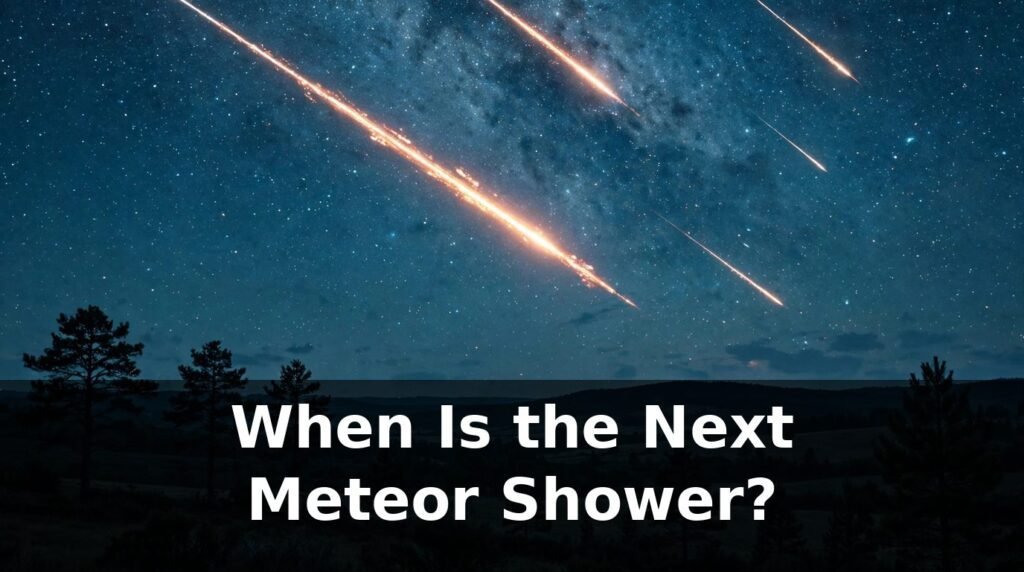
If you have ever looked up at a shooting star and asked yourself when is the next meteor shower, you are not alone. It is one of the most common questions in stargazing, and one of the most rewarding to answer, because a good meteor shower is among the easiest and most exciting sky events you can watch. You do not need a telescope, you do not need special training, and you do not even need to stay out all night. You just need to know which night to choose, and where to look.
There is something quietly exciting about a night sky that suddenly starts moving. You step outside, look up, and a bright streak crosses the darkness before you have time to point at it. That is the simple pleasure of a meteor shower, and it is why so many people plan their evenings around one. A clear, dark sky and a little patience are all it takes, and even a modest shower can give you a memorable evening under the stars.
The short answer: The next major meteor shower is the Leonids. It is active from 6 to 30 November 2026, and it peaks on the night of Tuesday 17 November into Wednesday 18 November 2026. The best time to watch is after midnight, into the early hours before dawn. Under a dark sky, you can expect around 10 to 15 meteors per hour. If you are asking when is the next meteor shower, that is the date to put in your diary first, although a smaller shower, the Northern Taurids, reaches its peak a few nights earlier, on 11 and 12 November.
When Is the Next Meteor Shower?
When is the next meteor shower? Right now, the answer is the Leonids, with the Northern Taurids peaking just before them. The Taurids are a slow, gentle shower, and they are worth a look on the nights of 11 and 12 November 2026, when the Moon is mostly out of the way and the sky at its darkest early in the evening. They are not the most spectacular shower of the year, but they sometimes produce a few bright, slow-moving fireballs, which makes them a nice warm-up for the main event.
The Leonids take over a few nights later. They are active all through November, from the 6th to the 30th, but the night that matters is Tuesday 17 November into Wednesday 18 November, when the Earth passes through the densest part of the debris stream left behind by Comet Tempel-Tuttle. That is when you will see the most meteors, and when the shower is at its best.
Checking when is the next meteor shower a few days ahead also gives you time to watch the weather forecast and pick the clearest night near the peak. A clear sky on the night before or after the peak is better than a cloudy sky on the perfect night, so it pays to be flexible. Keep an eye on the forecast, choose a dark spot away from streetlights, and give yourself at least an hour outside so your eyes have time to adjust to the dark.
The Next Meteor Showers at a Glance
Here are the next showers coming up, with their peak nights and what to expect. The Leonids are the main event this month, the Geminids are the big one to look forward to in December, and the Northern Taurids are a quiet show that peaks in between.
| Meteor Shower | Active | Peak | Expected Rate |
| Northern Taurids | 20 Oct – 10 Dec 2026 | 11-12 Nov | 5-10 per hour |
| Leonids | 6-30 Nov 2026 | 17-18 Nov | 10-15 per hour |
| Geminids | 4-20 Dec 2026 | 13-14 Dec | Up to 120 per hour |
| Ursids | 17-26 Dec 2026 | 22-23 Dec | 5-10 per hour |
| Perseids | 17 Jul – 24 Aug 2027 | 12-13 Aug | Up to 100 per hour |
Rates like these are only a guide. The number of meteors you actually see depends on the darkness of your sky, the phase of the Moon, the weather, and how long you spend watching. Under a truly dark sky, with no Moon and good conditions, you will see far more than you will from a bright town garden, so the place you choose matters just as much as the date.
More Information: What Is a Blue Moon? Meaning, Types and How Rare It Is
What Is a Meteor Shower?
A meteor shower happens when the Earth passes through a stream of dust and small rocks left behind by a comet or an asteroid. These tiny particles, most of them no bigger than a grain of sand, hit the upper atmosphere at very high speed, usually tens of kilometers every second. As they fall, they heat up and burn, and that burning is the bright streak you see in the sky. A single streak is called a meteor, or a shooting star, even though it is not a star at all.
The dust in a stream is spread along the orbit of its parent comet, so the Earth crosses the same stretch of dust at the same time every year. That is why meteor showers return on the same dates each year, and why they have names. The meteors in a shower all seem to come from a single point in the sky, called the radiant, which usually lies inside the constellation the shower is named after. The Leonids, for example, seem to come from the constellation Leo, and the Perseids seem to come from Perseus.
Most meteors burn up completely long before they reach the ground. Every so often, a bigger piece survives all the way down, and that is called a meteorite, but that is rare, and it is not what you are watching for during a shower. During a shower, almost everything you see is dust turning into light high above you, gone in less than a second. A shower is also different from a single stray meteor. On any clear night you might see a few stray meteors, but during a shower you can see many in an hour, all from the same part of the sky.
How to Watch a Meteor Shower
Watching a meteor shower is simple, and the first step is to know when is the next meteor shower so you can pick the right night and make the most of it. Once you have the date, a little preparation makes a big difference, but you do not need any equipment at all. The most useful thing you can bring is patience, because a good shower rewards people who stay out and let their eyes adjust.
- Pick the peak night. The nights on either side of the peak can still be good, but the peak night gives you the most meteors, so build your plans around it when you can.
- Get away from lights. Streetlights, house lights, and car headlights all brighten the sky and hide fainter meteors, so a dark field, a quiet park, or a country lane is far better than a bright back garden.
- Let your eyes adjust. Your eyes need about 20 to 30 minutes in the dark before they can pick out faint meteors, so arrive early, keep your phone in your pocket, and use a red light if you need to see anything close by.
- Lie back and look up. A deckchair, a camping mat, or a blanket and a pillow all work well. Look at the darkest part of the sky, not straight at the radiant, because meteors show up best when they cross your view a little way from the point they came from.
- Stay warm and take your time. An hour or two outside is often enough for a good shower, but the best meteors sometimes arrive in short bursts with quiet spells in between, so do not give up after ten minutes.
Bring a warm coat, a drink, and a blanket, and treat it as a quiet evening out under the stars, not a race to count meteors.
Where Is the Best Place to Watch a Meteor Shower?
You can see a meteor shower from almost anywhere with a clear sky, but once you know when is the next meteor shower, the place you choose matters as much as the night you pick. A dark sky makes the biggest difference of all. From a bright town, you might see only the brightest few meteors each hour, while from a dark hill or beach you might see several times as many.
The best spots are simple ones: a dark-sky reserve or park, open countryside, a hilltop away from towns, or a beach with no lights behind you. Keep the brightest city glow behind you, and make sure you have a wide, open view of the sky, with trees, hills, and rooftops as low as possible. Do not forget to tell someone where you are going, and take a phone for safety, even if you keep it in your pocket while you watch.
If you live in a town, try to find the darkest corner you can, and use walls or fences to block out nearby lights. You will still see the brighter meteors, especially during the Geminids or the Perseids, and the Leonids can still put on a fine show. Many people head to dark-sky reserves such as Exmoor, Snowdonia, or the Northumberland National Park for shower nights, but any quiet, dark place away from streetlights will do.
If you only watch one shower a year, make it one you can actually see: check when is the next meteor shower and pick the darkest, clearest night you can find.
More Information: Red Herring Definition: Meaning, Examples and Uses
How to Take Photographs of a Meteor Shower
Photographing a meteor shower is a challenge, but a camera on a tripod can catch what your eyes cannot. Use the widest lens you have, set the camera to a high sensitivity, and leave the shutter open for 15 to 30 seconds at a time. Point it at a dark part of the sky, away from the radiant, and take many pictures one after the other. A bright meteor appears in only one frame, so you need patience and a lot of frames, and a spare battery, because long exposures drain batteries quickly.
Why the Leonids Are Special
The Leonids are special because of their history, and because they are the shower that made people take meteor showers seriously. If you are wondering when is the next meteor shower with a real story behind it, this is the one. The Leonids have been recorded for centuries, and they sometimes produce a storm, when hundreds or thousands of meteors fall in a single hour, though most years they are much quieter, at around 10 to 15 an hour.
The most famous Leonid storm happened in November 1833, when around a hundred thousand meteors appeared in a single night over North America, and many people called it the night the stars fell. That one night changed how people thought about the sky, because it showed that a shower could be huge. These storms do not happen every year. The biggest ones have come roughly every 33 years, when Comet Tempel-Tuttle returns, but every Leonid season carries a little of that history, which is another reason these meteors are worth a night outside.
They are also among the fastest meteors of the year, and many of them leave glowing trains, bright streaks that stay in the sky for a second or two after the meteor has passed.
Frequently Asked Questions About Meteor Showers
When is the next meteor shower?
The next major meteor shower is the Leonids, peaking on the night of 17 November into 18 November 2026, with around 10 to 15 meteors per hour under a dark sky. The Northern Taurids peak just before them, on 11 and 12 November. That is the short answer to when is the next meteor shower, and the rest of this guide explains how to make the most of it.
What is the next meteor shower after the Leonids?
After the Leonids, the next major shower is the Geminids, which peak in mid-December 2026 and are usually the best shower of the year, with up to 120 meteors per hour under a dark sky. Once you have enjoyed the answer to when is the next meteor shower this November, the Geminids give you another date to look forward to in December.
What is the best time of night to watch a meteor shower?
The best time is usually after midnight, into the early hours before dawn. That is when your part of the Earth is facing into the stream of dust, so more meteors hit the sky above you, and it is also when the radiant is highest in the sky. For the Leonids, the hours after midnight are best. The evening can still be worth watching, but it is usually much quieter.
Do I need a telescope to see a meteor shower?
No. A telescope is too narrow to follow meteors, and it shows only a tiny area of sky. Meteor showers are best watched with your eyes alone, looking at the widest area of sky you can. Binoculars can be interesting for part of the evening, but for the shower itself, unaided eyes and a dark sky are all you need.
What causes a meteor shower?
Meteor showers are caused by dust and small rocks left behind by comets or asteroids. When the Earth passes through one of these streams, the tiny pieces hit the atmosphere and burn up as meteors. A comet leaves a stream along its whole path around the Sun, so the Earth crosses the same stream each year on the same dates.
Can I see a meteor shower from a city?
Yes, you can, but you will see fewer meteors. City lights brighten the sky and hide the fainter meteors, so try to find the darkest place you can reach, keep bright lights behind you, and look toward the darkest part of the sky. For the best view, a dark-sky site a short distance from town is always worth the trip.
Final Thoughts
Keep your plans simple. Pick a clear night near the peak, go somewhere dark, and give yourself a good hour outside. The Leonids in November and the Geminids in December are two dates worth writing in your diary, and they are both proof that you do not need a telescope to see something special in the night sky.
If you are lucky, you will see a few bright ones that you will remember for years. And if a friend asks you when is the next meteor shower, you will know exactly what to tell them.
Read Also: Perseverance: NASA’s Mars Rover Mission Explained Simply
