
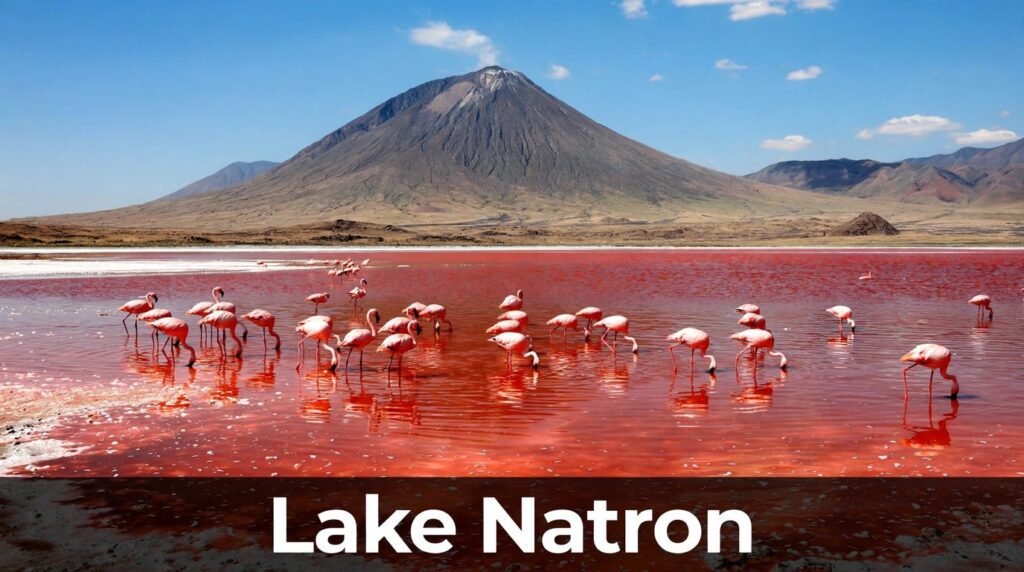
Seen from the air, Lake Natron does not look like a lake at all. It looks like a spill of red paint across the floor of the Rift Valley, edged with white salt and watched over by a perfect volcanic cone. The water glows orange and crimson, the shoreline cracks into salt flats, and for much of the year the shallows are crowded with pink flamingos standing on one leg.
It is beautiful, strange, and genuinely dangerous — all at the same time.
That combination is what makes Lake Natron famous. This is a lake where the water can burn your skin, where the temperature can top 60°C, and where animals that die in the shallows wash up looking like stone statues. And yet it is also one of the most important wildlife sites in Africa: the breeding ground for most of the world’s lesser flamingos.
This guide explains what Lake Natron is, where it sits, why its water turns red, how flamingos survive in it, and what the famous “stone animals” really are. It also covers the volcano next door, how to visit safely, and the threats facing the lake today.
The short answer: Lake Natron is a shallow soda lake in northern Tanzania, near the Kenyan border, with water so alkaline (pH 9 to 10.5, sometimes above 12) and so hot (up to 60°C) that almost nothing can live in it. Algae and bacteria turn the water red. Around 2.5 million lesser flamingos — about 75% of the world’s population — breed there because the caustic water keeps predators away from their nests. Animals that die in the lake are preserved by natural sodium carbonate, which is why they look like stone.
Where Is Lake Natron?
Lake Natron sits in the far north of Tanzania, in Ngorongoro District of the Arusha Region, close to the Kenyan border. Its northern tip crosses into Kenya.
The lake lies in the Gregory Rift, the eastern branch of the East African Rift Valley, in a dry, low-lying landscape of volcanic rock and open plains. The nearest city of any size is Arusha, to the south-east, and reaching the lake means a long drive over rough roads — which is part of why it still feels wild and little-visited.
The setting matters because it explains almost everything about the lake. This is a volcanic landscape. The ground is old lava, the hills are volcanic ash, and the volcano Ol Doinyo Lengai rises just to the south. Hot springs bubble up around the shore, and the only river of any size that feeds the lake, the Southern Ewaso Ng’iro, flows down from central Kenya.
Crucially, no river flows out of Lake Natron. Water arrives, and the only way it leaves is by evaporation under a fierce equatorial sun.
The lake is also far bigger than it looks from the shore, yet astonishingly shallow. At its fullest it stretches up to 57 kilometres long and 22 kilometres wide, but it is less than 3 metres deep almost everywhere.
That means its size changes dramatically with the seasons: in the dry season it shrinks back and exposes wide salt flats, while after rain it spreads out again across the plain.
Lake Natron at a Glance
| Fact | Detail |
|---|---|
| Location | Northern Tanzania, Ngorongoro District, Arusha Region; northern tip crosses into Kenya |
| Setting | Gregory Rift, eastern branch of the East African Rift Valley |
| Lake type | Saline soda lake with no outlet |
| Length and width | Up to 57 km long and 22 km wide |
| Depth | Less than 3 metres |
| Surface area | Roughly 850 to 1,040 km², depending on water level |
| Elevation | About 600 metres above sea level |
| pH | Typically 9 to 10.5, can exceed 12 when water is low |
| Water temperature | Up to 60°C (140°F) |
| Fed by | Southern Ewaso Ng’iro River and mineral-rich hot springs |
| Protected status | Ramsar Wetland of International Importance since 4 July 2001 |
The land around the lake belongs to the Maasai, and Maasai villages and herders are part of the landscape here. Most visitors arrive with a local guide, and that is the sensible way to see the lake: the ground is uneven, the heat is intense, and the difference between a safe viewpoint and a dangerous stretch of caustic mud is not always obvious to an outsider.
Why Is Lake Natron’s Water Red?
The red colour is the first thing everyone notices, and it comes from life, not from rock. Lake Natron’s water is full of salt-loving algae and cyanobacteria — tiny organisms that thrive in conditions that would kill almost anything else.
As they grow in huge numbers, they tint the water red, orange, and pink. The colour is strongest when the water is shallow and salty, and it shifts through the year as the lake rises and falls.
Evaporation is the engine behind the colour. Because no water flows out, the lake steadily concentrates everything dissolved in it. In the dry season, the water level drops, the salts concentrate, the algae bloom harder, and the red deepens. From the air, the pattern looks almost abstract: red open water, orange shallows, and white crusts of salt where the water has dried completely.
Why the Colour Changes
- Water level: low water means more concentrated salts and a deeper red.
- Salt crusts: dried areas turn white, framing the red water in sharp contrast.
- Season: after rain, the lake spreads out and the colour can look paler pink.
- Depth: the shallowest edges, where the water is warmest and saltiest, colour first.
It is worth saying plainly that the red is not blood, and it is not pollution. It is a natural bloom of organisms that have adapted to one of the harshest lakes on Earth. Satellite images taken by NASA show the same red pattern year after year, which is how most people first come across Lake Natron — as a startling red shape on the map of northern Tanzania.
Why Is Lake Natron So Alkaline?
The short answer is that the lake has nowhere to send its minerals. Every lake collects minerals from the land around it, but most lakes flush them away through an outlet river.
Lake Natron has no outlet. The water that flows in from the Ewaso Ng’iro and the hot springs carries dissolved minerals, and then the water evaporates and leaves those minerals behind. Over thousands of years, the lake has become a concentrated brine.
The geology makes it worse — or more extreme, depending on your point of view. The surrounding rock is alkaline volcanic lava, laid down during the Pleistocene, rich in carbonate and low in calcium and magnesium. Water washing through that rock picks up large amounts of sodium carbonate. Ash from Ol Doinyo Lengai adds more of the same.
The result is water dominated by natron (sodium carbonate) and trona (sodium sesquicarbonate), the very minerals the lake is named after.
The numbers tell the story. Most freshwater lakes sit between pH 6 and 8. Lake Natron usually measures between pH 9 and 10.5, and when the water is low it can pass pH 12.
For comparison, household bleach sits around pH 12.5. That is why the water is described as caustic: it can burn skin and eyes, and even a small cut stings painfully on contact.
What “Natron” Actually Is
Natron is a naturally occurring mixture of sodium carbonate and sodium bicarbonate. The ancient Egyptians used it in mummification because it dries and preserves soft tissue — and that same preserving power is at work in Lake Natron today. The lake did not get its name by accident. It is, quite literally, a lake full of natron.
How Hot Does Lake Natron Get?
Heat is the lake’s second weapon. Because Lake Natron is less than 3 metres deep, the sun warms the whole water column. Surface temperatures can reach 60°C (140°F) in the hottest parts of the year, and air temperatures around the shore frequently pass 40°C (104°F). The hot springs that feed the lake add further warmth in places.
This matters for two reasons. First, the heat makes the water even more hostile: hot, caustic water is far more damaging to skin than cold caustic water. Second, the heat speeds up evaporation, which concentrates the salts further. Heat, alkalinity, and evaporation reinforce each other in a loop, and that loop is what keeps Lake Natron extreme.
For visitors, the practical point is simple. Do not touch the water, do not wade in it, and certainly never swim in it. The combination of heat and caustic salts can cause serious burns, and the muddy shoreline can be deceptively soft underfoot. Look, photograph, and admire the lake from the shore — that is the safe way to experience it.
Why Do Flamingos Breed at Lake Natron?
Here is the great paradox of Lake Natron: the most hostile lake in the region is also the most important flamingo nursery on the planet. Lake Natron is the only regular breeding area in East Africa for the lesser flamingo, and around 2.5 million of them — roughly 75% of the world’s lesser flamingos — are born here.
The reason is simple once you see it from the flamingo’s point of view. The same caustic water that keeps almost everything else out also keeps predators out. Flamingos build their nests as mounds of mud on low, salty islands that form in the middle of the lake as the water drops.
Foxes, jackals, and other nest raiders cannot cross the burning shallows to reach them. The lake is a fortress with a moat made of poison.
How Flamingos Survive Water That Burns
Flamingos are not immune to the lake, but they are adapted to it in ways that look almost engineered:
- Tough legs: their legs have thick, scaly skin that resists the caustic water, and they keep moving so no one patch of skin is exposed for long.
- Salt glands: glands near their eyes let them excrete excess salt, so they can cope with water that would dehydrate other birds.
- The right food: lesser flamingos feed on the very algae and cyanobacteria that colour the water red. The food that makes the lake hostile to others is dinner for them.
- Timing: breeding peaks between October and February, and the birds time their nesting to the lake’s water levels, so breeding success varies from year to year.
Greater flamingos also breed on the mud flats at Lake Natron, although the lesser flamingo is the species the lake is famous for.
At peak times, two to four million flamingos have been counted on and around the lake at once. The breeding colony is one of the largest gatherings of a single bird species anywhere in the world.
It is important to add a detail that often gets lost in the dramatic photographs. The flamingos do not spend their whole lives standing in the caustic water. They feed and rest in the shallows, but they also use the salt marshes and freshwater wetlands around the lake, where the water is far gentler.
The lake is their nursery and their fortress; the surrounding wetlands are part of their home too.
The species is listed as near threatened, which makes Lake Natron’s role even more important. If this one lake were damaged, three quarters of the world’s lesser flamingos would lose their main breeding ground. There is no easy backup site.
What Are the “Stone Animals” of Lake Natron?
No story about Lake Natron travels further than the “stone animals.” In 2011, photographer Nick Brandt was walking the shoreline when he found birds and bats that looked as if they had turned to stone. He photographed them in lifelike poses, and the images went around the world.
They are real photographs of real animals — but the popular explanation is wrong in an important way.
The animals do not turn to stone while they are alive, and the lake does not flash-freeze them into statues. What actually happens is slower and sadder. Birds and bats that die in the lake — most likely after landing on the water by mistake — are preserved by the sodium carbonate in the water.
The minerals calcify the body and dry it out, much as natron preserved bodies in ancient Egyptian mummification. As the water level drops in the dry season, the preserved bodies wash up on the shore, stiff and pale, looking like statues.
What Is True and What Is Not
- True: dead animals in Lake Natron are calcified and preserved by the lake’s minerals.
- True: Nick Brandt found and photographed these preserved birds and bats along the shore in 2011.
- Not proven: the idea that the lake’s mirror-like surface confuses birds into flying into it. Brandt suggested it as a possibility, but nobody knows for certain why the animals end up in the water.
- False: the lake turns living animals to stone on contact. The animals die first, and the preserving happens afterwards.
The “stone animals” are still a striking sight, and they tell you something real about the lake: the water is so full of dissolved minerals that it can preserve a dead bird almost intact.
But they are a reminder to be careful with dramatic stories. The truth — a natural mummification process in a volcanic soda lake — is strange enough on its own.
What Else Lives at Lake Natron?
For a lake this hostile, Lake Natron supports a surprising amount of life — provided you look at the right scale. Only three species of fish live in the water itself: three kinds of alkaline tilapia that have adapted to the salt and heat. Almost nothing else with fins can survive there.
The real abundance is smaller and pinker. The algae and cyanobacteria that colour the water form the base of the food chain. Tiny invertebrates and salt-adapted shrimps feed on them, and the flamingos feed on both. Around the edges of the lake, where fresh water mixes in, the picture changes completely: salt marshes and freshwater wetlands support a much wider community.
Wildlife Around the Lake
- Waterbirds: pelicans, egrets, herons, lapwings, and waders work the shoreline alongside the flamingos.
- Fish: three species of alkaline tilapia, found nowhere else in these conditions.
- Land animals: ostriches, zebras, and kudus visit the wetlands around the lake.
- Small life: algae, cyanobacteria, and salt-tolerant invertebrates in the water itself.
The contrast is the point. The open lake is nearly empty of life; the wetlands around it are busy. Lake Natron is not one habitat but a set of them pressed together — caustic lake, salt flat, marsh, and fresh wetland — and the wildlife uses all of them.
What Is Ol Doinyo Lengai, the Volcano Beside the Lake?
You cannot talk about Lake Natron without talking about the mountain that stands over it. Ol Doinyo Lengai — “Mountain of God” in the Maasai language — is an active volcano just south of the lake, rising to nearly 3,000 metres above sea level. Its near-perfect cone dominates the skyline, and on a clear morning it is the first thing you see from the lakeshore.
The volcano is remarkable for a reason that matters to the lake. Ol Doinyo Lengai is the only active volcano known to erupt carbonatite lava — lava made mostly of carbonate minerals rather than the silica that forms most lava.
This rare, sodium-rich lava is the source of much of the mineral load that makes Lake Natron so alkaline. The volcano feeds the lake, chemically speaking, every time it erupts or sheds ash across the basin.
Visiting the Volcano
- The climb: climbing Ol Doinyo Lengai is a serious undertaking, usually done at night to avoid the daytime heat, with a local guide. The slope is steep and the ground is loose ash.
- The crater: the crater holds lava that bubbles at around 500°C — far cooler than most volcanic lava, which is one of the strange features of carbonatite eruptions.
- The view: from the rim you look out across Lake Natron and the whole Rift Valley floor, which is the real reward for the climb.
- The base: the camps near the lake serve as the usual base for the climb, so most visitors combine the two.
The volcano had a major explosive phase in 2007–2008, and a new eruption period began in April 2017 and was still continuing in 2026.
That ongoing activity is part of what keeps Lake Natron extreme: as long as the volcano supplies carbonate minerals and hot springs feed the basin, the lake will stay caustic, red, and hostile to almost everything except flamingos.
Can You Visit Lake Natron?
Yes — and for travellers who enjoy remote places, it is one of the most rewarding stops in northern Tanzania. But it is not a casual day trip. The roads are rough, the heat is severe, and there is very little infrastructure. Go with a guide, go prepared, and respect the lake’s dangers.
How to Visit Safely
- Go with a local guide. Guides know the safe viewpoints, the state of the roads, and where the ground is firm. Most visits are arranged from Arusha, and a 4×4 vehicle is essential.
- Never swim or wade. The water can cause serious burns, and the mud can trap your feet. Stay on dry ground and enjoy the view.
- Carry plenty of water and sun protection. Daytime temperatures around the shore regularly pass 40°C. A hat, sunscreen, and more water than you think you need are not optional.
- Visit early or late in the day. Sunrise and sunset are the best times for light, for photography, and for flamingo watching — and the only comfortable hours to be out.
- Keep your distance from breeding areas. The main flamingo breeding grounds in the middle of the lake cannot be reached on foot or by boat, and that is by design. Do not try to approach them.
What to See and Do
Beyond the lake itself, there is plenty to fill a day or two. The flamingo flocks are the obvious highlight, best seen in the shallows in the early morning. The salt flats make for extraordinary photographs, especially when the red water meets the white crust.
A guided walk to the waterfalls at Engare Sero, in a gorge not far from the lake, is a popular half-day trip and a welcome break from the heat. Visits to Maasai villages in the area are possible with a local guide, and the night climb of Ol Doinyo Lengai is the big challenge for fit and adventurous travellers.
There are simple campsites near the lake, and most people stay at least one night so they can see the lake at dawn.
The best time to visit depends on what you want. The dry months are easiest for travel and give you the deepest red colours and the widest salt flats. The flamingo breeding season peaks between October and February, which is when the lake is at its most crowded with birds. Either way, check conditions with your guide before you travel: the lake changes fast, and road conditions after rain can be difficult.
What Threatens Lake Natron?
For all its harshness, Lake Natron is fragile. The flamingos depend on a precise balance of water level, salinity, and isolation, and that balance can be upset by decisions made far away from the shore.
The most serious threat is a proposed soda ash plant on the lake’s shores. The plan would pump water from the lake and extract sodium carbonate — the same mineral that makes the lake what it is — on an industrial scale.
Conservationists warn that this would destroy the flamingos’ breeding habitat, and the lake’s Ramsar listing is part of the argument against it. The lake was added to the Ramsar List of Wetlands of International Importance on 4 July 2001, which gives it formal recognition as a wetland the world has agreed to protect.
Water is the other pressure. The Ewaso Ng’iro river that feeds the lake is also wanted for irrigation and hydroelectric power upstream, and any large diversion would lower the lake and change its chemistry.
Climate change adds a third pressure: hotter, drier years shrink the lake further, and the flamingos’ breeding success already varies sharply from year to year with water levels.
The Threats in Brief
- Soda ash mining: a proposed plant would extract sodium carbonate from the lake at industrial scale.
- Water diversion: dams and irrigation on the Ewaso Ng’iro could starve the lake of inflow.
- Drought and climate change: lower rainfall shrinks the lake and disrupts flamingo breeding.
- Disturbance: unregulated tourism near breeding areas can stress the birds.
The good news is that Lake Natron is now widely recognised as irreplaceable. There is no other lake that can take its place for the lesser flamingo. Protecting it is not only about one strange red lake in Tanzania — it is about keeping three quarters of the world’s lesser flamingos in existence.
Lake Natron vs a Typical Freshwater Lake
The fastest way to understand how extreme Lake Natron is: put it next to an ordinary lake.
| Feature | Lake Natron | Typical freshwater lake |
|---|---|---|
| pH | 9 to 10.5, can exceed 12 | 6.5 to 8.5 |
| Outlet | None — water leaves only by evaporation | Rivers and streams carry water away |
| Water temperature | Up to 60°C (140°F) | Rarely above 30°C |
| Colour | Red and orange from algae | Blue or green |
| Fish species | Only 3 alkaline tilapia | Dozens or hundreds of species |
| Main wildlife | Flamingos, algae, brine shrimps | Fish, frogs, waterbirds |
| Minerals | Concentrated sodium carbonate (natron) | Low dissolved minerals |
The table makes the point clearly. Lake Natron is not a slightly unusual lake. It is a different kind of place altogether — a lake that behaves more like a chemical basin than a body of fresh water, and that is exactly why it matters.
Frequently Asked Questions
Is Lake Natron dangerous?
Yes, for people and for most animals. The water is highly alkaline, with a pH that can exceed 12, and it can reach 60°C. Contact can burn skin and eyes, and swimming is out of the question. The danger is easy to avoid, though: stay on dry ground, go with a guide, and admire the lake from the shore.
Why is Lake Natron red?
The red colour comes from salt-loving algae and cyanobacteria that thrive in the lake’s warm, salty water. As the water evaporates and the salts concentrate, the organisms bloom and tint the water red, orange, and pink. The colour is strongest in the dry season, when the water is at its lowest and saltiest.
Can you swim in Lake Natron?
No. Swimming in Lake Natron would be extremely dangerous because of the heat and the caustic, alkaline water. The lake’s high pH can burn skin, and water temperatures of up to 60°C can scald. Nobody swims in Lake Natron, and visitors should not even wade in the shallows.
Why do flamingos live in Lake Natron?
Flamingos breed at Lake Natron because the caustic water protects their nests. They build mud nests on salty islands in the middle of the lake, and predators cannot cross the burning shallows to reach them. The lake also provides their food: the algae and cyanobacteria that colour the water red. Around 2.5 million lesser flamingos — about 75% of the world’s population — are born there.
Do animals really turn to stone in Lake Natron?
Not while they are alive. Animals that die in the lake are preserved by the sodium carbonate in the water, which calcifies and dries out their bodies. The preserved bodies wash up on the shore looking like statues. Photographer Nick Brandt photographed these calcified birds and bats in 2011, and his pictures made the phenomenon famous. The animals die first; the “stone” effect happens afterwards.
Where is Lake Natron located?
Lake Natron is in northern Tanzania, in Ngorongoro District of the Arusha Region, near the Kenyan border, with its northern tip crossing into Kenya. It sits in the Gregory Rift, the eastern branch of the East African Rift Valley, just south of the Kenyan border and north-west of the city of Arusha. The active volcano Ol Doinyo Lengai stands just to the south of the lake.
When is the best time to visit Lake Natron?
It depends on what you want to see. The dry season is the easiest time to travel and gives you the deepest red water and the widest salt flats. The flamingo breeding season peaks between October and February, when the lake holds its largest numbers of birds. Early morning and late afternoon are the best times of day for flamingo watching, photography, and bearable temperatures.
Final Thoughts
Lake Natron is one of those places that sounds impossible until you see it: a red lake in a volcanic desert, hot enough to scald and alkaline enough to burn, that still manages to be the nursery for most of the world’s lesser flamingos.
The chemistry that makes it deadly is the same chemistry that makes it safe for the birds — a fortress of caustic water that no predator can cross.
That is what makes the lake worth understanding, and worth protecting. The flamingos have nowhere else to go in these numbers. The volcano will keep feeding the lake with minerals, the sun will keep evaporating the water, and the algae will keep turning it red. What happens next depends on the choices people make about mining, water, and access. For now, Lake Natron remains what it has always been: one of the strangest and most beautiful lakes on Earth, and a reminder that the harshest places can hold the most life.
Read Also: Order of the Planets: From Mercury to Neptune Explained

2 Comments