
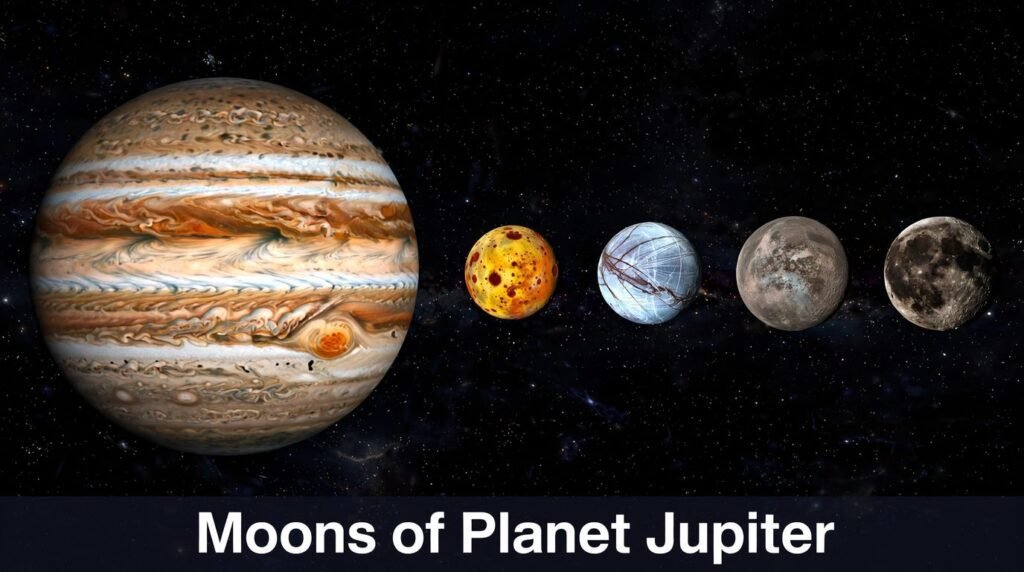
Look up at Jupiter on a clear night and you are looking at far more than a single planet. You are looking at a whole miniature solar system, with a family of moons so large and so varied that astronomers still argue about exactly how to count them. The moons of planet Jupiter range from four giant worlds that could each pass for a planet in their own right to dozens of tiny, distant rocks that were probably captured asteroids.
Together, they tell the story of how Jupiter formed, how its gravity shapes everything around it, and where scientists think life might one day be found. Few subjects show that story as clearly as the moons of planet Jupiter.
If you have ever wondered how many moons Jupiter really has, which ones matter, and whether you can see any of them yourself, this guide answers all of it. We start with the headline number, then work through the four famous Galilean moons one by one, explain the difference between regular and irregular moons, look at the spacecraft that have visited them, and finish with practical advice for spotting them from your own back garden.
The short answer: Jupiter has 95 officially recognised moons in the widely cited count, and that number has grown as new small moons have been confirmed — so you will also see figures of 97 and higher. Four of them dominate everything: Io, Europa, Ganymede and Callisto, the Galilean moons discovered in 1610. Ganymede is the largest moon in the solar system, Europa hides a global ocean under its ice, Io is the most volcanically active body known, and Callisto is one of the most heavily cratered worlds ever seen.
How Many Moons of Planet Jupiter Are There?
The simple answer is 95, and that is the number most textbooks and guides still use. It is also the number in the title of this article, because it was the established, officially recognised count for several years. But if you search for the number today, you may find a different one, and that difference is worth understanding rather than ignoring.
Astronomers count moons in stages. First, a telescope spots a faint moving dot near Jupiter. Then observers track it long enough to work out a stable orbit and confirm that it really circles the planet rather than passing by. Only after that confirmation does the moon receive a permanent designation, and later, in many cases, a proper name.
Two further small moons were announced in 2025, bringing the total with confirmed orbits to 97 at that point. NASA’s Jupiter moons page, updated in 2026, puts the number of officially recognised moons higher still, at 115, reflecting additional confirmed objects. The gap between these figures comes down to what is being counted: confirmed orbits, officially recognised moons, or provisional objects still awaiting full confirmation.
For a reader, the practical point is simple. Jupiter has far more moons than any planet except Saturn, and the exact total keeps creeping upward as telescopes improve. The four Galilean moons hold almost all of the mass in the whole system. Every other moon combined, plus Jupiter’s faint rings, makes up only a tiny fraction of one per cent of the total orbiting mass. So when people talk about the moons of planet Jupiter, they usually mean the big four first, and the dozens of small ones second.
Why Does Jupiter Have So Many Moons?
Jupiter’s huge gravity is the main reason. It is more than twice as massive as all the other planets in the solar system combined, so its gravitational reach extends enormously far into space. Anything that wanders too close can be pulled into orbit, and anything that formed nearby long ago had a good chance of staying.
The big moons of planet Jupiter probably formed in a disc of gas and dust around the young Jupiter, in much the same way that planets formed around the young Sun. That is why the four Galilean moons sit in neat, nearly circular orbits close to Jupiter’s equator. The small moons tell a different story. Most of them orbit far away, on tilted and stretched-out paths, and many travel backwards around the planet. Those are the hallmarks of captured objects: asteroids or fragments of larger bodies that Jupiter’s gravity trapped long after the planet itself had formed.
Jupiter also keeps breaking things apart. Some of the small moon families look like the shattered remains of a single larger moon that was torn apart by an impact or by Jupiter’s tidal forces. Their pieces still travel together in loose groups, sharing similar orbits like debris from the same wreck.
Who Discovered the Moons of Planet Jupiter?
The story begins in January 1610, when Galileo Galilei pointed one of the first telescopes at Jupiter and saw four small points of light in a line beside it. Night after night, the points changed position, and Galileo realised they were circling Jupiter itself. It was the first time anyone had seen objects orbiting something other than the Earth or the Sun, and it struck a direct blow against the old idea that everything in the heavens revolved around the Earth.
Galileo originally called them the Medicean Stars, after his patrons. The names we use today — Io, Europa, Ganymede and Callisto — were suggested by Simon Marius, who had observed them independently around the same time. All four names come from lovers and companions of the god Zeus in Greek myth, the equivalent of the Roman god Jupiter. That naming tradition has continued ever since: new moons of planet Jupiter are named after figures connected to Zeus or Jupiter.
For nearly three centuries, those four were the only moons anyone knew. Then, in 1892, Edward Emerson Barnard found Amalthea, the fifth moon, and the count began to grow.
The twentieth century added more, and the twenty-first century has added them much faster, thanks to large digital cameras on big telescopes that can spot faint objects far from Jupiter. Many of the newest moons are only a kilometre or two across, and some still carry only a provisional label, such as S/2017 J 10, made up of the year of discovery and an order number, while they wait for a proper name.
What Are the Galilean Moons?
The Galilean moons are Io, Europa, Ganymede and Callisto. They are the four largest moons of planet Jupiter, the first four ever discovered, and by far the most interesting. Each one is larger than the dwarf planet Pluto, and Ganymede is larger than the planet Mercury. Together they form a system of their own, locked in a precise orbital rhythm called the Laplace resonance: for every one orbit Ganymede makes around Jupiter, Europa makes two and Io makes four. That gravitational link keeps their orbits stable and, crucially, keeps Io and Europa flexed and heated from within.
You can think of them as four siblings with very different personalities. Io is fiery and restless. Europa is smooth, bright and secretive. Ganymede is huge, ancient and magnetic. Callisto is dark, battered and quiet. The sections below take each one in turn, starting closest to Jupiter and working outward.
Io: The Volcanic Moon
Io is the innermost of the Galilean moons, orbiting Jupiter at a distance of about 421,700 kilometres and completing one lap in just under two Earth days. It is slightly larger than Earth’s Moon, at about 3,643 kilometres across, and it is the most volcanically active body known anywhere in the solar system.
Io’s volcanoes are powered by tidal heating. Jupiter’s enormous gravity squeezes and stretches Io as it orbits, and the neighbouring moons Europa and Ganymede tug on it too. That constant flexing generates heat inside the moon, melting rock and driving eruptions.
Hundreds of volcanoes have been spotted on Io, and some of their plumes rise far above the surface. Lava flows constantly resurface the moon, which is why Io has almost no impact craters: fresh volcanic material buries them almost as fast as they form.
The result is a world of extraordinary colour. Io’s surface is painted in yellows, oranges, reds and greens by sulphur and sulphur compounds, with dark lava flows cutting across bright plains. It looks nothing like the grey, cratered Moon we know from Earth, and nothing like the icy surfaces of its sister moons. It is a reminder that a small world, given the right gravitational push, can stay geologically alive for billions of years.
Europa: The Ocean Moon
Europa is the smallest of the four Galilean moons, about 3,122 kilometres across, and the most exciting for the search for life. Its surface is a shell of water ice, criss-crossed by long red-brown cracks, and smoother than almost any other solid surface in the solar system. There are very few craters, which tells scientists the surface is young and constantly renewed.
Under that ice lies the real prize: a global ocean of liquid water. Evidence gathered by the Galileo spacecraft, which orbited Jupiter from 1995 to 2003, pointed to a salty ocean beneath the ice, kept liquid by the same tidal heating that drives Io’s volcanoes.
Scientists think Europa’s ocean may hold about twice as much water as all of Earth’s oceans combined, although that estimate depends on how deep the ocean is, and its exact depth is still uncertain.
That ocean is why Europa sits at the top of the list of places to look for life beyond Earth. Where there is liquid water, a source of heat and the right chemistry, life as we know it has a chance.
Europa has the water and the heat. The open question is whether it also has the chemistry, and whether anything could survive in a dark ocean sealed under kilometres of ice. Two new missions are heading there to find out more, and we cover them later in this guide.
Ganymede: The Largest Moon in the Solar System
Ganymede is the giant of the group. At about 5,268 kilometres across, it is the largest moon in the entire solar system, bigger than Mercury and nearly as large as Mars. It orbits Jupiter at about 1,070,400 kilometres, taking just over seven Earth days to complete one circuit.
Ganymede is also the only moon known to generate its own magnetic field, a feature it shares with Mercury and Earth but with no other moon. That magnetic field creates its own small magnetosphere inside Jupiter’s much larger one, and it produces auroras near Ganymede’s poles, just as Earth’s magnetic field produces the northern and southern lights.
Its surface is a mixture of two kinds of terrain. Dark, heavily cratered regions record billions of years of impacts, while lighter grooved terrain shows where the icy crust has been stretched and cracked, probably by tectonic activity long ago. Beneath the surface, scientists think Ganymede also holds a salty ocean, sandwiched between layers of ice. It is a colder, deeper and less accessible ocean than Europa’s, but it makes Ganymede a second ocean world in the same system, which is remarkable in itself.
Callisto: The Ancient, Cratered Moon
Callisto is the outermost Galilean moon, orbiting Jupiter at about 1,882,700 kilometres and taking nearly seventeen Earth days to go around once. At about 4,821 kilometres across, it is the second largest of the four, and the third largest moon in the solar system after Ganymede and Saturn’s Titan.
Callisto is the most heavily cratered object known in the solar system. Its dark surface is covered in impact scars, some of them surrounded by bright rings, and it has changed very little over billions of years. Unlike its siblings, Callisto is not locked into the Laplace resonance, so it feels much less tidal heating.
Its interior never warmed enough to fully separate into layers, and its surface never resurfaced the way Europa’s or Io’s did. In that sense, Callisto is a frozen record of the early solar system, a world that has kept its ancient face.
That quiet history makes Callisto valuable in a different way. It is a stable, well-understood world, and scientists have suggested it could one day serve as a base for exploring the rest of the Jupiter system, because it sits outside the worst of Jupiter’s radiation belts. There is also evidence that a salty ocean may exist deep inside Callisto, although it is far harder to confirm than Europa’s, and Callisto is not considered as promising for life.
| Moon | Diameter | Distance from Jupiter | Orbital period | Best known for |
|---|---|---|---|---|
| Io | About 3,643 km | About 421,700 km | About 1.8 days | Volcanoes and tidal heating |
| Europa | About 3,122 km | About 670,900 km | About 3.5 days | Hidden ocean, possible life |
| Ganymede | About 5,268 km | About 1,070,400 km | About 7.2 days | Largest moon, own magnetic field |
| Callisto | About 4,821 km | About 1,882,700 km | About 16.7 days | Ancient, heavily cratered surface |
What Is the Difference Between Regular and Irregular Moons?
Astronomers divide the moons of planet Jupiter into two broad groups: regular and irregular. The distinction is based on how they orbit, and it tells you a great deal about where each moon came from.
- Regular moons orbit close to Jupiter, in the same direction as the planet spins, on nearly circular paths close to Jupiter’s equatorial plane. The four Galilean moons are regular moons, and so are the four small inner moons — Metis, Adrastea, Amalthea and Thebe — which orbit even closer to Jupiter than Io does. Regular moons probably formed around Jupiter itself.
- Irregular moons orbit far away, on tilted, stretched-out paths, and many of them orbit backwards, in the opposite direction to Jupiter’s spin. These are the captured objects. They are small, often only a few kilometres across, and they cluster into families that share similar orbits, suggesting each family came from a single parent body that broke apart.
The irregular moons are further divided into prograde groups, which orbit in the same direction as Jupiter’s spin, and retrograde groups, which orbit backwards.
The largest irregular moon groups are named after their biggest members: the Himalia group, the Carme group, the Ananke group and the Pasiphae group. The names may sound obscure, but each group is a clue to a past collision or capture event, and mapping them helps scientists reconstruct the history of the whole Jupiter system.
How Are the Moons of Planet Jupiter Named and Discovered?
New moons are not named the moment they are spotted. First, astronomers must confirm the orbit, which can take months or even years of follow-up observations. During that time the moon carries a provisional designation that records the year it was found and the order in which it was announced, for example S/2017 J 10.
Once the orbit is confirmed, the International Astronomical Union gives the moon a permanent number, and the discoverers can propose a proper name. The rules are strict: moons of planet Jupiter must be named after lovers, companions or descendants of Zeus, the Greek equivalent of Jupiter. That is why the names sound like a roll call from Greek mythology: Himalia, Elara, Pasiphae, Carme, Ananke, Leda and many more.
Discovery itself has changed beyond recognition since Galileo’s day. Modern surveys use wide-field cameras on large telescopes in Hawaii and Chile, taking repeated images of the sky around Jupiter and using software to spot faint dots that move against the background stars.
The faintest new moons are so dim and so far from Jupiter that confirming them takes patient work, and the count is likely to keep rising as telescopes become more sensitive.
Which Missions Have Visited the Moons of Planet Jupiter?
No spacecraft has ever landed on one of the moons of planet Jupiter, but several have flown past or orbited the system, and two major missions are on their way now.
- Pioneer 10 and 11 flew past Jupiter in the early 1970s and sent back the first close-up images of the planet and its moons.
- Voyager 1 and 2 flew past in 1979 and transformed our understanding of the Galilean moons. Voyager 1 discovered Io’s active volcanoes, and both spacecraft revealed Europa’s cracked ice and the varied surfaces of Ganymede and Callisto.
- Galileo was the first spacecraft to orbit Jupiter, arriving in 1995 and operating until 2003. It studied the planet and its moons in detail for eight years, and its measurements of Europa’s magnetic field provided key evidence for the hidden ocean.
- Juno arrived at Jupiter in 2016 and is still in orbit today. Its main job is to study Jupiter itself, but it has also made close flybys of Ganymede, Europa and Io, sending back striking images and new data about their surfaces and interiors.
- JUICE, the European Space Agency’s Jupiter Icy Moons Explorer, launched in April 2023. It is due to arrive at Jupiter in July 2031, and it will study Ganymede, Callisto and Europa before eventually going into orbit around Ganymede — the first time any spacecraft has orbited a moon other than Earth’s.
- Europa Clipper, NASA’s mission to Europa, launched in October 2024. It is due to enter orbit around Jupiter in April 2030 and will then make 49 close flybys of Europa to study its ice, ocean and chemistry, and to judge whether the moon could support life.
Between them, JUICE and Europa Clipper will give scientists their closest look yet at the icy moons of planet Jupiter, and their findings in the 2030s may finally answer the question of whether Europa’s ocean is habitable.
Could Any of the Moons of Planet Jupiter Host Life?
Europa is the strongest candidate, and it is not close. Its ocean is the key: liquid water, in contact with a rocky seafloor, heated from below, could provide the energy and chemistry that life needs.
Scientists are careful to say that Europa Clipper will look for habitability — the conditions for life — rather than life itself, because the spacecraft cannot drill through the ice or sample the ocean directly.
Ganymede is the second candidate. Its ocean is thought to lie deeper, trapped between layers of ice, which may make it harder for nutrients from the rocky interior to reach the water. Callisto may also hold a deep ocean, but the evidence is weaker and the environment looks less promising.
Io is the least likely of the four to host life. Its surface is far too hot, dry and volcanic, with no liquid water and intense radiation. It is fascinating for geology, but not for biology.
The small irregular moons of planet Jupiter are not considered candidates at all. They are tiny, cold, airless rocks with no internal heat and no liquid water. Their value is scientific, not biological: they record the early history of the solar system.
| Moon | Ocean? | Heat source | Chance of life |
|---|---|---|---|
| Europa | Likely global ocean under ice | Tidal heating | Best candidate in the Jupiter system |
| Ganymede | Likely deep ocean | Tidal and internal heating | Possible, but harder to reach |
| Callisto | Possible deep ocean | Little internal heat | Low, evidence is uncertain |
| Io | No liquid water | Extreme tidal heating | Very unlikely |
How Can You See the Moons of Planet Jupiter from Earth?
You do not need a large telescope to see the moons of planet Jupiter. A pair of steady binoculars, or a small telescope, is enough on a clear, dark night when Jupiter is well placed in the sky. That is the easiest way to meet the moons of planet Jupiter for yourself.
Here is how to try it yourself:
- Find Jupiter first. It is the brightest star-like object in its part of the sky, and it does not twinkle the way stars do. A free stargazing app can point you to it in seconds.
- Use binoculars of at least 7×50 or 10×50 power, held steady against a fence, a wall or a tripod. Even a small telescope at low magnification works well.
- Look for tiny points of light in a straight line on either side of Jupiter. Those are the Galilean moons. On any given night you may see two, three or all four, depending on where each moon sits in its orbit.
- Come back the next night and look again. The moons will have moved, and over a few nights you can watch them swing from one side of Jupiter to the other.
- Try at a time when Jupiter is high in the sky and the Moon is not too bright, because moonlight and haze wash out faint objects.
You will not see surface detail with binoculars — the moons will look like small stars — but simply seeing four worlds orbiting another planet with your own eyes is a remarkable experience.
It is the same sight Galileo saw in 1610, and it still has the power to change how you think about our place in the universe.
One caution: never look at the Sun through binoculars or a telescope, and keep Jupiter away from bright street lights if you can. Dark skies, patience and a steady hand matter far more than expensive equipment.
Why Do the Moons of Planet Jupiter Matter for Astronomy?
The moons of planet Jupiter matter because they are a laboratory for almost every big question in planetary science. They show how moons form, how tides can heat a world from the inside, how oceans can survive far from the Sun, and how life might exist in places we once thought were frozen and dead.
They also matter for history. Galileo’s discovery of the Galilean moons helped overturn the Earth-centred view of the universe and supported the idea that the Earth moves around the Sun. That single observation, made with a telescope barely more powerful than a modern pair of binoculars, changed science forever.
Today, the moons of planet Jupiter are at the centre of the search for life beyond Earth. If Europa’s ocean turns out to be habitable, it would mean that habitable worlds are not rare, and that life could exist in subsurface oceans throughout the solar system and beyond. That is why two spacecraft are travelling to Jupiter right now, and why astronomers keep counting, naming and studying even the smallest and faintest of its moons.
Frequently Asked Questions
How many moons of planet Jupiter are there in 2026?
The widely cited count is 95 officially recognised moons, and that figure is still used in most guides. Two further moons were confirmed in 2025, bringing the total with confirmed orbits to 97, and NASA’s updated Jupiter moons page lists 115 officially recognised moons. The exact number depends on what is counted, and it is likely to rise further as new small moons are confirmed.
What are the four Galilean moons?
The Galilean moons are Io, Europa, Ganymede and Callisto, the four largest moons of Jupiter. They were discovered by Galileo Galilei in 1610 and named after figures from Greek mythology connected to Zeus. They are the only large, spherical moons of planet Jupiter, and they hold almost all of the mass in the entire moon system.
Which is the largest moon of planet Jupiter?
Ganymede is the largest moon of planet Jupiter, and the largest moon in the whole solar system. At about 5,268 kilometres across, it is bigger than the planet Mercury. It is also the only moon known to have its own magnetic field.
Does Europa really have an ocean?
Yes, scientists are confident that Europa has a global ocean of liquid water beneath its icy shell, based on magnetic field measurements from the Galileo spacecraft and observations of its cracked, youthful surface. The ocean is thought to hold about twice as much water as all of Earth’s oceans, although its exact depth is still uncertain.
Is Io the most volcanic world in the solar system?
Yes. Io is the most volcanically active body known, with hundreds of volcanoes driven by tidal heating from Jupiter’s gravity. Its surface is constantly resurfaced by lava flows, which is why it has almost no impact craters despite being billions of years old.
Can I see the moons of planet Jupiter with binoculars?
Yes. The four Galilean moons are visible through steady binoculars or a small telescope as tiny points of light in a line beside Jupiter. You need a clear, dark night and a steady hold, and you will see the moons change position from night to night as they orbit the planet.
Will JUICE and Europa Clipper land on Europa?
No. Neither mission is a lander. JUICE will fly past Europa, Callisto and Ganymede before going into orbit around Ganymede, and Europa Clipper will orbit Jupiter and make 49 close flybys of Europa. Both missions will study the moons from close range, but neither will land on the surface or drill through the ice.
Final Thoughts
The moons of planet Jupiter are far more than a number in a textbook. They are a volcanic world, an ocean world, the largest moon in the solar system and the most cratered world we know, all orbiting a single planet, plus dozens of smaller moons that record the violent history of the early solar system.
The count of 95 is a useful starting point, but the real story is the variety: four giant moons that could each fill a book on their own, and a growing family of small ones that astronomers are still discovering and naming.
If you take one idea away from this guide, let it be this: Jupiter is not just a planet, it is a system.
And with two spacecraft already on their way to its icy moons, the next decade is likely to change what we know about them more than the last four centuries did. Until then, step outside on a clear night, find Jupiter, and look for the four small lights beside it. You will be seeing the same moons Galileo saw, and the same worlds that may one day answer the question of whether we are alone. That is why the moons of planet Jupiter still reward anyone who looks up.
Read Also: Lake Natron: Tanzania’s Red Lake and Flamingo Haven (2026)
