
Contents
- What Is the Diameter of the Earth?
- Why Does Earth Have Two Different Diameters?
- What Is Earth’s Circumference?
- What Is Earth’s Radius?
- What Is the Diameter of the Earth in Miles and Kilometres?
- How Did Eratosthenes Measure Earth?
- How Do Scientists Measure Earth’s Diameter Today?
- How Does Earth Compare to Other Planets?
- What Is the Diameter of the Earth Compared to Other Worlds?
- Diameter, Circumference, Area, and Volume
- What Is the Diameter of the Earth and Why Does It Matter?
- Common Misconceptions About Earth’s Size
- Frequently Asked Questions
- Conclusion
If you stood at one side of Earth and drilled straight through the centre to the other side, how far would you travel? That is another way of asking what is the diameter of the Earth, and it sounds like a simple question, but the answer depends on where you start.
Earth is not a perfect ball. It spins, it bulges, and it is slightly squashed at the top and bottom. That is why scientists do not give just one number for its diameter. They give three: one for the equator, one for the poles, and one average that works for most everyday purposes.
Once you understand those three numbers, the size of our planet suddenly makes a lot more sense. You can picture how it compares to the Moon, to Mars, and to the giant planets. You can also understand why maps stretch, why satellites need exact measurements, and why an ancient Greek scholar could work out the size of Earth more than 2,000 years ago with a stick and a shadow.
The short answer: The mean diameter of the Earth is about 12,742 km (7,918 miles). The equatorial diameter is 12,756 km (7,926 miles), and the polar diameter is 12,714 km (7,900 miles). Earth is wider at the equator because it spins and bulges outward, making it an oblate spheroid rather than a perfect sphere.
What Is the Diameter of the Earth?
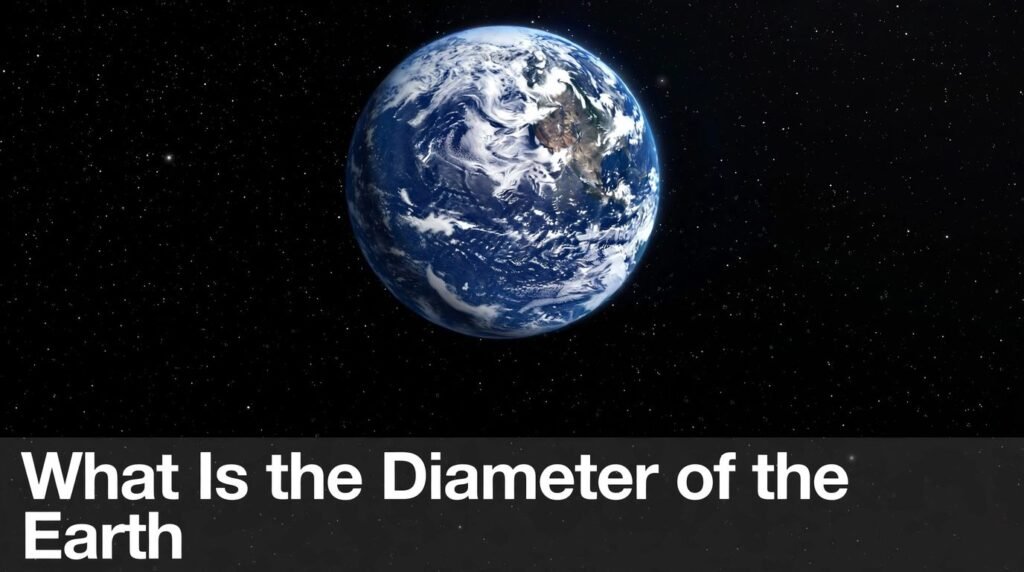
What is the diameter of the Earth? The diameter is the straight-line distance through the centre of Earth from one side to the other. For most people, the number to remember is the mean diameter: 12,742 kilometres, or 7,918 miles.
That figure is an average. It sits between the two real measurements. If you measured across the equator, you would get 12,756 km. If you measured from the North Pole to the South Pole, you would get 12,714 km. The difference is only 42 km, or about 26 miles, which is tiny compared with the size of the planet.
In everyday terms, 12,742 km is hard to picture. It helps to think in journeys. That distance is roughly the same as flying from London to Sydney and back again, with a little extra. It is about 315 times the length of the English Channel crossing from Dover to Calais. If you drove at motorway speed without stopping, it would take you more than five days to cover it.
Scientists often round the figure to 12,742 km because it is useful and accurate enough for general use. Textbooks, space agencies, and astronomy guides use the same three figures, so you will see them again and again. They have not changed much in modern times, because our measurement tools are now extremely precise.
Why Does Earth Have Two Different Diameters?
Earth has two diameters because it is not a perfect sphere. It is an oblate spheroid, which means it is slightly flattened at the poles and slightly wider at the equator.
The reason is rotation. Earth spins once every 24 hours, and that spin creates a force that pushes material outward at the equator. Think of a ball of soft dough spinning on a potter’s wheel. As it spins faster, the middle bulges out and the top and bottom flatten a little. Earth does the same thing, only much more slowly and on a huge scale.
The bulge is small in percentage terms — about 0.3 percent — but it is real and measurable. It affects gravity, sea level, and even where the highest point on Earth is if you measure from the centre rather than from sea level. Mount Chimborazo in Ecuador, for example, is farther from Earth’s centre than Mount Everest, because it sits near the equatorial bulge.
The Equatorial Diameter
The equatorial diameter is 12,756 km (7,926 miles). This is the widest measurement of Earth, taken across the equator.
The equator is the line around the middle of the planet, halfway between the North and South Poles. Because of the spin bulge, this is where Earth is at its widest. Countries on the equator, such as Ecuador, Kenya, and Indonesia, sit slightly farther from Earth’s centre than places near the poles.
The Polar Diameter
The polar diameter is 12,714 km (7,900 miles). This is the distance from the North Pole to the South Pole, straight through the centre.
It is 42 km shorter than the equatorial diameter. That is the flattening effect. If Earth were a perfect sphere, the two numbers would be identical. The fact that they are not tells us a lot about how a spinning planet behaves.
What Is Earth’s Circumference?
Diameter and circumference are linked, but they are not the same thing. The diameter goes straight through the middle. The circumference goes all the way around the outside.
Earth’s equatorial circumference is about 40,075 km (24,901 miles). Its polar circumference — the distance around Earth through the poles — is slightly less, about 40,008 km (24,860 miles).
That difference matters for navigation and for satellite orbits. A satellite in a polar orbit travels a slightly shorter loop than one flying around the equator. Over thousands of orbits, those small differences add up.
For most of us, the circumference is the more familiar number. It is the distance you would travel if you walked all the way around the planet. At a steady walking pace of 5 km per hour, without stopping to eat or sleep, it would take you almost a year to complete the trip. When people ask what is the diameter of the earth, they often start with the circumference.
What Is Earth’s Radius?
The radius is half the diameter. It is the distance from the centre of Earth to the surface.
Earth’s mean radius is about 6,371 km (3,959 miles). The equatorial radius is 6,378 km, and the polar radius is 6,357 km. Again, the equatorial figure is a little larger because of the bulge.
Radius is the number scientists use most in calculations. When they work out Earth’s volume, its mass, its gravity, or the distance to a satellite, they start with the radius. It is also the number you need if you want to understand how deep the layers of Earth are. Doubling it gives what is the diameter of the earth.
To put it in scale, the deepest mine in the world reaches about 4 km down. The deepest ocean trench, the Mariana Trench, is about 11 km deep. Both are tiny scratches compared with a radius of 6,371 km. We have never drilled anywhere near the centre.
What Is the Diameter of the Earth in Miles and Kilometres?
When people ask what is the diameter of the Earth in miles and kilometres, most sources give Earth’s size in both kilometres and miles, because readers use different systems. Here are the key figures together, so you can use whichever is easier for you.
- Mean diameter: 12,742 km / 7,918 miles
- Equatorial diameter: 12,756 km / 7,926 miles
- Polar diameter: 12,714 km / 7,900 miles
- Mean radius: 6,371 km / 3,959 miles
- Equatorial circumference: 40,075 km / 24,901 miles
- Polar circumference: 40,008 km / 24,860 miles
If you only remember one set, remember the mean diameter and the equatorial circumference. Those two numbers appear most often in books, classrooms, and space websites, and they give you a solid sense of scale. When people ask what is the diameter of the earth, those two numbers are the ones to give them.
It is worth noting that older books sometimes give slightly different figures, such as 12,756 km for the diameter without explaining that it is the equatorial figure. That is not a mistake. It is just a different choice of which diameter to quote. Modern sources are clearer because they list all three.
How Did Eratosthenes Measure Earth?
More than 2,200 years ago, a Greek scholar named Eratosthenes worked out what is the diameter of the Earth with remarkable accuracy, long before satellites, telescopes, or modern maps.
Eratosthenes was the head librarian at Alexandria in Egypt. He had heard that at noon on the summer solstice, the Sun shone straight down a well in the city of Syene, far to the south. That meant the Sun was directly overhead there, with no shadow at all.
In Alexandria, at the same time on the same day, the Sun cast a shadow. Eratosthenes measured the angle of that shadow. It was about 7.2 degrees, which is about one fiftieth of a full circle.
He reasoned that if the distance between Syene and Alexandria was one fiftieth of Earth’s circumference, then the full circumference must be fifty times that distance. He estimated the distance between the two cities at about 5,000 stadia, an ancient Greek unit. Multiplying by fifty gave him a circumference of about 250,000 stadia.
Converted to modern units, his result was somewhere between 39,000 and 46,000 km, depending on which length of stadion he used. The most commonly quoted version puts him within a few percent of the true value. For a measurement made with a stick, a shadow, and a long walk, that is an astonishing achievement.
Eratosthenes also proved something else. His method only worked if Earth was round. If Earth were flat, the Sun’s rays would hit both cities at the same angle. The difference in shadows showed that the surface was curved.
How Do Scientists Measure Earth’s Diameter Today?
Today we do not need shadows and long walks. We use satellites, lasers, and global positioning systems that can measure Earth’s shape to within millimetres. When people ask what is the diameter of the earth today, scientists can answer with that precision.
The main method is satellite geodesy. Satellites in orbit send signals to receivers on the ground, and by timing those signals, scientists can work out exact positions. The Global Positioning System, or GPS, works on the same idea. Your phone uses it to find your location. Scientists use a much more precise version to map the shape of the whole planet.
Another method is satellite laser ranging. A laser is fired from a ground station at a satellite fitted with reflectors. By timing how long the light takes to return, scientists can measure the distance with great accuracy. Repeating this over years shows not only Earth’s size but also how it changes slowly over time, as ice melts, land rises, and tectonic plates move.
Gravity measurements also help. Satellites such as GRACE and GOCE mapped Earth’s gravity field in detail. Because gravity depends on mass and distance from the centre, those maps reveal where Earth bulges, where it dips, and where the crust is thicker or thinner.
Together, these tools give us a model of Earth called the geoid. It is not a simple sphere. It is a lumpy, slightly squashed shape that follows sea level if there were no winds, tides, or currents. The diameter figures we use are averages drawn from that model.
How Does Earth Compare to Other Planets?
Earth is the largest of the rocky planets in our Solar System, but it is small compared with the gas giants. The comparison puts our home in perspective. Knowing what is the diameter of the earth makes that comparison clearer.
Mercury, the smallest planet, is only about 4,879 km across. Mars is about 6,779 km across, a little more than half Earth’s size. Venus is the closest in size to Earth, at about 12,104 km across, which is why it is often called Earth’s sister planet.
Then the scale jumps. Jupiter, the largest planet, is about 139,820 km across — almost eleven times wider than Earth. Saturn is about 116,460 km across. Even Uranus and Neptune, the smallest gas giants, are about four times wider than Earth.
The Moon is much smaller. Its diameter is about 3,474 km, which is about a quarter of Earth’s diameter. That is why the Moon looks small in the sky, even though it is our closest neighbour in space.
What Is the Diameter of the Earth Compared to the Moon and Mars?
The size difference shapes everything else. Earth has enough gravity to hold a thick atmosphere. Mars, being smaller, lost most of its atmosphere long ago. The Moon, smaller still, has almost no atmosphere at all.
Earth’s size also helps it keep its oceans and its magnetic field. The magnetic field comes from the movement of molten iron in Earth’s outer core, and that core is large because Earth itself is large. Without it, the solar wind would strip away our atmosphere, as it did on Mars.
What Is the Diameter of the Earth Compared to Other Worlds?
A table makes the comparison easier to see at a glance. The figures below are mean diameters, rounded to the nearest kilometre.
| Body | Mean Diameter (km) | Compared to Earth |
|---|---|---|
| Mercury | 4,879 | 0.38 times Earth |
| Venus | 12,104 | 0.95 times Earth |
| Earth | 12,742 | 1.00 times Earth |
| Moon | 3,474 | 0.27 times Earth |
| Mars | 6,779 | 0.53 times Earth |
| Jupiter | 139,820 | 10.97 times Earth |
| Saturn | 116,460 | 9.14 times Earth |
| Uranus | 50,724 | 3.98 times Earth |
| Neptune | 49,244 | 3.86 times Earth |
| Sun | 1,392,700 | 109.3 times Earth |
Look at the last row. The Sun is more than a hundred times wider than Earth. You could fit about 1.3 million Earths inside the Sun by volume. That is a useful reminder: Earth feels huge to us, but in the Solar System it is a medium-sized rocky world.
Diameter, Circumference, Area, and Volume
Diameter is only one way to describe Earth’s size. Scientists also talk about its surface area and its volume, because those numbers tell us how much land and ocean there is, and how much material Earth contains.
| Measurement | Value |
|---|---|
| Mean diameter | 12,742 km |
| Equatorial circumference | 40,075 km |
| Surface area | About 510 million square km |
| Volume | About 1.08 trillion cubic km |
| Mass | About 5.97 x 10^24 kg |
The surface area is about 510 million square kilometres. About 71 percent of that is ocean, and about 29 percent is land. That means most of Earth’s surface is water, even though we live on the land part.
The volume is about 1.08 trillion cubic kilometres. That is the amount of space Earth takes up. Most of that volume is in the mantle, the thick layer of hot rock between the crust and the core. The crust we live on is only a thin skin by comparison.
What Is the Diameter of the Earth and Why Does It Matter?
What is the diameter of the Earth, and why does it matter? The diameter might seem like a piece of trivia, but it matters in practical ways. It affects navigation, spaceflight, climate, and even timekeeping.
First, navigation depends on it. Maps, flight paths, and shipping routes all assume a certain size and shape for Earth. If the diameter were wrong by even a small amount, GPS positions would drift, and long-distance flights would miss their destinations.
Second, satellites depend on it. A satellite’s orbit is calculated from Earth’s centre. If you get the radius wrong, you get the orbit wrong. That is why space agencies measure Earth’s shape so carefully, down to the centimetre.
Third, Earth’s size affects its gravity and its climate. A larger planet would have stronger gravity and would hold its atmosphere more tightly. A smaller planet would lose heat faster and cool down sooner. Earth’s size is part of why it has stayed warm enough for liquid water and life for billions of years.
Finally, the diameter matters for astronomy. When scientists study other planets, they compare them to Earth. A planet that is 1.5 times Earth’s diameter might be rocky or might be a mini-Neptune, depending on its mass. Earth is the baseline. Everything else is measured against it. That is why astronomers use Earth as the baseline when people ask what is the diameter of the earth.
Common Misconceptions About Earth’s Size
A few misunderstandings come up often, so it is worth clearing them up. Many of them begin with what is the diameter of the earth, so the exact figures matter.
One common idea is that Earth is a perfect sphere. It is close, but not exact. The equatorial bulge is small, but it is real. If you made a model of Earth to scale, you would barely notice the bulge with your eyes, but instruments can measure it easily.
Another idea is that Mount Everest is the farthest point from Earth’s centre. It is the highest point above sea level, but not the farthest from the centre. Because of the equatorial bulge, Mount Chimborazo in Ecuador is about 2 km farther from the centre, even though it is shorter above sea level.
A third idea is that the diameter and the circumference are interchangeable. They are not. The diameter is the straight line through the centre. The circumference is the distance around the outside. You can work one out from the other if you know that Earth is roughly circular in cross-section, but they describe different things.
Frequently Asked Questions
What is the diameter of the Earth in kilometres?
The mean diameter of Earth is about 12,742 km. The equatorial diameter is 12,756 km, and the polar diameter is 12,714 km.
What is the diameter of the Earth in miles?
The mean diameter is about 7,918 miles. The equatorial diameter is 7,926 miles, and the polar diameter is 7,900 miles.
Why is Earth’s equatorial diameter larger than its polar diameter?
Earth spins, and the spin pushes material outward at the equator. This creates a bulge that makes the equatorial diameter about 42 km larger than the polar diameter.
What is Earth’s circumference?
Earth’s equatorial circumference is about 40,075 km (24,901 miles). Its polar circumference is about 40,008 km (24,860 miles).
What is Earth’s radius?
Earth’s mean radius is about 6,371 km (3,959 miles). The equatorial radius is 6,378 km, and the polar radius is 6,357 km.
How did scientists first measure Earth’s size?
Eratosthenes measured it in ancient Greece by comparing shadows in two cities on the same day. His result was remarkably close to the modern value. Today scientists use satellites, GPS, and laser ranging. That was an early answer to what is the diameter of the earth, made long before satellites existed.
Is Earth bigger than Mars?
Yes. Earth is about 12,742 km across, while Mars is about 6,779 km across. Earth is almost twice as wide as Mars and has about six times its volume.
Conclusion
So, what is the diameter of the Earth? Earth’s diameter is about 12,742 km on average, 12,756 km at the equator, and 12,714 km from pole to pole. The small difference between those numbers tells a bigger story: Earth is a spinning, slightly squashed world, not a perfect ball. When people ask what is the diameter of the earth, the answer they usually want is the mean figure, 12,742 km.
That shape was worked out long ago by Eratosthenes with a shadow, and it is now measured to the millimetre by satellites. It shapes our maps, our flights, our climate, and our place in the Solar System. The next time you look at a globe, remember that the slight bulge around the middle is real, and it is the reason we need three numbers instead of one. It is also why, when people ask what is the diameter of the earth, the answer is not a single round number.
Read Also: NASA Name Spelling: Full Form and How to Write It
1 Comment