
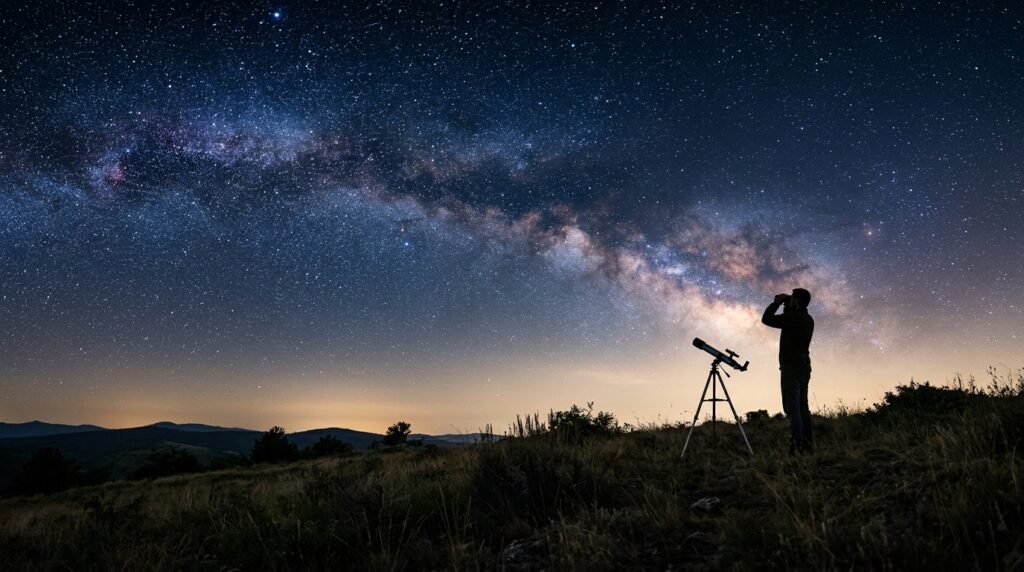
I still remember the first night the sky properly got me. I was nineteen, standing in a friend’s back garden, when someone pointed up and said, “That fuzzy patch? That’s the Andromeda Galaxy. You’re looking at two and a half million years into the past.” I laughed. Then I looked through his battered old telescope, and there it was. I did not sleep much that night. I just kept going back outside.
That is what astronomy does to people. It starts as curiosity and quietly turns into a habit. This guide is the starting point I wish someone had handed me back then. No physics degree, no expensive gear, just clear explanations and honest advice from someone who made every beginner mistake so you do not have to.
What Is Astronomy, Really?
At its simplest, Astronomy101 is the study of everything beyond Earth. Stars, planets, moons, comets, galaxies, black holes, the whole lot. It is one of the oldest sciences in history. Long before telescopes, farmers watched the sky to plan crops and sailors used stars to cross oceans. When you learn astronomy, you join a very long line of curious humans.
The beginner version of Astronomy101 is wonderfully simple. You go outside at night, you look up, and you learn what you are seeing. That is genuinely most of it. The fancy equipment comes later. Some of my most joyful stargazing has involved nothing but my eyes and a reclining garden chair.
One quick clarification, because people mix these up constantly. Astronomy101 is a science based on observation and evidence. Astrology is the belief that the positions of stars and planets influence human personality and daily life. They share some history and some vocabulary, but they are completely different things. This guide is about the science.
Why Start Stargazing Now?
There has never been a better time to be a beginner. Twenty years ago, learning the sky meant buying paper star charts and squinting at them with a red torch. Today your phone can identify any star you point it at in seconds. Beginner telescopes are better and cheaper than they have ever been. And dark sky reserves around the world now protect their night skies specifically so visitors can experience them.
But the deeper reason is personal. Stargazing slows you down in a way almost nothing else does. You cannot rush it. I have had stressful weeks completely reset by a single clear night with my binoculars. Psychologists call this feeling awe, and research links it to lower stress and a greater sense of wellbeing. The night sky is one of the cheapest sources of awe on the planet, and it is free every clear night.
You Do Not Need a Telescope Yet
This is the advice I give every beginner, and it is the opposite of what most shops will tell you. Do not buy a telescope first.
Most beginners who buy too early end up frustrated. They spend good money, point at something random, see a blurry smudge, and shelve it for a year. The telescope was never the problem. They had not learned the sky first. A telescope magnifies your view, but it also magnifies your confusion.
Start with your naked eyes. Spend a few weeks learning the brightest stars and constellations. Then, when you are ready for your first piece of equipment, buy binoculars, not a telescope. This is one of my strongest opinions in all of beginner astronomy. A decent pair of 10×50 binoculars costs a fraction of a telescope, needs zero setup, and will show you the moons of Jupiter, the craters of the Moon, star clusters like the Pleiades, and even some bright galaxies. I still use my binoculars on most clear nights, years into this hobby. They are the most underrated tool in astronomy.
When you do eventually buy a telescope, you will buy the right one, because by then you will know what you actually enjoy looking at. That is worth more than any sales assistant’s advice.
Learn the Sky in Small Pieces
The biggest mistake beginners make is trying to learn the whole sky at once. The night sky holds 88 official constellations and thousands of visible stars. Trying to memorize all of that in one night is like trying to learn a new city by studying the entire map in one sitting. You will just feel lost.
Instead, learn one small piece at a time. Start with a single easy constellation. In the northern hemisphere, the Big Dipper is the classic starting point. It looks like a giant saucepan, and the two stars at the front point straight to Polaris, the North Star. Once you can find it, you have an anchor, and the rest of the sky starts to make sense around it.
My method is the “one constellation per week” rule. Each clear night, find your one constellation until you can spot it instantly. The next week, add a neighboring one. Within two months you will know a dozen, and the sky will start to feel like yours.
Get a free stargazing app to help. Stellarium, SkySafari, and SkyView label everything you point your phone at. Switch on night mode, which turns the screen red. Your eyes need twenty minutes to adapt to the dark, and one blast of white light resets the clock. I learned that the hard way.
The Moon and Planets: Your First Real Targets
Once you know a few constellations, it is time for the showpieces. The Moon is the single best beginner target in the sky. It is big, bright, impossible to miss, and packed with detail. With the naked eye you can see the dark lunar maria, ancient lava plains. With binoculars, the craters along the terminator, the line between lunar day and night, look three dimensional.
Here is a tip most beginners never hear. The full Moon is the worst time to observe it, because direct sunlight washes out the shadows and everything looks flat. The best views come a few days before or after full Moon, when long shadows make the craters pop.
After the Moon, try the planets. Venus is often the brightest “star” in the evening sky, so bright people mistake it for an airplane. Mars glows orange-red. Jupiter is bright and steady, and even basic binoculars will show up to four tiny points of light in a line beside it. Those are the Galilean moons, discovered by Galileo in 1610. When I first saw them, I gasped. Other worlds, visible with your own eyes.
Saturn is the crown jewel. Through even a small telescope its rings are unmistakable. It does not look real. I have shown Saturn to dozens of people, and the reaction is always the same. Silence, then “wow.”
A Few Big Ideas, Explained Simply
Astronomy101 has a reputation for being full of impossible concepts, but most of the big ideas are simpler than they sound.
A light year is not a measure of time. It is the distance light travels in one year, about 9.5 trillion kilometers. Saying a star is four light years away tells you something intuitive. Its light left four years ago. When you look at the Andromeda Galaxy, you are seeing light that left two and a half million years ago.
Stars twinkle, but planets do not, and the reason is our atmosphere. Starlight gets bent by turbulent air, making stars flicker. Planets appear as tiny discs, so the flicker averages out and they shine steadily. Watch a bright object for a few seconds. Steady glow means planet. Flickering means star.
Light pollution is why most people have never seen the Milky Way. The stars are still there, just drowned out by wasted light shining upward. Astronomers measure sky darkness with the Bortle scale, from 1 for pristine dark sky to 9 for inner city. Drive an hour out of town and the difference will honestly shock you.
Common Beginner Mistakes (and How to Dodge Them)
I have made all of these, so you do not have to. First, buying too much telescope too soon, which we already covered. Start with eyes, then binoculars, then a telescope you actually understand.
Second, observing from the worst possible spot. Your instinct is to stand under the nearest streetlight. Do the opposite. Find the darkest spot you can, even just the shadow side of your house. Every bit of direct light costs you faint stars.
Third, giving up after ten minutes. Your eyes need twenty to thirty minutes to fully adapt. The sky gets better the longer you stay out. Bring a chair and a warm drink, and keep expectations low for the first half hour.
Fourth, comparing your view to photographs. Long exposure photos show galaxies in swirling color. Through a telescope, most are faint gray smudges. That sounds disappointing until you realize that smudge is the combined light of a hundred billion stars, and its photons traveled millions of years to reach your eye. Adjust your expectations and the hobby becomes ten times more rewarding.
Taking Your First Night Sky Photos
You do not need a fancy camera to start astrophotography. Modern phones are shockingly capable at night. I have taken Milky Way shots on a phone that made friends assume I owned thousands of pounds of camera gear.
The basics are simple. Find the darkest sky you can and prop your phone up so it is perfectly still. A small tripod helps, but a bag of rice on a wall works too. Switch to night mode, set the longest exposure, focus on a bright star, and use a timer so your finger does not shake the phone. Your first attempts might be blurry. Mine were terrible. But within a few sessions you will have a genuine Milky Way photo taken with the thing in your pocket.
For the Moon, it is even easier. Tap to focus and drag the exposure down so it is not a blown out white disc. The craters will surprise you.
Conclusion
Astronomy is one of the rare hobbies that asks almost nothing of you and gives back enormously. You do not need money, you do not need qualifications, and you do not even need equipment to begin. You need a clear night, a little patience, and the willingness to look up. Start with your eyes, learn one constellation at a time, graduate to binoculars when you are ready, and let the big questions find you naturally. The sky has been waiting for you for a very long time. Tonight could be the night you finally look back.
Frequently Asked Questions
Do I need a telescope to start astronomy?
No. Your eyes are enough to begin, and binoculars are the best first purchase when you are ready. Buy a telescope only after you have learned the basics of the sky, so you know what you actually want to look at.
What is the easiest constellation to find?
In the northern hemisphere, the Big Dipper is the classic starting point because it is bright and shaped like a saucepan. Its two front stars point directly to Polaris, the North Star. In the southern hemisphere, the Southern Cross plays the same role.
Why do stars twinkle but planets do not?
Stars are points of light that Earth’s atmosphere makes flicker. Planets are tiny discs, so the flicker averages out and they shine steadily.
What is a light year?
A light year is a unit of distance, not time. It is the distance light travels in one year, about 9.5 trillion kilometers. When you see a star four light years away, you are seeing light that left it four years ago.
Can I see the Milky Way with the naked eye?
Yes, but you need a dark sky. From a rural location, the Milky Way appears as a cloudy band of light across the sky. Summer offers the best views in the northern hemisphere.
When is the best time to go stargazing?
Clear, moonless nights away from city lights are best. The days around the new Moon are ideal. Give your eyes at least twenty minutes to adapt.