
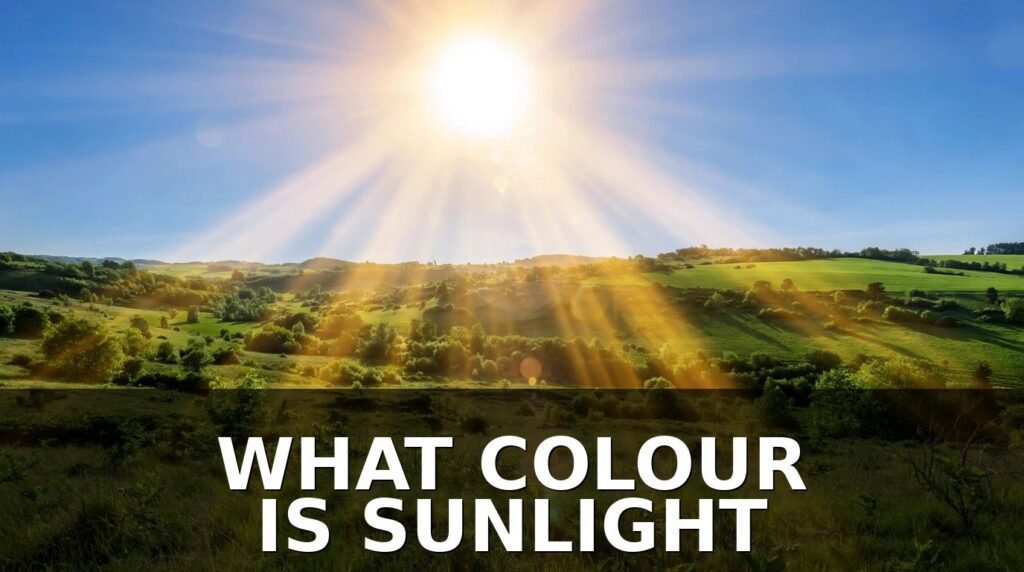
If you asked a room full of adults what colour is sunlight, most of them would say yellow without thinking twice. Children draw the Sun as a yellow circle, weather apps use a yellow Sun icon, and on a bright afternoon the disc in the sky does look pale yellow.
It turns out the obvious answer is wrong. Sunlight is white — genuinely white, the colour you get when every colour of visible light is mixed together in roughly equal amounts. The yellow we see is something Earth adds on the way. Our atmosphere steals some of the blue light out of the beam before it reaches our eyes, and what is left over looks yellow. Take the atmosphere away, and the trick disappears.
Asking what colour is sunlight is a good way to test how much you trust your eyes. From the ground, the Sun often looks yellow, yet photographs taken from space show a white disc, and the difference is entirely down to air. When you ask what colour is sunlight, the honest answer is the colour you get when all the colours in the spectrum arrive together, which is white. Knowing what colour is sunlight really is also helps you understand sunsets, blue skies, and why the Sun can look orange on a dusty day.
The short answer: Sunlight is white. The Sun gives off all the colours of visible light mixed together, and that mixture looks white to the human eye. It only appears yellow from the ground because Earth’s atmosphere scatters blue light away from the direct beam. From space, where there is no air to interfere, the Sun is a brilliant white disc.
Why We All Think Sunlight Is Yellow
The yellow Sun is one of the first things most of us learn to draw. A child picks up a yellow crayon for the Sun and a blue one for the sky, and nobody corrects them, because the picture matches what they see. That early habit sticks, and by adulthood the yellow Sun feels like common sense rather than something worth questioning.
Everyday experience keeps reinforcing it. Step outside on a clear morning and the disc in the sky has a warm, pale-yellow tint. Even the language gives it away: we talk about “golden hour” light and “sunny yellow” paint. The colour has become part of how we imagine daylight itself.
Our brains also adjust for the light around us without us noticing, so the world looks normally coloured at midday even though the light itself is slightly warm — while the Sun, as the source of the light, keeps its yellow tint.
What Sunlight Really Is: All the Colours at Once
The simplest way to see the true nature of sunlight is with a prism. Isaac Newton showed this in the 1660s, and it still works the same way today: shine a beam of sunlight through a triangular piece of glass and it spreads out into a rainbow — red, orange, yellow, green, blue, indigo and violet. A rainbow in the sky does the same job on a grander scale, splitting sunlight into its separate colours with raindrops instead of glass.
That spread of colours is called a spectrum, and it is the key to the whole question. Sunlight is not one colour. It contains the entire range of visible light, from violet at the short-wavelength end to red at the long-wavelength end. When all of those colours reach your eye at the same time, your visual system does not pick one of them. It blends them, and the result of blending every colour together is white.
The Physics: A 5,778-Degree Surface That Glows White
To understand why the Sun’s light comes out white, it helps to know how hot the Sun’s visible surface is. The photosphere — the glowing layer we actually see — has an effective temperature of about 5,778 Kelvin, roughly 5,505 degrees Celsius. At that temperature, matter glows, and the colour of the glow depends on the temperature.
Physicists describe glowing objects with a simple model called a blackbody. A blackbody at the Sun’s temperature puts out light across a broad range of wavelengths, with its brightest output — its peak — at a wavelength of about 500 nanometres, in the blue-green part of the spectrum. That detail surprises people. If the Sun shines brightest in blue-green light, why does it not look blue-green?
The answer is that the peak is only part of the story. The Sun’s spectrum is very broad: it emits plenty of red, orange, yellow, green, blue and violet as well. The curve rises to a peak near green and falls away gently on both sides, but there is substantial light at every visible wavelength. Your eye does not respond to the peak alone. It adds up the whole spectrum, and the sum of that broad mixture is white.
Why the Atmosphere Turns the Sun Yellow
The change happens in the roughly 100 kilometres of air between space and your eyes. Earth’s atmosphere is mostly nitrogen and oxygen, and the molecules of those gases are far smaller than the wavelengths of visible light. When sunlight passes through them, the light gets scattered — bounced off in different directions — and the scattering is not equal for all colours.
This is Rayleigh scattering, named after the physicist Lord Rayleigh, who worked out the maths in the 19th century. Its key rule is simple: shorter wavelengths scatter much more strongly than longer ones. The strength of the scattering is inversely proportional to the fourth power of the wavelength, which means blue light, at around 450 nanometres, is scattered roughly five to six times more strongly than red light at around 650 nanometres.
That one rule explains two things at once. First, it explains why the sky is blue. Blue light from the Sun gets scattered in every direction by air molecules, so it reaches your eyes from all parts of the sky, not just from the direction of the Sun. The whole dome overhead glows blue because it is full of scattered blue light.
Second, it explains why the Sun looks yellow. The direct beam of sunlight — the light that travels in a straight line from the Sun to your eye — has lost a chunk of its blue and violet on the way. Those short wavelengths were scattered sideways out of the beam and into the sky. What remains in the beam is depleted in blue and weighted toward the longer wavelengths: yellow, orange and red. Your eye reads that depleted mixture as pale yellow.
Why Sunsets Are Red and Noon Sunlight Is White
Watch the Sun from midday to evening and you can see Rayleigh scattering working in real time. The Sun starts the day high and nearly white, slides into pale yellow in the afternoon, turns gold, then orange, and finally sinks as a deep red disc. The light itself has not changed. The path it takes through the air has.
When the Sun is low on the horizon, its light has to travel sideways through far more atmosphere than it does at noon — many times more air. Along that long journey, more and more of the blue and green light is scattered away. By the time the beam reaches you, almost all that is left is the red and orange light that scatters least. The Sun looks red for the same reason it looks yellow at noon, only much more so.
Dust, smoke and pollution in the air add to the effect. Larger particles scatter light differently from tiny air molecules — a process called Mie scattering — and they are especially good at removing the remaining middle wavelengths. That is why sunsets after a volcanic eruption, a wildfire, or a dusty day can be unusually vivid, with deep crimson and purple skies. The same physics is behind the strange, dimmed Sun sometimes seen during heavy wildfire smoke, when the disc can look orange or even blood-red at midday.
So the colour of the Sun in the sky is really a measurement of how much air its light has crossed. Short path, white. Medium path, yellow. Long path, red. The Sun itself never changes colour at all.
What Colour Is Sunlight from Space?
The cleanest test of the Sun’s real colour is to remove the atmosphere entirely — and astronauts have done exactly that. From the International Space Station, from the Moon, and from spacecraft far from Earth, the Sun is a blazing white disc. There is no yellow tint to correct in photographs taken above the atmosphere, because the atmosphere is what creates the tint in the first place.
The Apollo astronauts saw it most starkly. Standing on the Moon, they worked under a black sky in full daylight, because with no atmosphere there was nothing to scatter sunlight into a blue dome. The Sun above them was white and fiercely bright, and the shadows it cast were pitch black, with none of the soft, blue-tinged fill light that the sky provides on Earth. Photographs from the lunar surface show a white Sun in a black sky — a scene that looks wrong to anyone raised on blue-sky daylight, but it is the honest picture.
This is also why the sky is black on the Moon during the day: no air means no scattering, which means no blue sky and no yellow Sun.
Why Astronomers Still Call the Sun a “Yellow Dwarf”
If the Sun is white, why do astronomers classify it as a G2V star — a “yellow dwarf”? The answer is history, and it is worth clearing up because the label is used everywhere.
The classification system for stars was built in the late 19th and early 20th centuries, before anyone had photographed the Sun from space. Astronomers sorted stars by the patterns in their spectra — the dark lines where particular elements absorb light — and assigned letters to the groups. The Sun’s spectrum put it in class G, and the stars in that class were described as yellow, partly because of how they looked through the telescopes and photographic plates of the time, and partly because the Sun itself looks yellow from the ground.
The “dwarf” part is separate. It refers to the star’s size and luminosity class: the Sun is a main-sequence star of ordinary size, as opposed to a giant or supergiant. “Yellow dwarf” is therefore a historical label for a class of star, not a description of what the Sun looks like to the eye. Modern astronomers know perfectly well that a G-type star seen without an atmosphere looks white.
What Colour Is Sunlight Through the Day?
It does — but only from our point of view on the ground. The light leaving the Sun stays the same. What changes is how much atmosphere it crosses and how much dust and moisture are in the air.
| Time or condition | What the Sun looks like | Why |
|---|---|---|
| Noon, clear sky | Almost white, faint warm tint | Shortest path through the air, least blue removed |
| Morning or late afternoon | Pale yellow to gold | Longer path, more blue scattered away |
| Sunrise and sunset | Orange to deep red | Longest path, nearly all blue and green removed |
| After wildfires or volcanic eruptions | Deep red, sometimes dimmed | Extra particles scatter away even more light |
| High altitude, clear air | Whiter than at sea level | Less air above you to scatter the blue |
| From space or the Moon | Pure white | No atmosphere at all |
A Quick Safety Note
One thing never changes, whatever colour the Sun appears: it is dangerous to look at directly. The Sun’s light is intense enough to damage the retina, and the damage can happen without pain, because the retina has no pain receptors. This applies at noon, at sunset, and during a solar eclipse, when the temptation to look is strongest. Ordinary sunglasses do not make it safe. Only certified eclipse glasses or proper solar filters do, and they should be used exactly as instructed.
Frequently Asked Questions
What colour is sunlight, really?
Sunlight is white. It contains all the colours of visible light mixed together, and that mixture looks white to the human eye. It only appears yellow from Earth because the atmosphere scatters blue light out of the direct beam before it reaches us.
Why does the Sun look yellow from Earth?
Because of Rayleigh scattering. Air molecules scatter short blue and violet wavelengths far more strongly than longer yellow and red ones. The scattered blue light fills the sky — which is why the sky looks blue — and the direct sunlight left over, with some blue removed, looks yellow.
What colour is the Sun from space?
White. Astronauts on the International Space Station and on the Moon see a brilliant white Sun against a black sky. There is no atmosphere in space to scatter blue light away, so the Sun shows its true colour.
Why are sunsets red?
At sunset the Sun is low, so its light travels through much more atmosphere to reach your eyes. Along that long path, almost all the blue and green light is scattered away, leaving mostly red and orange. Dust, smoke and pollution can make sunsets even redder.
Why is the Sun called a yellow dwarf if it is white?
“Yellow dwarf” is a historical classification, not a description of the Sun’s appearance. Astronomers class the Sun as a G2V star, and G-type stars were labelled yellow when the system was created, partly because the Sun looks yellow from the ground. The name describes its temperature class and size, not its true colour.
Is sunlight white at noon?
Almost. At noon on a clear day the Sun is high, so its light takes the shortest path through the atmosphere and loses the least blue. It looks close to white, with only a faint warm tint. It never looks as purely white as it does from space, because some air is always in the way.
Final Thoughts
Sunlight is white. That is the simple answer, and it is worth holding on to, because almost everything else about the Sun’s colour is a story about Earth rather than about the Sun. The yellow disc of the afternoon, the gold of late evening, the red of sunset — all of these are made by our atmosphere, which strips blue light out of the beam a little at a time as the Sun sinks lower. Take the air away, and the performance stops.
From the Moon, or from orbit, the Sun is a white disc in a black sky, and the sky itself is black for the same reason the Sun is white: there is nothing up there to scatter the light.
For everyday living tips, home ideas and practical guides, DailyOrvix is a handy place to browse.
Read Also: Planets That Are Terrestrial: What Makes a Rocky World