
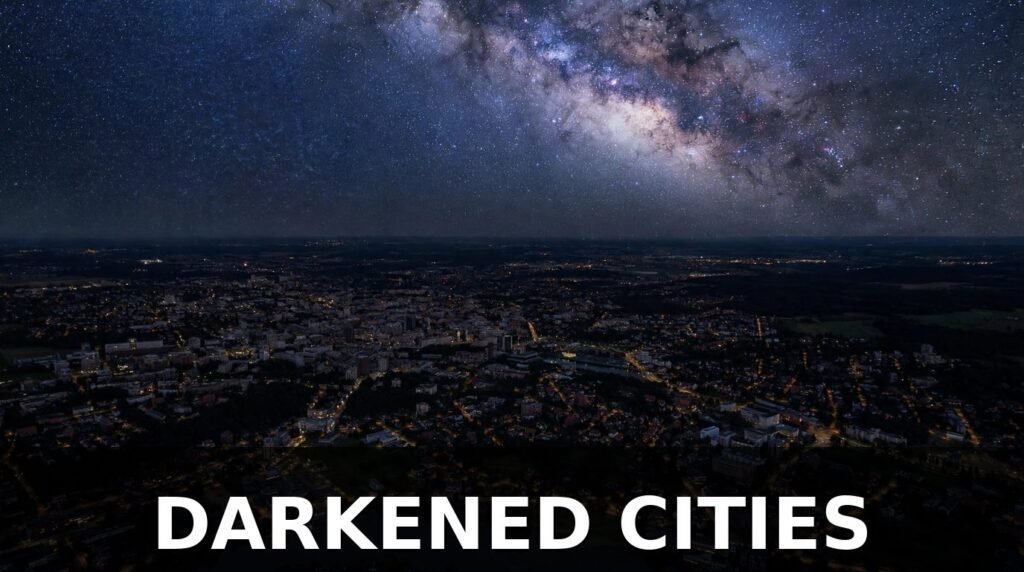
Imagine standing in the middle of a city at night and looking up to find the Milky Way stretched across the sky. For most city dwellers, that sounds impossible. The glow of streetlights, billboards, office windows and car headlights washes out all but the brightest stars, and on many nights you would be lucky to spot a dozen of them.
Now imagine the same city with its lights switched off. The change is instant and dramatic. Faint stars appear one by one, then constellations, then the pale band of our own galaxy.
Darkened cities are not a single thing. Some go dark on purpose, when a town dims its streetlights to protect the stars or joins an event like Earth Hour. Some go dark by accident, when a blackout cuts the power and satellites overhead watch a glowing metropolis vanish from the map. And some go dark because nature steps in, when a total solar eclipse turns day into twilight for a few minutes and streetlights flicker on in confusion.
This article explains why cities darken, what happens to the sky when they do, and which places have made darkness a permanent part of how they live.
The short answer: A darkened city is a city whose lights are reduced or switched off, deliberately or by accident. When that happens, the artificial glow that hides the stars fades and the night sky returns. Some cities dim their lights every night to protect the stars, others do it for a single evening, and a few go dark without warning when the power fails.
What Does “Darkened Cities” Mean?
The phrase “darkened cities” can mean a few different things, and it helps to separate them, because the reason a city goes dark changes what happens next.
The first meaning is the deliberate one. A city or town decides to reduce its light on purpose. It might replace bright streetlights with dimmer, shielded ones, switch lights off after midnight, or ask residents and businesses to turn off unnecessary lighting for one evening. The goal is usually the same: to let the stars show again, to save energy, or to protect wildlife that depends on real darkness.
The second meaning is accidental. A blackout knocks out the power grid, and a whole city goes dark at once. From space, satellites can see it happen in real time. A bright patch on the night map of the Earth simply disappears. For the people below, it is usually an inconvenience or an emergency. For astronomers, it is an accidental experiment in what the sky looks like without the city.
The third meaning is natural. During a total solar eclipse, the Moon blocks the Sun and daylight fades to a strange twilight in the middle of the day. Birds go quiet, streetlights switch themselves on, and for a few minutes a city experiences something close to night. It is not the same as switching the lights off, but it shows how quickly darkness changes a place.
All three share one thing in common. A city is only bright at night because we make it bright. Take the light away, and the sky that was always there comes back.
Why Can’t We See Stars From Cities?
To understand why a darkened city looks so different, it helps to know why an ordinary lit city hides the stars in the first place.
The problem has a name: skyglow. When a streetlight, a lit billboard or an office window sends light upward or sideways instead of down onto the road, some of that light hits tiny particles and droplets in the air. Each hit scatters the light in a new direction, including back down toward the ground. Millions of these scattering events, from every light in the city, add up to a dull orange or grey glow that covers the whole sky.
A bright star can still beat that glow. Sirius, the brightest star in the night sky, is visible from most cities. But a faint star sends only a tiny amount of light to your eye, and once the background glow is brighter than that star, the star simply disappears. It is still there. Your eyes just cannot pick it out against the lit-up sky.
The scale of the problem is large. A world atlas of artificial night sky brightness published by Fabio Falchi and colleagues in 2016 found that about 83 percent of the world’s population lives under light-polluted skies, and that the Milky Way is hidden from more than one-third of humanity. In the United States and Europe, the share of people living under light-polluted skies is above 99 percent.
It is also getting worse. A study published in the journal Science in 2023, led by Christopher Kyba, analysed more than 50,000 naked-eye observations of star visibility sent in by citizen scientists through the Globe at Night programme. It found that sky brightness rose by about 9.6 percent per year between 2011 and 2022. At that rate, a child born in a place where 250 stars were visible would see only about 100 by the time they turned 18.
That is why a darkened city feels so startling. The stars have not moved. The sky behind them has simply gone dark enough to let them through.
How Dark Is Dark? The Bortle Scale
Astronomers and stargazers measure sky darkness with a simple tool called the Bortle scale. It was published by amateur astronomer John E. Bortle in 2001, and it runs from Class 1, the darkest skies on Earth, to Class 9, the severely light-polluted sky of an inner city.
Under a Class 1 sky, the naked eye can reach stars as faint as magnitude 7.6 to 8.0, and the Milky Way is so bright and detailed that it can cast a faint shadow. Under a Class 9 inner-city sky, the naked eye reaches only about magnitude 4.0, which means only the brightest few dozen stars are visible at all.
The Milky Way disappears completely once the sky reaches about Class 7. Most large cities sit at Class 8 or 9. A darkened city, even for one night, can drop several classes at once, which is why people who live through a blackout often report seeing stars they had never noticed before.
Here is how the scale breaks down in plain terms:
| Bortle class | Sky | What you can see |
|---|---|---|
| 1 | Excellent dark sky | Milky Way highly detailed, thousands of stars |
| 2–3 | Rural sky | Milky Way bright and structured |
| 4–5 | Suburban sky | Milky Way visible but washed out |
| 6–7 | Bright suburban / urban sky | Milky Way faint or invisible |
| 8–9 | Inner-city sky | Only the brightest stars and planets |
You do not need a telescope to notice the difference. Moving from Class 9 to Class 5 roughly doubles or triples the number of stars you can see with your eyes alone, and the Milky Way goes from invisible to plainly visible.
Cities That Dim Their Lights on Purpose
Some cities have decided that darkness is worth protecting every night, not just during a special event. Their stories show what a darkened city looks like when the change is permanent.
Tucson, Arizona: Less Light, Better Light
Tucson is one of the best-known examples. The city sits close to several major observatories, and astronomy contributes a large share of the local economy, so protecting the night sky is a practical decision as well as a romantic one.
In 2016 and 2017, Tucson converted its municipal street lighting to LEDs. That sounds like a small technical change, but the way it was done mattered. The old lights were high-pressure sodium lamps that were already fully shielded, so they sent no light directly upward. The problem was sheer volume: there was simply too much light.
The new 3000K white LED lights were less bright than the ones they replaced, and the city cut total light output by almost 63 percent while keeping illumination above the minimum levels needed for safety. On top of that, Tucson introduced an overnight dimming programme. At midnight, most streetlights dim from 90 percent to 60 percent of their full power.
The result was measurable from space and from the ground. Satellite observations showed a 7 percent reduction in upward-directed light from the city, and at remote observatory sites nearby, night sky brightness decreased by as much as 20 percent. Tucson did not go dark. It got darker on purpose, and the stars got brighter.
Flagstaff, Arizona: The First Dark Sky City
Flagstaff was designated the world’s first International Dark Sky Community in 2001, and it earned the title the hard way. The city has controlled its outdoor lighting with local ordinances for decades, limiting unshielded lights and requiring fixtures that point downward instead of outward.
The rules work. Despite growing to a city of tens of thousands of people, Flagstaff has kept its skies at around Bortle Class 5, far darker than most cities its size. The Milky Way is still visible from parts of town, and the Lowell Observatory, where Pluto was discovered in 1930, still operates within the city limits.
When a City Goes Dark for One Night
Not every darkened city stays dark. Some go dark for a single evening, and the effect is just as striking.
The best-known example is Earth Hour, the annual event run by the World Wide Fund for Nature. On one evening each March, landmarks, businesses and households around the world switch off non-essential lights for an hour. Famous buildings go dark, city skylines change shape, and for sixty minutes the sky above participating cities is measurably darker.
Earth Hour is symbolic rather than a solution to light pollution. One hour of darkness does not fix a sky that is bright the other 364 nights of the year. But it does something useful: it shows people, in a single evening, what their city would look like with less light.
Astronomy events create darkened cities too. When a meteor shower peaks, or a bright comet appears, towns near dark-sky parks sometimes dim their lights for the night so visitors can see the show. And during a total solar eclipse, the darkness arrives on its own schedule, no switch required.
When a City Goes Dark by Accident
A blackout is the most dramatic way a city darkens, and it is the one nobody plans for. When the power grid fails, streetlights, signs, homes and offices all go out together, and the change is visible from orbit.
Satellite images taken before and during major blackouts show the effect clearly. A city that appears as a bright blob on a night map of the Earth suddenly shrinks to a faint smudge, or vanishes entirely. The dark patch left behind is the shape of the power cut.
For the people on the ground, a blackout is usually a problem to solve, not a stargazing opportunity. But many people who have lived through one remember the sky. Without the city glow, the stars come out in numbers that surprise people who have lived in the same place for years.
Blackouts also show how fast the sky recovers. Skyglow does not linger. The moment the lights go out, the scattered light in the atmosphere fades, and the sky darkens within minutes. Light pollution is almost unique among forms of pollution in that respect: stop producing it, and it disappears almost instantly.
Dark Sky Places: Where Darkness Is Protected
Beyond individual cities, a global network of protected places keeps the night sky dark by law and by habit. DarkSky International, the non-profit that certifies them, listed 277 International Dark Sky Places worldwide as of November 2026, with 165 of them in the United States.
The designations come in several types, and the difference between them is worth knowing:
| Designation | What it is | Examples |
|---|---|---|
| Dark Sky Park | A park or natural area with exceptional starry skies | Great Basin National Park, Joshua Tree National Park |
| Dark Sky Reserve | A larger area with a dark core and protected surroundings | Aoraki Mackenzie, New Zealand; Greater Big Bend, USA–Mexico |
| Dark Sky Community | A town or city that controls its lighting | Flagstaff, Arizona |
| Dark Sky Sanctuary | A remote, exceptionally dark place | Cosmic Campground, New Mexico |
| Urban Night Sky Place | A dark-sky site inside or near a city | Sites that bring stars to city dwellers |
Some of these places are enormous. The Aoraki Mackenzie International Dark Sky Reserve in New Zealand covers more than 4,000 square kilometres and is one of the largest gold-tier reserves in the world. The Greater Big Bend International Dark Sky Reserve, which straddles the border between the United States and Mexico, spans roughly 9 million acres and is the largest protected dark-sky area on Earth. It is also home to the McDonald Observatory in Texas.
Utah holds more certified Dark Sky Places than any other American state, with 27 as of November 2026. That is no accident. The state’s high desert, dry air and sparse population make it one of the best places in the country to see the stars, and local communities have worked hard to keep it that way.
What Darkness Does for Wildlife and People
A darkened city is not only about stargazing. Darkness is part of the natural world, and many living things depend on it.
Migrating birds are the most famous example. Many species navigate by the stars, and bright city lights can pull them off course. Insects are drawn to lights in huge numbers, which disrupts the food chain for the animals that eat them. Sea turtle hatchlings, which find the ocean by heading toward the brightest horizon, can crawl toward streetlights instead of the sea.
People are affected too. Our bodies run on a daily rhythm set by light and darkness, and bright light late at night can disturb sleep. None of this means cities should go dark entirely. It means the light we do use should be aimed carefully, used only where it is needed, and switched off or dimmed when it is not.
There is also a simpler argument. The night sky is part of our shared heritage. For most of human history, everyone could see the Milky Way. Today, most people in developed countries have never seen it. A darkened city gives that experience back, at least for a night.
How to Experience a Darkened City Sky
You do not need expensive equipment to see what a darkened city reveals. A little planning goes a long way.
Pick a moonless night. Even the Moon is bright enough to wash out faint stars, so the darkest skies come in the week around the new moon. Check a moon calendar before you go.
Get away from the glow. You do not need to drive for hours. Even moving from a city centre to a suburb, or to a park on the edge of town, can drop the sky by a Bortle class or two. The further you get from the brightest lights, the more stars appear.
Let your eyes adapt. Your eyes need about 20 to 30 minutes in darkness to reach their full sensitivity. Avoid looking at your phone screen, and if you need light, use a dim red torch, which affects night vision less than white light.
Start with the easy targets. The Moon, the bright planets and the most famous constellations are the easiest things to find. Once your eyes adapt, look for the Milky Way as a pale, cloudy band stretching across the sky.
Visit a Dark Sky Place. If you want the full experience, plan a trip to one of the certified Dark Sky Parks or Reserves. Many run public astronomy programmes in the summer, and rangers can point out objects you would never find on your own.
What the Future Holds for Darkened Cities
The trend in sky brightness is still going in the wrong direction. More lights, brighter lights and the spread of cheap LEDs mean that the average city sky gets brighter every year. But the tools to reverse that trend already exist, and more cities are using them.
Shielded fixtures that point light downward are now standard in many places. Warmer-coloured LEDs scatter less than blue-rich ones. Smart streetlights that dim late at night are becoming common.
The most encouraging sign is that the fix is fast and cheap compared with other environmental problems. A city that changes its streetlights can see its sky darken within months, and the effect is visible the first night the new lights switch on. Tucson proved it. Flagstaff proved it decades earlier. Vienna is proving it now.
The question is not whether cities can go dark. It is whether they want to.
Frequently Asked Questions
What is a darkened city?
A darkened city is a city whose lights are reduced or switched off, either deliberately or by accident. Deliberate examples include cities that dim their streetlights to protect the night sky, towns that take part in Earth Hour, and communities that switch lights off during bird migration. Accidental examples include blackouts, when a power cut darkens a whole city at once.
Why do cities dim their lights?
Cities dim their lights to reduce light pollution, save energy, protect wildlife and improve the view of the night sky. Dimming late at night, when fewer people are out, cuts wasted light without making streets unsafe. Some cities also dim lights to protect nearby observatories, whose telescopes need dark skies to work properly.
Can you see stars in a city after the lights go out?
Yes, and the change is fast. When the lights go out, skyglow fades within minutes and faint stars appear. During blackouts, people in cities often report seeing far more stars than usual, including constellations they had never noticed. The Milky Way can become visible if the sky is dark enough and the Moon is down.
What is skyglow?
Skyglow is the brightening of the night sky over populated areas, caused by artificial light scattered in the atmosphere. Light from streetlights, signs and windows hits particles in the air and is scattered in all directions, including back down to the ground. The result is a dull glow that hides faint stars. Skyglow is the most visible form of light pollution.
Which city was the first Dark Sky City?
Flagstaff, Arizona was designated the world’s first International Dark Sky Community in 2001. The city has controlled its outdoor lighting with local ordinances for decades, and its skies remain far darker than most cities of its size. The Lowell Observatory, where Pluto was discovered in 1930, still operates within the city.
How many International Dark Sky Places are there?
DarkSky International listed 277 International Dark Sky Places worldwide as of November 2026, with 165 of them in the United States. They include Dark Sky Parks, Reserves, Communities, Sanctuaries and Urban Night Sky Places. Utah has the most of any American state, with 27.
What is the Bortle scale?
The Bortle scale is a nine-level scale for measuring how dark the night sky is, published by John E. Bortle in 2001. Class 1 is the darkest sky on Earth, where the Milky Way is bright enough to cast a faint shadow. Class 9 is the severely light-polluted sky of an inner city, where only the brightest stars are visible.
Final Thoughts
Darkened cities tell a simple story. The night sky never went away. We covered it up with our own light, and whenever we take that light away, the stars come back.
Some cities darken by choice, dimming their streetlights and shielding their lamps so that the Milky Way is visible again. Some darken for an hour, as a reminder of what we have lost. And some darken by accident, when the power fails and people look up in surprise at a sky they had forgotten.
The encouraging part is how quickly it happens. Light pollution clears within minutes of the lights going out, and a city that changes its lighting can see its sky improve within months. Tucson, Flagstaff and Vienna have all shown that a city can stay safe, busy and bright where it matters, and still keep its stars.
If you have never seen a truly dark sky, find one. Wait for a moonless night, get away from the brightest lights, give your eyes half an hour to adapt, and look up. The sky above a darkened city is the same sky your grandparents saw every night. It is still there, waiting for the lights to go down.
For everyday living tips, home ideas and practical guides, DailyOrvix is a handy place to browse.
Read Also: Planets That Are Terrestrial: What Makes a Rocky World