
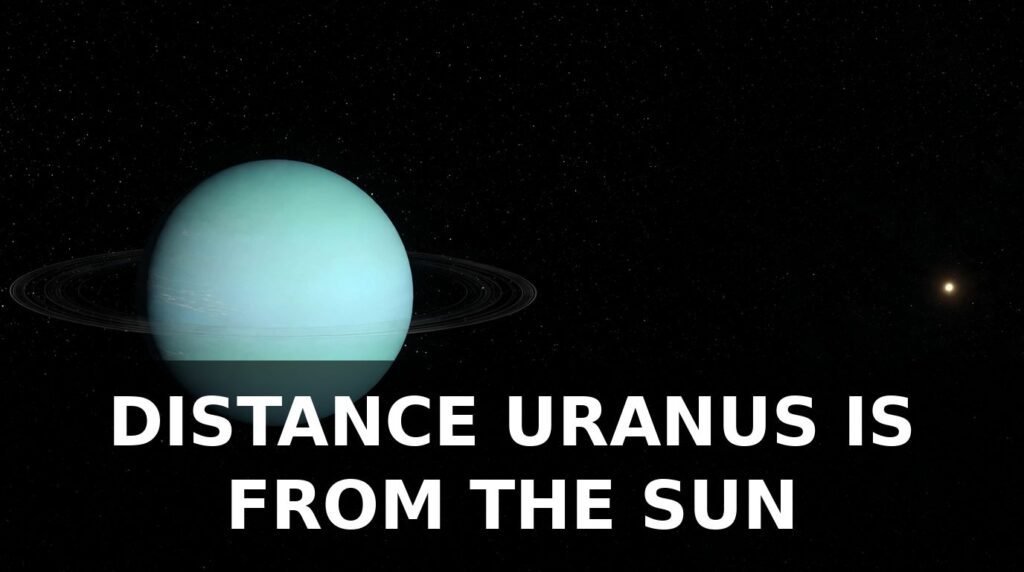
The distance Uranus is from the Sun is about 19.2 astronomical units. That works out to roughly 2.87 billion kilometres, or around 1.78 billion miles. It is the seventh planet out from the Sun, and the gap between it and our star is so large that sunlight needs about two hours and forty minutes just to get there.
That number is hard to picture, so this guide puts it in terms that make sense: how it compares with Earth and the other planets, how much it changes as Uranus moves around its orbit, and what that vast gap means for temperature, light, and seasons.
The distance Uranus is from the Sun also explains why the planet looks so faint from Earth. At that range, sunlight is about 370 times weaker than on Earth, so Uranus receives only a small fraction of the energy that warms our planet. The distance Uranus is from the Sun also means that any signal or spacecraft takes years to make the trip, which is why only Voyager 2 has ever visited. Remembering the distance Uranus is from the Sun helps to explain its cold, dim appearance, its slow 84-year orbit, and why astronomers need large telescopes to study it in detail.
How Far Is Uranus From the Sun?
The short answer is 19.2 AU on average. Astronomers call that figure the semi-major axis of the orbit, and the precise value is 19.19126 AU, or 2.870972 billion kilometres. Most sources round it to 19.2 AU or 2.87 billion kilometres, and that is the number worth remembering.
Here are the key figures in one place:
| Measurement | Value |
|---|---|
| Average distance (semi-major axis) | 19.19 AU / 2.87 billion km |
| Closest approach to the Sun (perihelion) | 18.29 AU / 2.74 billion km |
| Farthest point from the Sun (aphelion) | 20.10 AU / 3.01 billion km |
| Distance in miles (average) | About 1.78 billion miles |
| Orbital period | 84.02 Earth years |
| Time for sunlight to reach Uranus | About 2 hours 40 minutes |
One thing worth noting is that there is no single fixed distance. Uranus does not travel in a perfect circle. Its orbit is slightly squashed, an ellipse, so the planet drifts closer to the Sun at one end of its path and farther away at the other. The gap between its closest and farthest points is about 1.8 AU — roughly 270 million kilometres — larger than the swing of any other planet, though still smaller than that of the dwarf planet Pluto.
What Is an Astronomical Unit, and Why Do Astronomers Use It?
Kilometres work fine for distances on Earth, but they get clumsy fast once you leave our neighbourhood. Saying Uranus is 2,870,972,000 kilometres away is technically correct and almost useless as a mental picture. The astronomical unit solves that problem by giving astronomers a yardstick that fits the solar system.
One AU is the average distance from Earth to the Sun, about 149.6 million kilometres (roughly 93 million miles). So saying Uranus is 19.2 AU away really means it is about nineteen times farther from the Sun than Earth is.
Uranus is almost exactly twice as far from the Sun as Saturn, and about three and a half times farther than Jupiter.
Perihelion and Aphelion: Why the Distance Keeps Changing
Uranus reaches its closest point to the Sun, perihelion, at about 18.29 AU, or 2.74 billion kilometres. Its farthest point, aphelion, is about 20.10 AU, or 3.01 billion kilometres. The next perihelion is expected around 17–19 August 2050, which tells you something about the pace of things out there: Uranus only visits each end of its orbit once every 84 years.
The reason the distance changes at all is orbital eccentricity. A perfectly circular orbit would have an eccentricity of zero, and the distance would never vary. Uranus has an eccentricity of 0.04717 — small, but at nearly 3 billion kilometres, even a small percentage change adds up to hundreds of millions of kilometres. Earth’s eccentricity is only about 0.0167, so our distance from the Sun varies by just 5 million kilometres over the year.
That swing changes the sunlight Uranus receives by roughly 20 percent, but since the planet gets only about one 370th of Earth’s sunlight to begin with, the difference is small. Its seasons are driven far more by its extreme tilt than by its distance from the Sun at any given moment.
How Long Does Sunlight Take to Reach Uranus?
Light travels at about 300,000 kilometres per second, but the solar system is big enough that even light needs real time to cross it. Sunlight reaches Earth in about eight minutes and twenty seconds. It reaches Uranus in about two hours and forty minutes.
That delay is more than a curiosity. It means astronomers looking at Uranus see it as it was nearly three hours ago, and when NASA sent commands to Voyager 2 during its 1986 flyby, every instruction took close to three hours to arrive. Operating a spacecraft that far away is less like driving a car and more like sending letters: you plan carefully, send your message, and wait.
The same delay would apply to anything we send there in the future. A Uranus orbiter mission, ranked as a top priority in the 2023–2032 Planetary Science Decadal Survey, would face the same long round trip for every command — one of the practical reasons missions to the outer planets are so expensive and so carefully planned.
How Uranus Compares With the Other Planets
A list of distances puts Uranus in context better than any single number. Here is how far each planet sits from the Sun on average:
| Planet | Average distance from the Sun | Orbital period |
|---|---|---|
| Mercury | 0.39 AU / 58 million km | 88 days |
| Venus | 0.72 AU / 108 million km | 225 days |
| Earth | 1.00 AU / 150 million km | 1 year |
| Mars | 1.52 AU / 228 million km | 1.9 years |
| Jupiter | 5.20 AU / 779 million km | 11.9 years |
| Saturn | 9.58 AU / 1.43 billion km | 29.4 years |
| Uranus | 19.19 AU / 2.87 billion km | 84.0 years |
| Neptune | 30.07 AU / 4.50 billion km | 164.8 years |
A few things stand out from that table. The gaps between planets grow as you move outward: Mercury and Venus are separated by about 50 million kilometres, while Uranus and Neptune are separated by about 1.6 billion. And distance and orbital period go together — the farther a planet is, the slower it moves and the longer its year lasts. Uranus takes 84 Earth years to complete a single orbit.
Uranus is also worth comparing with its near-twin, Neptune. The two are often called the ice giants, and they are similar in size and composition. But Neptune is half as far again from the Sun as Uranus, at about 30 AU, and its year lasts nearly 165 Earth years.
What the Distance Means for Temperature and Light
Distance from the Sun decides how much energy a planet receives, and Uranus receives very little. Sunlight follows the inverse square law: double the distance and you get a quarter of the light; go nineteen times farther and you get about one 370th. Standing on Uranus, the Sun would look like a bright star rather than the blazing disc we see from Earth — still the brightest thing in the sky by far, but giving almost no warmth.
The temperature numbers tell the story. At the level where atmospheric pressure equals sea level on Earth, Uranus averages about 76 Kelvin, or minus 197 degrees Celsius. The coldest temperature ever measured in its atmosphere is 49 Kelvin — minus 224 degrees Celsius — the lowest minimum temperature recorded on any planet in the solar system.
Part of the reason Uranus is so cold is that it gives off very little heat of its own. Jupiter, Saturn, and Neptune all radiate noticeably more energy than they receive from the Sun, thanks to heat left over from their formation. Uranus radiates almost none, and scientists still do not fully understand why. One leading idea is that a giant collision early in its history — the same impact that may have knocked the planet onto its side — stirred up its interior and let much of its internal heat escape long ago.
The low light also shapes what we can see. Uranus looks pale and almost featureless in most images because its atmosphere is calm and its cloud tops sit under a thick layer of haze. The blue-green colour comes from methane in the upper atmosphere, which absorbs red light and reflects blue and green wavelengths back into space.
The Sideways Planet: Distance, Tilt, and 42-Year Seasons
Uranus is famous for rolling around the Sun on its side. Its axial tilt is about 82 degrees relative to its orbital plane (often quoted as 98 degrees when its retrograde rotation is taken into account), compared with Earth’s modest 23.5 degrees. As Uranus travels around the Sun, each of its poles takes turns pointing almost directly at it.
Because a Uranian year lasts 84 Earth years, each pole gets about 42 years of continuous sunlight followed by 42 years of continuous darkness. At the solstices, one pole faces the Sun while the other faces away into the dark. At the equinoxes, the Sun shines on the equator and the planet rolls around it like a barrel. When Voyager 2 flew past in 1986, the south pole faced the Sun; Hubble has since watched the seasons slowly shift, with the equinox passing in 2007.
How Do We Know How Far Away Uranus Is?
Nobody has ever stretched a tape measure to Uranus, so the distance comes from careful measurement and calculation, built up over more than two centuries.
The story starts with discovery. Uranus was the first planet found with a telescope, spotted by William Herschel on 13 March 1781. Herschel first thought he had found a comet, but as astronomers tracked the object night after night, its slow, steady motion showed it was a planet orbiting far beyond Saturn. Early estimates of its orbit came from those position measurements: watch where a planet appears against the background stars over months and years, and the shape of its orbit gradually reveals itself.
Modern measurements are far more precise: telescopes track Uranus to tiny fractions of a degree, Voyager 2’s 1986 flyby pinned down its position and mass, and Kepler’s laws tie the orbital period directly to the size of the orbit.
The numbers quoted in this guide come from those measurements. The semi-major axis of 19.19126 AU, the perihelion of 18.2861 AU, and the aphelion of 20.0965 AU are the standard values used by NASA and in current reference works. Different sources round them slightly differently, which is why you will sometimes see 19.2 AU, 19.22 AU, or “roughly 20 AU” in older material.
How Long Would It Take to Travel There?
Voyager 2 remains the only spacecraft ever to visit Uranus. Launched in 1977, it used a rare alignment of the outer planets — one that happens only about every 175 years — to swing past Jupiter, Saturn, and then Uranus, arriving on 24 January 1986. That is roughly eight and a half years of travel, and it was the fast route: gravity assists from Jupiter and Saturn gave the spacecraft a huge push it could never have managed on its own. During the flyby, Voyager 2 passed within about 81,500 kilometres of the cloud tops, discovered ten new moons, found two new rings, and measured the planet’s oddly tilted magnetic field.
A future mission would face the same problem: getting there takes the better part of a decade, which is why no second mission has flown yet.
Does the Distance Change Over Time?
On human timescales, no. The orbit of Uranus is stable, and the figures in this guide will still be correct decades from now. Over millions of years, the gravitational pull of Jupiter, Saturn, and Neptune causes small, slow changes in the orbits of all the planets, but these are tiny effects.
There is one more subtlety worth mentioning. Because Uranus and Earth both move, the distance between the two planets changes constantly. When Uranus is on the same side of the Sun as Earth, the gap between them is about 18.2 AU; on the opposite side, it grows to about 20.2 AU. That is the number that matters for planning a telescope observation or a spacecraft launch.
Can You See Uranus From Earth?
Yes, just barely. Uranus is visible to the naked eye under a truly dark sky, but it is very dim and moves so slowly against the background stars that for centuries nobody realised it was a planet. Herschel’s telescope was what made the difference: magnification showed a small disc rather than a point of light, which is the giveaway that an object is a planet and not a star.
With binoculars or a small telescope, Uranus is much easier to find, appearing as a tiny pale blue-green disc. It looks small partly because it is far away and partly because it is genuinely smaller than Jupiter and Saturn: about 25,362 kilometres in radius, roughly four times wider than Earth.
Conclusion
The distance Uranus is from the Sun is about 19.2 AU, or 2.87 billion kilometres. It drifts between roughly 18.3 AU at its closest and 20.1 AU at its farthest, sunlight takes about two hours and forty minutes to cross the gap, and a single orbit takes 84 Earth years. That distance is why Uranus is so cold, so dim, and so little visited — and it is also what makes the planet worth studying.
Frequently Asked Questions
How far is Uranus from the Sun in kilometres?
Uranus is about 2.87 billion kilometres from the Sun on average. Its closest point is about 2.74 billion kilometres and its farthest point is about 3.01 billion kilometres, so the exact figure depends on where the planet is in its 84-year orbit.
How far is Uranus from the Sun in miles?
On average, Uranus is about 1.78 billion miles from the Sun — roughly 19.2 times the distance between Earth and the Sun.
How long does it take sunlight to reach Uranus?
Sunlight takes about 2 hours and 40 minutes to travel from the Sun to Uranus. By comparison, sunlight reaches Earth in about 8 minutes and 20 seconds, so the trip to Uranus takes about twenty times longer.
How many Earth years is one year on Uranus?
One year on Uranus — a single orbit around the Sun — lasts 84.02 Earth years, or about 30,688 Earth days. Each of its seasons lasts around 21 Earth years.
Is Uranus farther from the Sun than Saturn?
Yes. Uranus is about twice as far from the Sun as Saturn, which orbits at an average of 9.58 AU against Uranus’s 19.19 AU. Only Neptune, at about 30 AU, is farther out.
What is the coldest temperature on Uranus?
The coldest temperature measured in Uranus’s atmosphere is 49 Kelvin, or minus 224 degrees Celsius. That is the lowest minimum temperature recorded on any planet in the solar system, and it is a direct result of how little sunlight reaches a planet nearly 3 billion kilometres from the Sun.
For everyday living tips, home ideas and practical guides, DailyOrvix is a handy place to browse.
Read Also: Little Dipper Dipper: Finding the Little Dipper in the Night Sky