
Why Understanding the Solar System Matters
I remember the first time I really looked up at the night sky and thought about what I was actually seeing. I was about nine years old, standing in my backyard with my grandfather, and he pointed out Mars. He told me that what we were looking at was a planet, just like Earth, but completely different from our home. That moment sparked something in me that never went away. It made me wonder about how everything up there worked together, how planets stayed in their places, and what held this massive system of ours together.
Understanding how the solar system works isn’t just about memorizing facts for a science test. It’s about grasping one of the most fundamental aspects of our existence. We live inside this system, on a small planet called Earth, orbiting a star we call the Sun. Everything we see in the night sky, every constellation, every planet, and every twinkling star tells a story about physics, space, and time. When you understand how the solar system operates, you’re essentially understanding the forces that have shaped human history, influenced our calendars, and created the very conditions that allowed life to exist on our planet.
The solar system is often described as a cosmic machine, and like any machine, it follows specific rules and principles. These principles weren’t invented by humans; they’re fundamental laws of physics that have been working the same way for billions of years. By learning about these laws and how they apply to our planetary neighborhood, we gain insights into not just space, but into how the universe itself functions.
The Center of Everything: Our Sun
The Sun isn’t just important to the solar system; it’s literally the foundation upon which the entire system is built. When we talk about the solar system, we’re talking about the Sun and everything that orbits around it. The Sun is what gives the solar system its name, its structure, and its energy.
Our Sun is a star, which means it’s a massive ball of hot gas that produces energy through nuclear fusion. Every single second, the Sun converts about 620 million tons of hydrogen into helium, and in doing so, it releases enormous amounts of energy. This energy travels to Earth in about eight minutes and twenty seconds, and it’s what makes life possible on our planet. Without the Sun, there would be no light, no heat, no photosynthesis, and ultimately, no life as we know it.
In terms of size, the Sun is absolutely enormous. It accounts for about 99.86 percent of all the mass in the entire solar system. If you were to compare the Sun to Earth, it would be roughly 109 times wider. Imagine packing about 1.3 million Earths inside the Sun. That’s how big it is. Despite its incredible size, the Sun is actually considered a medium-sized star compared to some of the monsters out there in space.
The Sun’s composition is primarily hydrogen and helium, with trace amounts of heavier elements. The heat at its core reaches about 27 million degrees Fahrenheit. The surface, called the photosphere, is still an incredible 10,000 degrees Fahrenheit. This extreme temperature is what allows the Sun to maintain the nuclear fusion process that keeps it shining and providing energy to everything in the solar system.
What fascinates me most about the Sun is that it’s not static. It has an atmosphere called the corona, it produces solar flares and coronal mass ejections, and it actually rotates. The Sun rotates once every 25 to 35 days, depending on the latitude. It’s a dynamic, living object that’s constantly changing and affecting everything around it.
How Gravity Makes Everything Work
If the Sun is the foundation of the solar system, then gravity is the mechanism that makes everything function. Gravity is the force that holds the solar system together. Without gravity, there would be no orbits, no planets staying in their paths, and no system at all.
Gravity is a force of attraction between objects with mass. Every object in the universe, from the smallest pebble on Earth to the largest planet, exerts a gravitational pull on every other object. The greater the mass of an object, the stronger its gravitational pull. The Sun, being the most massive object in the solar system, has the strongest gravitational pull, which is why everything orbits around it.
Sir Isaac Newton figured out the mathematical relationship behind gravity, and it’s elegant in its simplicity. The gravitational force between two objects increases when their masses increase and decreases when the distance between them increases. This is why the Sun’s gravity affects close planets more strongly than distant ones. Mercury, being closest to the Sun, experiences a much stronger gravitational pull than Neptune, which is much farther away.
The way gravity works in the solar system creates a delicate balance. Each planet isn’t being pulled straight into the Sun because it’s also moving sideways through space. Imagine throwing a ball straight ahead while you’re falling. The ball would follow a curved path, not straight down or straight forward. That’s essentially what planets do. They’re constantly falling toward the Sun because of gravity, but their sideways motion curves that fall into an elliptical orbit.
Johannes Kepler discovered that planets don’t orbit in perfect circles; they orbit in ellipses. This means sometimes a planet is closer to the Sun, and sometimes it’s farther away. When a planet is closest to the Sun, we call that point perihelion. When it’s farthest, we call it aphelion. These variations in distance affect how fast a planet moves. When closer to the Sun, planets move faster because the Sun’s gravitational pull is stronger. When farther away, they move slower.
I find it remarkable that this balance has continued for about 4.6 billion years. The same gravitational forces that keep planets in orbit today have been keeping them in orbit since the solar system formed. It’s a testament to the stability and predictability of physics at the scale of our cosmic neighborhood.
The Eight Planets: An Overview
Our solar system contains eight planets, and they’re divided into two main categories based on their characteristics. These planets have fascinating differences and similarities, and learning about each one helps us understand the diversity and complexity of our solar system.
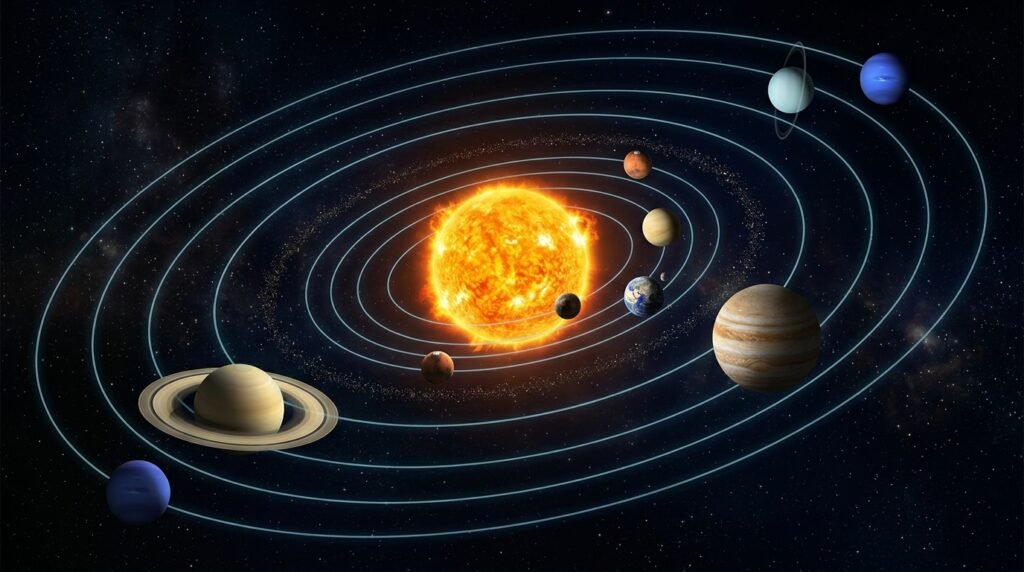
The eight planets are Mercury, Venus, Earth, Mars, Jupiter, Saturn, Uranus, and Neptune. They’re arranged in order from closest to the Sun to farthest. Some people remember this order with a mnemonic device, though I’ve always found it easier to just think about the characteristics that divide them.
The first four planets, Mercury through Mars, are called the terrestrial or inner planets. These are relatively small, rocky worlds with solid surfaces where you could theoretically stand. They’re closer to the Sun, and they all have atmospheres of varying densities, though some are quite thin.
The last four planets, Jupiter through Neptune, are called the gas giants or outer planets, though technically Jupiter and Saturn are gas giants while Uranus and Neptune are ice giants. These planets are much, much larger than the terrestrial planets, but they don’t have solid surfaces. Instead, they consist of gases and liquids surrounding a core. They’re much farther from the Sun, and they move much more slowly through their orbits.
There’s actually a huge distance gap between Mars and Jupiter called the asteroid belt. This region contains millions of rocky remnants from the solar system’s formation. Interestingly, there used to be nine planets in our solar system. Pluto was discovered in 1930 and considered a planet for 76 years. However, in 2006, astronomers reclassified Pluto as a dwarf planet because it’s smaller and hasn’t cleared its orbital path of other debris, which are two criteria for being considered a full planet. Pluto is now considered part of the Kuiper Belt, a region of icy bodies beyond Neptune.
The Inner Planets: Rocky and Close
Mercury is the closest planet to the Sun and also the smallest planet in our solar system. It’s only about 3,032 miles in diameter, which is smaller than Earth’s moon. Despite being closest to the Sun, it’s not the hottest planet because it doesn’t have much of an atmosphere to trap heat. Instead, Mercury has extreme temperature variations, with the sunny side reaching about 800 degrees Fahrenheit while the dark side drops to minus 290 degrees Fahrenheit. Mercury orbits the Sun every 88 Earth days.
Venus is the second planet from the Sun, and it’s actually the hottest planet in our solar system, even though Mercury is closer to the Sun. This is because Venus has an incredibly thick atmosphere made mostly of carbon dioxide with clouds of sulfuric acid. This creates a runaway greenhouse effect where temperatures reach about 900 degrees Fahrenheit, hot enough to melt lead. Venus takes 243 Earth days to rotate once on its axis, which is actually longer than it takes to orbit the Sun. Interestingly, Venus rotates backward compared to most other planets.
Earth is our home, the third planet from the Sun. It’s about 7,926 miles in diameter and the only planet we know for certain that has life. Earth has a relatively thin atmosphere that protects us from harmful radiation while allowing sunlight to reach the surface. It orbits the Sun every 365.25 days, which is why we have leap years. Earth has one natural satellite, the Moon, which has played a crucial role in stabilizing our planet’s climate and rotation.
Mars is the fourth planet and is known as the Red Planet because of iron oxide on its surface. It’s about half the diameter of Earth. Mars has a thin atmosphere composed primarily of carbon dioxide, and its surface features include the largest volcano in the solar system, Olympus Mons, and a massive canyon system called Valles Marineris. Scientists have found evidence that Mars once had liquid water on its surface, which is why it’s such a focus of the search for past microbial life. Mars has two small moons called Phobos and Deimos.
The Outer Planets: Giants in the Distance
Jupiter is the fifth planet and is absolutely massive. It’s the largest planet in our solar system by far. You could fit about 1,300 Earths inside Jupiter. Despite its size, Jupiter rotates incredibly fast, completing one rotation every 10 hours. This rapid rotation causes Jupiter to bulge at its equator and flatten at its poles. Jupiter doesn’t have a solid surface; instead, it’s a gas giant with layers of gases and liquids. The most famous feature is the Great Red Spot, a storm larger than Earth that’s been raging for at least 350 years. Jupiter has at least 79 known moons, including the four large Galilean moons discovered by Galileo himself.
Saturn is the sixth planet and is famous for its spectacular ring system. These rings consist of countless particles of ice and rock, ranging from tiny particles to chunks the size of houses. Saturn, like Jupiter, is a gas giant without a solid surface. It’s the second-largest planet and has a similar composition to Jupiter. Saturn has at least 82 known moons, with Titan being the largest and having a thick atmosphere and liquid methane seas on its surface.
Uranus is the seventh planet and is unusual in many ways. First, it rotates on its side, with its axis tilted at about 98 degrees. Scientists believe a collision early in the solar system’s history knocked Uranus onto its side. Uranus is an ice giant, meaning its composition differs from Jupiter and Saturn. It has a layer of water, methane, and ammonia ices surrounding a rocky core. Uranus appears as a featureless blue-green sphere because of methane in its atmosphere. It has a faint ring system and at least 27 known moons.
Neptune is the eighth and outermost planet. It’s about 30 times farther from the Sun than Earth. Neptune was never seen by the naked eye before telescopes were invented; its existence was predicted mathematically before it was actually observed. Like Uranus, Neptune is an ice giant with a composition that differs from the larger gas giants. It has the fastest winds in the solar system, with speeds exceeding 1,200 miles per hour. Neptune has at least 14 known moons, with Triton being the largest.
Moons, Asteroids, and Other Objects
Beyond the eight planets, our solar system contains numerous other objects that play important roles in its overall structure and dynamics. Moons, or natural satellites, orbit planets. Our Moon orbits Earth, and as I mentioned, many other planets have moons. Jupiter and Saturn have the most, but even Mars has two small moons. These moons vary tremendously in size and composition. Some are rocky, some are icy, and some are believed to have subsurface oceans.
The asteroid belt, located between Mars and Jupiter, contains millions of rocky remnants from the solar system’s formation. Most asteroids are small, but some are quite large. Ceres, the largest asteroid, is so large it’s classified as a dwarf planet. The asteroid belt isn’t as densely packed as science fiction movies often suggest; if you were to travel through it, you’d likely never see most asteroids.
The Kuiper Belt extends from beyond Neptune and contains thousands of icy bodies and dwarf planets. Pluto is the most famous object in the Kuiper Belt. The Oort Cloud is a theoretical spherical shell of icy objects surrounding the solar system, much farther out than the Kuiper Belt. Comets are believed to originate from these distant regions.
Comets are often called dirty snowballs because they consist primarily of ice with rocky debris. When a comet gets close enough to the Sun, solar radiation causes some of the ice to vaporize, creating the famous tails that extend away from the Sun. Meteors, or shooting stars, are particles that enter Earth’s atmosphere and burn up, creating the streaks of light we see in the night sky.
How the Solar System Formed
Understanding how the solar system formed gives us insight into why it’s structured the way it is today. Most scientists agree that the solar system formed about 4.6 billion years ago from a giant cloud of gas and dust called a nebula. This nebula was probably disturbed by a nearby supernova explosion, which caused it to collapse and start spinning.
As the nebula collapsed and spun, it flattened into a disk shape. The center of this disk became progressively hotter and denser as more material gathered there. Eventually, the center became hot enough to initiate nuclear fusion, and our Sun was born. Around the Sun, in the disk of dust and gas, small particles began colliding and sticking together, forming larger and larger bodies. This process is called accretion.
In the inner solar system, closer to the Sun, only materials with high melting points could exist in solid form. This is why the inner planets are small and rocky. In the outer solar system, it was cold enough for gases and ices to exist, so planets grew much larger by accumulating these lighter materials. This is why the outer planets are gas and ice giants.
The orbits of planets can tell us about the solar system’s violent history. Scientists have found evidence that the giant planets may have migrated from their original positions due to gravitational interactions with the disk of material and with each other. This migration helps explain features of the current solar system that wouldn’t otherwise make sense.
The Movement and Rhythm of Space
Every object in the solar system is constantly in motion. The Sun doesn’t sit still; it orbits around the center of the Milky Way galaxy. The planets orbit the Sun. Moons orbit planets. This hierarchy of motion continues, creating a cosmic rhythm that’s been consistent for billions of years.
The orbital periods vary dramatically. Mercury completes its orbit in just 88 days. Earth takes 365.25 days. Jupiter, being much farther out, takes 12 Earth years. Neptune, the farthest planet, takes 165 Earth years to complete a single orbit. This variation follows Kepler’s Third Law, which states that the square of a planet’s orbital period is proportional to the cube of its average distance from the Sun.
The planes of planetary orbits are similar but not identical. All planets orbit in roughly the same plane, called the ecliptic plane. This uniformity makes sense given that they all formed from the same disk of material spinning in one direction. The tilts of planetary axes, called axial inclinations, vary. Earth’s tilt of 23.5 degrees is what creates our seasons. Some planets have more extreme tilts, like Uranus with its 98-degree tilt.
The solar system isn’t a static, unchanging system. Planets slowly migrate over vast timescales due to gravitational interactions. Asteroid impacts have shaped planetary surfaces and evolution. The Sun is gradually increasing in brightness, which will eventually make Earth uninhabitable in a few billion years. The solar system will continue to evolve and change for as long as it exists.
Conclusion
Understanding how the solar system works requires grasping multiple concepts and how they interconnect. The Sun sits at the center, providing gravity that holds everything together and energy that sustains life on Earth. The eight planets orbit this central star in predictable paths determined by gravity and physics. Each planet has its own characteristics, from Mercury’s extreme temperatures to Neptune’s powerful winds. Beyond the planets exist countless moons, asteroids, and other objects that add complexity and richness to our cosmic neighborhood.
The solar system is the result of billions of years of cosmic evolution and represents one of the fundamental structures of the universe. By understanding how it works, we’re not just learning about space; we’re understanding the physical laws that govern reality itself. Whether you’re studying this for science class or simply curious about your place in the cosmos, the solar system offers endless fascination and wonder.
Frequently Asked Questions
What exactly is the solar system?
The solar system is the gravitational system comprising the Sun and all objects that orbit it, including eight planets, their moons, asteroids, comets, and other celestial bodies.
Why do planets stay in orbit around the Sun?
Planets stay in orbit because of gravity. While the Sun pulls them inward, their sideways motion curves this pull into an elliptical orbit, creating a balance that keeps them traveling around the Sun indefinitely.
How long has the solar system existed?
The solar system formed approximately 4.6 billion years ago from a collapsing nebula and has maintained its basic structure since then.
Will the solar system last forever?
No. In about 5 billion years, the Sun will exhaust its hydrogen fuel and expand into a red giant, likely engulfing Mercury, Venus, and possibly Earth. Eventually, the Sun will shrink into a white dwarf and cool over trillions of years.
Are there other solar systems?
Yes. Thousands of exoplanetary systems have been discovered orbiting other stars. Our solar system is just one of countless planetary systems in the universe.
Why was Pluto reclassified?
Pluto was reclassified as a dwarf planet in 2006 because it hasn’t cleared its orbital path of other debris, one of three criteria needed to be classified as a full planet.
Can we visit other planets?
We’ve sent unmanned spacecraft to all eight planets. Humans have only visited the Moon so far, but there are plans for human missions to Mars in the coming decades.
What’s the asteroid belt?
The asteroid belt is a region between Mars and Jupiter containing millions of rocky remnants from the solar system’s formation. It’s not densely packed as movies suggest.
How fast do planets orbit?
Orbital speeds vary. Mercury, being closest to the Sun, orbits at about 47 kilometers per second. Neptune, being much farther, orbits at about 5 kilometers per second.
Is Earth the only planet with life?
As far as we know, yes. However, scientists believe life might exist in subsurface oceans on moons like Europa (orbiting Jupiter) and Enceladus (orbiting Saturn).
