
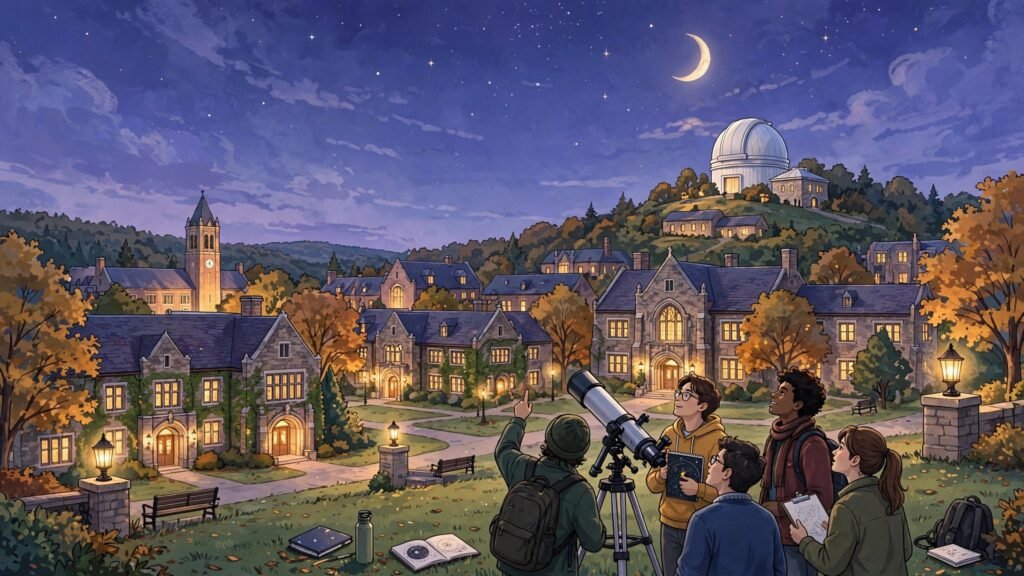
It usually starts the same way for most students considering an astronomy subject in college. Somewhere around the second year of high school, you look up at the night sky — or maybe you watch a documentary about black holes — and a thought lands: could I actually study this for real? Is astronomy a thing you can take as a college subject, or is it one of those dream fields that only exists in movies and observatories on mountaintops?
It is very real, and it is more accessible than most people assume. Colleges and universities around the world offer astronomy not just as a subject but as a full undergraduate major, and in some places as a minor, an elective track, or a gateway into physics, astrophysics, and space science. But here is the part nobody tells you at the stargazing party: studying astronomy in college is a very different experience from watching the stars on a clear night. It is more mathematics than moonlight, more problem sets than planetariums — and for the right kind of student, it is genuinely wonderful.
The short answer: Yes, the astronomy subject in college is real — offered as a major, minor, or elective at many universities. Expect core courses in observational astronomy, astrophysics, planetary science, and cosmology — built on a foundation of calculus, physics, and programming. It is math-heavy but far more accessible than its reputation suggests, and it leads to careers in research, aerospace, data science, teaching, and science communication.
Is Astronomy Actually a College Subject?
Yes — and it has been for a long time. Most universities with a science faculty list astronomy somewhere in their course catalog, though the exact shape varies. At some schools it is a standalone degree program (BSc Astronomy or BA in Astronomy). At others, it lives inside the physics department, which means you would enroll in physics with an astronomy or astrophysics concentration. Both routes teach the same essential science; the difference is mainly in branding and a few required courses.
There is also a softer entry point. Many colleges let students take one or two astronomy modules as part of a general science requirement or as electives alongside an unrelated major. The classic “Introduction to Astronomy” lecture — the one that fills a 300-seat hall because it satisfies a science credit — is how a huge number of people first encounter the subject properly. If you are curious but not committed, that is the ideal first step: one module, real astronomy, no life decisions required.
A word of honesty here. Some small colleges offer astronomy only as a minor or as occasional electives, because running a full astronomy department needs telescopes, observatory time, and specialist faculty. If a full major is what you want, check the department’s page and see whether “astronomy” appears in degree titles — not just in the course list. That distinction matters when you are choosing where to apply.
What Do You Study in a College Astronomy Program?
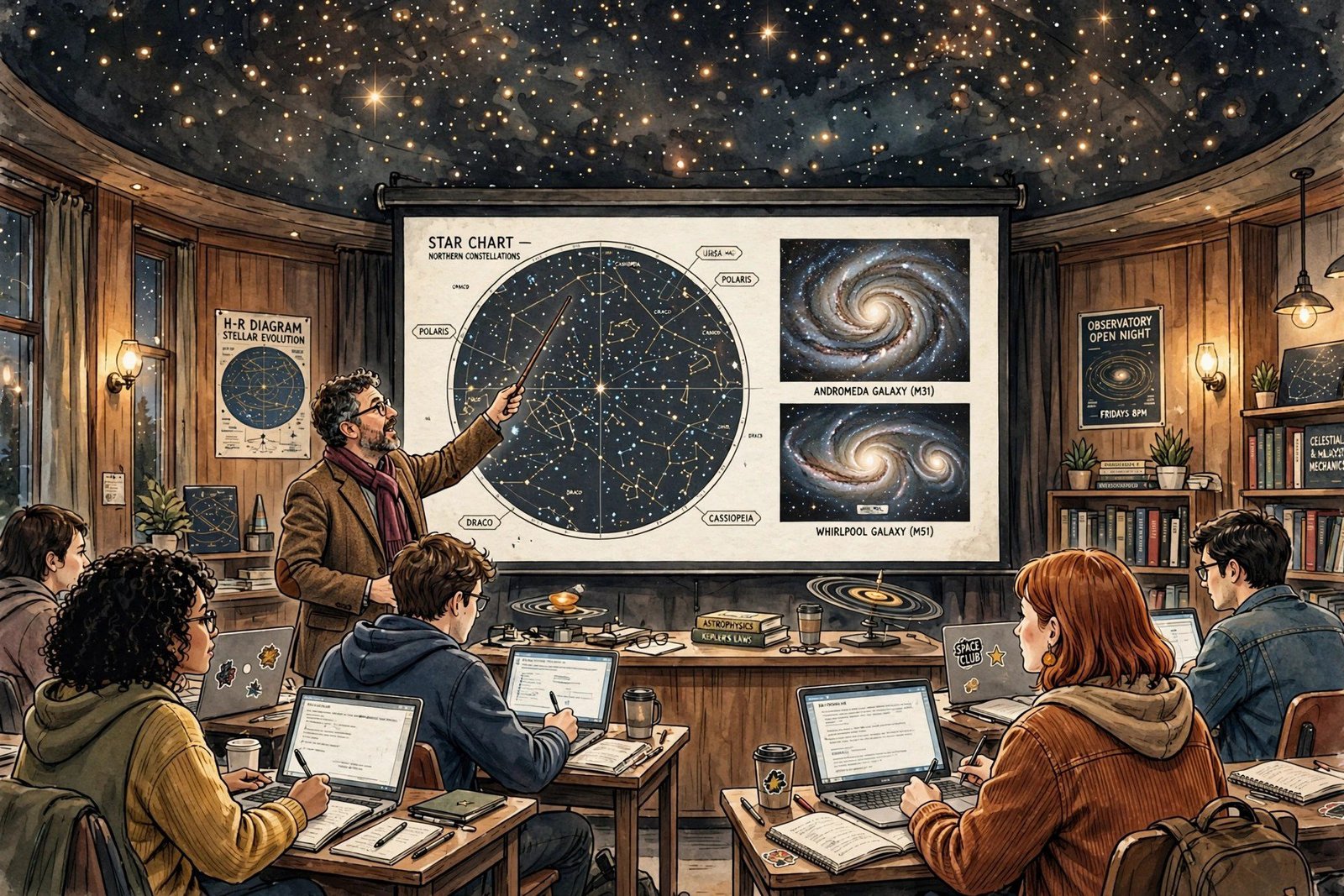
The romantic version of the curriculum is telescopes and galaxies. The real version is broader — and more interesting. A typical undergraduate astronomy program combines four strands: observation (how we collect light from the sky), theory (how stars, planets, and galaxies actually work), physics (the engine underneath everything), and data analysis (because modern astronomy is largely done on computers, not at eyepieces).
Here is what the course map usually looks like, year by year. Exact titles differ between universities, but this skeleton is remarkably consistent.
| Year | Typical courses | What you are actually learning |
|---|---|---|
| 1st | Intro to Astronomy; Calculus I–II; General Physics I–II; Programming basics | The sky’s layout, orbital mechanics, the language of math you will need all through the degree |
| 2nd | Stellar astronomy; Planetary science; Calculus III & differential equations; Lab methods | How stars are born and die, solar system geology, applied mathematical tools |
| 3rd | Astrophysics; Cosmology; Observational techniques; Electrodynamics | Stellar structure equations, the expanding universe, operating real instruments and detectors |
| 4th | Senior thesis or capstone project; Advanced electives (exoplanets, galaxies, relativity, instrumentation) | Independent research — many students work with real data from public telescope archives |
Notice what is missing: you will not spend most of your time looking through a telescope. Professional astronomy is overwhelmingly computational. You learn to request telescope time, calibrate detectors, reduce data, model systems in code, and write results up clearly. The night sky becomes something you analyze as much as admire.
The topics that surprise new students
New undergraduates are often surprised by three things. First, how much of the program is history of discovery — you learn how we figured out the distance to stars, the age of the universe, and the existence of dark matter, which trains your intuition beautifully. Second, how much chemistry shows up: spectra, molecular clouds, and exoplanet atmospheres are chemistry problems as much as physics problems. Third, how fast the field moves. A lecture on exoplanets today teaches things that did not exist in textbooks ten years ago, and lecturers know it — you will hear “as of this semester” more than you expect.
How Much Math Does Astronomy Really Need?
Let us deal with the elephant in the observatory, because this is the question that decides everything: yes, the astronomy subject in college is math-heavy. There is no honest way around it. You will need calculus (single and multivariable), differential equations, linear algebra, and statistics. Physics goes hand in hand with all of it — classical mechanics, electromagnetism, and eventually quantum mechanics and relativity at the conceptual level.
But “math-heavy” does not mean “only for math geniuses.” It means consistent, cumulative work. The students who struggle are rarely the ones who are bad at math; they are the ones who skip the weekly problem sets and try to cram. Astronomy math is applied math — you are not proving abstract theorems, you are calculating the mass of a star from its brightness, or the age of a crater from decay rates. That context makes the math stick in a way pure algebra classes sometimes do not.
A practical way to test yourself
Before committing to the major, take this honest test:
- Did you enjoy physics or calculus in school, even when it was hard?
- Can you sit with one difficult problem for an hour without giving up?
- Do you like the idea that a number on a spreadsheet can tell you something about a galaxy?
If you answered yes to two of the three, you have the right temperament. If math was genuinely painful for you in school, an astronomy minor or elective pair might give you the joy of the subject without the mathematical load of the full major. Both are valid paths — choosing the lighter one is not failure, it is good self-knowledge.
Should You Major in Astronomy, or Something Related?
This is where students overthink things, and understandably so. The truth is that astronomy, physics, and astrophysics overlap so heavily in the first two years that the choice rarely locks you in early. Here is the honest comparison.
| Route | Best for | Watch out for |
|---|---|---|
| Astronomy major | Students sure about space science; strong observational and instrumentation courses | Fewer graduates means smaller alumni networks; research is concentrated in few locations |
| Physics major with astronomy focus | Maximum flexibility; keeps engineering and tech doors open | Less observational training; you choose astronomy through electives |
| Astrophysics track | Research-oriented students; the most theory-rich route | The most math-intensive of the three; fewer schools offer it as a distinct degree |
| Astronomy minor + other major | The space-curious who want a different career base (engineering, CS, education) | You get the fascination without the deep research training |
One piece of advice that admissions officers and professors repeat constantly: do not choose based on the degree title. Compare actual course lists. A “Physics” degree at one university may contain more astronomy than an “Astronomy” degree at another. Read the modules, not the label.
What about a double major?
Astronomy pairs beautifully with mathematics, computer science, physics, and even philosophy (for those drawn to cosmology’s big questions). A CS double major is especially powerful today, because the modern astronomer is essentially a data scientist who happens to work on stars. But be realistic about workload: two lab-science majors is a heavy timetable, and your sleep schedule will know about it.
What Skills Do You Actually Pick Up?
Ask graduates what the degree gave them, and few will say “I can name constellations.” What they say instead is a list that reads like a tech recruiter’s wishlist:
- Programming — most programs now teach Python as the working language, plus data-handling libraries, because real astronomy is done in code.
- Statistics and data analysis — fitting models to noisy observations is the heart of the subject, and it transfers directly to finance, tech, and research roles.
- Mathematical modeling — turning physical situations into equations, solving them, and checking whether the answer makes sense.
- Technical writing — lab reports, observing proposals, and the senior thesis teach you to write clearly about complex things.
- Working with uncertainty — measurements have error bars; learning to quantify what you do not know is a genuinely rare and valuable skill.
- Presenting science — journal clubs and project presentations build the communication muscle most technical degrees underdevelop.
That last point deserves emphasis. The students who treat presentation and writing as seriously as the math graduate with a noticeably wider set of options — from teaching and planetarium work to science media and policy roles.
How Is Astronomy Different From Astrophysics at College?
Students use the two words interchangeably, and honestly, so do plenty of adults. At the college level the difference is real but subtle. Astronomy is the older, broader discipline: the study of celestial objects and phenomena — planets, stars, galaxies — including observation, cataloging, and instrumentation. Astrophysics is the physics behind those phenomena: the equations of stellar structure, the thermodynamics of accretion disks, the general relativity of black holes.
In practice, undergraduate programs blend them freely. A course called “Stellar Astronomy” will teach you what types of stars exist (astronomy) and why they shine (astrophysics). Some universities offer them as separate degree titles; more commonly, astrophysics is a concentration within a physics or astronomy degree. If you love telescopes and observing, lean astronomy. If you love deriving things from first principles, lean astrophysics. Most students end up loving both.
What Does the Coursework Feel Like Week to Week?
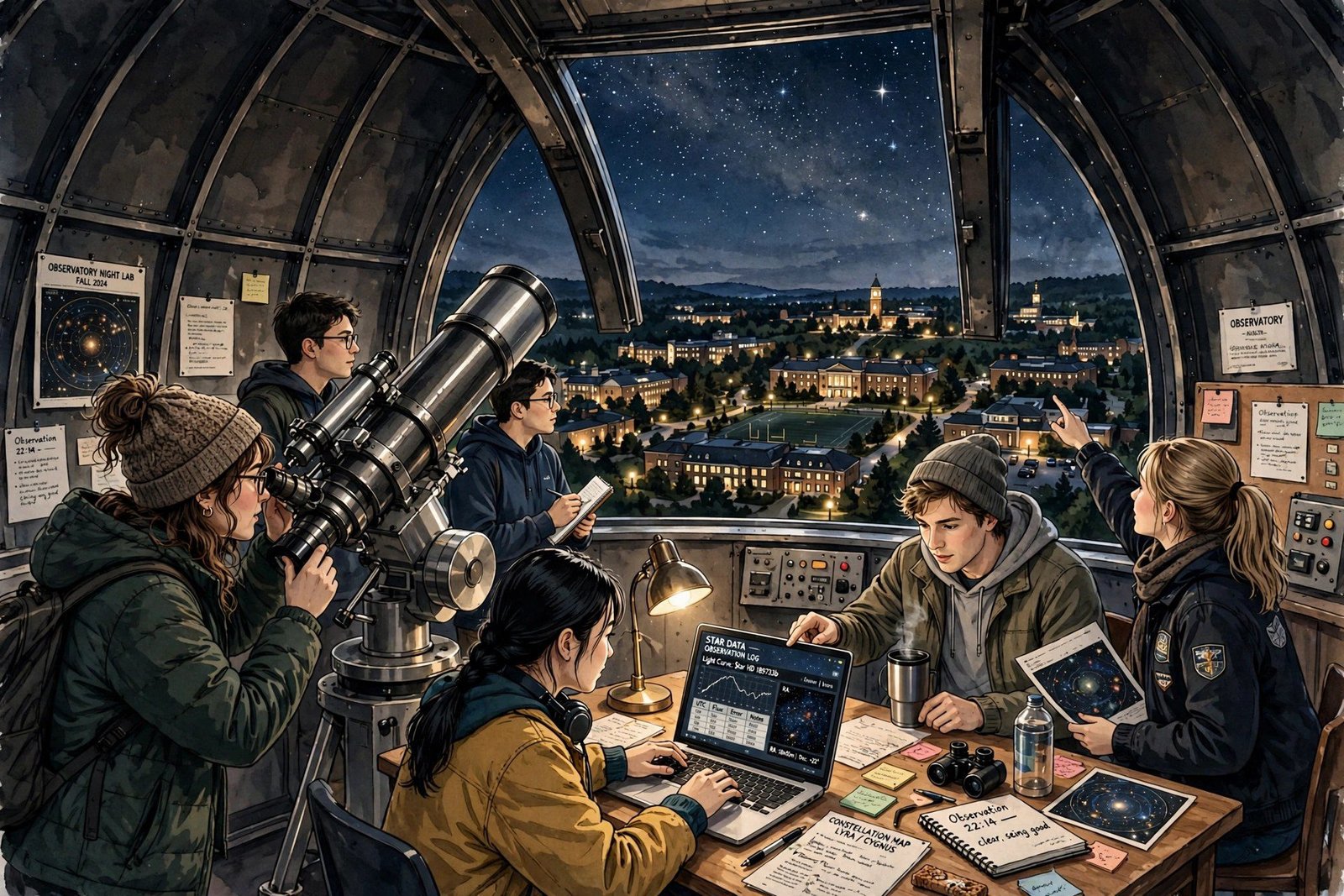
Forget the brochure photos of domes at sunset. A typical week for an astronomy undergraduate looks like this: two or three lecture courses, one or two problem sets that each take several hours, a lab session (which might mean operating a campus telescope at night or, more often, analyzing data files at a computer), and readings that mix textbook chapters with actual published papers in the later years.
The night-observing component exists but is smaller than people expect — a few scheduled sessions per term, weather permitting, because a cloudy night cancels the whole plan. What surprises students more is how much writing there is. Every lab needs a report. Every dataset needs documentation. The senior thesis, usually in the final year, is a genuine piece of independent research, often using data from public archives of major observatories — meaning an undergraduate today can work with the same data as professionals at the world’s best telescopes.
Workload-wise, treat it like engineering: steady, cumulative, and unforgiving of falling behind, but entirely manageable with consistent habits. The students who thrive are organized, not brilliant.
How Much Does Studying Astronomy Cost?
Costs vary enormously by country and institution, so treat any specific figure you read online with suspicion unless it comes from the university itself. The honest answer: the astronomy subject in college costs the same as any other science degree at the same school. There is no “telescope surcharge.” Tuition is set by the university and the country, not the subject.
What differs is the equipment you might want. A decent personal telescope for your own stargazing hobby is a want, not a need — the university provides all the instruments the coursework requires. A laptop capable of running Python and data-analysis software is the one genuine necessity, and most programs will tell you the specifications on day one. Scholarships, grants, and research assistantships exist in this field like any other STEM subject; the departmental office, not the internet, is the right place to ask.
One cost worth naming: some programs run optional field trips or summer observing schools, which may carry extra fees. These are almost always optional and often have financial support available. Ask early, apply early.
What Careers Does an Astronomy Subject in College Lead To?
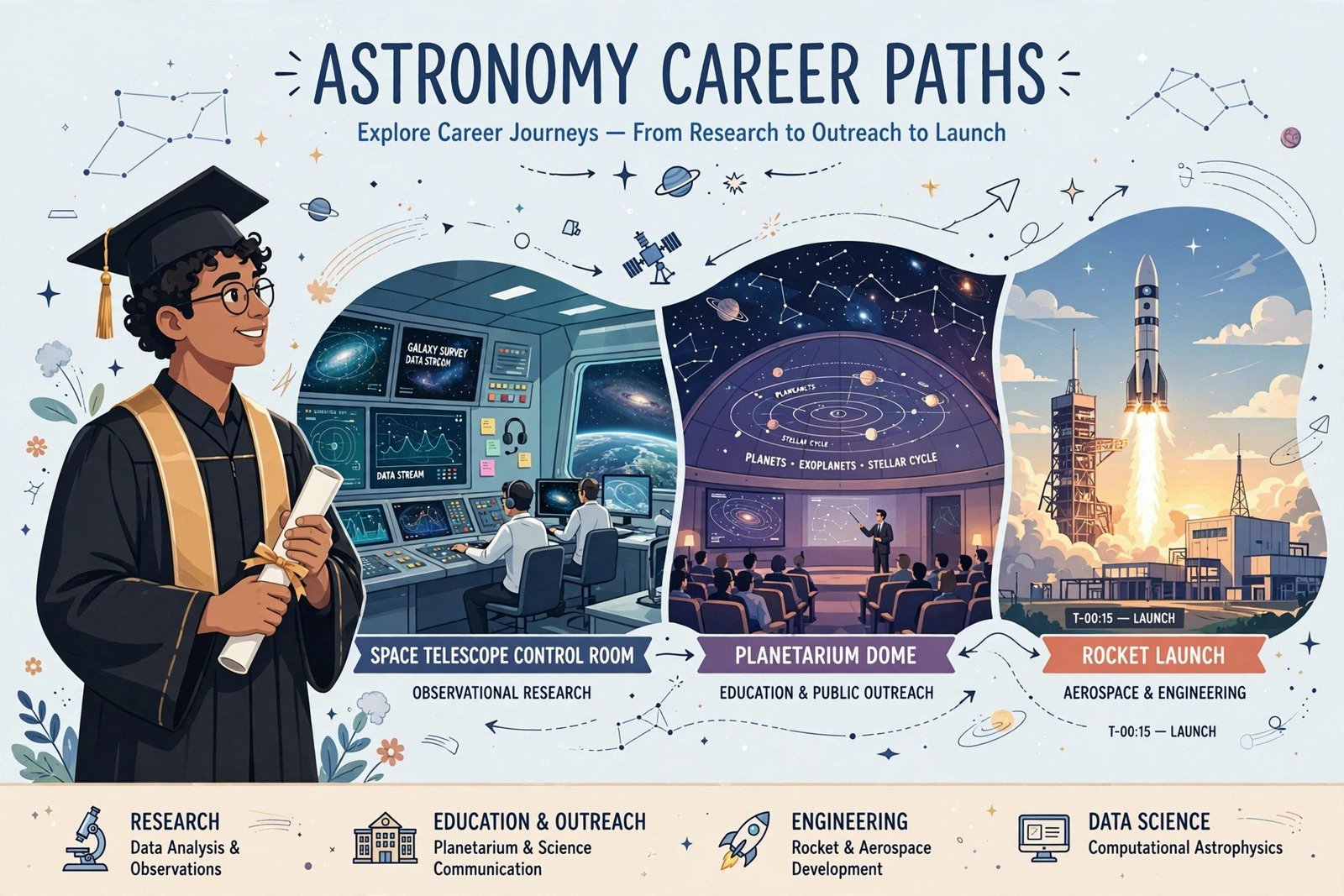
Here is the part that makes parents nervous and students excited. The number of people employed as professional astronomers — the ones with faculty positions or observatory jobs — is small. It is a competitive, research-driven career path that typically requires a PhD. That is the honest truth, and any article that hides it is doing you a disservice.
But that narrow path is not the whole story, and not even the most common story. Astronomy graduates work across a surprisingly wide map:
- Aerospace and space industry — mission analysis, satellite operations, systems engineering (often after further study).
- Data science and software — the single most common destination; the degree’s math and programming training is directly marketable.
- Science communication and media — planetariums, museums, documentary research, science journalism. The 9bio.co.uk site, for instance, shows how much appetite there is for well-written profiles of people in science and public life — science storytelling is a real and growing career.
- Teaching — schools are always short of physics and science teachers, and an astronomy background makes the subject come alive.
- Finance and consulting — quantitative degrees are welcomed; the modeling skills transfer.
- Instrumentation and optics — building the cameras, detectors, and telescopes themselves.
- Observatory and planetarium operations — technical and public-facing roles at science centers.
The pattern is clear: the degree trains you in quantitative reasoning, and quantitative reasoning is employable almost everywhere. Students who build programming and communication skills alongside the physics graduate into one of the most flexible STEM profiles there is. Many also find inspiration in how science careers are covered in the media — outlets like themodernpost.co.uk regularly show the sheer variety of modern professional paths, which is worth remembering when anyone tells you an astronomy degree has “only one” career.
Do you need a PhD?
Only for research astronomy and university faculty roles. For the careers above — data science, teaching, industry, communication — a bachelor’s or master’s is the standard entry point. Decide this late, not early: do the undergraduate degree, see which parts lit you up, and let the PhD question answer itself in your final year.
How Do You Know If It Is Right for You?
After all the practical detail, this is the question that actually matters, and only you can answer it. But there are signs worth listening to.
Signs it might be a great fit: you read science articles for fun; you stuck with the hard math problems because the answer felt worth it; you are curious about how we know things, not just what we know; you enjoy long projects where the payoff comes at the end. Also — and this one is underrated — you are comfortable with the idea that some questions have no final answer yet. Cosmology lives at the edge of the known, and it rewards people who find that thrilling rather than frustrating.
Signs to think twice: you want a subject with minimal math; you chose it mostly because space sounds cool (it is, but “cool” fades around week six of differential equations); you need a direct, guaranteed career pipeline. None of these are character flaws — they are just data about fit, and fit is what makes a degree enjoyable rather than endured.
The best test of all: take one introductory astronomy course as an elective before declaring anything. One semester of real college astronomy — the lectures, the problem sets, the lab — will teach you more about your fit than a hundred articles. Most students know by midterms whether they want more or whether they are happy to keep the stars as a hobby. Both answers are good ones.
Frequently Asked Questions
Is the astronomy subject in college hard?
It is demanding in the way all physics-based subjects are: heavy on math, cumulative, and unforgiving of cramming. Most students find the difficulty manageable with steady work habits. The conceptual ideas are often beautiful and intuitive; the challenge is the mathematical machinery needed to work with them precisely.
Can I study astronomy without strong math?
A full major really does require calculus and physics — there is no math-free route through the degree. But many colleges offer astronomy as a minor, an elective, or a general-education science course where the math is lighter and the emphasis is on concepts and the history of discovery. That can be the perfect middle ground.
What is the difference between astronomy and astrophysics degrees?
Astronomy is the broader, observation-rooted discipline; astrophysics is the physics underlying celestial phenomena. Undergraduate programs blend them heavily, and the degree titles matter less than the actual course lists. Choose by comparing modules, not labels.
Do astronomy students get to use real telescopes?
Yes, but less than people imagine. Most programs include some scheduled observing sessions on campus instruments, weather permitting. The bulk of modern work uses data from major observatories’ public archives, analyzed on computers — which is how professional astronomy actually operates today.
What jobs can you get with an astronomy degree?
Beyond research astronomy (which usually needs a PhD), graduates commonly enter data science, software, aerospace, teaching, science communication, planetarium and museum work, finance, and instrumentation. The degree’s real product is quantitative reasoning, which employers across industries value.
Is an astronomy degree worth it?
It is worth it if you enjoy mathematical problem-solving and quantitative work, because the skills transfer widely even outside space science. It is a weaker choice if you are choosing it purely for the romance of space without appetite for the math — in that case, a minor or electives give you the joy with less risk.
Can I switch into astronomy from another major?
Usually yes, especially in the first two years, because the early requirements (calculus, general physics) are shared across science degrees. Talk to the department early, since some programs have specific prerequisite sequences. Switching in the final year is much harder.
Conclusion
The astronomy subject in college is one of those rare things that is both more demanding and more rewarding than its reputation suggests. More demanding, because the math and physics are non-negotiable and the workload is steady. More rewarding, because few subjects train you to reason so precisely about a universe so vast — and few degrees leave you with a skill set as transferable as this one.
If the subject calls to you, do the practical things: compare real course lists, take one introductory module before committing, build your programming skills early, and be honest with yourself about the math. Do that, and whether you end up as a researcher, a data scientist, a teacher, or simply someone who understands the night sky on a deeper level than almost anyone at the stargazing party, the time will have been well spent.
Read Also: Astronomy 101 Online: The Complete Beginner’s Guide to Learning the Universe from Home (2026)

1 Comment