
Almost everyone remembers the night the sky first got their attention. Maybe it was a camping trip where the Milky Way finally showed itself, or a phone photo of the Moon that came out far better than expected, or simply a clear winter evening when the stars looked impossibly close. Whatever it was, it usually gets followed by the same quiet question: how do I actually learn this?
That is where most people stall. The internet is full of telescope reviews written in a language that seems designed to confuse, forum threads that assume you already know your Messier objects from your meteors, and the nagging suspicion that astronomy is a subject for people who were good at physics in school. So the curiosity fades, the clear nights pass, and the sky stays a beautiful mystery.
It does not have to be that way. Learning astronomy is one of the most forgiving hobbies in the world. There is no exam, no deadline, and no wrong place to start — only clear nights and questions. This guide lays out the full path: what astronomy actually is, what to learn first and in what order, whether you need any gear at all, the free resources worth your time, and a realistic answer to how long the journey takes.
The short answer: To learn astronomy from scratch, start with your naked eyes and a free stargazing app, learn the Moon’s phases and a handful of constellations, then try binoculars before ever buying a telescope. A few evenings a month will take you from curious beginner to someone who can genuinely read the night sky within a year — no degree, and no expensive gear, required.
What Does It Actually Mean to Learn Astronomy?
Before picking up a single star chart, it helps to know that “learning astronomy” means different things to different people — and all of them are legitimate. Most beginners are actually chasing one of two versions of the subject, and knowing which one pulls you will shape everything that follows.
The observer’s path
The observer wants to see things. Finding Jupiter’s moons with their own eyes, tracing Orion across a winter sky, catching a meteor shower from a dark field. This is the hobby side of astronomy: stargazing, binoculars, telescopes, and eventually maybe astrophotography. It is hands-on, deeply relaxing, and surprisingly social — you will find that pointing a telescope at Saturn for a stranger’s kid never gets old.
The learner’s path
The learner wants to understand things. Why the Moon has phases, what a black hole really is, how we know the universe is expanding. This is the science side: reading, documentaries, courses, and the occasional mind-bending evening of falling down a cosmology rabbit hole. You do not need to touch a telescope for any of this.
Most people end up blending both, and that is honestly the best way. What you see with your eyes gives meaning to what you read, and what you read makes what you see ten times more interesting. When you know that the smudge of Andromeda you found in binoculars is a galaxy of roughly a trillion stars sitting over two million light-years away, looking at it feels completely different.
How Hard Is Astronomy to Learn?
Let us clear this up early, because it stops more people than anything else: hobby astronomy requires almost no math. The university subject called astrophysics is genuinely demanding — it is applied physics and mathematics. But finding constellations, understanding Moon phases, and enjoying a telescope have about as much to do with calculus as birdwatching has to do with zoology degrees.
Here are the fears that trip people up, and why they are overblown:
- “I was never good at physics.” Irrelevant for 95% of what a hobbyist does. You need curiosity and patience, not equations.
- “I live in a city.” Light pollution limits you, but the Moon, planets, bright constellations, and meteor showers all work fine from town. More on that below.
- “I need an expensive telescope first.” The single most common and most damaging beginner myth. Most experienced amateurs will tell you to wait a year before buying one.
- “The jargon is overwhelming.” Every field has jargon. Astronomy’s is unusually friendly — most terms are just Latin names for things you already recognize.
The genuinely hard part is simpler and less scary: learning to look slowly. The night sky rewards patience more than intelligence. Your eyes take time to adapt, faint objects reveal themselves gradually, and the difference between a frustrating evening and a magical one is usually just twenty unhurried minutes.
Where Do I Start? The Beginner’s Roadmap
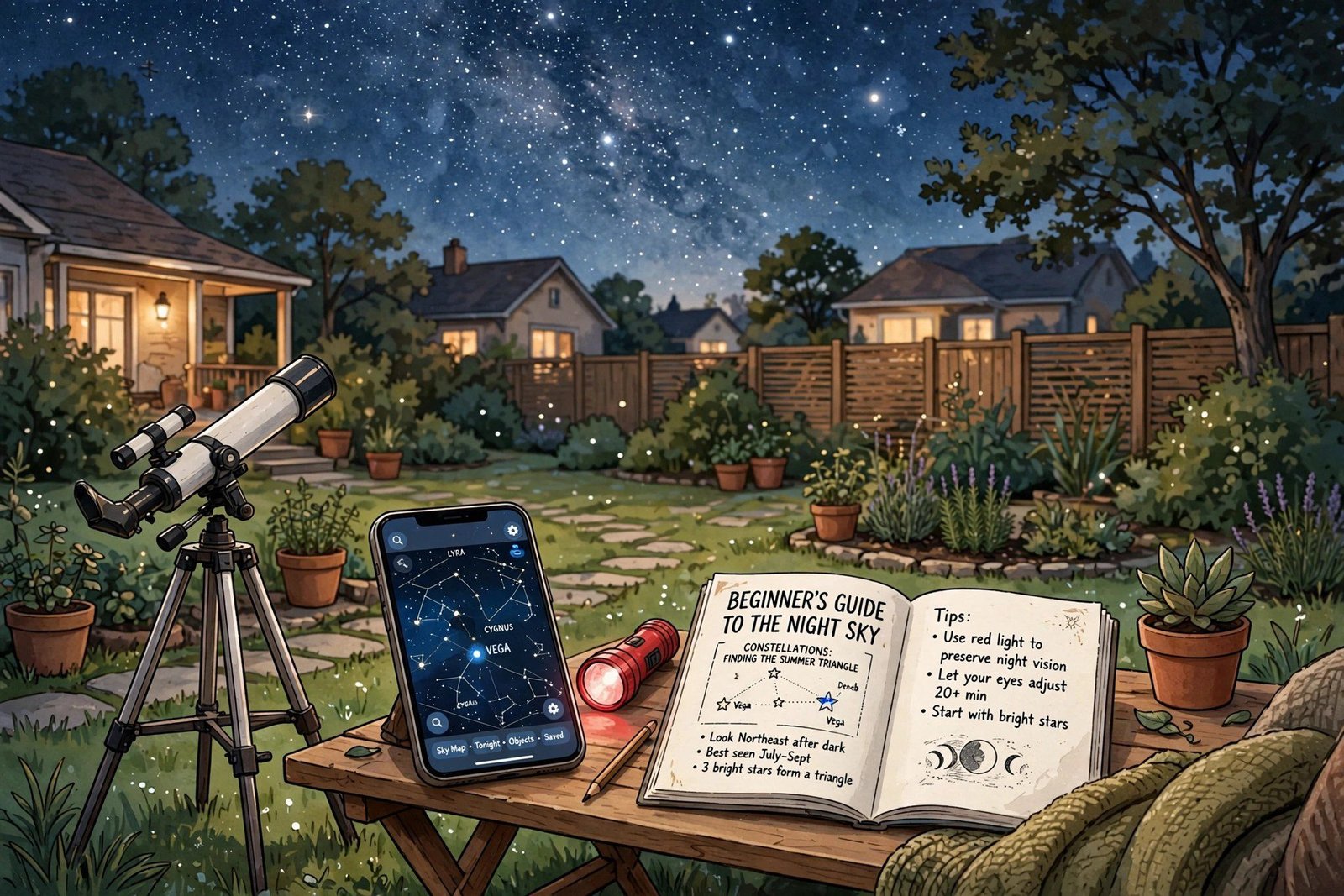
The biggest beginner mistake is learning things in a random order — watching a black hole documentary on Monday, downloading a star app on Tuesday, and never connecting the two. Astronomy builds on itself beautifully if you go in sequence. Here is the order that works:
- How the sky moves. Everything else rests on one idea: the sky appears to turn because the Earth is spinning. Stars rise in the east and set in the west, and the whole pattern shifts a little every night as the Earth orbits the Sun. Once you feel this in your bones, half of astronomy clicks into place.
- The Moon. It is the perfect first subject — bright, easy to find, and different every night. Learn the phases and why they happen (the Moon is lit by the Sun, and we see different amounts of the lit half as it orbits us). Track it for one full month and you will understand more than most people ever do.
- Why we have seasons. Here is the fact that surprises nearly everyone: seasons happen because the Earth’s axis is tilted, not because we are closer to the Sun in summer. In fact, Earth is slightly closest to the Sun in January. Understanding the tilt explains the seasons, the changing constellations, and why the Sun’s path across the sky changes through the year.
- A handful of constellations. Do not try to learn all 88 official constellations at once — start with the bright, unmistakable ones. In the northern hemisphere, that means the Big Dipper (part of Ursa Major), Cassiopeia’s “W” shape, and Orion the Hunter. These become your landmarks for everything else.
- The bright planets. Learn to tell planets from stars: planets do not twinkle the way stars do, and they drift along a specific path across the sky. Venus, Mars, Jupiter, and Saturn are all naked-eye targets when they are well placed.
- Deep-sky basics. Once you know the constellations, graduate to their hidden treasures: star clusters like the Pleiades, nebulae like the Orion Nebula, and galaxies like Andromeda. This is also when terms like “magnitude” (a star’s brightness) start to feel natural instead of technical.
- The Sun and special events. Yes, daytime counts — with a proper solar filter, the Sun is a fantastic target, and its surface changes daily. Then come the calendar events: meteor showers, eclipses, and bright comets when they appear.
| Learning stage | Roughly when | What you can do |
|---|---|---|
| Sky motion + the Moon | First few weeks | Explain phases, find your way around the sky’s daily rhythm |
| Seasons + first constellations | First couple of months | Name a dozen constellations, explain why the sky changes through the year |
| Planets + deep-sky basics | First 6 months | Find planets on sight, locate star clusters and bright galaxies |
| Events + the Sun (safely) | Within a year | Predict meteor showers, observe eclipses, follow solar activity |
This is a realistic pace for someone going out a few times a month — not a bootcamp schedule. The sky is patient. It will be there whenever you are ready.
Can I Learn Astronomy Without a Telescope?
Yes — and honestly, you should start that way. Some of the most rewarding observations in all of astronomy need zero equipment, and learning them first makes you a better telescope user later, because you will already know the sky instead of fumbling with it through a narrow eyepiece.
Here is a partial list of what your naked eyes can do:
- Track the entire lunar cycle. Watch the Moon grow from a sliver to full and shrink back, over about a month. Notice how the terminator — the line between light and dark — makes craters near it look dramatic.
- Learn the seasonal constellations. The summer triangle, the winter hexagon, Scorpius curling across southern summer skies — the sky has a calendar, and you can read it.
- Watch meteor showers. The Perseids in August and the Geminids in December need nothing but a dark spot and a reclining chair. On a good night you can count dozens of meteors per hour.
- Follow the planets. Venus blazing after sunset, Mars glowing red, Jupiter outshining nearly everything — spotting them with no help feels like a superpower the first time.
- See satellites and the space station. On many evenings you can watch the International Space Station glide silently overhead, brighter than most stars. There are free websites that predict flyovers for your location.
- Witness eclipses. Lunar eclipses turn the Moon a deep copper red and are visible to half the planet at once. Solar eclipses need eye protection, but even a partial one is unforgettable.
There is also a deeper reason to start equipment-free: it teaches you the skill telescopes cannot give you, which is knowing where things are. A telescope shows you a tiny patch of sky. If you already know the constellations, finding anything becomes easy. If you do not, a telescope mostly shows you confusing patches of darkness.
Should My First Gear Be Binoculars or a Telescope?
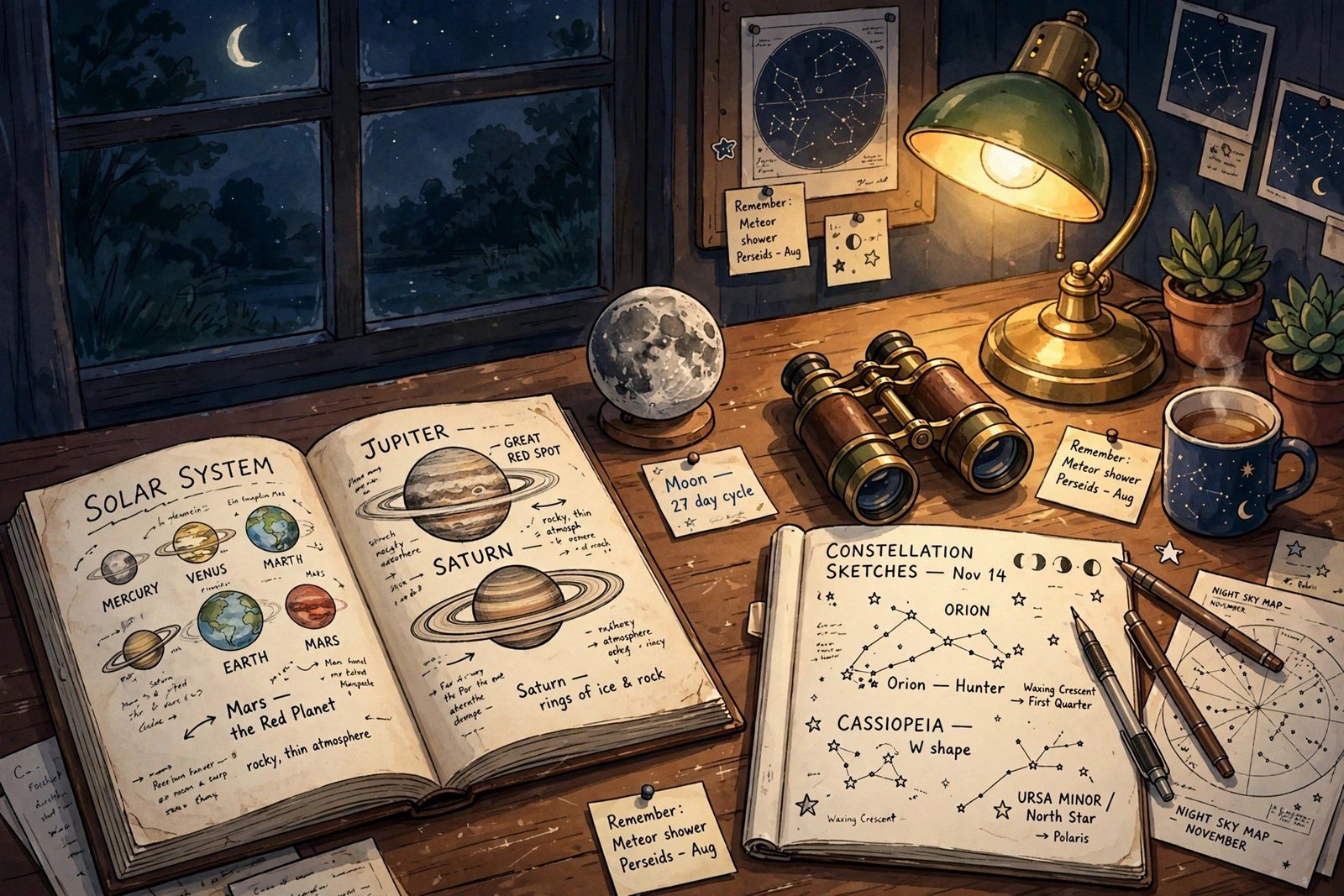
Sooner or later, every beginner asks this. Here is the honest answer most telescope retailers will not give you: buy binoculars first, or buy nothing at all for a while. Telescopes are wonderful, but they are also the most common source of beginner regret — usually because someone bought too much scope, too soon, without knowing the sky.
A comparison makes the choice clearer:
| Naked eye | Binoculars (e.g. 7×50 or 10×50) | Telescope | |
|---|---|---|---|
| Cost commitment | Free | Modest — a one-time purchase | Real money, and the wrong choice stings |
| Learning curve | Zero | Minutes to learn | Steep at first: setup, alignment, finding things |
| What you’ll see | Thousands of stars, Moon, planets, meteors | Moon craters, Jupiter’s four largest moons, star clusters, Andromeda’s glow | Saturn’s rings, nebula detail, galaxies with structure |
| Portability | Perfect | Excellent — fits in a bag | Often bulky, needs setup time |
| Best for | Learning the sky | Learning the sky in more detail | Dedicated observing sessions |
Binoculars hit a sweet spot that surprises people. A decent pair reveals the Moon’s craters in sharp detail, splits double stars, resolves the Pleiades into dozens of sparkling members, and shows Jupiter as a tiny disk with its four largest moons strung alongside it like beads. And because they show a wide patch of sky, they teach you star-hopping — the core skill of finding faint objects — instead of bypassing it.
When you do start thinking about a telescope, follow the advice experienced amateurs give every beginner: try before you buy. Many astronomy shops will set up a scope and walk you through it, and local clubs are full of people who love showing off their equipment. Looking through several different telescopes at a star party tells you more in one evening than weeks of reading reviews — you will learn what you actually enjoy looking at, which matters more than any specification sheet.
What Are the Best Free Ways to Learn Astronomy?
One of the best-kept secrets of this hobby is how much of it costs nothing. Before spending a penny, work through these:
Stargazing apps
A good sky app turns your phone into a map of the heavens — point it at the sky and it labels what you are seeing. Stellarium is a powerful free planetarium program for desktop that shows the sky from any location and any date, which is brilliant for planning ahead. For the phone in your pocket, apps like SkySafari and Sky Guide do the point-and-identify trick beautifully (just remember to dim the screen or use a red-light mode so you don’t wreck your night vision). Weather apps like Clear Outside tell you when the sky will actually be clear, saving you from standing outside under clouds.
Free courses and videos
Universities regularly publish free introductory astronomy courses online, and public lectures by research astronomers are some of the best teaching on the planet — many end up on video platforms. Start with the fundamentals courses rather than the flashy cosmology ones; a solid grip on the solar system pays off everywhere else.
Books and magazines from the library
Your library card is an astronomy superpower. A Brief History of Time by Stephen Hawking and Cosmos by Carl Sagan remain wonderful starting points for the “understanding” side of the hobby, and there are excellent illustrated observing guides for the “seeing” side. Hobby magazines like Astronomy run a monthly “what’s in the sky” section that tells you exactly what to look for on any given night — reading one issue will teach you more than a week of random browsing.
Free resources from space agencies
NASA’s education pages publish clear, reliable explainers on everything from Moon phases to the James Webb Space Telescope’s latest images — all free, all accurate. When you read something surprising elsewhere, checking it against an agency source is a good habit that will serve you for years.
Between clear-sky sessions, there is also plenty of enjoyable general-interest reading to keep the curiosity warm — for example, the mixed bag of science, tech, and culture coverage on Daily ORVIX makes for good cloudy-night browsing while you wait for the next clear evening.
How Do I Actually Learn the Constellations?
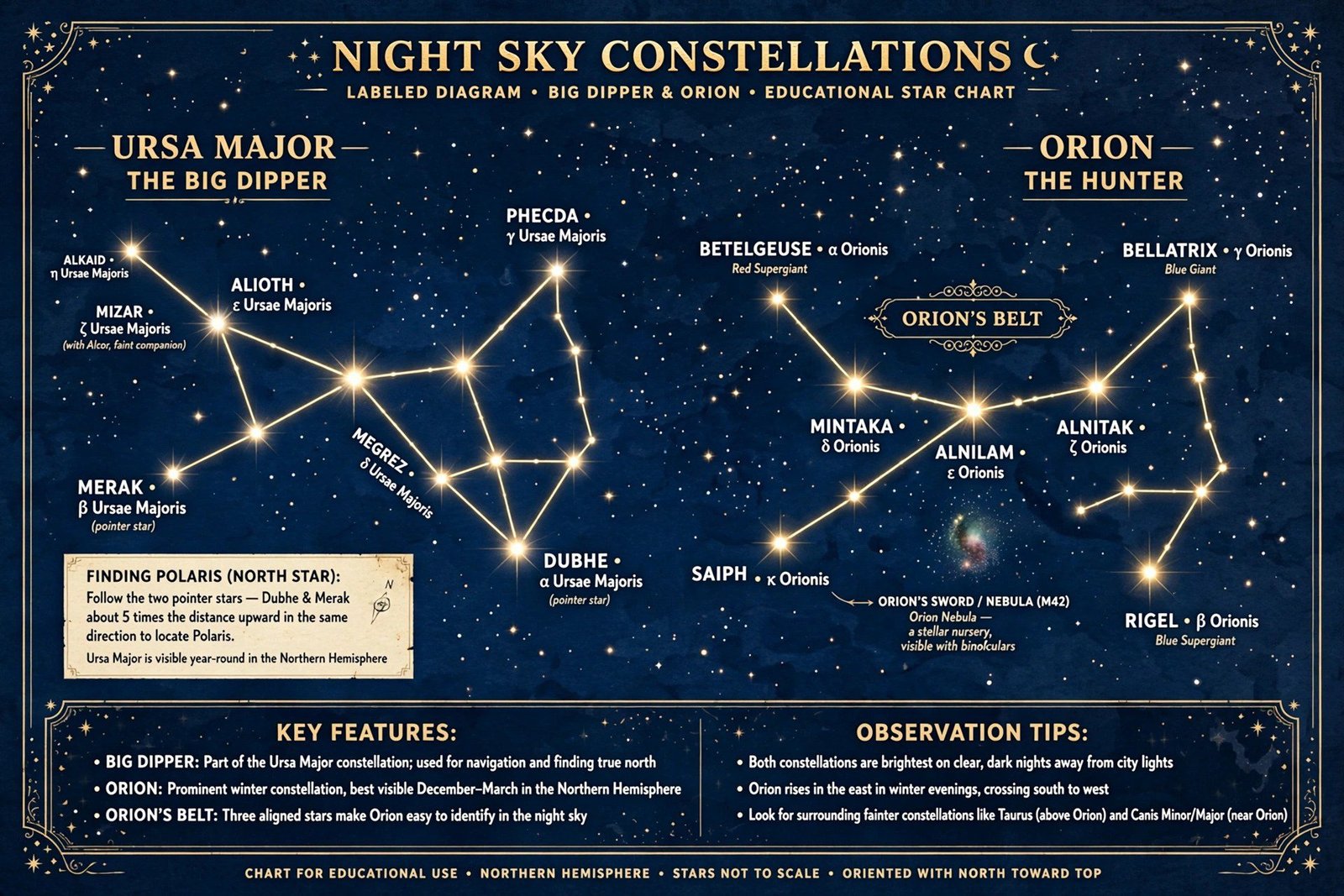
This is the part that looks hard and is secretly easy, because you only need three landmarks to unlock most of the northern sky. The trick is to learn them as shapes and stories, not as lists of star names.
Start with the Big Dipper. Find its familiar saucepan shape — it is part of the larger constellation Ursa Major, the Great Bear. The two stars at the front of the “bowl” point straight at Polaris, the North Star. The Dipper’s handle arcs toward the bright orange star Arcturus. One shape, three destinations.
Add Cassiopeia. Look for a bright “W” (or “M”, depending on the season) on the opposite side of Polaris from the Dipper. It sits in the middle of the Milky Way’s glow, and it is your gateway to some of the finest star clusters in the sky.
Add Orion. In winter, you cannot miss him: three bright stars in a row for the belt, with the glowing Orion Nebula hanging below like a smudge of light. That “smudge” is a stellar nursery — and it is visible to the naked eye.
From these three anchors, use star-hopping: find a landmark you know, then hop from star to star following your app or chart until you reach your target. It is the same technique telescope users rely on, and it works with nothing but your eyes.
A few practical tips that speed everything up:
- Learn constellations by season, three or four at a time. The winter sky and the summer sky are almost entirely different shows.
- Give it a few minutes per shape. Stare, look away, look back. Your brain is a pattern-matching machine — let it work.
- Say the names out loud. Sounds silly, works brilliantly. “That bright one is Vega, and below it is the Summer Triangle” sticks far better than silent staring.
- Do not try to learn all 88 official constellations. Even professionals use a working set of a few dozen. Depth beats breadth.
Where Is the Best Place to Stargaze?
The single biggest factor in what you will see is not your equipment — it is your sky. Light pollution, the glow of towns and cities bouncing off the atmosphere, washes out faint stars and hides the Milky Way entirely in the worst spots. So location matters, but do not let a city address stop you.
Your backyard or balcony works for the Moon, the bright planets, major constellations, and meteor showers. Some of the finest lunar observing in history was done from city rooftops. Darker is always better, but “not perfectly dark” beats “never going out” by a mile.
A short drive helps enormously. Even 20–30 minutes away from town lights can transform the sky. Look for high ground with a clear horizon, away from direct lights — parks, hilltops, beaches, and quiet country roads are all classic choices. Amateur astronomers rate sky darkness on the Bortle scale; you do not need to memorize it, just know that each step darker roughly doubles what you can see.
Set yourself up for comfort and dark-adapted eyes:
- Give your eyes about 20 minutes to adapt to the dark. You will literally see more stars appear as the minutes pass — it is one of the hobby’s small miracles.
- Use only red light. White light resets your dark adaptation instantly; red light preserves it. A cheap red flashlight, or red cellophane over a regular one, does the job. Dim your phone screen or switch it to a red night mode.
- Dress warmer than you think. Standing still under a clear sky gets cold fast, even in summer. A reclining chair or even a blanket on the ground saves your neck and keeps you out longer — and time under the sky is what this is all about.
- Scout in daylight. Visit a new spot during the day to check for hazards, fences, and whether you will actually feel safe there after dark. Bring a friend when you can.
A planisphere — a rotating star chart you dial to the date and time — is a lovely low-tech companion for these sessions. It never runs out of battery, never blinds you with a bright screen, and there is something satisfying about using the same kind of tool astronomers used for centuries.
How Long Does It Take to Get Good at Astronomy?
This is the question everyone wants a number for, and the honest answer is: it depends on what “good” means to you. But the milestones are remarkably predictable, because the sky itself sets the curriculum — the Moon cycles monthly, the constellations change seasonally, and the planets keep their own slow schedules.
| Time in | You can realistically… |
|---|---|
| First night out | Find the Moon’s main features, spot 2–3 constellations, feel the sky’s motion |
| First month | Explain the Moon’s phases, name a dozen constellations, catch a meteor shower |
| 3–6 months | Identify planets on sight, find star clusters and bright galaxies with binoculars, predict what’s up each season |
| One year | Navigate the whole sky confidently, observe eclipses and special events, guide a friend around the heavens |
| 2–3 years | Tackle faint deep-sky objects, attempt astrophotography, answer most beginner questions yourself |
Notice what is missing from that table: a degree, expensive gear, and any math beyond counting. If your goal is to become a professional astronomer or astrophysicist, that is a different road — a physics degree, serious mathematics, and years of study. It is a wonderful road, but it is not this road, and nobody should confuse the two. Hobby mastery is real mastery; the sky does not check credentials.
Should I Join an Astronomy Club or Learn Alone?
You can absolutely learn astronomy solo — plenty of people do, and the resources above are enough. But if there is one shortcut in this hobby, it is other astronomers. Joining a club or attending a public star party compresses years of trial and error into single evenings.
Here is what clubs give you that no app can:
- Look through real telescopes before buying one. This alone can save you from an expensive mistake. Club members love showing off their scopes, and you will quickly learn what you enjoy viewing.
- Mentors on tap. Stuck finding something? Someone at a star party has found it a hundred times and will happily point the way.
- Dark-sky access. Many clubs own or share access to dark observing sites you could never use alone.
- Beginner programs. Lots of clubs run structured “learn the sky” sessions designed exactly for people at your stage.
Finding one is easy: search for an astronomy club or astronomical society near your town, check your local planetarium’s event calendar, or look for public star parties at parks and observatories. If nothing is nearby, the online amateur astronomy community is large, welcoming, and full of beginners asking exactly your questions.
And the hobby has its heroes, too — the story of astronomy is full of fascinating characters, from Galileo to the modern telescope builders. If the human side of the science pulls you in, the explainers and science stories on A Daily Insight360 are a good way to meet the people and ideas behind the discoveries between observing nights.
Frequently Asked Questions
Do I need to be good at math to learn astronomy?
No — not for the hobby. Finding constellations, using binoculars, understanding Moon phases, and enjoying a telescope require essentially no mathematics. Math becomes essential only if you pursue astronomy as a university subject or career (astrophysics), where it is genuinely demanding. Do not let school-era math anxiety keep you from the night sky.
What is the best age to start learning astronomy?
Whatever age you are now. Children take to constellations naturally — the shapes-and-stories approach was basically designed for young imaginations — and adults bring the patience that faint objects demand. Some of the most dedicated amateur astronomers picked up the hobby in retirement. The sky does not care how old you are.
Can I learn astronomy using only my phone?
Largely, yes. A stargazing app plus your eyes covers the entire naked-eye curriculum: constellations, planets, the Moon, meteor showers, satellite flyovers. The phone’s real weakness is its screen — bright white light ruins your night vision, so use the dimmest red night mode you can. For actual observing, many beginners eventually prefer a printed star chart or planisphere alongside the app.
How much does it cost to start learning astronomy?
Nothing. The entire first stage — learning the sky’s motion, the Moon’s phases, the constellations, the bright planets — is free. When you are ready for gear, binoculars are a modest one-time purchase, and many clubs will let you observe through members’ telescopes for free. The expensive mistakes happen when beginners buy a telescope first and the sky-knowledge later; reverse that order and the hobby stays cheap for a long time.
When is the best time of year to start stargazing?
Right now — whenever “now” is. Every season has its showpiece constellations and events: summer brings the Milky Way’s bright core and the Perseid meteors, autumn offers Andromeda at its best, winter has Orion and the year’s clearest skies, and spring brings galaxies galore. Starting today just means you start with this season’s sky, which is as good a place as any.
Is astronomy a good hobby if I live in a city?
Yes, with adjusted expectations. City skies still show the Moon beautifully, the bright planets, major constellations, meteor showers, eclipses, and space station flyovers. What cities hide are the faint deep-sky objects — galaxies, dim nebulae, the Milky Way’s glow. Many urban astronomers do their casual observing from home and save the faint stuff for occasional trips to darker skies.
What is the difference between astronomy and astrology?
Astronomy is the scientific study of the universe — planets, stars, galaxies, and how they work, tested with observation and evidence. Astrology is a belief system claiming celestial positions influence human personality and events; it is not supported by scientific evidence. They share ancient roots and some vocabulary, which is where the confusion comes from, but they are entirely different enterprises.
Conclusion
Learning astronomy is not about conquering a difficult subject — it is about building a relationship with the sky, one clear night at a time. Start with your eyes and a free app. Learn the Moon, then a few constellations, then the planets. Add binoculars when curiosity outgrows the naked eye, and only think about a telescope once you know the sky well enough to point one. Find other stargazers, because everything is better shared.
A year from now, on some ordinary evening, you will glance up and realize you can read what you are seeing — that bright star is Vega, that red one is Mars, that smudge is a galaxy two million light-years away. It is a quiet kind of literacy, and it never wears off. The sky has been waiting for you. Go outside tonight.
Read Also: Astronomy Subject in College: What Taking Astronomy at University Is Really Like (2026 Guide)

1 Comment