
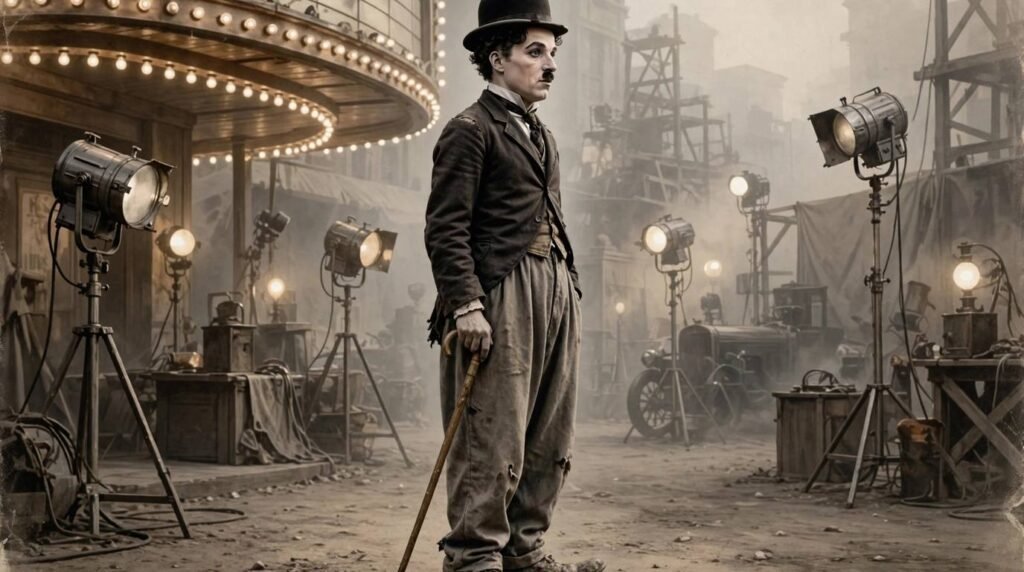
Picture a small man in a bowler hat, twirling his cane, waddling down a dusty road with a half-confident, half-hopeless grin. You have never seen one of his films? Chances are you recognized him anyway. That is the strange power of Charlie Chaplin: nearly fifty years after his death, his face still needs no introduction.
Chaplin was not just a comedian. He was an actor, director, writer, producer, and composer — often all at once, on the same film. He turned silent cinema into an art form, made the world laugh through two world wars and a Great Depression, and paid a heavy price for speaking his mind in an era when that could end a career. This is his story: where he came from, why the Little Tramp mattered, which films you should actually watch, and why Chaplin still matters today.
The short answer: Charlie Chaplin (1889–1977) was a British actor, filmmaker, and composer who became the most famous star of the silent-film era. As his character the Little Tramp — bowler hat, cane, toothbrush moustache — he made classics like The Kid, The Gold Rush, City Lights, Modern Times, and The Great Dictator, blending physical comedy with deep human feeling. Driven from America in the 1950s over his politics, he settled in Switzerland, received an honorary Oscar in 1972, and was knighted in 1975. He remains one of the most influential figures in film history.
Who Was Charlie Chaplin?
Charlie Chaplin — born Charles Spencer Chaplin in London on 16 April 1889 — was the biggest film star on the planet before the end of the First World War, and arguably the first true global celebrity the movies ever produced. Britannica describes him as widely regarded as the greatest comic artist of the screen and one of the most important figures in motion-picture history. That is not hype. He earned it.
What made him unusual was how much of his own work he controlled. From 1914 onward he wrote and directed nearly everything he appeared in. By 1916 he was producing his films too, and from 1918 he was composing the music for them. In 1919 he co-founded United Artists with Mary Pickford, Douglas Fairbanks, and D. W. Griffith — a distribution company built on one radical idea: artists, not studio bosses, should own their work. It gave him creative independence almost nobody else in Hollywood enjoyed, and he used it to make films exactly the way he wanted, for as long as he wanted.
His career stretched over 75 years, from Victorian music halls as a child performer to his death at 88 in 1977. Along the way he married four times, raised eleven children, weathered poverty, scandal, political exile, and a changing industry that eventually made his entire art form obsolete — and he still came out the other side a knight, an Oscar winner, and a legend.
What Was Charlie Chaplin’s Childhood Like?
It is hard to overstate how rough Chaplin’s start was. His father, Charles Chaplin Sr., was a music-hall entertainer who drank heavily and separated from the family when Charlie was small. His mother, Hannah Chaplin, was a music-hall singer who performed under the stage name Lily Harley. After the separation, Hannah’s health collapsed. She was confined to an asylum, and Charlie — along with his older half-brother Sydney — was shuttled through a series of bleak workhouses and residential schools. His father died while Charlie was still a boy.
Two Performers as Parents
Both of Chaplin’s parents lived on stage, and show business was practically in his blood. Hannah had a beautiful singing voice until it failed her one night mid-performance — in the famous story, the stage manager pushed five-year-old Charlie onstage to fill in for her, and the boy won the audience over, even imitating his mother’s cracking voice. Whether every detail is exact or not, the shape of it is well documented: Chaplin’s education was not school. It was watching, listening, and performing.
Workhouses and Music Halls
By age eight he was earning a living as a clog dancer. He toured with a children’s clog-dancing troupe and did a stint with a vaudeville act called Casey’s Court Circus. These were not glamorous beginnings — Victorian workhouses were grim places, and the poverty stuck with him for life. Watch the Tramp sharing a meal in The Gold Rush and you are watching a man who genuinely knew what hunger felt like. His films never forgot the poor, and neither did he.
How Did a London Clog Dancer Conquer Hollywood?
The Karno Years
In 1908 Chaplin joined Fred Karno’s pantomime troupe, one of the biggest comedy companies in Britain, and quickly rose to star status. Karno’s shows were physical, wordless comedy — pratfalls, chases, carefully timed bits of business. It was the perfect training ground for silent film, because the language Chaplin was learning had no words in it.
Touring America with Karno in 1910, Chaplin was spotted by Mack Sennett, the king of slapstick and founder of Keystone Studios. Sennett signed him. In early 1914, Chaplin started making one-reel comedies for Keystone, cranking them out at a furious pace — and by April he was already writing and directing his own material.
Keystone, 1914: The Tramp Is Born
Chaplin first played the Tramp in a Keystone short called Kid Auto Races at Venice in 1914. The story goes that the costume came together in a dressing room in minutes: baggy trousers, a too-tight jacket, a bowler hat that was too small, shoes that were too big, a cane, and a little moustache — each piece deliberately the wrong size, and the wrong-size pieces together somehow exactly right. He kept that costume for the rest of his silent career. It became the most recognizable silhouette in early cinema.
Who Was the Little Tramp?
The Little Tramp is a gentleman in rags. Polite, gallant, and dignified — and also broke, hungry, and unlucky in love. He is shunned by polite society but keeps surviving it, usually with a shrug and a twirl of the cane. Audiences loved his cheekiness, his deflation of pomposity, his unexpected gallantry, and his refusal to stay down.
- The costume: battered derby hat, toothbrush moustache, too-tight coat, baggy trousers, oversized worn shoes, bamboo cane. Every item contradicts the others; that contradiction is the character.
- The walk: a bow-legged, flat-footed waddle — part dance, part struggle, entirely Chaplin.
- The code: the Tramp never steals from someone poorer than himself, never punches down, and always finds dignity where there is none.
- The feeling: Chaplin mixed slapstick with genuine pathos. A Tramp film can make you roar with laughter in one scene and ache in the next, sometimes in the same scene.
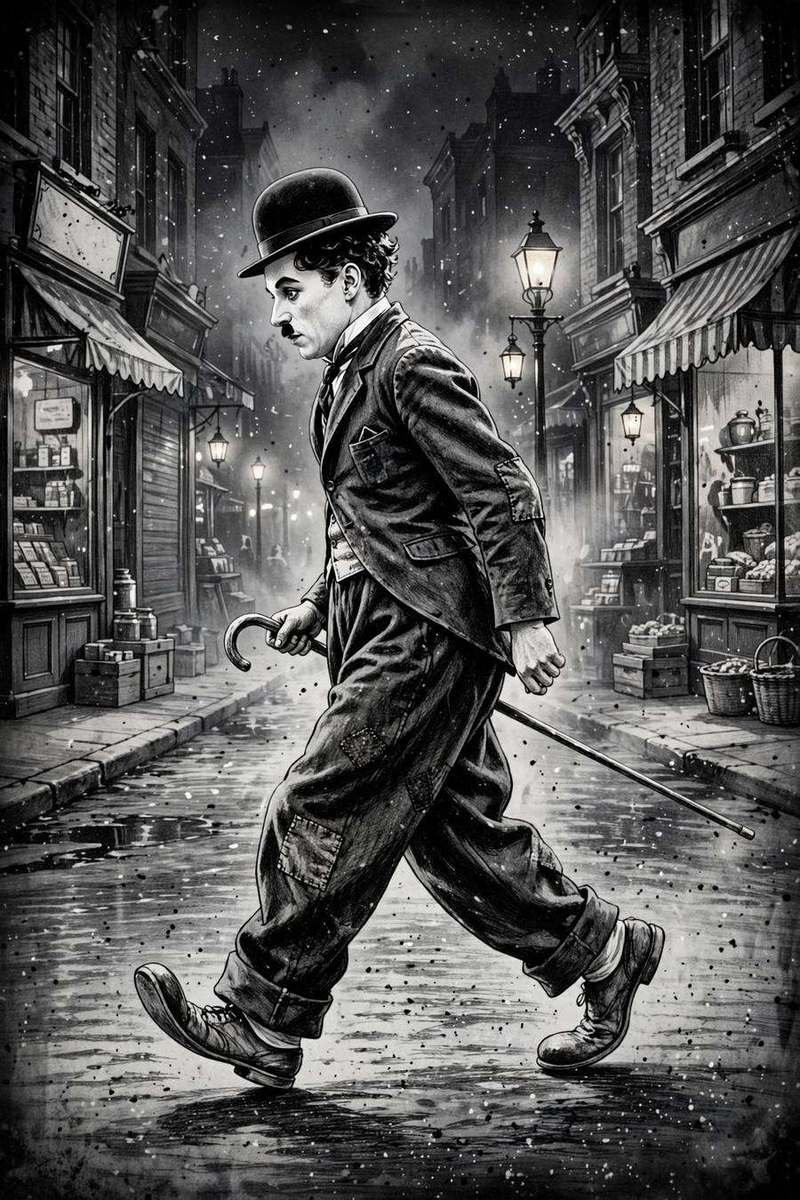
The Little Tramp — bowler hat, cane, and baggy trousers — became one of the most recognizable characters in film history. Chaplin assembled the costume from deliberately mismatched pieces in 1914 and kept it for the rest of his silent career.
Critics have called the Tramp a symbol of the hopes, fears, defeats, and optimism of all humanity. That sounds grand for a man in floppy shoes, but the character carried Chaplin through two world wars and a Depression because ordinary people saw themselves in him: the little guy, outmatched by the world, refusing to stop being decent.
What Are Charlie Chaplin’s Most Famous Films?
Chaplin made dozens of short films, but his reputation rests on a handful of features — each one written, directed, produced by, and starring him. Here are the essential ones:
| Year | Film | Why It Matters |
|---|---|---|
| 1921 | The Kid | Chaplin’s first feature as a director; mixes comedy with genuine heartbreak — the Tramp raises an abandoned child. |
| 1925 | The Gold Rush | The Tramp heads for the Klondike; contains the famous “dance of the rolls” and the boot-eating scene. |
| 1928 | The Circus | Won Chaplin a special Academy Award at the very first Oscars ceremony in 1929. |
| 1931 | City Lights | A silent romantic masterpiece released in the sound era; often called his finest film. |
| 1936 | Modern Times | Satire of industrial life and the assembly line; the Tramp’s last appearance. |
| 1940 | The Great Dictator | Chaplin’s first true talkie; a bold political satire that mocked fascism — earned him an Oscar nomination for best actor. |
| 1947 | Monsieur Verdoux | A dark comedy about a man who murders rich widows; shocking for its time. |
| 1952 | Limelight | A bittersweet farewell to the music hall; its score later won Chaplin another Academy Award. |
The Silent Masterpieces: The Kid, The Gold Rush, and City Lights
The Kid (1921) showed the world that a Tramp film could break your heart. Chaplin cast the young Jackie Coogan as the abandoned boy the Tramp takes in, and the result is part comedy, part tearjerker — a combination Chaplin kept returning to for the rest of his career.
The Gold Rush (1925) is the film Chaplin himself wanted to be remembered by. He plays a lone prospector in the Klondike, and the film swings between some of the funniest sequences ever filmed and some of the saddest. The scene where he eats his own boot for Thanksgiving dinner — carving it like a turkey, picking the laces like spaghetti — was reportedly his own favorite piece of comedy.
City Lights (1931) is the crown jewel. Chaplin released it as a silent film four years into the sound era, financing it himself through United Artists. The Tramp falls for a blind flower girl who believes he is a millionaire. The final close-up of Chaplin’s face — hope, shame, and joy all at once, without a word spoken — is studied in film schools to this day as one of the great moments in screen acting.
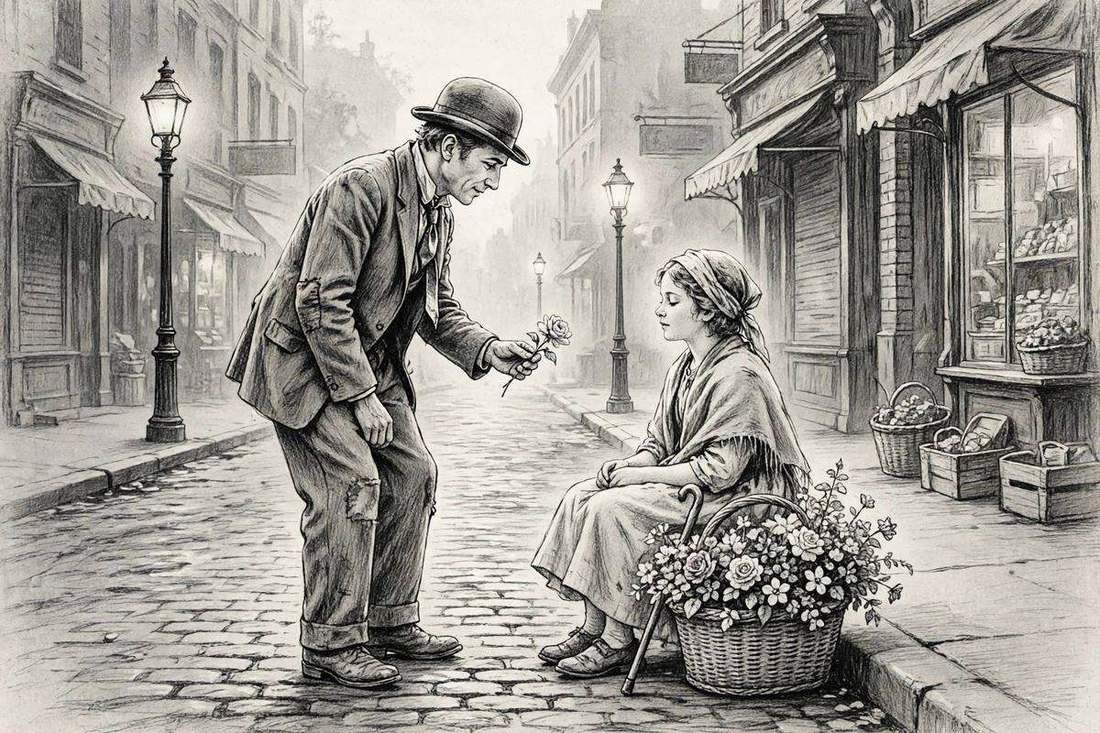
This illustration evokes Chaplin’s City Lights era, when he was making silent masterpieces even after sound had arrived in Hollywood. The film’s final scene remains one of the most celebrated moments in all of cinema.
Modern Times: The Silent Rebellion
Modern Times (1936) is Chaplin’s satire on industrial life, and it is also one of the boldest career moves in film history: he made it essentially silent nearly a decade after the talkies took over. The Tramp goes to work on a factory assembly line and is quite literally swallowed by the machinery — one of the most famous images Chaplin ever created.
The film’s message was unmistakable: machines were devouring the humans who served them. It was also the last time the Tramp ever appeared on screen. When the Tramp walks off down the road at the end, hand in hand with his companion, he walks out of cinema history. If you only watch one Chaplin film for its ideas, make it this one.
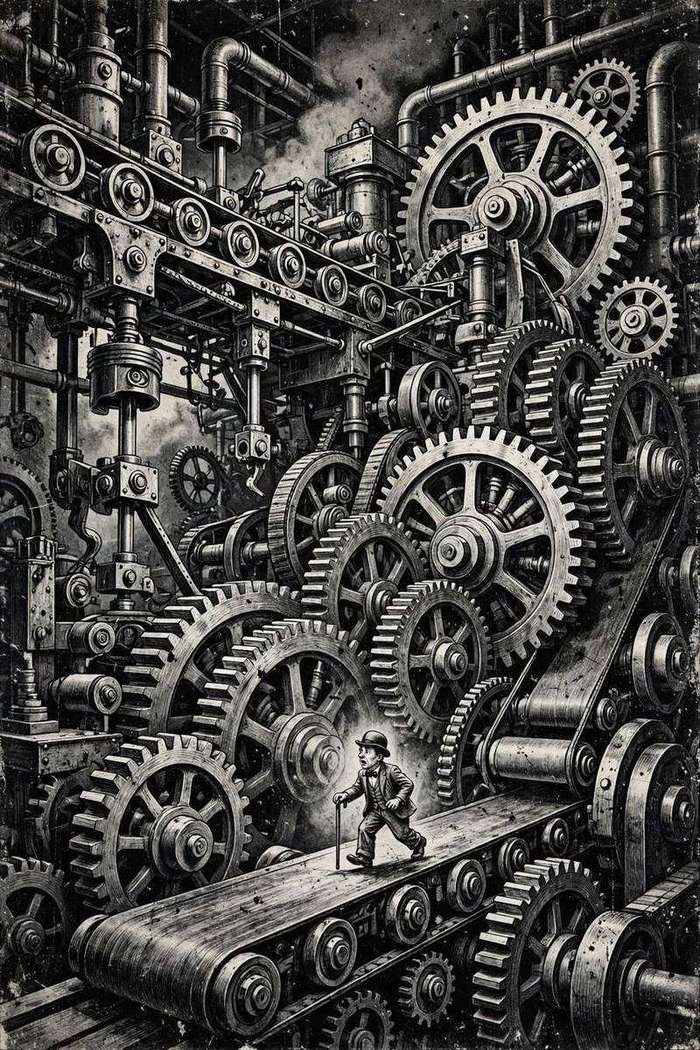
Modern Times (1936) put the Tramp on a factory assembly line to satirize industrial life. This illustration captures its famous image of a tiny worker overwhelmed by enormous machinery.
The Great Dictator: Chaplin Finds His Voice
The Great Dictator (1940) was Chaplin’s first full talking picture, and what a debut: he played dual roles — Adenoid Hynkel, a blustering dictator unmistakably modeled on Adolf Hitler, and a meek Jewish barber who gets mistaken for him. The film was a commercial and critical hit, and it earned Chaplin an Academy Award nomination for best actor.
The film ends with a direct-to-camera speech — several minutes of Chaplin, no longer the Tramp, pleading for humanity, tolerance, and peace. It was a shocking departure for a silent comedian, and it remains one of the most quoted and debated endings in film history. Making an anti-fascist satire in 1940, before America had even entered the war, took genuine courage.
The Later Films
After the war came Monsieur Verdoux (1947), a pitch-black comedy about a charming man who murders wealthy widows — Chaplin’s bleakest and most misunderstood film — and Limelight (1952), a tender story of an aging music-hall clown that doubled as Chaplin’s farewell to the world that raised him. He also made A King in New York (1957) and A Countess from Hong Kong (1967) in his European years.
For more remarkable life stories told well, take a look at 9Bio — its biographies of extraordinary people are written in the same spirit of making history feel human.
Why Did Charlie Chaplin Keep Making Silent Films in the Sound Era?
This is one of the most interesting things about Chaplin. The talkies arrived in 1927, and nearly every silent star either adapted or faded. Chaplin refused to follow the trend. He believed the Tramp’s comedy was universal precisely because it had no language — a silent film could play in Tokyo, Buenos Aires, and London without translation, and everyone would laugh at the same moments.
He had a point. City Lights (1931) and Modern Times (1936) were both enormous successes made silent long after sound had won. Chaplin only gave the Tramp up when he decided the character belonged to the silent era forever. When he finally embraced dialogue, he did it his way, on his terms, in a film that used speech as a weapon against tyranny.
Why Did Charlie Chaplin Leave America?
The end of Chaplin’s American career is the darkest chapter of his story. In the late 1940s and early 1950s, during the Red Scare and the McCarthy era, Chaplin’s outspoken sympathy for the poor and the working class made him a target. He was accused of harboring communist sympathies, and though he was never a member of any party, the accusations stuck in a climate of suspicion. The press turned on him; some of his films were boycotted.
In 1952, while traveling to Europe for the London premiere of Limelight, he was informed he would face questioning about his political views and moral fitness if he tried to re-enter the United States. Chaplin chose not to go back. He settled with his family in Corsier-sur-Vevey, Switzerland, where he lived for the rest of his life. It was, by most accounts, a happy exile — he had his family, his work, and his peace — but America lost its greatest filmmaker for a quarter of a century.
What Awards Did Charlie Chaplin Win?
For a man who dominated cinema for decades, Chaplin’s official award record is shorter than you might expect — partly because the Academy Awards barely existed when he was at his peak. But what he received matters enormously:
| Year | Award | Details |
|---|---|---|
| 1929 | Special Academy Award | At the first-ever Oscars ceremony, for writing, directing, producing, and starring in The Circus. |
| 1940 | Oscar nomination | Best actor for The Great Dictator. |
| 1972 | Honorary Academy Award | For “the incalculable effect he has had in making motion pictures the art form of this century” — accepted to a legendary 12-minute standing ovation. |
| 1972 | Academy Award | Best original dramatic score for Limelight, decades after the film was made. |
| 1975 | Knighthood | Knighted by Queen Elizabeth II for services to entertainment, becoming Sir Charles Chaplin. |
The 1972 honorary Oscar was the emotional high point. Chaplin returned to America for the first time in twenty years, walked onto the Academy Awards stage, and received an ovation that ran a full twelve minutes — one of the longest in the ceremony’s history. He had outlived his enemies. The industry that had exiled him was applauding him home.
What Is Charlie Chaplin’s Legacy Today?
The Filmmaker’s Filmmaker
Chaplin proved that comedy could be art — not just entertainment between the “serious” films, but the art form itself, carrying ideas about poverty, dignity, mechanization, and tyranny. Generations of directors, from Federico Fellini to Woody Allen to modern physical comedians, have named him as a direct influence. His working method was famously obsessive: he would shoot hundreds of takes of a single gag until it landed exactly right, a perfectionism that drove his crews mad and his films into history.
He also wrote film history’s blueprint for creative independence. United Artists — his 1919 company with Pickford, Fairbanks, and Griffith — was the original statement that artists should own their work, an idea that echoes through every independent filmmaker and creator-owned platform today.
The Cultural Symbol
The Tramp never really left. The silhouette — hat, cane, moustache, waddle — is one of the most imitated images in popular culture, from advertising to street art to Halloween costumes. His films are still screened, restored, and studied, and they still work: children who have never heard of silent cinema laugh at the Tramp the first time they see him. Comedy that needs no translation does not age.
There are good roundups of cultural history across the web, too — for instance, Daily Scope 67 covers the stories and figures that shaped popular culture, if you enjoy this kind of deep dive.
Facts About Charlie Chaplin Most People Miss
- He composed his own film scores. From 1918 onward Chaplin wrote the music for his films, including the haunting theme for Limelight, “Eternally.”
- He was once told he had no future in film. Early skeptics said his stage style would never work on camera. He proved otherwise within a year.
- His body was stolen. In 1978, months after his death, grave robbers stole his coffin from the Swiss cemetery and demanded a ransom from his widow, Oona. Police recovered the coffin and caught the culprits; he was reburied under reinforced concrete.
- He was a perfectionist to an extreme. Chaplin routinely shot a scene dozens or hundreds of times — a habit that made him slow and expensive, and his films timeless.
- He never became an American citizen. Despite living in the United States for forty years, Chaplin remained a British subject his entire life.
- His fourth wife was Oona O’Neill, the daughter of playwright Eugene O’Neill. They married when he was 54 and she was 18, and stayed together for 34 years until his death.
Frequently Asked Questions
Who was Charlie Chaplin?
Charlie Chaplin (1889–1977) was a British actor, director, writer, producer, and composer who became the most famous star of the silent-film era. He is best known for his character the Little Tramp and for classics like City Lights, Modern Times, and The Great Dictator.
What is Charlie Chaplin famous for?
He is famous for the Little Tramp — the bowler-hatted, cane-twirling silent-film character — and for turning screen comedy into an art form. His films blended slapstick with deep emotion and social commentary, and he wrote, directed, produced, and starred in nearly all of them.
What was Charlie Chaplin’s first movie?
His film debut was Making a Living, a Keystone Studios short released in February 1914. He first played the Tramp later that year in Kid Auto Races at Venice.
Why did Charlie Chaplin not talk in his movies?
Chaplin believed silent comedy was universal — it needed no translation, so the same film could make audiences laugh in London, Tokyo, and Buenos Aires. He kept making silent films (City Lights, Modern Times) long after the talkies arrived, and only embraced dialogue with The Great Dictator in 1940.
How did Charlie Chaplin die?
Chaplin died in his sleep on Christmas Day, 25 December 1977, at his home in Corsier-sur-Vevey, Switzerland. He was 88. He had lived in Switzerland since leaving the United States in 1952.
Did Charlie Chaplin win an Oscar?
Yes — several. He received a special Academy Award at the first Oscars in 1929 for The Circus, an honorary Oscar in 1972 for his lifetime contribution to cinema (accepted to a 12-minute standing ovation), and an Oscar for the score of Limelight. He was also nominated for best actor for The Great Dictator and was knighted in 1975.
Where can I watch Charlie Chaplin’s movies?
His major films — The Kid, The Gold Rush, City Lights, Modern Times, and The Great Dictator — are widely available on major streaming platforms and in restored editions. Start with City Lights or Modern Times; both are perfect introductions.
Final Thoughts
Charlie Chaplin started as a hungry kid in a London workhouse and ended as Sir Charles Chaplin, the most famous clown who ever lived. In between, he reinvented what movies could do: he made the world laugh without saying a word, made silence speak louder than dialogue, and then — when it mattered most — found his voice to stand against tyranny.
Watch the Tramp eat a boiled boot like it is Thanksgiving dinner, or get swallowed by a factory machine, or look into a flower girl’s eyes in the last shot of City Lights, and you are watching something that has not dated in a century. That is the real test of art: does it still work when everything around it has changed? Chaplin’s work does. It probably always will.
Read Also: How Do Black Holes Form? Stellar Collapse to Supermassive Giants (Explained Simply)

1 Comment