
Somewhere in the sky right now, a star is dying. Not quietly, and not like our Sun will. This star is enormous — tens of times heavier than the Sun — and when it runs out of fuel, it won’t fade into a gentle ember. Its core will implode in less than a second, squeeze itself into a space smaller than a city, and leave behind the strangest object physics has ever described: a black hole. But how do black holes form?
Black holes sound like science fiction, but astronomers are confident they’re real. They’ve photographed one’s shadow, detected the ripples two of them make when they collide, and tracked stars whipping around an invisible point at the heart of our own galaxy. But how do black holes form? It starts with an ordinary — if enormous — star, and ends with gravity winning a war it has been losing for millions of years.
The short answer to how do black holes form: Most black holes form when a massive star — at least 20 times the mass of our Sun — runs out of nuclear fuel. Fusion stops, gravity takes over, and the star’s core collapses in on itself in a fraction of a second. The outer layers blast outward as a supernova, while the core crushes down so far that nothing, not even light, can escape. That collapsed core is a black hole.
What Is a Black Hole, Really?
Before we get into how they form, it helps to be precise about what we’re describing. A black hole is a region of space where so much mass has been packed into such a small volume that the escape velocity — the speed something would need to climb back out — exceeds the speed of light. Since nothing travels faster than light, nothing inside that boundary can ever leave.
That boundary has a name: the event horizon. Cross it, and you are cut off from the rest of the universe forever. What’s inside is thought to be a singularity — a point (or region) of extraordinary density where our current laws of physics break down and stop giving sensible answers.
Here’s the part that surprises most people: a black hole isn’t a cosmic vacuum cleaner. It doesn’t reach out and suck everything in. Outside the event horizon, its gravity behaves like any other mass. If our Sun were somehow swapped for a black hole of the same mass, Earth would keep orbiting exactly as it does now — we’d just freeze in the dark. Black holes are dangerous because they’re dense, not because they’re greedy.
Because no light escapes from within the event horizon, we can’t photograph a black hole directly. Astronomers find them by their effects: stars orbiting an invisible point, gas glowing white-hot as it spirals inward, and — since 2015 — gravitational waves rippling through spacetime when two of them merge. The 2019 image from the Event Horizon Telescope of the shadow in galaxy M87 wasn’t a photo of the black hole itself, but of the hot gas around it, with a dark silhouette in the middle where light had vanished. Which brings us to the central question: how do black holes form?
What Keeps a Star Alive — and What Kills It?
Every star, including our Sun, survives because of a stalemate. On one side is gravity, trying to crush the star’s enormous mass inward. On the other is the outward pressure from nuclear fusion in the core — hydrogen atoms fusing into helium, releasing colossal energy. Physicists call this balance hydrostatic equilibrium, and it holds for almost the entire life of a star.
The key insight is that a star is always on a countdown. Fusion consumes fuel. A star fuses hydrogen into helium for most of its life — the Sun will do this for about 10 billion years total — but eventually the hydrogen in the core runs out. What happens next depends entirely on how massive the star is.
Low-mass stars like the Sun swell into red giants, shed their outer layers, and settle down as white dwarfs: small, dense embers that slowly cool over billions of years. Nothing dramatic. But massive stars — the ones that can become black holes — take a far more violent path. That violent end is exactly where the answer to “how do black holes form” begins.
How Does a Massive Star Run Out of Fuel?
A star more than about 8 times the mass of the Sun lives fast and dies young. Its core burns through hydrogen quickly, then starts fusing helium into carbon, carbon into oxygen, oxygen into silicon — layering up like an onion, with heavier and heavier elements burning in shells around the core. A truly massive star can complete this entire sequence in just a few million years, while the Sun will live ten billion.
The sequence has a hard stop, though: iron. Fusing elements lighter than iron releases energy, which is what keeps pushing back against gravity. But fusing iron consumes energy instead of releasing it. So once a star builds an iron core, fusion can no longer pay the bills. The outward pressure that held gravity at bay for the star’s whole life vanishes, almost overnight.
What follows is one of the most violent events in nature: core collapse. With nothing to support it, the iron core — roughly the size of Earth but vastly more massive — falls inward at about a quarter of the speed of light. In less than a second, it is crushed into something incomprehensibly dense. The gravitational energy released in that moment is so enormous it briefly outshines entire galaxies.
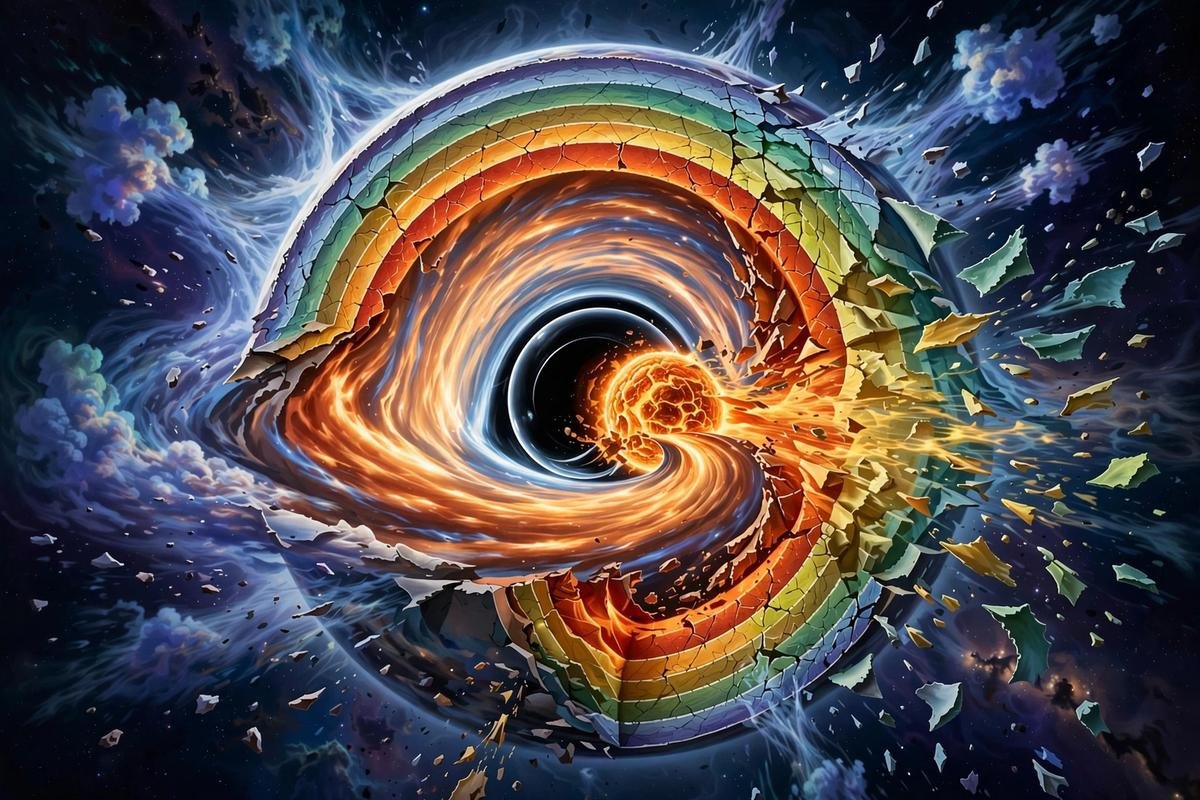
So how do black holes form from here — with a bang, or quietly?
What Is a Supernova, and Is It Always Part of the Story?
When the core collapses, the outer layers of the star rebound off it and are blasted outward in a titanic explosion called a supernova. For a few weeks, a single supernova can shine brighter than its entire host galaxy. It’s not just a firework — supernovae forge and scatter the heavy elements (carbon, oxygen, iron, gold) that make up planets and people. The iron in your blood was literally blasted out of a dying star.
But here’s a twist that’s changed the textbooks in recent years: the supernova doesn’t always happen. Some massive stars seem to collapse directly into black holes without any dramatic explosion — a “failed supernova” or direct-collapse route. Astronomers have watched at least one supergiant star in a nearby galaxy simply fade away and vanish from telescopes, likely having collapsed quietly into a black hole. So while the supernova is the classic picture, it may be optional.
What matters is the fate of the core, not the fireworks around it. And the core’s fate comes down to one thing: mass.
Neutron Stars vs. Black Holes: Where’s the Line?
After core collapse, the remnant left behind falls into one of two categories, and the dividing line is brutally precise. If the collapsed core is heavy enough to keep crushing past the neutron-star stage, a black hole is born. If not, you get a neutron star — the densest thing in the universe that isn’t a black hole.
The neutron star: a failed black hole
A neutron star packs about one and a half times the mass of the Sun into a ball roughly 20 kilometres across — the size of a small city. Its density is so extreme that a teaspoon of neutron-star material would weigh billions of tonnes. It resists further collapse because of a quantum rule called the Pauli exclusion principle: neutrons simply refuse to be squeezed any closer together.
But this resistance has a limit. Theoretical work puts the maximum stable mass of a neutron star at roughly three times the mass of the Sun (the Tolman–Oppenheimer–Volkoff limit). Push past it, and even quantum mechanics can’t hold gravity back. The collapse continues — and a black hole is the result.
Stellar remnants at a glance
| Star’s initial mass | What it becomes | Size of remnant |
|---|---|---|
| Less than ~8 solar masses | White dwarf | Roughly Earth-sized |
| ~8–20 solar masses | Neutron star | ~20 km across |
| More than ~20 solar masses | Stellar-mass black hole | Singularity inside an event horizon |
These thresholds are approximate — rotation, composition, and how much mass the star sheds during its life all shift the exact numbers. The widely quoted rule of thumb, used by NASA and most astronomy outreach, is that forming a stellar-mass black hole requires a star of at least 20 times the mass of the Sun. Below that line, the answer to “how do black holes form” is: they don’t.
How Do Black Holes Form and Grow? Mergers and Accretion
A stellar-mass black hole is born weighing a handful of solar masses. But many black holes are far heavier than that, so something must fatten them up over time. Birth is “how do black holes form”; growth is how they become giants. There are two well-established growth routes.
Feeding: gas and accretion disks
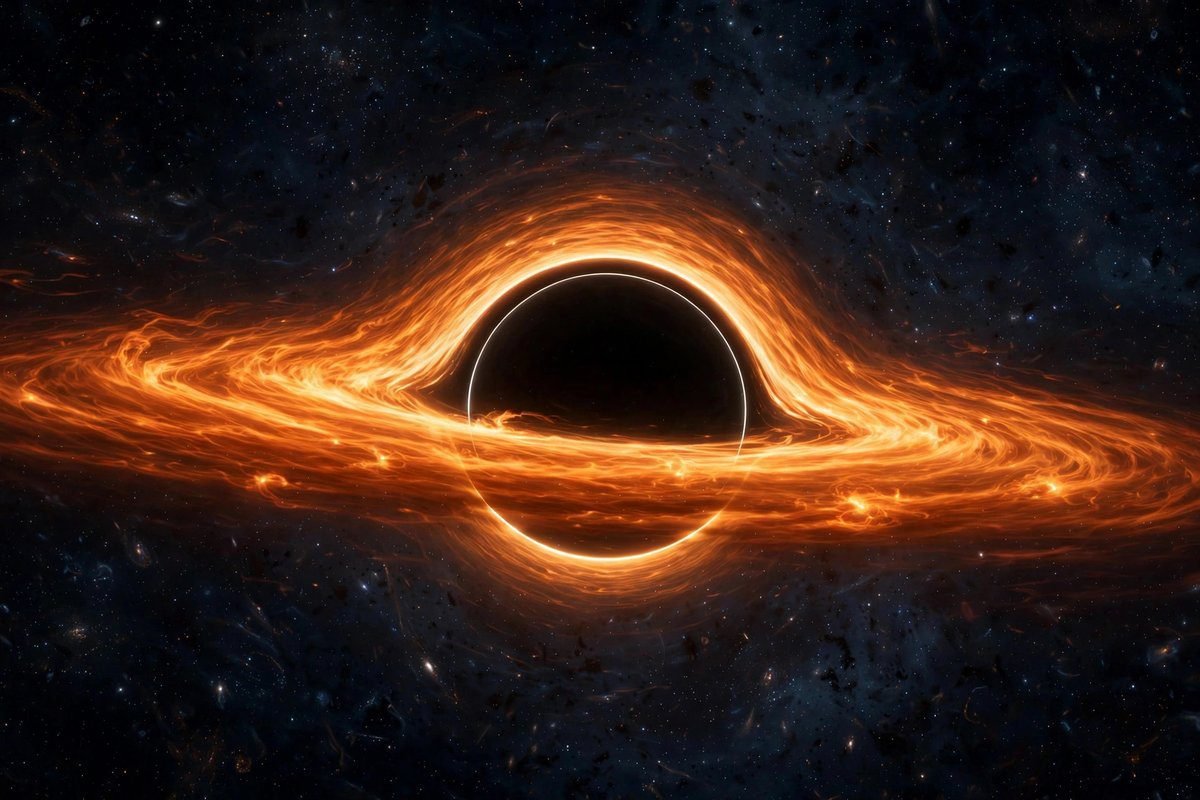
If a black hole sits in a gas-rich environment — say, next to a companion star — it pulls in matter. That gas doesn’t fall straight in; it spirals, forming a flat, glowing structure called an accretion disk. Friction in the disk heats the gas to millions of degrees, making it one of the brightest things in the universe before it crosses the event horizon and vanishes. Some black holes in binary systems are discovered exactly this way: we see the glowing disk and the wobbling companion star, and infer the invisible partner between them. Cygnus X-1, the first widely accepted black-hole candidate, was identified through this kind of evidence.
Merging: collisions detected as gravitational waves
The second growth route is far more dramatic. When two black holes spiral together and merge, the collision shakes the fabric of spacetime itself, sending out gravitational waves. Detectors like LIGO and Virgo have recorded dozens of these mergers since the first detection in 2015. Each event ends with a single, heavier black hole — and for a fraction of a second, the merger radiates more power than all the stars in the observable universe combined.
Mergers are how astronomers think black holes climbed from a few solar masses to dozens. A recent survey of the merger catalogue found black holes in the 100-solar-mass range that were almost certainly built by repeated collisions. It’s a ladder, rung by rung. Think of mergers as a second chapter to “how do black holes form”: not birth, but growth.
How Do Supermassive Black Holes Form?
And then there are the monsters. Almost every large galaxy appears to have a supermassive black hole at its centre, weighing millions or billions of times the mass of the Sun. Ours, Sagittarius A*, is about four million solar masses. The one in galaxy M87 is billions. These objects are so big they defy the ladder described above — mergers and steady feeding, at the rates we observe, shouldn’t have had enough time to build them in the early universe.
So how do supermassive black holes form? The stellar story behind “how do black holes form” is well understood — but scaling it to millions of solar masses is one of the biggest open questions in astrophysics. The leading ideas include:
- Runaway mergers: in dense young star clusters, stellar-mass black holes merged repeatedly, then merged with each other, climbing the mass ladder quickly.
- Direct collapse: in the early universe, giant clouds of gas — far more massive than any star — collapsed straight into black holes weighing thousands or tens of thousands of solar masses, skipping the star stage entirely. These “heavy seeds” then grew by accretion.
- Primordial black holes: a more speculative idea, in which black holes formed in the first fractions of a second after the Big Bang from dense pockets of matter. None has ever been confirmed.
Whatever the exact mechanism, astronomers agree on one thing: supermassive black holes and their galaxies grew up together, shaping each other’s evolution.
Black holes by size
| Type | Typical mass | How it forms |
|---|---|---|
| Stellar-mass | 3–100 solar masses | Collapse of a massive star’s core |
| Intermediate-mass | 100–100,000 solar masses | Probably repeated mergers; rarely observed |
| Supermassive | Millions to billions of solar masses | Uncertain — mergers, direct collapse, or both |
Could Our Sun Ever Become a Black Hole?
No — and this is worth saying clearly, because it’s one of the most common worries. The Sun is about twenty times too light. In roughly five billion years it will swell into a red giant, shed its outer layers, and settle down as a white dwarf: a cooling ember about the size of Earth. No supernova, no event horizon, no drama.
Nor can a black hole form spontaneously from ordinary matter here on Earth. The mass just isn’t available. Black holes need stellar-scale violence — the death of a star dozens of times heavier than the Sun — and there’s nothing remotely like that in our neighbourhood. The recipe for “how do black holes form” simply doesn’t exist here.
How Do Astronomers Know Any of This Is Real?
Given that black holes are invisible by definition, it’s fair to ask how confident scientists really are. The honest answer: very. The evidence is layered and independent.
- Orbits: stars at the centre of the Milky Way have been tracked for decades whipping around an invisible point of immense mass — Sagittarius A*. The astronomers who led this work won the 2020 Nobel Prize in Physics.
- Shadows: the Event Horizon Telescope imaged the glowing ring of hot gas around the black holes in M87 (2019) and Sagittarius A* (2022), each with a dark central shadow exactly where an event horizon should be.
- Gravitational waves: since 2015, LIGO, Virgo, and KAGRA have detected close to a hundred black-hole mergers, measuring their masses and spins directly from the ripples.
- X-rays: accretion disks around stellar-mass black holes like Cygnus X-1 glow fiercely in X-rays, letting telescopes map material in its final orbits.
Each of these is an independent line of evidence, and they all agree. Black holes aren’t a theory anymore — they’re an observational science, and that includes the story of “how do black holes form.”
Frequently Asked Questions
How long does it take for a black hole to form?
The final core collapse is astonishingly fast — a fraction of a second, with the core falling inward at about a quarter of the speed of light. But the star that makes it possible has to live first: a massive star burns through its fuel in just a few million years, compared with the Sun’s ten-billion-year lifespan.
What is the event horizon?
The event horizon is the boundary around a black hole where the escape velocity equals the speed of light. Anything that crosses it — matter, light, information — can never come back out. It isn’t a physical surface; it’s a point of no return set by gravity.
What’s inside a black hole?
Nobody knows for certain, and that’s not a dodge. Our best theories predict a singularity — a region of extreme density where general relativity breaks down. A full answer will require a theory of quantum gravity, which physicists are still working on.
Do black holes last forever?
Almost. Stephen Hawking showed that black holes should slowly leak energy as faint “Hawking radiation,” which means they evaporate — but the process is unimaginably slow. A stellar-mass black hole would take far longer than the current age of the universe to evaporate. For all practical purposes, they’re permanent.
Can two black holes merge?
Yes, and they do it often. When two black holes orbit each other, they spiral inward and collide, releasing gravitational waves. Detectors on Earth have recorded dozens of these mergers since 2015, and each one creates a single, heavier black hole. Every merger is a reminder that “how do black holes form” has a second act: growth by collision.
What’s the difference between a black hole and a wormhole?
A black hole is a real, observed object: a collapsed region of extreme gravity. A wormhole is a theoretical tunnel through spacetime that some solutions of Einstein’s equations allow, but none has ever been observed — and there’s no evidence they can form or stay open. Don’t confuse the two.
Will the Milky Way’s black hole ever swallow Earth?
No. Sagittarius A*, the supermassive black hole at our galaxy’s centre, is about 26,000 light-years away and Earth is in a stable orbit around the galaxy. Black holes don’t roam around hunting planets; their gravity behaves like any other mass at a distance.
Conclusion
Black holes form the same way almost everything dramatic in the universe forms: from the death of something enormous. A massive star spends millions of years holding gravity at bay with nuclear fusion, builds an iron core that fusion can’t sustain, and then — in less than a second — collapses into an object so dense that not even light can escape. Supernovae, neutron stars, accretion disks, and mergers fill in the rest of the story, and the supermassive giants at the hearts of galaxies remain the biggest puzzle of all. From stellar collapse to galactic giants, that is the story of “how do black holes form.”
The next time you look up at the night sky, remember that somewhere out there, a massive star is running out of fuel. And now, if someone asks you “how do black holes form,” you’ll know the answer. In a few million years, where it stood, there will be a brand-new black hole — invisible, silent, and utterly real.
Read Also: Honda Brand Guide 2026: History, Models & Reliability

1 Comment