
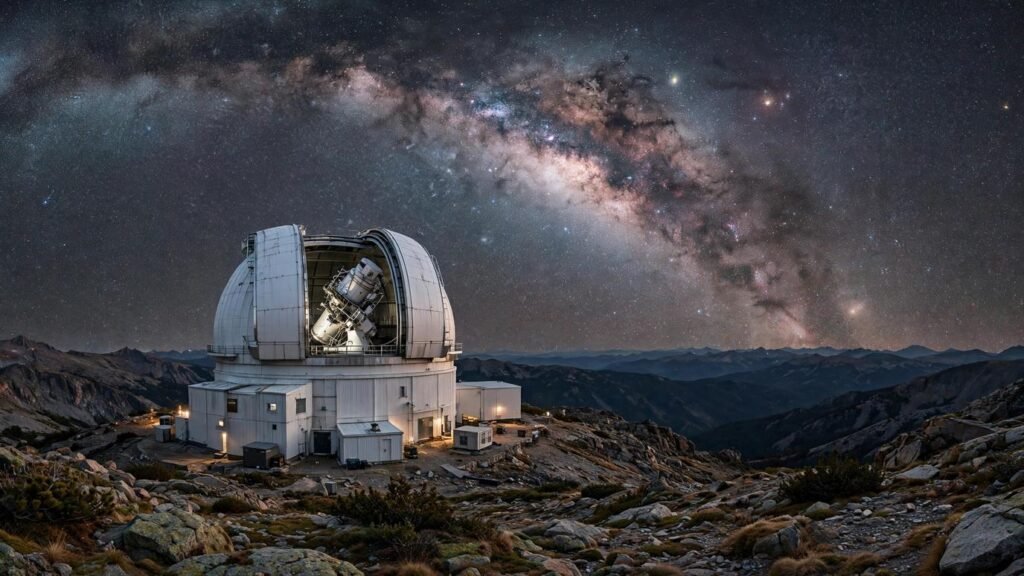
Point a telescope at the night sky and a natural question follows: just how far can it actually see? It feels like there should be a single number — a maximum range printed on the box, the way a car’s top speed is printed in a brochure. Telescopes do not work that way, and that is part of what makes them so fascinating.
The honest answer is that a telescope’s reach is not fixed. It shifts with the size of its mirror or lens, the brightness of whatever you are looking at, the darkness of your sky, and even the steadiness of the air above you. A small backyard telescope and the James Webb Space Telescope are both telescopes, yet the distances they can reach differ by a factor of millions. Understanding why that gap exists will change how you look through any eyepiece — and help you get far more out of the telescope you already own.
The short answer: A telescope has no single maximum distance. Under a dark sky, your unaided eyes already reach about 2.5 million light-years to the Andromeda Galaxy. A modest backyard telescope pushes that to tens of millions of light-years for bright galaxies, while the Hubble and James Webb space telescopes have captured galaxies more than 13 billion light-years away. The limit is not distance itself — it is how much faint light a telescope can gather from an object bright enough to stand out against the darkness.
How Far Can a Telescope See, Really?
Ask five astronomers this question and you may get five different answers, because each one is quietly answering a slightly different question. One might be thinking about the farthest single object ever detected. Another might mean the farthest thing a typical amateur can realistically see on a clear night. A third might be talking about the edge of the observable universe itself — the theoretical limit beyond which no telescope, no matter how powerful, will ever see.
All three answers are real, and all three matter. The trick is knowing which one applies to you. If you are standing in your backyard with a telescope you bought last Christmas, your practical limit is very different from a space observatory’s. But the physics connecting them is exactly the same, and it is surprisingly simple once you break it down.
Why There Is No Single Maximum Distance
A telescope does not “zoom” to a distance the way a camera lens zooms to a subject. It collects light. Every star, galaxy, and nebula sends a stream of photons across space, and the farther away an object sits, the more spread out and diluted that stream becomes by the time it reaches Earth. A telescope’s job is to catch enough of those photons to build an image your eye — or a camera sensor — can actually register.
That is why distance alone never tells the whole story. A brilliant nearby star can be far easier to see than a dim, distant galaxy, even though the galaxy is enormously farther away. Astronomers describe this with the idea of apparent brightness: how bright an object looks from Earth, regardless of how bright it truly is. A telescope extends your reach mainly by gathering more light than your pupil can, which lets fainter — and therefore often farther — objects cross the threshold of visibility.
Think of it like hearing a whisper across a room. Cupping your hand behind your ear does not change how far away the speaker stands; it simply collects more of the sound reaching you. A telescope’s aperture works the same way for light. The bigger the “cup,” the fainter the whisper it can pick up.
What Actually Limits a Telescope’s Reach?
Four factors do most of the work in deciding how far a telescope can see on any given night. Change any one of them and the answer changes with it.
Aperture: the size of the light bucket
Aperture — the diameter of a telescope’s main mirror or lens — is the single biggest factor. A telescope with twice the aperture collects four times as much light, because light-gathering power grows with the area of the opening, not just its width. That is why a 12-inch Dobsonian reveals galaxies that a small 60mm refractor can only hint at, even under the same sky.
The brightness of the object itself
Some cosmic objects are simply loud. A quasar — the blazing core of a young galaxy powered by a supermassive black hole — can outshine its entire host galaxy, which is why astronomers have spotted quasars billions of light-years away with telescopes that could never resolve an ordinary galaxy at that distance. Brightness beats distance, every time.
Your sky: darkness and atmosphere
Light pollution is the amateur astronomer’s worst enemy. From a city balcony, the sky glows, and faint galaxies drown in that glow no matter how good the telescope is. Under a truly dark rural sky, the same telescope can show objects many times fainter. Turbulent air matters too: unsteady atmosphere blurs fine detail, which is one reason the great observatories sit on high, dry mountaintops — and why the sharpest views of all come from telescopes above the atmosphere entirely.
Exposure time: patience as a superpower
Your eye takes in a scene in fractions of a second. A camera attached to a telescope can stare at one patch of sky for hours, patiently stacking photon upon photon until an object far too faint for any eye emerges from the dark. This is how the Hubble Deep Field images revealed thousands of galaxies in a patch of sky that looked empty. Time, in astronomy, is a kind of aperture all its own.
How Far Can the Naked Eye See?
Before you ever lift a telescope, your eyes already perform a small miracle. On a dark, moonless night, far from city lights, you can see the Andromeda Galaxy as a faint smudge of light — and Andromeda sits roughly 2.5 million light-years away. That means the photons hitting your retina left that galaxy 2.5 million years ago, long before modern humans existed.
Under exceptional skies, experienced observers have also reported glimpsing the Triangulum Galaxy, about 2.7 million light-years distant, though it is a much tougher catch. Either way, the naked-eye benchmark is worth remembering: without any instrument at all, you are already seeing across millions of light-years. Everything a telescope adds builds on that astonishing baseline.
How Far Can a Backyard Telescope See?
This is where the question gets personal, because it depends on the telescope in your hands and the sky above your head. A typical beginner telescope — say, a 4- to 8-inch reflector — will easily show you:
- The Moon and planets in crisp detail, from a fraction of a light-second to a few light-hours away.
- Star clusters and nebulae within our own Milky Way, thousands of light-years distant.
- Bright galaxies like Andromeda (2.5 million light-years) in real structure — not just a smudge, but a glowing core with hints of its spiral arms.
- Farther galaxy groups, such as the Virgo Cluster roughly 54 million light-years away, where a good telescope under dark skies can pick out individual member galaxies.
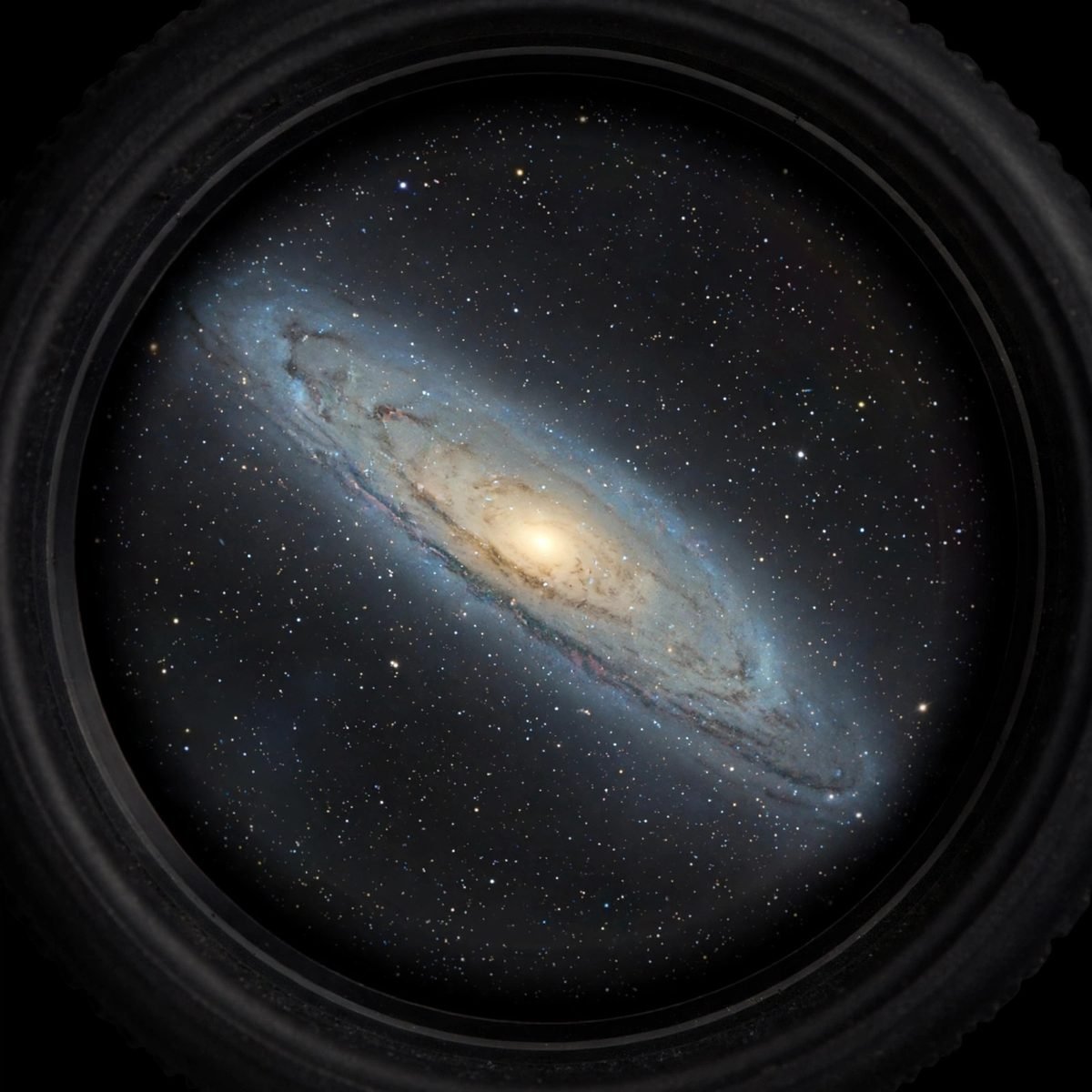
Larger amateur telescopes, in the 12- to 16-inch range, push deeper still. Skilled observers under pristine skies have logged galaxies 200 million light-years away and beyond — faint smudges, yes, but real photons from real galaxies that left home when dinosaurs still walked the Earth. The catch is that these are not the postcard views of popular astronomy books. At the edge of an amateur telescope’s reach, galaxies appear as dim gray patches, and finding them is half the adventure.
One honest note: magnification is not the secret here. Beginners often assume a more powerful eyepiece means seeing farther. In practice, cranking up the magnification spreads an object’s light thinner and makes it dimmer. For faint galaxies, lower magnification and a dark sky will almost always beat a high-power eyepiece.
How Far Can Professional Ground-Based Telescopes See?
Step up to the great observatories — the 8- to 10-meter class telescopes on mountaintops in Hawaii and Chile — and the numbers jump dramatically. These instruments gather millions of times more light than the human eye, and with long camera exposures they routinely image galaxies billions of light-years away.
The current generation of giant telescopes now under construction, with mirrors around 30 to 39 meters across, will go deeper still, studying the faint light of the universe’s first galaxies in detail that today’s telescopes can only hint at. Even so, ground-based telescopes share one unavoidable handicap: they must peer through Earth’s atmosphere, which blurs images and blocks some wavelengths of light entirely. That is why the farthest views of all belong to telescopes in space.
How Far Can Hubble and the James Webb Space Telescope See?
The Hubble Space Telescope, freed from atmospheric blur, has photographed galaxies whose light has traveled for more than 13 billion years to reach us. Its famous deep-field images stared at tiny, seemingly empty patches of sky for days and returned thousands of galaxies, some among the most distant objects ever seen.
The James Webb Space Telescope has gone further. Because it observes in infrared light, it can see through cosmic dust and catch the stretched, reddened light of the earliest galaxies — light that left its source over 13.5 billion years ago, when the universe was only a few hundred million years old. Some of Webb’s most distant confirmed galaxies sit roughly 13.4 to 13.5 billion light-years away in terms of light travel time.
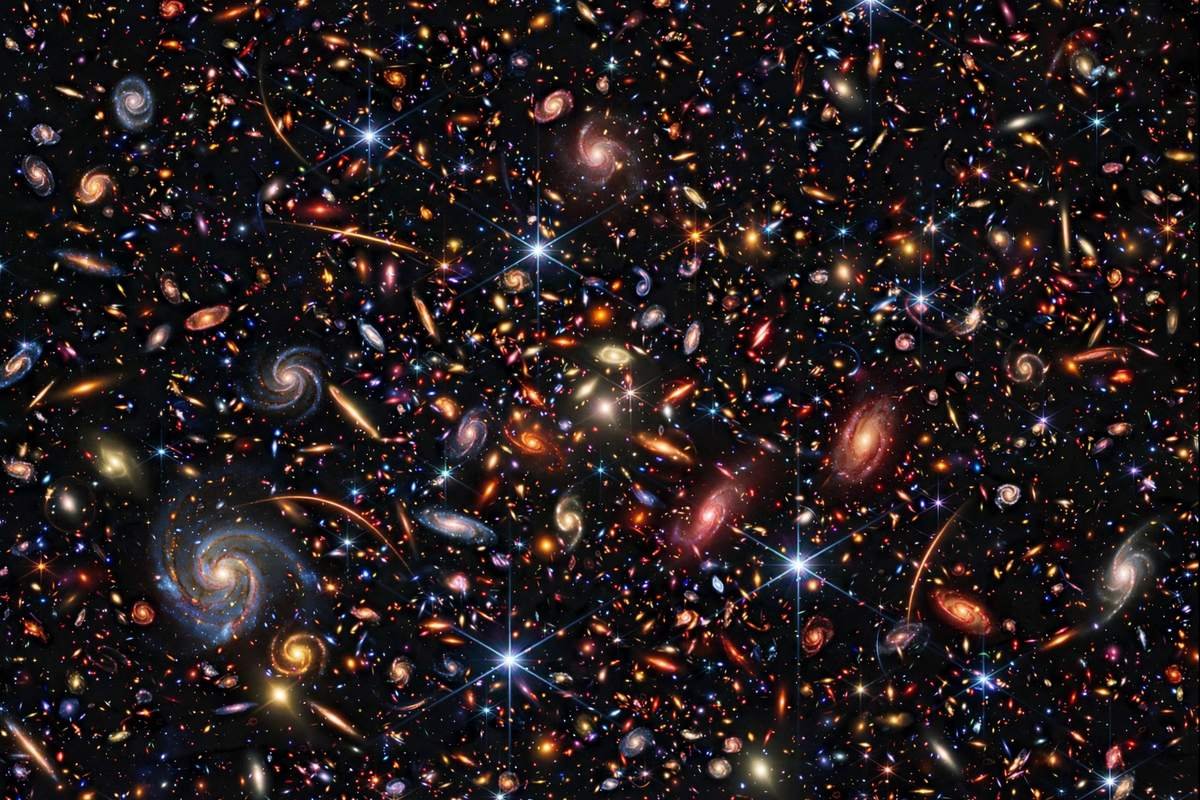
Here is a subtlety worth knowing: astronomers quote two different distances for these ancient galaxies. The light travel time is about 13.5 billion years, but because the universe has been expanding all the while that light was traveling, those galaxies are now far more distant — roughly 32 billion light-years away in today’s terms. Both numbers describe the same object; they just answer different questions. When you read that Webb saw a galaxy “13.5 billion light-years away,” you are reading its light travel distance, the more intuitive of the two.
What Is the Absolute Limit? The Observable Universe
If you keep asking “how far can a telescope see” until there is nowhere left to go, you arrive at the edge of the observable universe. Because the universe is about 13.8 billion years old, and because space itself has expanded during all that time, the farthest region we could ever observe is now roughly 46 billion light-years away in any direction — making the observable universe about 93 billion light-years across.
This is not a limit of technology. It is a limit of time and physics. Light from beyond that edge has not had enough time to reach us, and because distant space is expanding faster than light can cross it, that light may never reach us at all. No telescope, however large, can see past the observable universe. It is the final answer to the question — and also a reminder of how much of reality lies forever beyond our view.
Can a Telescope See to the Edge of Time?
In a poetic sense, every telescope is a time machine. When you look at the Sun, you see it as it was about eight minutes ago. When you look at Andromeda, you see it as it was 2.5 million years ago. When Webb photographs a galaxy 13.5 billion light-years away, it is showing us the universe as it was in its infancy.
That is why astronomers chase distance so eagerly. Looking farther away is literally looking further back in time. The faintest, most distant galaxies are not just records to break — they are snapshots of how the first stars ignited, how galaxies assembled, and how the universe grew from a hot, dense beginning into the star-filled expanse we see today.
Telescope Types Compared: Who Sees Farthest?
Not all telescopes are built for the same job. A refractor uses lenses, a reflector uses mirrors, and a compound design mixes both. For pure deep-sky reach, aperture usually wins over design, but each type has its strengths, and the table below puts them side by side.
| Telescope type | Typical aperture | Best for | Realistic deep-sky reach |
|---|---|---|---|
| Small refractor | 60–90 mm | Moon, planets, double stars | Bright galaxies like Andromeda (~2.5M light-years) |
| Mid-size reflector (Dobsonian) | 150–300 mm | Galaxies, nebulae, clusters | Galaxy groups tens of millions of light-years away |
| Large amateur reflector | 300–400 mm | Faint galaxies under dark skies | Faint galaxies 100M+ light-years away |
| Professional ground observatory | 8–10 m | Research imaging | Galaxies billions of light-years away |
| Space telescope (Hubble / Webb) | 2.4 m / 6.5 m | Deepest cosmic imaging | Galaxies over 13B light-years away (light travel time) |
Notice something interesting in that last row: Webb’s mirror is smaller than the biggest ground-based telescopes, yet it sees farther. Location matters as much as size. Above the atmosphere, in the cold dark of space, and observing in infrared, Webb escapes the limits that hold even giant mountaintop telescopes back.
How to See Farther With the Telescope You Already Own
You do not need a bigger telescope to see farther — you need better conditions and better technique. These five steps make the biggest difference, and none of them cost a fortune:
- Get to dark skies. Even a half-hour drive away from city lights can transform what your telescope shows. A dark-sky site is worth more than a bigger mirror under bright skies.
- Let your eyes adapt. Give yourself at least 20 to 30 minutes in the dark, and avoid phone screens and white flashlights. A red flashlight preserves your night vision.
- Use low magnification for galaxies. Start with your lowest-power eyepiece to keep faint objects bright, and only increase power once you have found your target.
- Use averted vision. Look slightly to the side of a faint object rather than directly at it. The more light-sensitive parts of your retina sit off-center, and this old observer’s trick genuinely works.
- Try a camera. Even a smartphone held to the eyepiece, or a basic astrophotography camera, can stack light over time and reveal objects your eye alone cannot hold.
If you are just starting out and want a grounding in the basics first, it is worth reading up on how telescopes gather light. And for a change of pace after a long night under the stars, many readers also enjoy browsing the latest stories and guides for a lighter read.
Common Myths About Telescope Distance
Myth 1: A more powerful telescope sees farther because it magnifies more
Magnification enlarges an image; it does not gather more light. Beyond a certain point, higher magnification only makes faint objects dimmer and blurrier. Light-gathering power, not magnification, sets the distance limit.
Myth 2: Expensive telescopes can see the edge of the universe
No telescope can. The observable universe’s edge is set by the age of the universe and the speed of light, not by engineering. Even the finest amateur telescope will never show you the cosmic microwave background — that faint afterglow of the Big Bang is a job for specialized radio instruments, not an eyepiece.
Myth 3: Bigger is always better
A huge telescope under light-polluted skies will lose to a modest one under dark skies. Portability matters too: the telescope you actually carry outside on a clear night will always outperform the giant one gathering dust in the garage.
Frequently Asked Questions
How far can a telescope see in light-years?
It depends on the telescope. The naked eye reaches about 2.5 million light-years to Andromeda. A backyard telescope can reach tens to hundreds of millions of light-years for bright galaxies, while space telescopes have observed galaxies more than 13 billion light-years away in light travel time.
Can a home telescope see another galaxy?
Yes, easily. Andromeda is visible to the naked eye under dark skies and shows structure in almost any telescope. Dozens of other galaxies, including the Whirlpool Galaxy and the Sombrero Galaxy, are within reach of modest amateur telescopes.
What is the farthest thing a telescope has ever seen?
The most distant confirmed galaxies, observed by the James Webb Space Telescope, emitted their light more than 13.5 billion years ago, when the universe was only a few hundred million years old. The farthest light ever detected is the cosmic microwave background, the afterglow of the Big Bang itself, picked up by specialized instruments rather than optical telescopes.
Does magnification affect how far a telescope can see?
Only indirectly. Magnification spreads light out, so very high magnification actually makes faint distant objects harder to see. Aperture — the size of the mirror or lens — is what determines how much faint light a telescope can gather, and therefore how far it can reach.
Can a telescope see the edge of the universe?
No telescope can see beyond the observable universe, which spans roughly 93 billion light-years in diameter. Light from beyond that boundary has not had time to reach us, and the expansion of space means some of it never will.
Why can Webb see farther than bigger telescopes on Earth?
Webb sits above the atmosphere, which blurs and blocks light, and it observes in infrared, letting it detect the stretched light of the earliest galaxies. Its cold, dark location in space also lets its sensors pick up incredibly faint signals that would be swamped by heat and sky glow on the ground.
How far can a telescope see on a cloudy night?
Not far at all — clouds block the light before it ever reaches the telescope. Even thin haze dims faint galaxies dramatically. For deep-sky observing, a clear, dark, moonless night matters more than any upgrade to your equipment.
Conclusion
So, how far can a telescope see? As far as the light allows. Your eyes alone carry you 2.5 million light-years to Andromeda. A backyard telescope stretches that to distant galaxy clusters millions more light-years out. And the great space observatories carry the story all the way back to the universe’s first few hundred million years, more than 13 billion light-years away in light travel time.
The real lesson is not a single number but a way of thinking. Distance in astronomy is really about light: how much of it an object sends our way, how much of it your telescope can catch, and how dark and steady the sky is while you look. Improve any of those, and you will see farther — tonight, with the telescope you already have.
Next time you step outside on a clear night, find Andromeda if you can. When you do, remember what you are actually seeing: light that began its journey before humanity existed, caught at last by nothing more than your eye, a mirror, and a little patience.
Read Also: Ram 1500: Trims, Features, and Buying Guide (2026)

1 Comment