
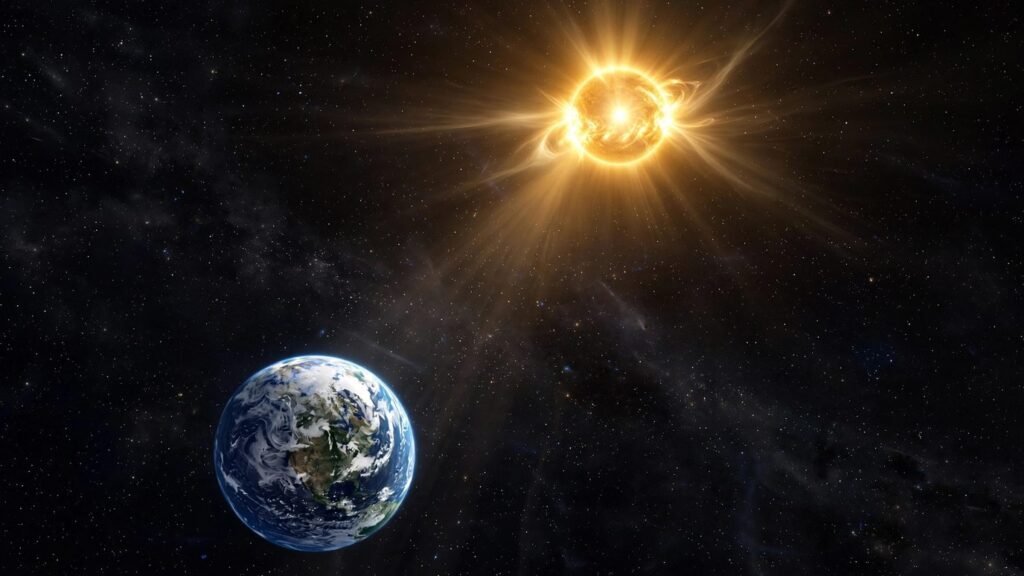
Look up on a clear night and the sky seems full of stars, all of them impossibly far away. It is natural to wonder which one is nearest to us. Is it the brightest star you can see? The one that twinkles hardest? Or something you have never even noticed?
The answer is much closer — and much more familiar — than most people expect. In fact, you have almost certainly seen the closest star to Earth today, without needing a telescope, a dark sky, or any special equipment at all. You just had to step outside in daylight.
That is the twist at the heart of this question. The star nearest to us does not look like a star at all. It looks like daytime. Once you understand why, the rest of the night sky starts to make a lot more sense: why some stars shine brightly and others barely register, why the Sun dominates our sky, and why even our nearest stellar neighbours are still staggeringly far away.
The short answer: The closest star to Earth is the Sun, about 93 million miles (150 million kilometres) away — roughly eight light-minutes. The closest star beyond the Sun is Proxima Centauri, a small red dwarf about 4.24 light-years away.
What Is the Closest Star to Earth?
The closest star to Earth is the Sun. That is not a trick answer, even though it can feel like one. The Sun is a genuine star, just like the points of light you see at night. It only looks different because it is so much nearer than any other star.
Everything else in the night sky is a distant sun in its own right. Some are bigger than our Sun, some are smaller, some burn hotter and some cooler. But every one of them is far, far farther away than the star that lights our days. When astronomers talk about “the nearest star,” they usually mean the Sun first — and then, to avoid confusion, they specify the nearest star other than the Sun.
That distinction matters, because the two answers tell very different stories. The Sun shapes our climate, our days, our seasons, and life itself. Proxima Centauri, the next star out, is so faint that you cannot see it with the naked eye at all, even though it is our second-nearest stellar neighbour.
Why the question has two answers
People usually ask this question meaning one of two things:
- Which star is physically nearest to Earth? The Sun, by an enormous margin.
- Which star beyond our own solar system is nearest? Proxima Centauri.
Both answers are correct. They just answer slightly different questions. Throughout this guide, we will keep the two clearly separate so there is no confusion.
Why Does the Sun Count as a Star?
It is easy to put the Sun in a category of its own. It rises, it sets, it warms your face. Stars, by contrast, come out at night and twinkle. But in astronomy, there is no separate category. A star is a huge ball of hot gas held together by gravity, shining because nuclear fusion is happening in its core. The Sun fits that description exactly.
Deep inside the Sun, hydrogen atoms are fusing into helium, releasing the energy that eventually reaches us as light and heat. That is the same basic process powering every other star, from the brightest beacon in the night sky to the faintest red dwarf. The Sun is, in astronomical terms, a fairly ordinary star — a yellow dwarf, middle-aged, middle-sized, and sitting in a quiet corner of the Milky Way.
What makes it special is not its type. It is its address. It happens to be our star, the one our planet orbits. And that closeness changes everything about how it appears.
What kind of star is the Sun?
Astronomers classify the Sun as a G-type main-sequence star, often called a yellow dwarf. Here is what that means in plain language:
- G-type refers to its surface temperature, roughly 5,500 degrees Celsius — hot enough to glow yellow-white.
- Main-sequence means it is in the stable, hydrogen-burning phase of its life, where it will spend most of its existence.
- Dwarf does not mean tiny in the everyday sense. It simply means it is not a giant star. In fact, the Sun holds about 99.86 percent of all the mass in our solar system.
The Sun is about 4.6 billion years old, roughly halfway through its main-sequence life. It will keep shining much as it does now for billions of years to come.
How Far Away Is the Sun, Really?
The average distance from Earth to the Sun is about 93 million miles, or 150 million kilometres. Astronomers call this distance one astronomical unit, or 1 AU, and they use it as a yardstick for measuring distances inside our solar system.
In terms of light travel time, that is about eight minutes and twenty seconds. When you look at the Sun (safely, never directly with unprotected eyes), you are seeing it as it was eight minutes ago. Sunlight that warms your skin left the Sun’s surface before you stepped outside.
That sounds fast, and it is — light is the fastest thing in the universe. But compare it with the next star out, and the scale of the gap becomes clear. Light from Proxima Centauri takes more than four years to reach us, not eight minutes. If the Sun is a neighbour across the street, Proxima Centauri is in another country entirely.
Why Earth’s distance from the Sun is not constant
Earth’s orbit is not a perfect circle. It is slightly elliptical, which means our distance from the Sun changes a little through the year:
- Perihelion (closest approach, early January): about 91 million miles.
- Aphelion (farthest point, early July): about 94.5 million miles.
That difference of a few million miles sounds large, but it is small compared with the overall distance, and it is not what causes the seasons. Seasons happen because Earth’s axis is tilted, not because we move closer to or farther from the Sun. It is a common mix-up, and a good reminder that distance alone does not tell the whole story.
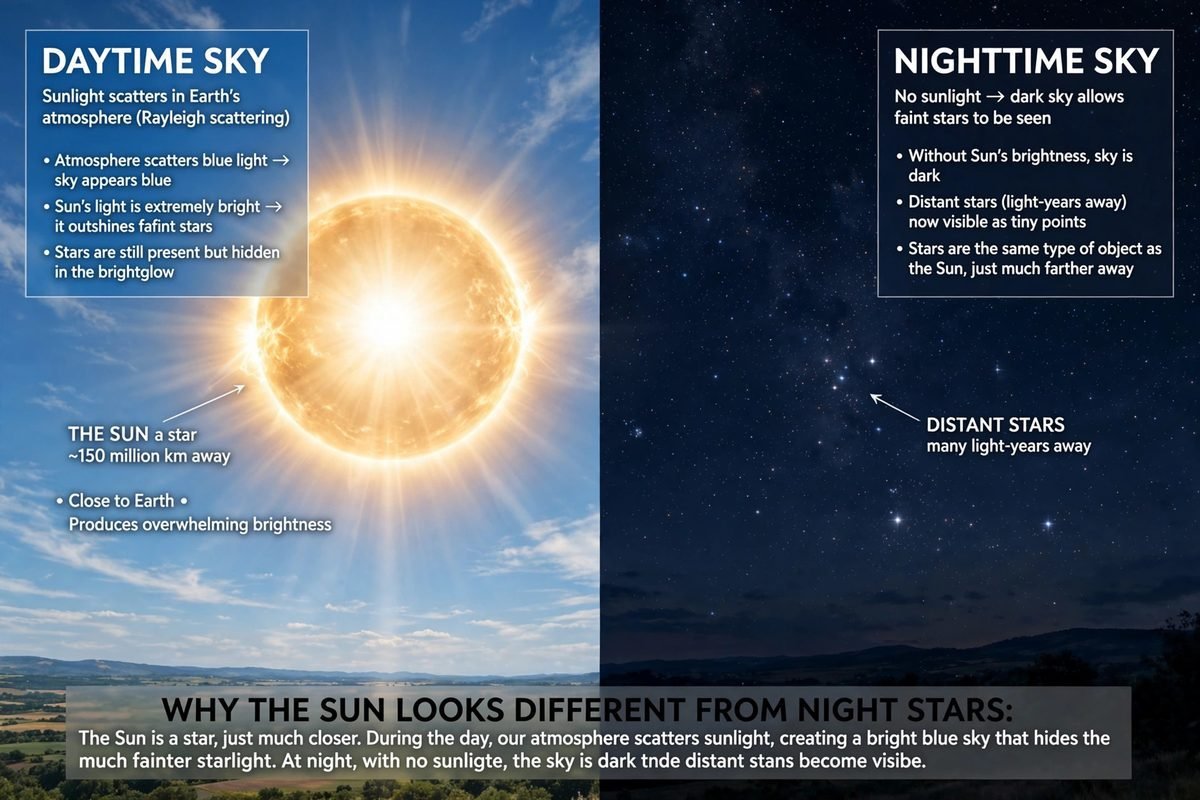
Why Does the Sun Look So Different From Other Stars?
If the Sun is just an ordinary star, why does it not look like one? The answer is almost entirely about distance.
Brightness falls off very quickly with distance. Move a light twice as far away and it looks four times dimmer, not twice as dim. Now imagine moving the Sun to the distance of the nearest night-time star. It would shrink to a point of light, no brighter than many stars you already see. Put another way, the Sun only looks overwhelming because it is close.
There are two other reasons the Sun looks different:
- It does not twinkle. Stars twinkle because their pinpoint light is disturbed by Earth’s atmosphere. The Sun is a visible disc, not a point, so the effect averages out.
- You cannot see it at night. The Sun is below the horizon at night, so it never competes with other stars for your attention. It owns the daytime sky entirely.
Take the Sun out of the daytime context and place it among the night stars, and it would blend right in. It would be bright — roughly as bright as some of the brightest stars — but nothing about it would scream “this is special.” Its specialness is its proximity.
A simple way to picture it
Imagine standing next to a streetlamp at night. It floods the pavement with light and you cannot look straight at it. Now walk a few miles away and look back. That same lamp is just one small light among many. The lamp did not change. Your distance did. That is exactly what happens with the Sun and every other star.
What Is the Closest Star Beyond the Sun?
Once you set the Sun aside, the closest star to Earth is Proxima Centauri. It lies about 4.24 light-years away. A light-year is the distance light travels in one year — roughly 5.88 trillion miles — so 4.24 light-years works out to about 25 trillion miles. Even at the speed of light, the fastest possible speed, a trip there would take well over four years.
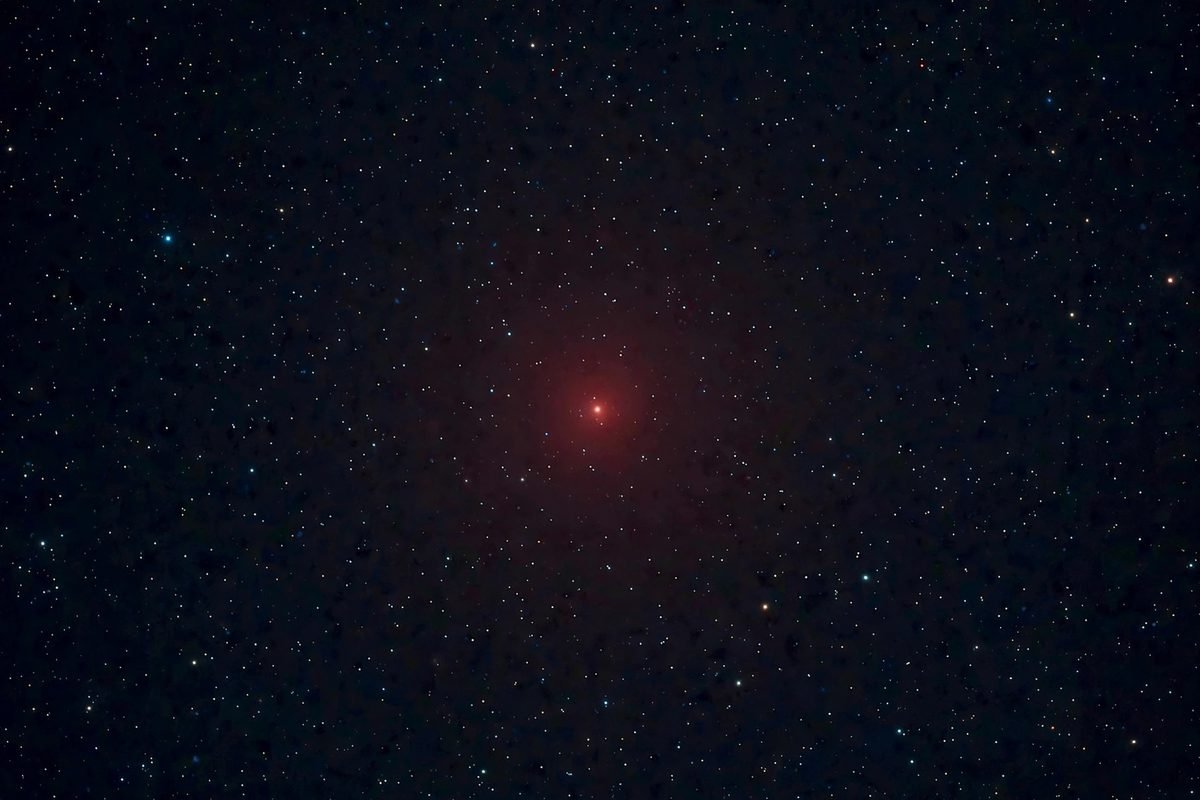
Proxima Centauri is part of a triple star system called Alpha Centauri, which sits in the southern constellation of Centaurus. It is the smallest and faintest member of that trio, orbiting the two brighter stars, Alpha Centauri A and Alpha Centauri B, at a great distance. Despite being our nearest neighbour beyond the Sun, Proxima Centauri is invisible to the naked eye. You need a telescope to see it, and even then it is just a faint red point.
That surprises a lot of people. We tend to assume the nearest things are the most obvious. In astronomy, that is often backwards. The nearest star beyond the Sun is faint precisely because of what kind of star it is.
What Kind of Star Is Proxima Centauri?
Proxima Centauri is a red dwarf — the most common type of star in the universe, and also one of the dimmest. Red dwarfs are small, cool, and miserly with their fuel. They burn hydrogen so slowly that they can shine for trillions of years, far longer than a star like our Sun ever will.
Here is how Proxima Centauri compares with the Sun:
- Size: About one-seventh the diameter of the Sun.
- Mass: Roughly one-eighth the mass of the Sun.
- Temperature: A surface temperature around 3,000 degrees Celsius, much cooler than the Sun’s 5,500 degrees.
- Brightness: Only about 0.17 percent as bright as the Sun. If the Sun were a floodlight, Proxima Centauri would be a candle.
That faintness is why it went undiscovered for so long. Proxima Centauri was only identified in 1915, even though it is our closest stellar neighbour beyond the Sun. Brighter, more distant stars had been catalogued for centuries before it.
Does Proxima Centauri have planets?
Yes — and that is part of why it draws so much attention. Astronomers have found at least one planet, Proxima Centauri b, orbiting in the star’s habitable zone, the region where temperatures could allow liquid water on a planet’s surface. Whether that planet is actually habitable is another question entirely. Red dwarfs are prone to powerful flares, and Proxima Centauri is no exception. Those flares could strip away a planet’s atmosphere or bathe its surface in radiation.
Still, the discovery makes our nearest neighbour feel a little less abstract. It is not just a faint point of light. It is a star with its own planetary system, sitting right next door in cosmic terms — and still unimaginably far away in human ones.
If you enjoy keeping up with space stories from different angles, you will also find plenty of general science reads on Dailyorvix that cover the wider world of discovery beyond astronomy.
How Do the Nearest Stars Compare?
It helps to see the nearest stars side by side. The table below lists the closest stars to Earth, starting with the Sun, so the scale of the jump from our own star to the next one is obvious.
| Star | Type | Distance from Earth | Visible to the naked eye? |
|---|---|---|---|
| The Sun | Yellow dwarf (G-type) | 1 AU (about 8 light-minutes) | Yes — it dominates the daytime sky |
| Proxima Centauri | Red dwarf (M-type) | About 4.24 light-years | No — telescope needed |
| Alpha Centauri A | Yellow dwarf (G-type) | About 4.37 light-years | Yes — from the Southern Hemisphere |
| Alpha Centauri B | Orange dwarf (K-type) | About 4.37 light-years | Yes — combined with A as one bright star |
| Barnard’s Star | Red dwarf (M-type) | About 5.96 light-years | No — telescope needed |
| Wolf 359 | Red dwarf (M-type) | About 7.86 light-years | No — telescope needed |
Notice a pattern: most of our nearest neighbours are red dwarfs. They are everywhere, but they are faint. The brightest stars in our night sky, by contrast, tend to be farther away — they are simply so luminous that they shine across the distance. Brightness in the sky is a mix of a star’s true power and its distance, not distance alone.
The Sun versus Proxima Centauri at a glance
| Feature | The Sun | Proxima Centauri |
|---|---|---|
| Star type | Yellow dwarf | Red dwarf |
| Distance from Earth | About 8 light-minutes | About 4.24 light-years |
| Diameter (compared with the Sun) | 1 | About 0.14 |
| Surface temperature | About 5,500°C | About 3,000°C |
| Brightness (compared with the Sun) | 1 | About 0.0017 |
| Visible without a telescope? | Yes | No |
| Known planets? | 8 | At least 1 confirmed, with more candidates studied |
What About Alpha Centauri A and B?
Alpha Centauri A and B are the two bright stars at the heart of the Alpha Centauri system, and they deserve a mention because they are what most people actually see when they look toward our nearest neighbours.
From the Southern Hemisphere, Alpha Centauri appears as one of the brightest stars in the sky — in fact, it ranks among the top few brightest stars overall. What looks like a single star is really two stars orbiting each other closely, with Proxima Centauri looping around them both at a much greater distance.
Here is the key point: Alpha Centauri A and B are slightly farther from Earth than Proxima Centauri, at about 4.37 light-years. They only appear brighter because they are bigger and hotter stars. Proxima Centauri wins on distance; its companions win on brilliance. It is a perfect example of why “closest” and “brightest” are different questions with different answers.
Can you see Alpha Centauri from the United States?
Only from the far south. Alpha Centauri sits deep in the southern sky, so from most of the United States it never rises above the horizon. Observers in Hawaii, southern Texas, and southern Florida may catch it very low in the sky under good conditions. From the rest of the country, it stays hidden — one more reason why the brightest star in your sky is rarely the closest one.
Can You See the Nearest Stars From Earth?
That depends on which star you mean, and where you are standing.
- The Sun: Yes, obviously — but never look at it directly without proper solar filters. Its light can damage your eyes in seconds.
- Proxima Centauri: No, not with the naked eye. You need a telescope, a dark sky, and a good star chart to pick it out. Even then, it looks like a faint red speck.
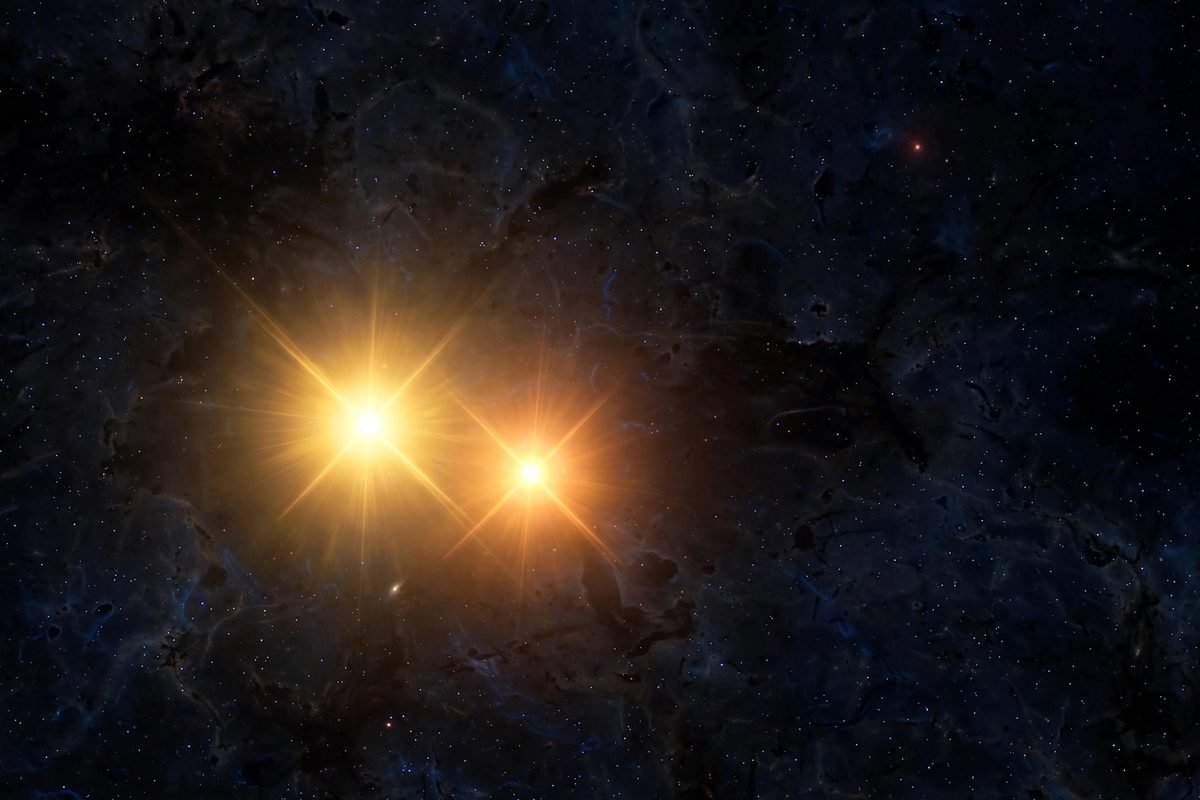
- Alpha Centauri A and B: Yes, easily — but only from the Southern Hemisphere and the far southern United States, where they appear as a single brilliant star.
- Barnard’s Star and Wolf 359: No. Both are red dwarfs, far too faint for unaided eyes.
For most people in the Northern Hemisphere, the brightest stars they see on a winter night — Sirius, Betelgeuse, Rigel — are all much farther away than Proxima Centauri. Sirius, the brightest star in the night sky, is about 8.6 light-years away, roughly twice Proxima Centauri’s distance. It looks brighter because it is a far more powerful star, not because it is closer.
What about the brightest star you can see tonight?
If you step outside tonight and pick the brightest star in view, you are almost certainly not looking at the closest star. You are looking at a star that is luminous enough to overcome its distance. That is worth remembering next time someone asks why the night sky does not simply rank stars by distance. The sky ranks them by apparent brightness, which mixes distance and true power together.
Will Another Star Ever Become the Closest?
Yes, over very long timescales. Stars are not fixed in place. They drift through the galaxy, each following its own path, and those paths sometimes bring them closer to us or carry them farther away.
Astronomers expect that in about 1.3 million years, a star called Gliese 710 will pass relatively near our solar system — not close enough to threaten Earth, but close enough to become one of our nearer neighbours for a time. On shorter timescales, Proxima Centauri is expected to remain the closest star beyond the Sun for tens of thousands of years.
The Sun, of course, is not going anywhere. It will remain the closest star to Earth for as long as Earth exists, because Earth orbits it. No passing star will change that. The only “closest star” title that changes hands is the one for the nearest star beyond our solar system.
Why this matters for stargazers
This slow stellar drift is invisible in a human lifetime, but it is a useful reminder that the sky is not a fixed backdrop. The constellations we know will distort over tens of thousands of years as their stars move at different speeds and in different directions. The night sky is a snapshot, not a permanent painting.
How Do Astronomers Measure the Distance to Nearby Stars?
It is fair to ask how anyone knows Proxima Centauri is 4.24 light-years away, given that no one has travelled there. The answer is a technique called parallax, and it is beautifully simple in concept.
Hold your finger in front of your face and close one eye, then the other. Your finger appears to jump against the background. That jump happens because your two eyes see it from slightly different positions. Astronomers do the same thing on a much bigger scale: they observe a nearby star from opposite sides of Earth’s orbit, six months apart, and measure how much it appears to shift against the more distant background stars. From that tiny shift, they can work out the distance using basic geometry.
For stars farther away, the shift becomes too small to measure this way, so astronomers use other methods — comparing a star’s true brightness with how bright it appears, for example. But for our nearest neighbours, parallax gives a direct, reliable measurement. It is how we know, with confidence, that Proxima Centauri really is the closest star beyond the Sun.
Frequently Asked Questions
Is the Sun the closest star to Earth?
Yes. The Sun is a star, and it is by far the closest one to Earth, at an average distance of about 93 million miles (1 AU, or roughly eight light-minutes). Every other star is light-years away.
What is the closest star to Earth after the Sun?
Proxima Centauri, a red dwarf about 4.24 light-years away. It is part of the Alpha Centauri system but is too faint to see with the naked eye.
Why is the Sun not counted when people list the nearest stars?
Sometimes it is counted, and sometimes it is not. Many star lists leave the Sun out because it is in a category of its own — it is our own star, and including it would make every other entry look absurdly distant by comparison. When a list says “nearest stars,” check whether it means including or excluding the Sun.
How long would it take to travel to Proxima Centauri?
With current spacecraft technology, tens of thousands of years. Even travelling at a tenth of the speed of light — far beyond anything we can build today — the journey would take over 40 years. At the speed of the fastest spacecraft ever launched, it would take far longer still. The distance is the single biggest obstacle to interstellar travel.
Is Proxima Centauri visible from the Northern Hemisphere?
No, not easily. Proxima Centauri sits in the far southern sky, in the constellation Centaurus. Like Alpha Centauri, it is essentially a Southern Hemisphere object, visible only from very low southern latitudes in the United States, and even then only with a telescope.
What is the brightest star in the night sky, and how far away is it?
Sirius, in the constellation Canis Major, is the brightest star in the night sky. It lies about 8.6 light-years away — roughly twice as far as Proxima Centauri. It looks brighter because it is intrinsically much more luminous.
Could a closer star be discovered in the future?
It is unlikely but not impossible. Faint red dwarfs and brown dwarfs are hard to spot, and astronomers have occasionally found nearby objects that were previously overlooked. However, any star closer than Proxima Centauri (other than the Sun) would have to be extremely faint to have escaped detection so far. Surveys continue to map our stellar neighbourhood, so the list of nearby stars is still being refined.
Conclusion
So, what is the closest star to Earth? The answer you carry away depends on how you ask the question, but both versions are worth remembering.
The closest star of all is the Sun — the star that gives us daylight, drives our weather, and makes life on Earth possible. It is so close that its light reaches us in minutes, while every other star’s light takes years. And the closest star beyond our solar system is Proxima Centauri, a faint red dwarf just over four light-years away, quietly orbited by at least one planet and invisible to the unaided eye.
That contrast is what makes this question so interesting. The nearest star is the one you see every day. The next-nearest is one you will probably never see at all. Between them lies the whole story of how distance, brightness, and star type combine to create the sky we actually experience — a daytime sky ruled by one brilliant star, and a night sky filled with distant suns, each shining across an almost unimaginable gulf.
Next time you step outside on a sunny day, remember: you are standing in the light of the closest star there is. And on a clear night, when you look up at the stars, remember that the nearest of those is still more than four years away at the speed of light — a humbling reminder of just how big our neighbourhood really is. For more wide-ranging reads beyond the night sky, Adailyinsight360 covers everyday topics with the same curiosity.
Read Also: How Far Can a Telescope See Into Space? (2026 Guide)

1 Comment