
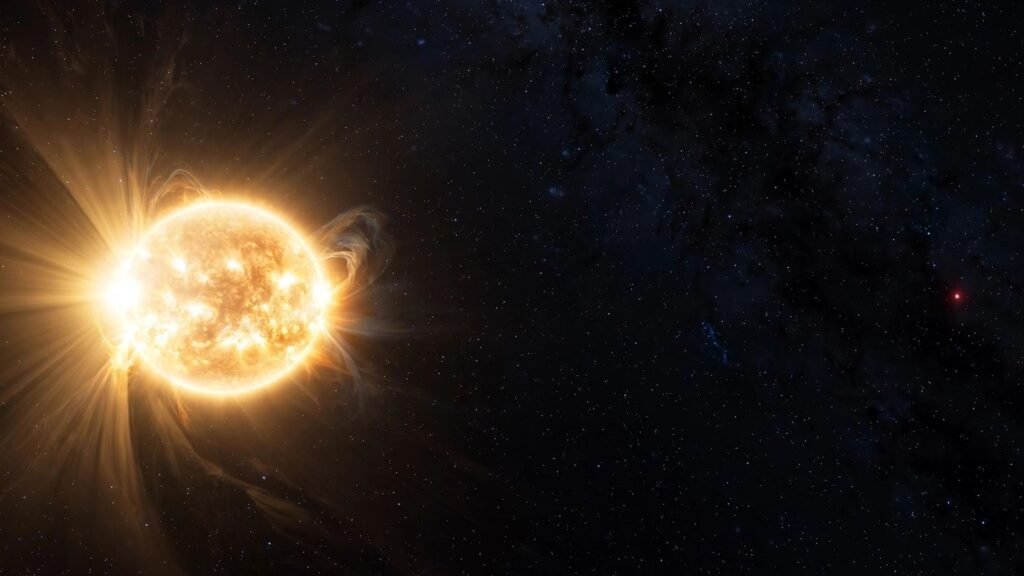
Look up on a clear night and the stars feel close. They hang overhead like tiny lamps, close enough that you half expect to reach out and touch one. The truth is stranger, and much bigger: even the nearest star beyond our own Sun is so far away that its light takes more than four years to reach your eyes.
That gap — between how close the stars look and how far they really are — is one of the most humbling facts in all of astronomy. It also raises a question that sounds simple but has two very different answers, depending on what you mean by “nearest.”
This article gives you both answers, in plain numbers. You will learn how far the Sun really is, how far the next star out is, what a light-year actually measures, and how astronomers figured out distances they could never travel. No physics degree required.
The short answer: If you count the Sun, the nearest star is about 149.6 million kilometres away — roughly 8 light-minutes. If you mean the nearest star beyond the Sun, it is Proxima Centauri, about 4.24 light-years away, or roughly 40 trillion kilometres. Its light left in 2022 and is only reaching us now.
How Far Away Is the Nearest Star, Exactly?
It depends on which star you mean, so let’s settle that first.
Most people asking this question are thinking of the night sky — the stars you see after dark. The Sun doesn’t count in that picture because you can’t look at it at night, and it dominates the daytime sky so completely that we forget it is a star at all. But scientifically, the Sun is a star, and it is by far the closest one to us.
So there are two honest answers:
- Nearest star overall: the Sun, at 1 astronomical unit (AU), about 149.6 million kilometres.
- Nearest star beyond the Sun: Proxima Centauri, at about 4.24 light-years, or roughly 40 trillion kilometres.
The second number is about 268,000 times larger than the first. That ratio alone tells you something important: in cosmic terms, our solar system is a tiny island, and the next island over is an enormous swim away.
Wait — Doesn’t the Sun Count as the Nearest Star?
Yes, absolutely — and this is the part that trips people up.
The Sun is a perfectly ordinary star, a yellow dwarf sitting in the middle of its life. It only looks different from other stars because it is so close. If you moved the Sun to the distance of Proxima Centauri, it would look like just another faint point of light in the night sky. Conversely, if you dragged Proxima Centauri into the Sun’s position, it would blaze in our sky — though being a dim red dwarf, it would still look far less impressive than our Sun.
The reason the distinction matters is light travel time. Sunlight takes about 8 minutes and 20 seconds to reach Earth. That means you never see the Sun as it is right now — you see it as it was eight minutes ago. If the Sun suddenly vanished (it won’t), we wouldn’t know for eight minutes.
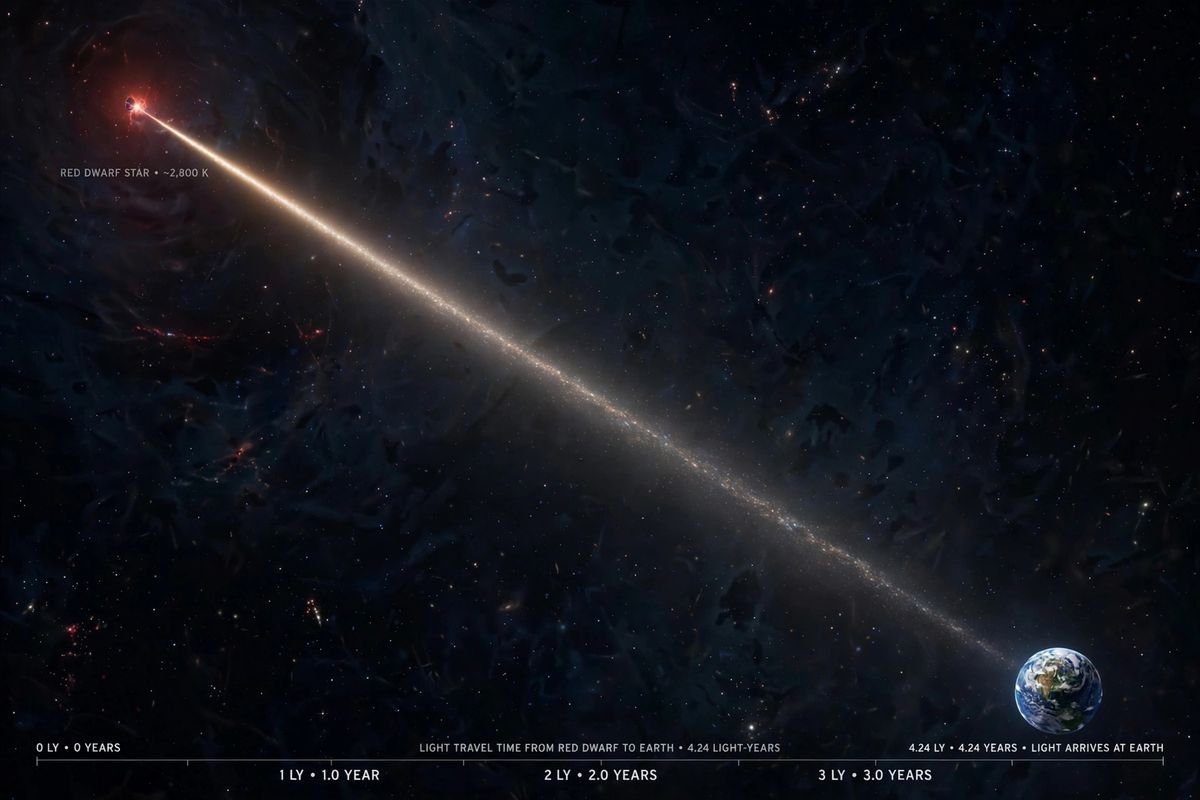
Proxima Centauri’s light takes 4.24 years to make the same journey. When you look at it through a telescope, you are seeing light that left the star more than four years ago. Every star in the sky is a message from the past; the only question is how old the message is.
What Is a Light-Year, Really?
A light-year is not a measure of time, even though the name makes it sound like one. It is a measure of distance: the distance light travels in one year through the vacuum of space.
Light moves fast — about 299,792 kilometres per second. Multiply that by the number of seconds in a year and you get one light-year: roughly 9.46 trillion kilometres (about 5.88 trillion miles).
That unit exists because kilometres become useless at interstellar distances. Saying Proxima Centauri is “40 trillion kilometres away” is technically correct, but the number is so large it stops meaning anything. Saying “4.24 light-years” at least gives your brain something to hold onto: light, the fastest thing in the universe, needs more than four years to get here from there.
Astronomers also use two other distance units, and it helps to know all three:
- Astronomical unit (AU): the average Earth–Sun distance, about 149.6 million kilometres. Used inside solar systems.
- Light-year (ly): about 63,241 AU. Used for distances between stars.
- Parsec (pc): about 3.26 light-years. Used by professional astronomers, and it comes directly from the parallax method explained below. Proxima Centauri is about 1.30 parsecs away.
| Unit | Equals | Best used for |
|---|---|---|
| 1 AU | 149.6 million km | Distances inside a solar system |
| 1 light-year | 9.46 trillion km (63,241 AU) | Distances between nearby stars |
| 1 parsec | 3.26 light-years | Professional star catalogues |
How Far Is Proxima Centauri in Kilometres and Miles?
Let’s put real numbers on it, because “4.24 light-years” can feel abstract.
- In light-years: ~4.24
- In parsecs: ~1.30
- In kilometres: ~40.1 trillion km
- In miles: ~24.9 trillion miles
- In astronomical units: ~268,000 AU
For comparison, the Moon is about 384,400 kilometres away, and light from the Moon reaches us in about 1.3 seconds. Neptune, the most distant planet in our solar system, sits roughly 30 AU from the Sun. Proxima Centauri is nearly 9,000 times farther than Neptune.
Here’s a scale model that might help it click. Shrink the Sun down to a grain of sand, about 1 millimetre across. On that scale, Earth would be a speck of dust about 10 centimetres away — close enough to fit on your desk. Proxima Centauri, the next grain of sand, would sit roughly 29 kilometres away, in another town entirely. And that is just the nearest star. The Milky Way galaxy is about 100,000 light-years across, which on the same scale stretches far beyond anything a scale model can hold.
That is why astronomers say space is mostly empty. It really is. The stars are grains of sand scattered across a continent-sized beach.
How Do Astronomers Actually Measure These Distances?
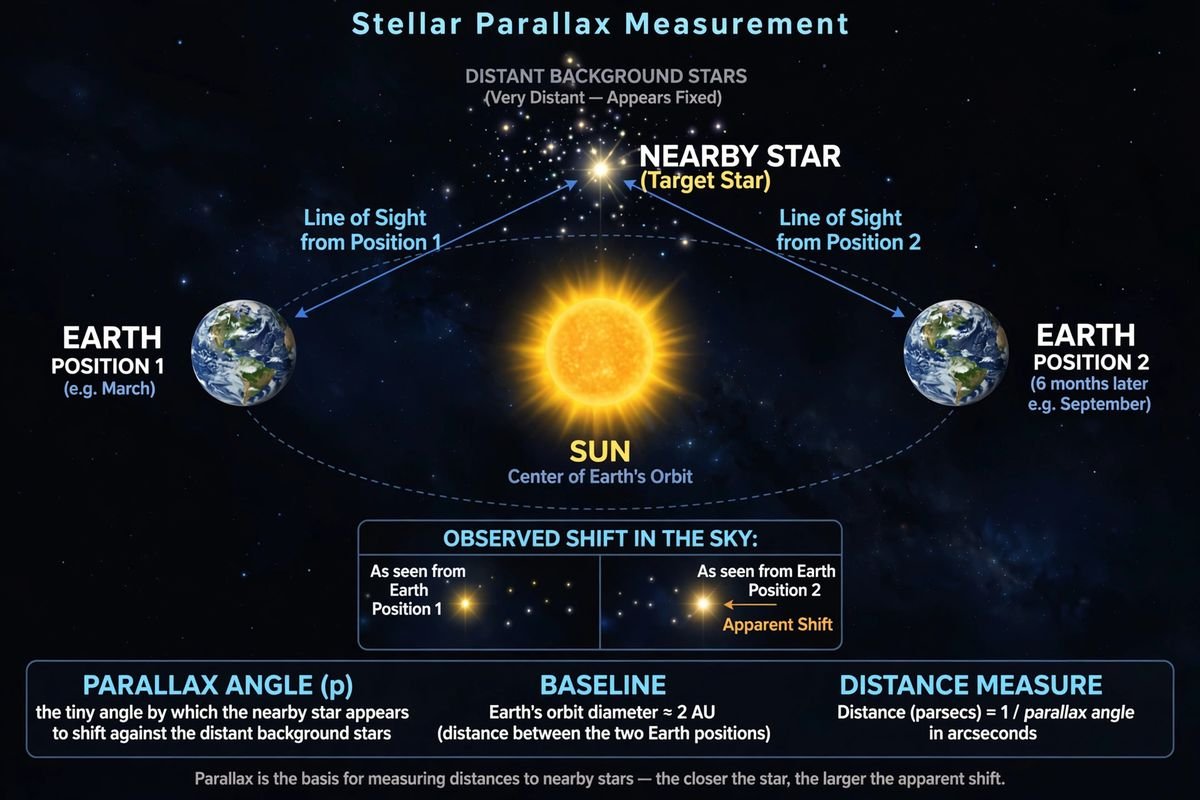
Nobody has ever stretched a tape measure to a star. So how do we know Proxima Centauri is 4.24 light-years away, and not, say, 3 or 6? The answer is a beautifully simple bit of geometry called parallax — the same trick your own eyes use to judge depth.
The Parallax Trick
Hold your thumb up at arm’s length and close one eye, then switch eyes. Your thumb seems to jump sideways against the background. That jump happens because your two eyes view it from slightly different positions. The closer your thumb, the bigger the jump.
Astronomers do the same thing with Earth itself. They photograph a nearby star in, say, January, then again in July, when Earth has moved to the opposite side of its orbit — a shift of about 300 million kilometres. Against the distant background stars, the nearby star appears to shift position by a tiny angle. Measure that angle, do the geometry, and you get the distance.
For Proxima Centauri, that shift is about 0.77 arcseconds — an arcsecond is 1/3,600th of a degree, so we are talking about an angle roughly the size of a coin seen from several kilometres away. Measuring something that small took centuries of improving telescopes, and it is still one of the most delicate measurements in astronomy.
Why Parsecs Come From Parallax
The parsec is defined by this very method: one parsec is the distance at which a star would appear to shift by exactly one arcsecond when viewed from opposite sides of Earth’s orbit. That is why professional astronomers prefer parsecs — the unit is built into the measurement itself. If a star’s parallax angle is 0.77 arcseconds, its distance is simply 1 divided by 0.77, or about 1.30 parsecs.
What About Stars Too Far for Parallax?
Parallax works brilliantly for nearby stars, but the shift gets tinier and tinier with distance. For stars thousands of light-years away, astronomers switch to other tools: comparing a star’s true brightness to how bright it looks (standard candles like Cepheid variables and supernovae), and measuring how fast the universe’s expansion is carrying galaxies away from us (redshift). Each rung of this “cosmic distance ladder” rests on the one below it — and the bottom rung is parallax, measured right here in our own solar system.
How Long Would It Take to Get There?
This is where the distance stops being a number and starts feeling real. Here is what the trip to Proxima Centauri would take at various speeds:
| Way of travelling | Speed | Time to Proxima Centauri |
|---|---|---|
| Walking | 5 km/h | ~915 million years |
| Driving a car | 100 km/h | ~46 million years |
| Passenger jet | 900 km/h | ~5 million years |
| Voyager 1 (fastest object to leave the solar system) | ~17 km/s | ~73,000 years |
| Parker Solar Probe at its record speed | ~192 km/s | ~6,600 years |
| Travelling at the speed of light | 299,792 km/s | 4.24 years |
Voyager 1, launched in 1977, is the farthest human-made object from Earth, yet it has covered less than a single light-day so far. At its current speed it would still need roughly 73,000 years to reach Proxima Centauri — and it isn’t even heading in that direction.
The Parker Solar Probe figure deserves a note: it reached about 690,000 kilometres per hour by falling toward the Sun, not by cruising through interstellar space. No spacecraft can sustain that speed in open space. But even hypothetically, at that record-breaking pace the journey would still take well over 6,000 years. That is the scale of the problem facing anyone who dreams of visiting another star.
How Does Proxima Centauri Compare to Other Nearby Stars?
Proxima Centauri is the closest, but it is not alone in our neighbourhood. It is actually part of the Alpha Centauri system, gravitationally bound to the brighter binary stars Alpha Centauri A and B, which sit slightly farther away at about 4.37 light-years. Here is how our nearest stellar neighbours stack up:
| Star / system | Distance (light-years) | Type |
|---|---|---|
| Proxima Centauri | 4.24 | Red dwarf |
| Alpha Centauri A & B | 4.37 | Sun-like binary |
| Barnard’s Star | 5.96 | Red dwarf |
| Luhman 16 | 6.5 | Brown dwarf pair |
| Wolf 359 | 7.78 | Red dwarf |
| Sirius | 8.6 | Bright white star |
Notice a pattern: most of our closest neighbours are red dwarfs — small, cool, dim stars that are by far the most common type in the galaxy. The brightest star in our night sky, Sirius, is nearly twice as far away as Proxima Centauri, yet it outshines it easily because Sirius is far more luminous. Brightness in the sky is a terrible guide to distance.
Why Does the Distance Keep Changing Slightly?
If you look up Proxima Centauri’s distance in different sources, you might see 4.22, 4.24, or 4.25 light-years. Nobody is wrong — the number gets refined as measurements improve, and the star itself is moving.
Proxima Centauri orbits the Alpha Centauri pair on a timescale of hundreds of thousands of years, and the whole system is drifting through space relative to our Sun. Over thousands of years, these motions change the distance by tiny amounts. The 4.24 light-year figure is the best current measurement, accurate to within a small fraction of a light-year, and it is the number astronomers use today.
The same is true of the Sun’s distance. Earth’s orbit is slightly elliptical, so our distance from the Sun varies between about 147 million kilometres in early January and 152 million kilometres in early July. The 149.6 million kilometre figure is the average — one astronomical unit.
Could We Ever Visit the Nearest Star?
Honestly? Not with anything resembling today’s technology. But the distance is not quite as hopeless as it sounds, and scientists are working on ideas that could change the picture.
The most famous is Breakthrough Starshot, a project aiming to send tiny gram-sized probes pushed by powerful Earth-based lasers to about 20% of the speed of light. At that pace, the trip to Proxima Centauri would take roughly 20 years, plus another 4.24 years for the photos to beam back. The probes would be the size of a postage stamp, not a crewed ship — but they would be our first close-up look at another star system.
Other ideas on the table include fusion-powered rockets, which might reach a few percent of light speed, and generation ships that would carry families across centuries. All of them remain concepts, not hardware. Still, the fact that serious engineers are sketching plans at all shows how far the conversation has come: a century ago, the distance to the nearest star wasn’t even known precisely. Now we are debating how to cross it.
There is also a reason Proxima Centauri matters beyond curiosity. It hosts at least one known planet, Proxima Centauri b, which orbits in the star’s habitable zone — the range where liquid water could exist on the surface. Whether that planet is actually habitable is an open question, since red dwarfs are prone to violent flares, but it gives us a destination worth dreaming about. When you read about the search for life beyond Earth, the nearest star is usually where the conversation starts.
Frequently Asked Questions
How far away is the nearest star in light-years?
The nearest star beyond the Sun is Proxima Centauri, about 4.24 light-years away. Counting the Sun itself, the nearest star is 1 AU away, or about 8 light-minutes.
How far away is the nearest star in kilometres?
Proxima Centauri is roughly 40 trillion kilometres away. The Sun, by comparison, is about 149.6 million kilometres away.
What is the closest star to Earth?
The Sun is the closest star to Earth, full stop. The closest star other than the Sun is Proxima Centauri, a red dwarf in the Alpha Centauri system.
How long does light take to travel from the nearest star?
Light from the Sun takes about 8 minutes and 20 seconds to reach Earth. Light from Proxima Centauri takes about 4.24 years.
Can you see Proxima Centauri with the naked eye?
No. Despite being the closest star beyond the Sun, Proxima Centauri is a faint red dwarf, far too dim to see without a telescope. It is also only visible from the Southern Hemisphere. The brightest stars you see at night are generally much farther away but far more luminous.
How did astronomers measure the distance to the nearest star?
They used stellar parallax: photographing the star from opposite sides of Earth’s orbit, six months apart, and measuring its tiny apparent shift against background stars. That shift, combined with simple geometry, gives the distance.
Will humans ever travel to the nearest star?
Not soon, and not with current rockets. Proposed concepts like laser-pushed micro-probes could theoretically reach Proxima Centauri in about 20 years, but they remain in the research stage. A crewed journey is far beyond today’s technology.
Conclusion
So, how far away is the nearest star? If you mean the star that lights your day, it is 149.6 million kilometres away — eight light-minutes, close enough that its light is practically live. If you mean the nearest star in the night sky, it is Proxima Centauri, 4.24 light-years and some 40 trillion kilometres away, a distance so large that the fastest thing in the universe needs more than four years to cross it.
Both answers are true, and the gap between them is the whole story of our place in the universe: we live pressed up against one star, in a galaxy where the next star over is an almost unimaginable journey away. Yet we measured that distance with nothing more than geometry, patience, and a telescope — and someday, if the engineers have their way, we may even send something across it.
If you enjoy wrapping your head around huge scales and everyday measurements, you will find a similar curiosity-driven approach over at Home Water Insights, and 9bio covers plenty of science explainers in the same plain-English style.

1 Comment