
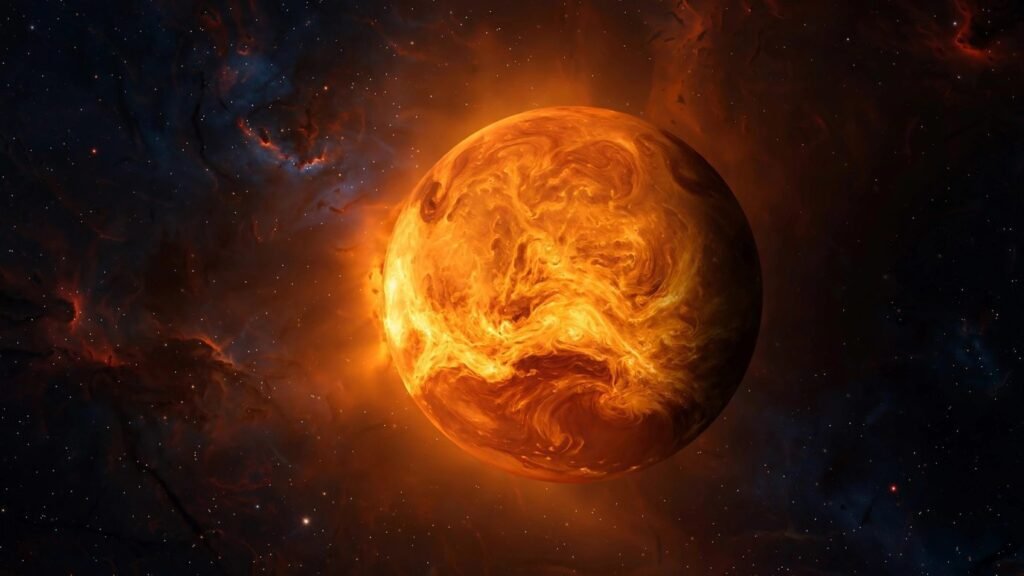
Ask a room full of people what is the hottest planet in the solar system, and most of them will answer the same way: Mercury. It makes perfect sense on the surface. Mercury is the closest planet to the Sun, so it must get the most heat, right? It is one of those facts that feels so obvious you never think to question it — until you do, and the real answer turns out to be far more interesting.
The hottest planet in the solar system is Venus, not Mercury. Venus is the second planet from the Sun, and yet its surface is hot enough to melt lead, crush spacecraft in a matter of hours, and glow faintly in the dark. Day or night, equator or pole, the temperature barely changes. It is a world that took a wrong turn billions of years ago and never recovered — and understanding why tells us a great deal about how planets, including our own, actually work.
The short answer: Venus is the hottest planet in the solar system, with an average surface temperature of around 465°C (867°F). Mercury is closer to the Sun but has almost no atmosphere to hold heat in, so its nights plunge to freezing. Venus’s thick carbon dioxide atmosphere traps heat in a runaway greenhouse effect, making it hotter than Mercury everywhere, all the time.
Why Isn’t Mercury the Hottest Planet?
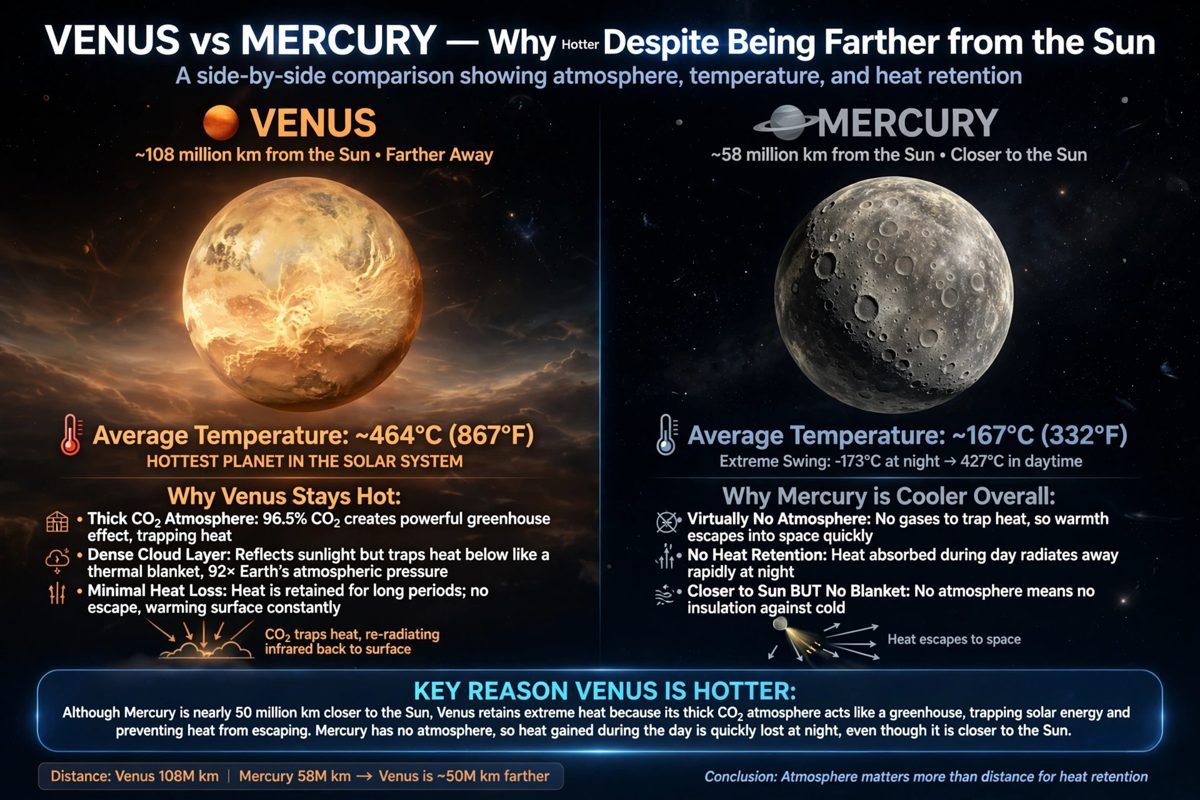
It helps to start with the logic behind the common guess, because it is not a silly guess at all. Mercury orbits at an average distance of about 58 million kilometres from the Sun, while Venus sits roughly 108 million kilometres away. Mercury therefore receives more than twice as much sunlight per square metre as Venus does. If distance were the only thing that mattered, Mercury would win easily.
But distance is only half the story. What a planet does with the sunlight it receives matters just as much, and sometimes more. A planet can soak up sunshine and radiate it straight back into space, or it can catch that heat and refuse to let go. Mercury does the first. Venus does the second, and it does it better than any other planet in the solar system.
Think of it this way: standing next to a campfire on a cold, clear night, you feel warm on the side facing the flames, but the moment you turn away, the cold bites again. There is nothing around you to hold the warmth. That is Mercury. Now imagine standing inside a sealed greenhouse on a summer afternoon, with the Sun beating down through the glass and nowhere for the heat to escape. That is Venus. The campfire is closer, but the greenhouse is hotter.
What Makes Venus So Hot?
Venus did not start out as the scorched world we see today — or at least, scientists believe it may once have been far milder. Billions of years ago, Venus may even have had oceans. What changed was a slow, unstoppable feedback loop that turned up the heat and never let it back down. Astronomers call it the runaway greenhouse effect, and Venus is the textbook example.
A sky made almost entirely of carbon dioxide
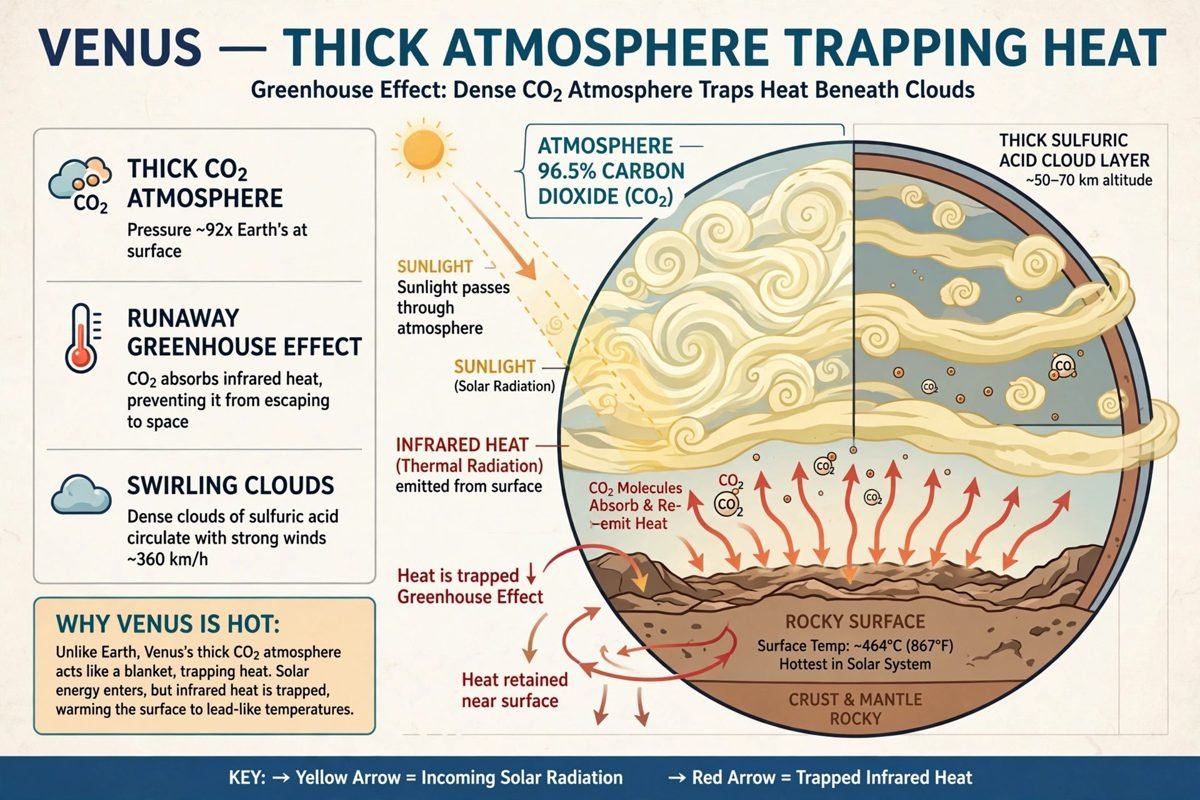
The atmosphere of Venus is about 96.5% carbon dioxide, a gas that is very good at absorbing infrared radiation — the kind of heat that radiates upward from a sun-warmed surface. Sunlight passes through the atmosphere and warms the ground, but when the ground tries to radiate that heat back into space, the carbon dioxide catches it and sends much of it back down again. Layer upon layer of this gas does the same thing, so heat piles up instead of escaping.
On Earth, carbon dioxide makes up a tiny fraction of the atmosphere, and the greenhouse effect it produces is mild enough to keep our planet comfortable rather than frozen. On Venus, the same physics runs at full throttle. The result is a surface temperature high enough to soften metals and a climate that has stayed brutally stable for an extremely long time.
Clouds of sulfuric acid
Above the surface, Venus is wrapped in clouds made largely of sulfuric acid droplets. These clouds are so thick and reflective that they bounce about three-quarters of incoming sunlight straight back into space. That is one reason Venus shines so brightly in our evening and morning sky — it is essentially a giant mirror.
Oddly enough, the clouds are part of what makes the planet so strange. They block most of the sunlight from ever reaching the ground, so the surface of Venus is dim, like a heavily overcast day on Earth. Yet the heat trapped below those clouds has nowhere to go. The clouds reflect sunlight away from the top while the carbon dioxide below holds heat in, and the combination keeps the whole system locked at furnace temperatures.
Crushing pressure that adds to the heat
The atmosphere of Venus is also extraordinarily heavy. At the surface, the pressure is roughly 92 times greater than the air pressure at sea level on Earth — about the same as being nearly a kilometre underwater. This thick, dense blanket of gas does not just trap heat; its sheer weight is part of the reason the lower atmosphere stays so uniformly hot. Temperatures at the surface barely vary from place to place, because the dense atmosphere circulates heat around the planet so effectively that there are almost no cold spots to hide in.
How Hot Does Venus Actually Get?
The headline number for Venus is an average surface temperature of about 465°C, which is 867°F. To put that in perspective, that is hot enough to melt lead, which liquefies at around 327°C, and it is well above the temperature of a typical kitchen oven at its highest setting. It is also remarkably consistent. Unlike Earth, where temperatures swing with seasons, latitude, and time of day, Venus stays within a few degrees of that average almost everywhere.
Here is how Venus compares with the other rocky planets at a glance:
| Planet | Average surface temperature | Distance from the Sun |
|---|---|---|
| Mercury | Around 167°C (but swings wildly) | ~58 million km |
| Venus | Around 465°C | ~108 million km |
| Earth | Around 15°C | ~150 million km |
| Mars | Around −65°C | ~228 million km |
The Mercury figure deserves a footnote, because an “average” hides the real story there. Mercury’s daytime high can reach about 430°C — still below Venus — while its nighttime low crashes to around −180°C. Venus, by contrast, does not really have a cold side. Its thick atmosphere moves heat around so efficiently that night is barely cooler than day, and the poles are barely cooler than the equator.
Why Is Mercury Cooler Than Venus?
Mercury’s problem is that it has almost nothing to trap heat with. Its “atmosphere” is so thin it barely qualifies for the name — scientists call it an exosphere, a sparse scattering of atoms knocked off the surface by sunlight and micrometeorites, rather than a real blanket of gas. With no meaningful atmosphere, there is nothing to catch outgoing heat and send it back down.
The consequences are dramatic:
- Scorching days: When the Sun is up, Mercury’s dark, airless surface heats up fast, reaching roughly 430°C at the equator at noon.
- Freezing nights: As soon as the Sun sets, that heat radiates straight back into space. Nighttime temperatures fall to about −180°C, a swing of more than 600 degrees.
- Slow rotation: A single day on Mercury — one sunrise to the next — lasts about 176 Earth days, so each side bakes or freezes for weeks at a time.
- No weather to speak of: With no real atmosphere, there are no clouds, no wind in the usual sense, and no way to move heat from the day side to the night side.
So Mercury can briefly get very hot in direct sunlight, but it cannot hold on to that heat, and it cannot spread it around. Venus can, and that is why Venus wins the title overall, even though Mercury occasionally produces a hotter single spot at high noon.
How Do Venus and Mercury Compare?
Putting the two side by side makes the difference easy to see. One is a scorched rock with no blanket; the other is a pressure cooker that never switches off.
| Feature | Venus | Mercury |
|---|---|---|
| Distance from the Sun | 2nd planet, ~108 million km | 1st planet, ~58 million km |
| Average surface temperature | ~465°C (867°F) | ~167°C, with extreme swings |
| Daytime high | ~465°C (barely changes) | ~430°C |
| Nighttime low | ~465°C (barely changes) | ~−180°C |
| Atmosphere | Thick, ~96.5% carbon dioxide | Extremely thin exosphere |
| Surface pressure | ~92 times Earth’s | Almost none |
| Clouds | Thick sulfuric acid clouds | None |
| Temperature variation | Almost none anywhere | Over 600°C between day and night |
The lesson of the table is simple: proximity to the Sun sets the starting point, but the atmosphere decides the final temperature. Venus starts with less sunlight than Mercury and ends up far hotter, because it keeps almost everything it receives.
What About the Other Planets?
Once you move past Venus and Mercury, temperatures drop quickly — and they keep dropping the farther out you go, because the outer planets have neither strong sunlight nor, in most cases, the kind of heat-trapping atmosphere that could compensate for it.
- Earth averages about 15°C, thanks to a balanced greenhouse effect and oceans that store and move heat around.
- Mars averages around −65°C. It has some carbon dioxide in its thin atmosphere, but far too little of it to warm the planet much, and its distance from the Sun leaves it cold.
- Jupiter is a gas giant with no solid surface to measure, but its cloud tops sit at roughly −110°C.
- Saturn is colder still, with cloud-top temperatures around −140°C.
- Uranus and Neptune are the deep freeze of the solar system, with temperatures around −195°C and −200°C respectively. Neptune, despite being the farthest planet, is slightly warmer than Uranus in places because it still radiates some internal heat.
None of these comes close to Venus. Even Mercury, the runner-up, is cooler on average by nearly 300 degrees. Venus is not just the hottest planet by a little — it is the hottest by a wide margin, and it holds that record everywhere on its surface at once.
Could Anything Survive on Venus?
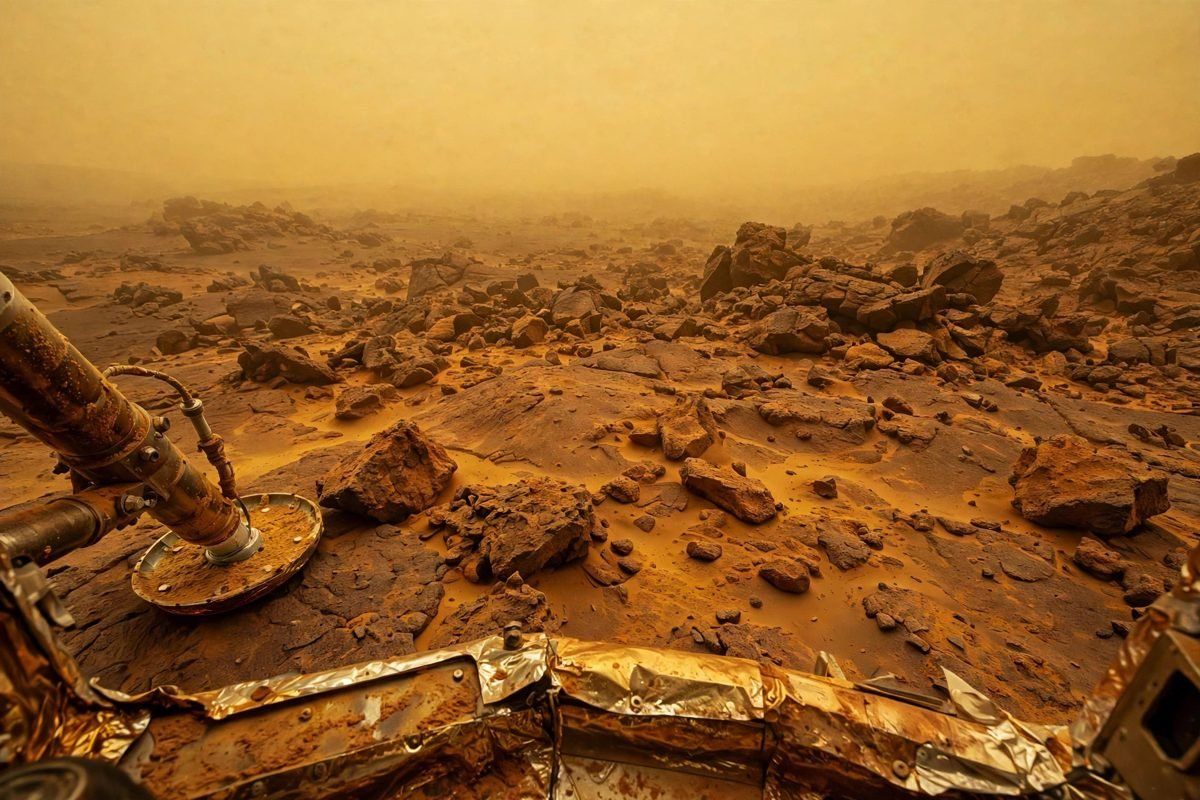
On the surface, the honest answer is no — not anything like life as we know it. The combination of 465°C heat, crushing pressure, and a corrosive atmosphere is lethal to every known organism, and it destroys machinery quickly too. The Soviet Venera landers of the 1970s and 1980s were built like tanks and still only survived on the surface for minutes to a couple of hours before the heat and pressure finished them. Those brief missions, though, sent back the first photographs from the surface of another planet, and they confirmed just how hostile Venus really is.
Higher up, the story gets a little more interesting. About 50 kilometres above the surface, the temperature and pressure in Venus’s clouds are actually similar to conditions at Earth’s surface — mild temperatures, breathable pressures. Some scientists have wondered whether hardy microbes could survive in those cloud layers, drifting in droplets far above the furnace below. It is a fascinating idea, and a few tantalising chemical hints have kept the debate alive, but there is no confirmed evidence of life there. For now, Venus’s clouds are a place to keep studying, not a place anyone would call habitable.
How Do Scientists Measure Venus’s Temperature?
You might wonder how we can be so sure about a temperature on a planet nobody has ever stood on. The answer is a combination of landers, orbiters, and basic physics, built up over decades.
- Venera landers: The Soviet Union’s Venera programme landed several probes on Venus between 1970 and the early 1980s. They measured surface temperatures directly before succumbing to the heat, and their readings cluster tightly around 460–470°C.
- Orbiters: Spacecraft such as NASA’s Magellan, the European Space Agency’s Venus Express, and Japan’s Akatsuki have mapped the planet’s atmosphere and cloud tops in detail, letting scientists model how heat moves through the whole system.
- Infrared observations: Telescopes measure the infrared radiation escaping from Venus. Because the amount and colour of that radiation depend on temperature, scientists can work out how hot different layers of the atmosphere are without touching them.
- Laboratory physics: The behaviour of carbon dioxide under Venus-like pressure and temperature can be tested in labs, and it matches what the spacecraft observed.
The numbers agree across all these methods, which is why the 465°C figure is stated with confidence rather than as a rough guess. It is one of the best-measured facts about another planet in the solar system.
What Does Venus Teach Us About Earth?
Venus is often called Earth’s twin, and at first glance the comparison is fair: the two planets are similar in size, mass, and composition, and they formed from similar material in the same part of the solar system. Yet one became a comfortable home for oceans and life, and the other became a furnace. The difference is a warning and a lesson rolled into one.
On Earth, carbon dioxide is mostly locked away in rocks, oceans, and living things, and the atmosphere holds only a small amount of it. On Venus, almost all of that carbon ended up in the air. As temperatures rose, any oceans Venus may have had would have evaporated, adding water vapour — itself a greenhouse gas — to the atmosphere, which raised temperatures further, which evaporated more water, and so on. Once that loop started, it was very hard to stop, because each step made the next one worse.
Earth is nowhere near that tipping point, and the two planets differ in important ways, including Venus’s extremely slow rotation and its lack of a magnetic field. But the basic physics is the same physics that governs our climate, and Venus shows what a greenhouse effect looks like when it runs without limits. That is why scientists study Venus so closely: it is the nearest example of a planet where the climate went badly wrong, and understanding it helps us understand the boundaries of the climate we live in. Readers who enjoy this kind of planet-by-planet comparison may also like the wider science and space coverage on sites like The Modern Post and Daily Orvix, which regularly explore how the solar system works.
Will Venus Ever Cool Down?
In any timescale that matters to us, no. The carbon dioxide in Venus’s atmosphere is not going anywhere on its own. There are no oceans to dissolve it, no plants to absorb it, and no plate tectonics in the Earth-like sense to drag it back into rocks at a meaningful rate. The runaway greenhouse effect is a stable state — once a planet settles into it, it tends to stay there.
Over billions of years, as the Sun gradually grows brighter, Venus will if anything get slightly hotter, not cooler. Human ideas for cooling Venus — such as shading it with giant reflectors in space or somehow removing its carbon dioxide — belong firmly in science fiction for now. They would require engineering on a scale far beyond anything humanity has attempted. Venus will remain the hottest planet in the solar system for the foreseeable future, and probably for as long as the solar system itself lasts in anything like its current form.
Frequently Asked Questions
What is the hottest planet in the solar system?
Venus is the hottest planet, with an average surface temperature of about 465°C (867°F). It is hotter than Mercury even though Mercury is closer to the Sun, because Venus’s thick carbon dioxide atmosphere traps heat in a runaway greenhouse effect.
Why is Venus hotter than Mercury?
Mercury has almost no atmosphere, so the heat it receives during the day escapes straight back into space at night. Venus has a dense atmosphere made mostly of carbon dioxide that absorbs outgoing heat and sends it back to the surface, keeping the whole planet at furnace temperatures around the clock.
How hot is Venus in Fahrenheit?
The average surface temperature of Venus is about 867°F (465°C). Unlike Mercury, which swings between roughly 800°F by day and −290°F by night, Venus stays near that temperature almost everywhere, day and night.
What is the coldest planet in the solar system?
Neptune is generally considered the coldest planet, with temperatures around −200°C, though Uranus has recorded the lowest single temperature of any planet’s atmosphere at about −224°C. Both are far colder than any of the rocky planets.
Can humans ever visit Venus?
Astronauts cannot land on Venus with current technology — the heat, pressure, and corrosive atmosphere would destroy a crewed lander quickly. Robotic probes have survived on the surface for up to a couple of hours. Some mission concepts focus on airships floating in the milder cloud layers, but no crewed Venus mission is planned.
Did Venus ever have oceans?
Scientists believe Venus may have had liquid water oceans early in its history, when the Sun was dimmer and the planet was cooler. As the runaway greenhouse effect took hold, those oceans would have evaporated, and the water vapour eventually escaped into space, leaving the dry, scorching world we see today.
Why is Venus so bright in the night sky?
Venus is the brightest planet in our sky because its thick sulfuric acid clouds reflect about three-quarters of the sunlight that hits them. Combined with its closeness to Earth, that reflectivity makes it shine brilliantly as the “morning star” or “evening star,” depending on where it is in its orbit.
Final Thoughts
So, what is the hottest planet in the solar system? The answer is Venus — a world that looks beautiful and serene from Earth, shining like a jewel in the dawn or dusk sky, but hides the most extreme surface conditions of any planet we know. It is hotter than Mercury not in spite of being farther from the Sun, but because of something Mercury lacks entirely: an atmosphere thick enough to trap heat and never let go.
That twist is what makes the question worth asking. It reminds us that in planetary science, the obvious answer is not always the right one, and that a planet’s atmosphere can matter more than its address. Venus earned its record through a runaway greenhouse effect that turned a potentially Earth-like world into a furnace — and in doing so, it gave us one of the clearest lessons the solar system has to offer about how fragile a comfortable climate can be.
Read Also: David Carradine: Life, Career, and Legacy (2026 Guide)

1 Comment