
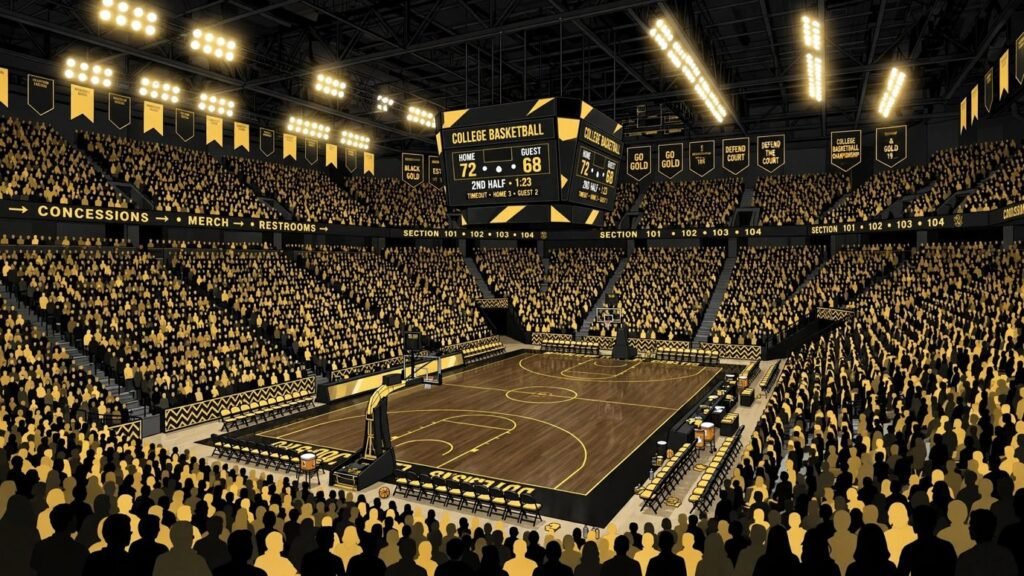
If you have ever watched a college basketball game in Iowa City on a cold winter night, you know the feeling. The lights go down, the crowd in black and gold rises, and Carver-Hawkeye Arena starts to shake. Iowa men’s basketball is not just a team on a schedule. For generations of fans across the state, the Hawkeyes have been a winter ritual, a family tradition, and a source of genuine pride.
The program’s story stretches back more than a century, and it is full of the kind of chapters that make college basketball so compelling: Final Four runs, unforgettable players, heartbreaking losses, and eras when a small Midwestern school stood toe to toe with the giants of the sport. This guide walks through all of it — the history, the stars, the arena, and what defines Iowa basketball today.
The short answer: Iowa men’s basketball is the University of Iowa’s NCAA Division I program, competing in the Big Ten Conference and playing home games at Carver-Hawkeye Arena in Iowa City. The Hawkeyes have reached the Final Four three times (1955, 1956, and 1980), produced some of the most beloved players in Big Ten history, and built an identity around skilled offense, loyal fans, and a deep connection to the state of Iowa.
What Is Iowa Men’s Basketball?
Iowa men’s basketball is the men’s college basketball team representing the University of Iowa. The Hawkeyes compete at the NCAA Division I level as members of the Big Ten Conference, one of the oldest and most competitive conferences in the country. That means a regular diet of games against programs like Michigan State, Purdue, Wisconsin, Illinois, and Michigan — opponents that test a team every single week.
The program is based in Iowa City, a college town where the university sits at the heart of daily life. On game days, the whole town seems to tilt toward the arena. Students camp out for big games, alumni fly back for rivalry weekends, and families pass down their seats the way other families pass down recipes.
The team’s colors are black and gold, and its mascot is Herky the Hawk. If you see a sea of black and gold in a Midwestern arena in January, there is a good chance you are looking at Hawkeye fans.
Where Do the Hawkeyes Play?
The Hawkeyes play at Carver-Hawkeye Arena, a 15,000-plus seat arena in Iowa City that opened in 1983. It is one of the largest on-campus basketball arenas in the country, and when it is full, it is one of the loudest.
Why Carver-Hawkeye Arena Matters
Before Carver-Hawkeye, the Hawkeyes played in the Iowa Field House, a much smaller and older building. The move to the new arena gave the program a stage worthy of Big Ten basketball — and gave fans a building that could hold the entire community’s passion at once.
A few things make the arena special:
- Size and sound: With room for more than 15,000 fans, the building creates a wall of noise that visiting teams genuinely feel.
- The student section: Iowa students bring energy that sets the tone, especially for rivalry games and late-season matchups with conference title implications.
- Tradition: The arena also houses the Iowa wrestling program’s home events, and the building itself has become a symbol of Hawkeye athletics as a whole.
For a visiting team, walking into a packed Carver-Hawkeye Arena on a Saturday night is one of the tougher assignments in the Big Ten. For Iowa fans, it is home.
When Did Iowa Basketball Begin?
Iowa’s basketball history dates back to the early 1900s, when the sport was still young and the rules were still evolving. The program grew up alongside college basketball itself, joining the Western Conference — the forerunner of the modern Big Ten — and slowly building a competitive tradition.
The early decades were uneven, as they were for most programs of the era. But by the middle of the twentieth century, Iowa had found its footing, and the 1950s would deliver the program’s first golden age.
What Was the 1950s Golden Age?
The mid-1950s remain the high-water mark for Iowa basketball in terms of national tournament success. Under head coach Bucky O’Connor, the Hawkeyes reached the Final Four in back-to-back seasons, in 1955 and 1956.
The Fabulous Five
The heart of those teams was a group known as the “Fabulous Five” — five Iowa players who started together and became legends in Iowa City. The group included players such as Carl Cain and Bill Logan, and their chemistry and skill carried Iowa to the national semifinals twice in a row.
Think about what that meant at the time. College basketball was dominated by a handful of established powers, and here was Iowa, a program from a farming state, standing among the final four teams in America two years running. The 1956 team reached the national championship game before falling to San Francisco, a team led by Bill Russell — one of the greatest players the sport has ever produced. Losing to Russell’s Dons was no disgrace; it was proof that Iowa belonged on the biggest stage.
Those 1950s teams set a standard that every Iowa team since has been measured against. They proved that the Hawkeyes could compete nationally, and they gave Iowa fans a story to tell their children and grandchildren.
How Did Lute Olson Change the Program?
If the 1950s were Iowa’s first golden age, the late 1970s brought the second. The central figure was Lute Olson, who became Iowa’s head coach in 1974 and rebuilt the program into a national contender.
Olson was a program builder in the truest sense. He recruited well, coached with discipline and poise, and brought a level of national credibility that Iowa had not enjoyed in years. His teams played smart, tough basketball, and they won consistently in one of the hardest conferences in America.
The 1980 Final Four Run
Olson’s crowning achievement at Iowa came in 1980, when the Hawkeyes returned to the Final Four for the first time since 1956. The run was remarkable not just for where it ended, but for how the team got there — battling through injuries and a brutal bracket to reach Indianapolis.
The 1980 team featured standout guard Ronnie Lester, one of the finest players in program history. Lester’s talent and leadership defined that squad, and his injury troubles during the tournament run only added to the legend: Iowa kept winning even when its best player was hurting.
The Final Four appearance in 1980 remains the program’s most recent trip to the national semifinals, and it is the moment that older Iowa fans point to when they talk about what this program can be. Olson would go on to even greater fame at Arizona, where he won a national championship, but his Iowa years are remembered fondly in Iowa City — and his statue-worthy impact on the program is undisputed.
Who Are the Greatest Iowa Hawkeyes of All Time?
Every program has its Mount Rushmore, and Iowa’s is crowded. Here are some of the names that come up in any honest conversation about Hawkeye greats.
| Player | Era | Why He Matters |
|---|---|---|
| Luka Garza | 2017–2021 | Two-time Big Ten Player of the Year and the program’s all-time leading scorer, known for his footwork, toughness, and relentless work ethic. |
| Keegan Murray | 2020–2022 | Exploded from lightly recruited freshman to one of the best players in America, then became a high NBA draft pick after a record-setting sophomore season. |
| Chris Street | 1990–1993 | A beloved forward whose life was tragically cut short in a car accident during his junior season; his No. 40 is retired, and his memory remains central to Hawkeye identity. |
| Ronnie Lester | 1976–1980 | Star guard of the 1980 Final Four team and one of the most talented players ever to wear an Iowa uniform. |
| Roy Marble | 1985–1989 | A high-scoring wing who starred in the late 1980s and helped keep Iowa nationally relevant during a strong era for the program. |
| B.J. Armstrong | 1985–1989 | A steady, skilled point guard who went on to a long NBA career, including championship seasons with the Chicago Bulls. |
| Jess Settles | 1993–1999 | A versatile forward whose career spanned much of the 1990s and who became a fan favorite for his effort and leadership. |
Luka Garza: The Modern Standard
No discussion of recent Iowa basketball is complete without Luka Garza. The Washington, D.C., native arrived in Iowa City as a promising but unheralded recruit and left as the most decorated player in program history. Garza won Big Ten Player of the Year honors twice, earned consensus national player of the year recognition, and finished as Iowa’s all-time leading scorer.
What made Garza special was not just production — it was approach. He played with a physicality and intensity that wore opponents down, and he improved every single season. His post moves, his rebounding, and his willingness to do the dirty work made him the anchor of Iowa teams that won consistently and drew national attention.
Keegan Murray: The Breakout Star
If Garza was the steady climb, Keegan Murray was the explosion. Murray arrived at Iowa with little fanfare, played sparingly as a freshman, and then delivered one of the greatest individual seasons in school history as a sophomore, averaging more than 23 points per game and setting the program’s single-season scoring record. He went on to become a top-five pick in the NBA draft — the highest selection for an Iowa player in decades.
Murray’s rise captured what Iowa fans love about their program: a player who develops, works, and earns stardom rather than arriving with it pre-packaged.
Chris Street: A Legacy Beyond Basketball
Chris Street’s story is the most emotional in Iowa basketball history. A talented forward from Indianola, Iowa, Street was a homegrown star who embodied the program’s connection to its state. In January 1993, during his junior season, Street was killed in a car accident on his way to a team dinner. He was 20 years old.
Iowa retired his No. 40 jersey, and his legacy has endured for more than three decades. The university established the Chris Street Memorial, and his story is told to every new generation of Hawkeyes. For Iowa fans, Street represents something deeper than wins and losses — the idea that these players are part of the state’s family, not just its team.
What Is Iowa’s NCAA Tournament History?
Iowa has been a regular participant in the NCAA Tournament across many decades, with the three Final Four trips — 1955, 1956, and 1980 — standing as the program’s signature achievements. Beyond those runs, the Hawkeyes have made numerous tournament appearances and have produced memorable moments in March, including deep runs and upset wins that remind fans why the tournament captivates the country every spring.
The program’s tournament history also tells a story of consistency. Iowa is not a program that appears once in a generation; it is one that regularly earns its way into the field and regularly gives its fans a reason to watch Selection Sunday with real hope.
That said, Iowa fans are honest about the gap between the program’s proud history and its recent tournament ceiling. The Hawkeyes have not returned to the Final Four since 1980, and ending that drought is the dream that drives every season. It is also what makes every promising Iowa team so exciting — the sense that this could be the group that finally breaks through.
What Defines Iowa’s Style of Play?
Over the years, Iowa teams have often been known for offense. Skilled, high-scoring teams have been a recurring theme in Iowa City, from the free-flowing squads of the 1980s to the Garza-led teams that filled up the scoreboard a few years ago.
A few hallmarks show up again and again:
- Skilled big men: Iowa has a long tradition of productive post players who can score, rebound, and pass — from the Fabulous Five era through Garza and beyond.
- Shooting: Hawkeye teams have often featured excellent shooters, stretching defenses and creating space for their stars.
- Player development: Iowa’s best stories are frequently about players who got better year after year, turning modest recruiting profiles into All-Big Ten careers.
- Toughness at home: Winning at Carver-Hawkeye Arena has rarely been easy for visitors, and Iowa teams have often built their seasons on protecting their home floor.
None of this is a rigid system. Different coaches have brought different philosophies. But the through-line — skill, development, and a home-court edge — has stayed remarkably consistent.
Who Are Iowa’s Biggest Rivals?
Rivalry games are the heartbeat of college basketball, and Iowa has several that matter deeply to its fans.
- Iowa State: The in-state rivalry, known as the Iowa Corn Cy-Hawk Series matchup, pits the Hawkeyes against the Cyclones from Ames. Bragging rights across the state are on the line every time these two meet, and the game divides families, workplaces, and entire towns.
- Wisconsin: A border rivalry in the Big Ten that has produced many hard-fought, physical games over the years.
- Minnesota: Another long-standing Big Ten neighbor rivalry with decades of history behind it.
- Illinois and Purdue: Conference rivals whose games often carry Big Ten standings implications late in the season.
The Iowa State game deserves special mention because it is about more than basketball. It is about identity — which school owns the state for a year — and it is one of the most anticipated dates on the Iowa sports calendar in any season.
What Is the Fan Culture Like?
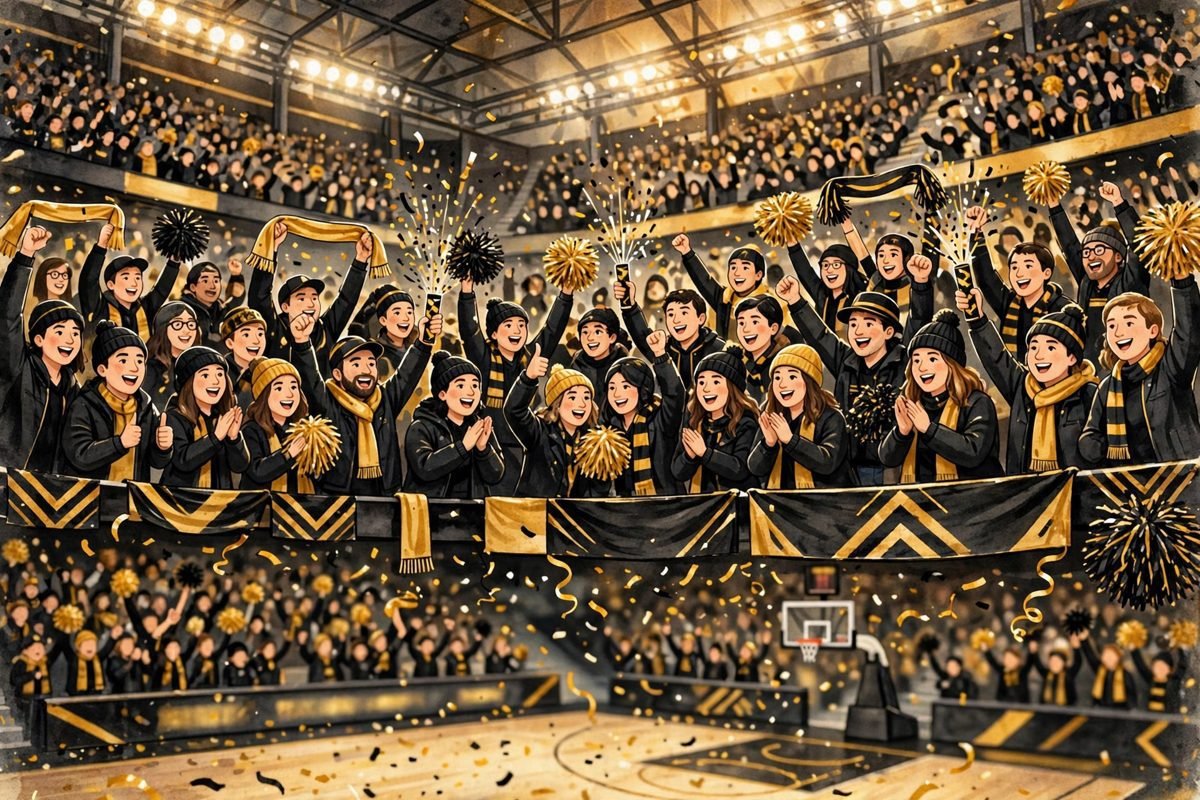
Iowa basketball fandom is best described as loyal, knowledgeable, and deeply personal. Many fans have followed the team for decades, and their connection to the program is tied to their connection to the university and the state itself.
A few traditions and habits define the culture:
- Black and gold everywhere: On game days, Iowa City turns black and gold, from downtown bars to the arena concourse.
- Generational fandom: It is common to meet fans whose parents and grandparents also cheered for the Hawkeyes. Seats, stories, and superstitions get passed down.
- The Hawkeye wave: Borrowed from football, the spirit of Iowa fans turning toward the children’s hospital that overlooks the football stadium reflects a broader Hawkeye community ethos — one that basketball fans share proudly.
- Patience and belief: Iowa fans have waited a long time for another Final Four. That wait has not dulled their enthusiasm; if anything, it has sharpened it. Every promising season carries the hope that this is the year.
What Is the Program’s Place in the Big Ten Today?
The Big Ten is arguably the deepest basketball conference in the country, and Iowa’s place in it is that of a respected, dangerous program — one that can beat anyone on a given night and regularly contends for NCAA Tournament bids.
Iowa’s challenge, shared by many programs in the conference, is turning regular-season success into March breakthroughs. The conference schedule is a grind, and the teams that survive it are battle-tested. Iowa’s goal each season is straightforward: protect home court, steal a few road wins, earn a strong tournament seed, and then make a run when it matters most.
For fans, that formula is both exciting and agonizing. The regular season delivers plenty of thrills, and March delivers the hope that this year will be different.
Why Does Iowa Basketball Matter Beyond Wins and Losses?
College basketball programs matter for reasons that go beyond their records, and Iowa is a perfect example. The program connects the university to the state, gives alumni a reason to come home, and provides a shared story for people who might otherwise have little in common.
For the players, Iowa has been a place to grow — as athletes, as students, and as people. The program’s best stories are about development and character as much as talent. Garza’s work ethic, Murray’s rise, Street’s legacy, Lester’s brilliance — these are stories that resonate because they are about more than basketball.
For the state, the Hawkeyes are a point of pride in a place that does not always get national attention. When Iowa basketball is good, the whole state feels a little taller.
Frequently Asked Questions
What conference does Iowa men’s basketball play in?
The Hawkeyes compete in the Big Ten Conference, one of the premier conferences in NCAA Division I men’s basketball.
Where do the Iowa Hawkeyes play their home games?
Iowa plays at Carver-Hawkeye Arena in Iowa City, Iowa. The arena opened in 1983 and seats more than 15,000 fans.
How many Final Fours has Iowa reached?
Iowa has reached the Final Four three times: in 1955, 1956, and 1980. The 1956 team advanced to the national championship game.
Who is Iowa’s all-time leading scorer?
Luka Garza finished his Iowa career (2017–2021) as the program’s all-time leading scorer and was twice named Big Ten Player of the Year.
Who coached Iowa to the 1980 Final Four?
Lute Olson coached the Hawkeyes from 1974 to 1983 and led the 1980 team to the Final Four before later winning a national championship at Arizona.
What are Iowa’s colors?
Iowa’s colors are black and gold, and the team’s mascot is Herky the Hawk.
Who is Iowa’s biggest rival?
Iowa State is Iowa’s biggest rival. The in-state matchup between the Hawkeyes and the Cyclones is one of the most anticipated games on the Iowa sports calendar each season.
Final Thoughts
Iowa men’s basketball is a program with a rich past, a loyal present, and an unfinished story. The Final Four banners from 1955, 1956, and 1980 hang as reminders of what the Hawkeyes have achieved — and what they are still chasing. The players who wore the black and gold, from the Fabulous Five to Luka Garza and Keegan Murray, gave fans memories that last lifetimes. And Carver-Hawkeye Arena remains one of the great home courts in college basketball, waiting for the next team that turns a promising season into a legendary one.
Whether you are a lifelong Hawkeye fan or someone just discovering the program, there is no better time to follow Iowa basketball. The history is worth knowing, the present is worth watching, and the next chapter — the one every Iowa fan has been waiting for — could be just around the corner.
For more stories from across the web, check out the latest features on themodernpost.co.uk and the everyday reads on dailyorvix.com.
Read Also: Socrates: His Life, Philosophy, Trial, and Enduring Legacy

3 Comments