
Why is Pluto not a planet?
If you went to school before 2006, you probably learned the planets in a neat little rhyme or a mnemonic that ended with Pluto. It was small, it was far away, and it was the ninth planet — end of story. Then, seemingly overnight, the textbooks changed. Pluto was out, the solar system had eight planets, and a lot of people felt oddly betrayed on behalf of a frozen world they had never visited.
So what actually happened? Pluto did not shrink, explode, or drift away. Nothing about Pluto itself changed at all. What changed was our understanding of the neighborhood it lives in, and the rules we use to decide what counts as a planet. Once astronomers found more worlds like Pluto out beyond Neptune, the old system stopped making sense, and a decision had to be made: either add a growing list of new planets, or draw a clearer line. In 2006, astronomers drew that line, and Pluto landed on the other side of it.
This is the full story — how Pluto was found, why it was called a planet in the first place, what forced the rethink, and why the argument still flares up every few years.
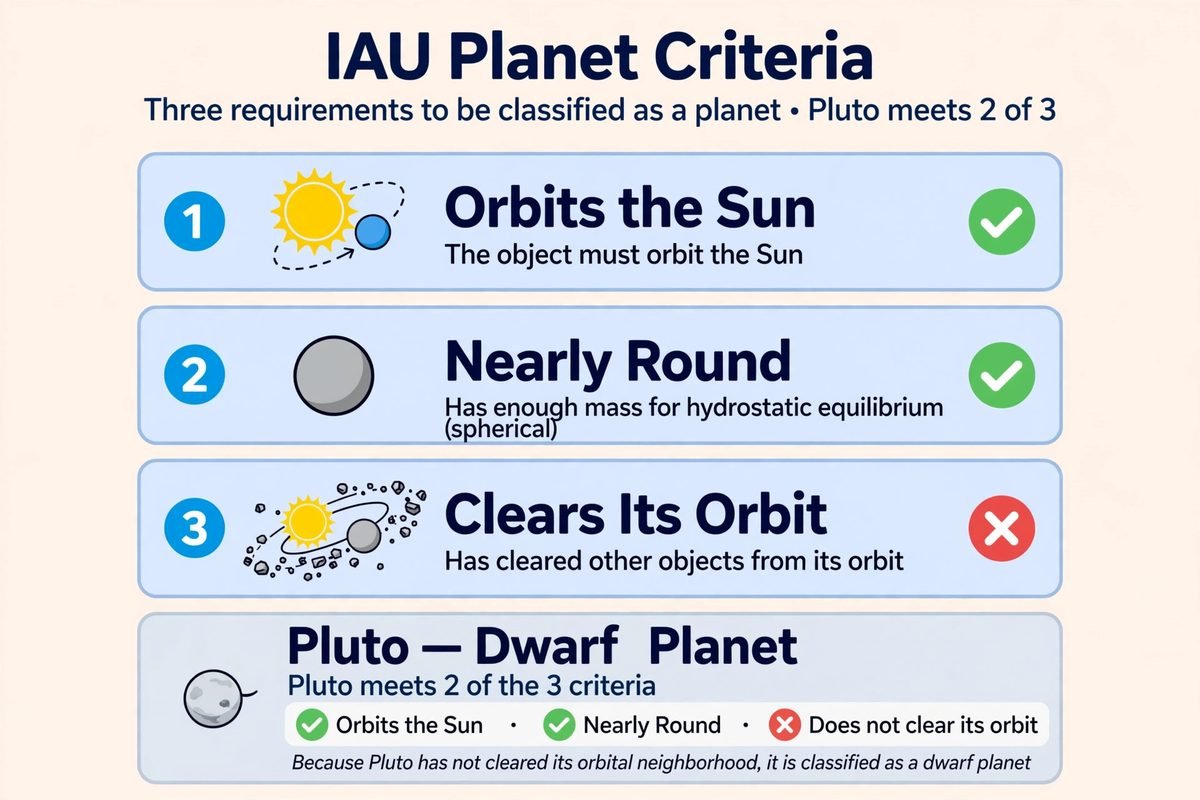
The short answer: Pluto is not a planet because it has not cleared its neighborhood of other objects. Under the definition adopted by the International Astronomical Union in 2006, a planet must orbit the Sun, be massive enough for gravity to pull it into a nearly round shape, and have cleared its orbital neighborhood. Pluto meets the first two conditions but fails the third, because it shares its region of space with many other icy bodies in the Kuiper Belt. It is now classified as a dwarf planet.
Why Did Everyone Grow Up Calling Pluto a Planet?
For most of the twentieth century, the solar system felt like a finished list. Mercury, Venus, Earth, Mars, Jupiter, Saturn, Uranus, Neptune, Pluto — nine planets, and that was that. School posters showed them in a row, and children memorized them without ever wondering who decided the list or what the rules were.
The truth is, there were no formal rules for a long time. When Pluto was discovered in 1930, astronomers simply assumed it was the ninth planet because it orbited the Sun and it was not a moon, an asteroid, or a comet — at least, not obviously. Nobody had written down a precise definition of a planet, because nobody had needed one. The eight classical planets were so different from everything else in the sky that the boundary seemed obvious.
That assumption held for more than seventy years, and Pluto became a cultural fixture along the way. It felt permanent, which is exactly why its reclassification felt so shocking. The surprise was not that Pluto changed — it was that the label had always rested on habit rather than a definition.
How Was Pluto Discovered in the First Place?
The search for Pluto began with a mystery. After Neptune was discovered in 1846, astronomers noticed small irregularities in the orbits of Uranus and Neptune, and some suspected an undiscovered planet was tugging on them. Percival Lowell, an American astronomer, funded a search for this hypothetical world at his observatory in Flagstaff, Arizona, and gave it the name Planet X.
Lowell died before the search succeeded, but the work continued. In 1930, a young astronomer named Clyde Tombaugh, working at Lowell Observatory, was comparing photographic plates of the night sky, looking for any dot that moved against the background stars. On February 18, 1930, he found it: a faint point of light that shifted position from one night to the next. It was a new world, far beyond Neptune.
The discovery made headlines around the world. An eleven-year-old schoolgirl in England, Venetia Burney, suggested the name Pluto, after the Roman god of the underworld — fitting for a dark, distant place. The name stuck, and so did the assumption that this new object was a full planet. But even in those early years, there were hints that Pluto was unusual. It was far smaller than expected, its orbit was tilted and stretched compared with the other planets, and it was so faint that astronomers struggled to measure it at all.
What Changed in the Kuiper Belt?
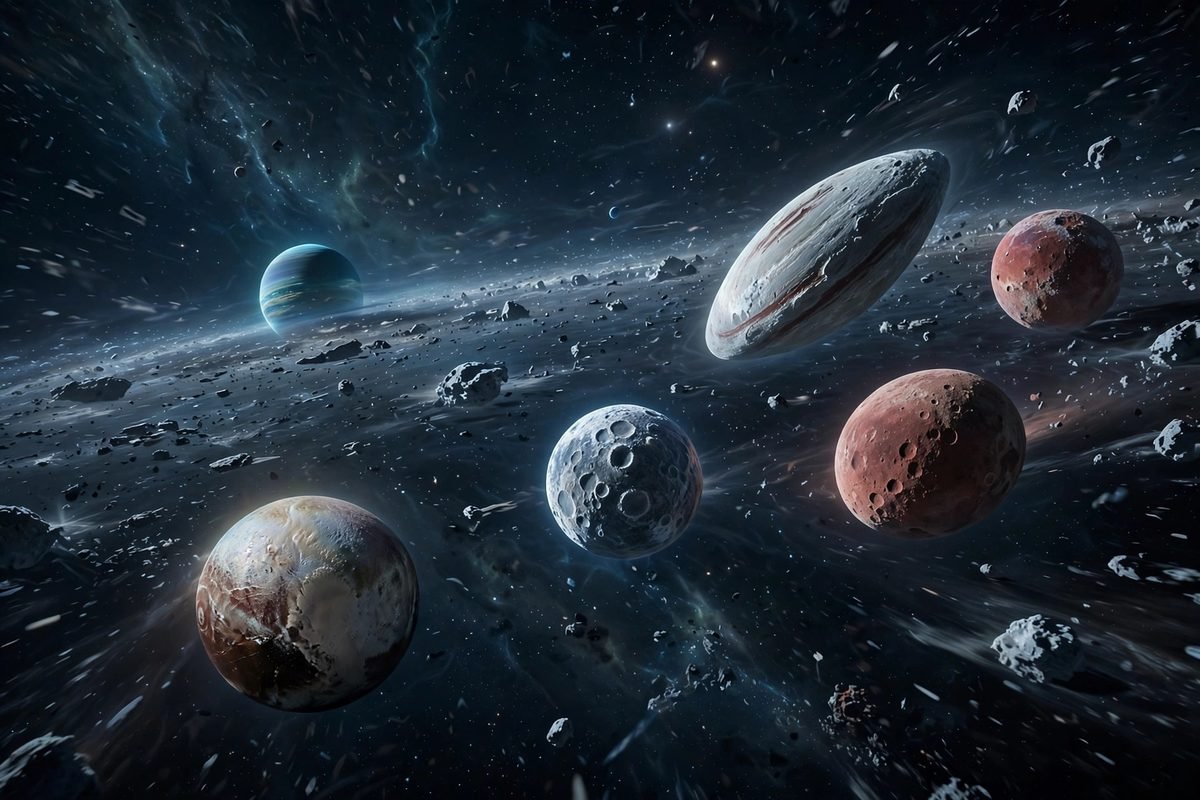
For decades, Pluto sat alone in the textbooks, but the sky had other plans. Starting in the 1990s, astronomers began finding more icy objects beyond Neptune, in a region now called the Kuiper Belt. These were not tiny asteroids. Some were substantial worlds in their own right, and one of them would change everything.
That object was Eris, discovered in 2005. Early measurements suggested Eris was about the same size as Pluto, and possibly slightly larger. Suddenly astronomers faced an uncomfortable question: if Pluto is a planet, then Eris must be one too. And if Eris is a planet, what about the other large Kuiper Belt objects, like Haumea and Makemake? Where would the list stop?
The problem was not just one new object. The Kuiper Belt turned out to be crowded with icy bodies, and Pluto was simply the first and brightest one found — the best-known member of a large family, not a lonely oddball. Keeping Pluto as a planet while excluding its similar-sized neighbors started to look arbitrary, so astronomers needed a rule that applied fairly to all of them.
What Is the IAU Definition of a Planet?
In August 2006, the International Astronomical Union, the body that names and classifies celestial objects, voted on a formal definition of a planet for the first time. The decision was made at its General Assembly in Prague, and it was not unanimous — but it passed, and it has shaped textbooks ever since.
Under that definition, an object in our solar system is a planet only if it meets all three of these conditions:
- It orbits the Sun.
- It has enough mass for its own gravity to pull it into a nearly round shape, a state called hydrostatic equilibrium.
- It has cleared the neighborhood around its orbit.
The first two rules are fairly intuitive. A planet must circle the Sun rather than another planet, and it must be big enough to be round. The third rule is the one that does all the heavy lifting, and it is the one Pluto fails. “Clearing the neighborhood” means the object is gravitationally dominant in its orbital zone — it has either absorbed, captured, or flung away most of the other material sharing its path around the Sun.
The eight classical planets all pass this test. Each dominates its region of the solar system. Pluto does not, and that single difference is the entire reason for its demotion.
Why Does Pluto Fail the Third Rule?
Pluto shares its orbital zone with a crowd. Its path around the Sun crosses the Kuiper Belt, a doughnut-shaped region full of icy bodies, and Pluto is not gravitationally dominant over them. It has not swept its neighborhood clean the way Earth, Jupiter, or Neptune have. In fact, Pluto’s mass is only a small fraction of the total mass of the other objects in its orbital zone.
This is not a judgment about Pluto’s size alone. It is about context. Mercury is far smaller than Neptune, but Mercury still counts as a planet because it dominates its own neighborhood. Pluto, despite being a fascinating and complex world, lives in a busy district and has never taken charge of it.
There is another wrinkle worth knowing: Pluto’s orbit is unusual. It is tilted relative to the plane of the other planets, and it is highly elliptical, which means its distance from the Sun varies a lot. For part of its 248-year orbit, Pluto is actually closer to the Sun than Neptune. That odd, tilted, stretched orbit is a clue to its origins in the Kuiper Belt, and it looks nothing like the tidy, nearly circular orbits of the eight planets.
What Exactly Is a Dwarf Planet?
When the IAU adopted its planet definition in 2006, it also created a new category: dwarf planet. A dwarf planet meets the first two planet conditions — it orbits the Sun and is nearly round — but it has not cleared its neighborhood. It is also not a moon of another planet.
Pluto became the most famous dwarf planet, but it is not alone. The IAU currently recognizes five dwarf planets in our solar system: Pluto, Eris, Haumea, Makemake, and Ceres. Ceres is the odd one out in a different way — it lives in the asteroid belt between Mars and Jupiter, not in the Kuiper Belt — but it fits the same definition.
Here is how the two categories compare side by side:
| Criterion | Planet | Dwarf planet |
|---|---|---|
| Orbits the Sun | Yes | Yes |
| Nearly round from its own gravity | Yes | Yes |
| Has cleared its orbital neighborhood | Yes | No |
| Is a moon of another planet | No | No |
| Examples | Mercury, Venus, Earth, Mars, Jupiter, Saturn, Uranus, Neptune | Pluto, Eris, Haumea, Makemake, Ceres |
The word “dwarf” can sound dismissive, but in astronomy it is a technical term, not an insult. Dwarf planets are still worlds with geology, weather, and seasons. The category says something specific about their gravitational influence, not about their interest or importance.
What Did New Horizons Reveal About Pluto in 2015?
If Pluto’s demotion made it seem less interesting, the New Horizons spacecraft proved the opposite. Launched in 2006 — the very year of the reclassification vote — New Horizons spent nearly a decade crossing the solar system and flew past Pluto in July 2015, sending back the first close-up images of a world humans had only ever seen as a blurry dot.
What it found stunned even the scientists. Pluto has a heart-shaped glacier of nitrogen ice, towering mountains of water ice, vast plains, possible ice volcanoes, and a thin but real atmosphere. Its largest moon, Charon, turned out to be a complex world in its own right, with canyons and a dark northern region. Pluto is geologically active in ways nobody had expected from a small, frozen body so far from the Sun.
The flyby did not change Pluto’s classification — the IAU definition is about orbital dominance, not about how beautiful or complex a world is — but it changed how people felt about it. Pluto stopped being an abstract entry on a list and became a real place. For many people, that made the “dwarf planet” label feel even more unfair, because here was a world more dynamic than some of the planets that kept their titles.

Why Do Some Astronomers Still Disagree?
The 2006 vote was controversial from the start, and the disagreement has never fully disappeared. Some planetary scientists argue that the IAU definition is flawed, and their objections are worth taking seriously.
One common criticism is that the “clearing the neighborhood” rule is about where an object is, not what it is. A planet moved to a different part of the solar system could, in theory, fail the test through no fault of its own. Critics say a definition should describe the object itself — its size, its roundness, its geology — rather than its surroundings. Under a geophysical definition like that, Pluto would be a planet again, and so would several other dwarf planets and even some large moons.
Another criticism is procedural. The vote took place at the end of a long conference, when many astronomers had already gone home, and only a fraction of the IAU’s members participated. Supporters of the definition reply that this is how such bodies work, and that the result has held for two decades. Still, the circumstances gave critics a lasting talking point.
Is Pluto a Planet Again?
No — at least, not officially. As of today, the IAU definition still stands, and Pluto remains a dwarf planet in every textbook, encyclopedia, and space agency listing that follows it. There have been proposals to change the definition, and the discussion resurfaces regularly in conferences and popular articles, but no new vote has overturned the 2006 decision.
That does not mean the story is over. Science revises its categories when the evidence demands it, and if astronomers ever agree on a better definition, Pluto’s status could change again. But for now, the honest answer is clear: the solar system has eight planets, and Pluto is the most famous dwarf planet. Whatever you call it, Pluto is still out there, completing one orbit every 248 years, with its heart-shaped glacier and its five known moons. No vote can take that away.
What Should You Tell Your Kids About Pluto?
If a child asks you why Pluto is not a planet anymore, the simplest and most accurate answer is this: scientists learned more, and when they learned more, they changed the label. That is not a failure of science — it is science working the way it is supposed to. Pluto did not get smaller or less important. We just discovered it has a lot of neighbors, and we needed a fair rule for all of them. Pluto is still there, still fascinating, and still the first world we ever found in the Kuiper Belt — and “dwarf planet” is a perfectly respectable title.
Frequently Asked Questions
Is Pluto still a planet in 2026?
No. Under the International Astronomical Union’s 2006 definition, Pluto is classified as a dwarf planet, not a planet. That classification is still in force today, and the solar system officially has eight planets.
Why was Pluto removed as a planet?
Pluto was reclassified because it has not cleared its neighborhood around its orbit, the third requirement in the IAU’s definition of a planet. After the discovery of Eris and other large Kuiper Belt objects, astronomers decided Pluto belonged to that population rather than to the eight gravitationally dominant planets.
When did Pluto stop being a planet?
The IAU voted on the new definition in August 2006, at its General Assembly in Prague. Pluto had been considered the ninth planet from its discovery in 1930 until that vote — a run of 76 years.
Who discovered Pluto?
Clyde Tombaugh discovered Pluto in 1930 at Lowell Observatory in Flagstaff, Arizona. He found it by comparing photographic plates of the sky and spotting a faint object that moved against the background stars. Venetia Burney, an eleven-year-old schoolgirl, suggested the name Pluto.
What is the difference between a planet and a dwarf planet?
Both orbit the Sun and are nearly round from their own gravity. The difference is the third rule: a planet has cleared its orbital neighborhood, while a dwarf planet has not. Dwarf planets share their orbital zone with other objects of similar size.
Could Pluto become a planet again?
It is possible in principle, but it would require the IAU to adopt a new definition of a planet. Some planetary scientists have proposed definitions based on geology rather than orbital dominance, under which Pluto would qualify. No such change has been adopted so far.
How many dwarf planets are there?
The IAU currently recognizes five dwarf planets: Pluto, Eris, Haumea, Makemake, and Ceres. Astronomers suspect there may be more dwarf planets waiting to be confirmed, particularly in the distant Kuiper Belt.
Conclusion
Pluto’s story is really two stories at once. One is about a small, distant world with a heart-shaped glacier, five moons, and a thin atmosphere — a place far stranger and more wonderful than anyone imagined in 1930. The other is about us: how we name things, how we draw lines, and how we react when new discoveries force us to redraw them.
Pluto is not a planet under the current definition, and that answer is clear. But the definition itself is a human tool, not a law of nature, and the debate about it continues for good reasons. The next time someone tells you Pluto was “kicked out” of the solar system, you can set the record straight: it was never kicked out at all. It is still out there, orbiting the Sun, leading a whole family of icy worlds at the edge of everything we know — and that is a title worth keeping.

1 Comment