
Which planet is farthest from the sun?
If someone asked you this at a quiz night, what would you say first? For a lot of people, the answer that pops out is Pluto. It feels right. Pluto has always had that lonely, far-away reputation, the tiny world at the edge of everything. Others go for Uranus, because its name sounds distant and its blue-green colour looks cold enough to be last.
Both guesses make sense, and both are wrong — at least if we are talking about actual planets.
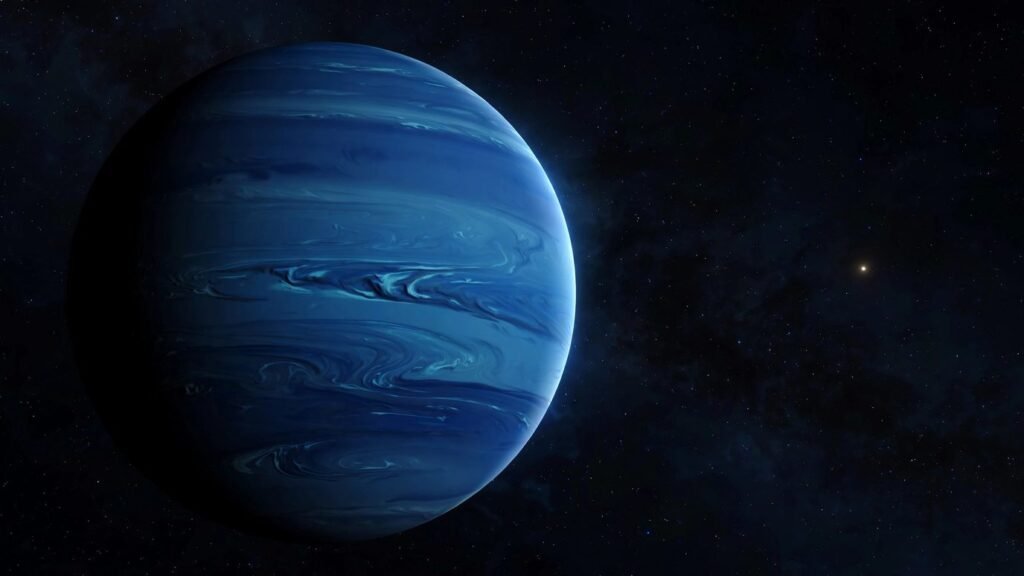
The planet farthest from the Sun is Neptune. It sits eighth in line from the Sun, out past Uranus, in a part of the solar system so dark and cold that sunlight takes more than four hours to get there. It is not the biggest planet, it is not the most famous, and you will never see it with your naked eye. But by distance, it wins, and it wins by a huge margin.
That is the simple answer. The interesting part is why it causes so much confusion, how we found a planet we could not even see at first, and what kind of world waits out there at the edge of the planetary neighbourhood.
The short answer: Neptune is the farthest planet from the Sun. It orbits at an average distance of about 4.5 billion kilometres, or roughly 30 times farther from the Sun than Earth. Pluto is farther away on average, but Pluto has been a dwarf planet, not a planet, since 2006.
How Far Is Neptune From the Sun, Really?
Numbers this big are hard to picture, so let us put them in terms you can actually feel.
Neptune’s average distance from the Sun is about 4.5 billion kilometres. In astronomy, that is usually written as about 30 astronomical units, or 30 AU. One AU is the average distance from Earth to the Sun, about 150 million kilometres. So Neptune is roughly 30 times farther out than we are.
Light from the Sun, which reaches Earth in about eight minutes, takes around four hours and six minutes to reach Neptune. If you could drive there at motorway speed without stopping — which you obviously cannot — the trip would take thousands of years. Even Voyager 2, the only spacecraft ever to visit Neptune, took 12 years to get there after launching in 1977, and it used gravity assists from Jupiter, Saturn, and Uranus along the way.
Neptune’s orbit is not a perfect circle, but it is close. Unlike Pluto, which swings wildly in and out, Neptune stays at a fairly steady distance. At its closest point to the Sun, called perihelion, it is about 4.45 billion kilometres away. At its farthest, aphelion, it is about 4.55 billion kilometres away. That small difference matters, because it is part of why Neptune keeps the title even when Pluto’s orbit crosses inside its own.
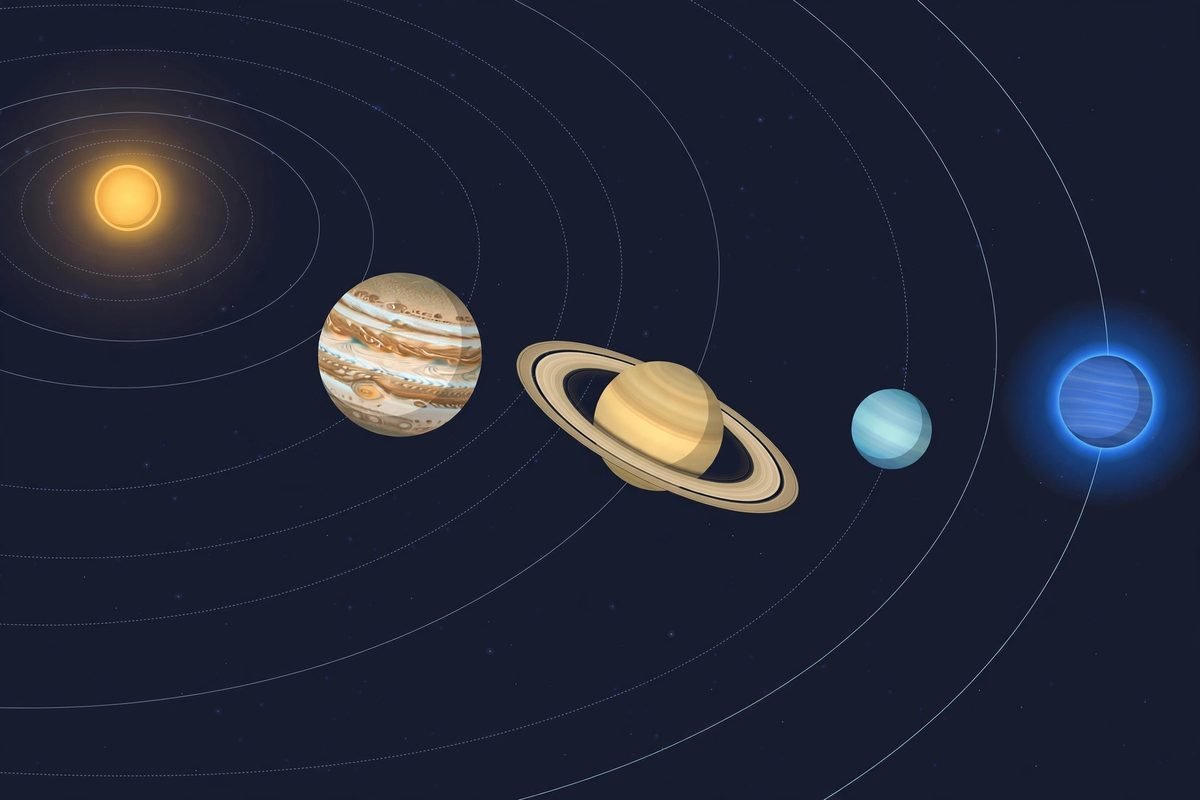
Here is how the outer planets stack up:
| Planet | Position from the Sun | Average distance | Orbital period |
|---|---|---|---|
| Jupiter | 5th | 778 million km (5.2 AU) | 11.9 Earth years |
| Saturn | 6th | 1.43 billion km (9.6 AU) | 29.4 Earth years |
| Uranus | 7th | 2.87 billion km (19.2 AU) | 84 Earth years |
| Neptune | 8th | 4.50 billion km (30.1 AU) | 164.8 Earth years |
You can see the jump. Uranus is already unimaginably far, and Neptune is another 1.6 billion kilometres beyond that.
Why Isn’t Pluto the Farthest Planet?
This is where most arguments start, so let us clear it up properly.
Pluto is, on average, farther from the Sun than Neptune. Its average distance is about 5.9 billion kilometres, or 39.5 AU. If distance alone decided it, Pluto would win. But Pluto is no longer classed as a planet.
In 2006, the International Astronomical Union (IAU) voted on a formal definition of a planet. To qualify, a body has to do three things:
- Orbit the Sun
- Be massive enough for its own gravity to pull it into a round shape
- Have cleared its orbit of other objects of similar size
Pluto passes the first two tests, but fails the third. It shares its neighbourhood in the Kuiper Belt with lots of other icy bodies, and it has not cleared them away. So the IAU reclassified Pluto as a dwarf planet. That decision is still debated by some astronomers and plenty of Pluto fans, but it is the official classification used in textbooks, exams, and by NASA.
There is a second twist that surprises people. Pluto’s orbit is highly stretched out, like an oval rather than a circle. Because of that, for about 20 years out of every 248-year orbit, Pluto actually comes closer to the Sun than Neptune. The last time that happened was from 1979 to 1999. During those years, if you had asked which planet was farthest, the answer would technically have been Neptune even before the reclassification — because Pluto was inside Neptune’s orbit.
So Pluto is a fascinating world, and it deserves its fans. It just does not count in a question about planets anymore.
How Was Neptune Discovered Without Being Seen First?
Neptune has one of the best discovery stories in all of astronomy, because it was found with maths before it was found with a telescope.
In the early 1800s, astronomers were tracking Uranus, which had been discovered in 1781. Something was off. Uranus was not quite where it was supposed to be. Its orbit wobbled in a way that suggested another massive object was tugging on it from farther out.
Two mathematicians worked on the problem independently: Urbain Le Verrier in France and John Couch Adams in England. Both calculated where this mystery planet should be. Le Verrier sent his prediction to the Berlin Observatory in September 1846, and on the very first night of searching, astronomer Johann Gottfried Galle found Neptune almost exactly where Le Verrier said it would be, less than a degree away.
Think about that for a second. Nobody had ever seen Neptune. Nobody knew what it looked like. But gravity left a fingerprint, and careful calculation followed it to a brand-new planet. It is still held up as one of the great triumphs of prediction in science.
Galileo, interestingly, may have recorded Neptune as early as 1612, but he mistook it for a star. It took more than 230 years and a lot of orbital maths before anyone recognised it for what it was.
How Long Does Neptune Take to Orbit the Sun?
A very long time. Neptune takes about 164.8 Earth years to complete one orbit around the Sun — usually rounded to 165 years.
That means since its discovery in 1846, Neptune has completed only one full orbit. It finished that first observed lap in 2011. Every birthday, every season, every year you have lived through is just a tiny fraction of a single Neptunian year.
A day on Neptune is much shorter than a year, by contrast. It spins once on its axis in about 16 hours. So Neptune has fast days and an enormously slow year, which is a strange combination when you think about it.
Its seasons are also extreme in length. Because Neptune’s axis is tilted by about 28 degrees, similar to Earth’s 23.5 degrees, it does have seasons. But each season lasts for more than 40 Earth years. A Neptunian summer is longer than most human lifetimes.
What does that mean for a human lifetime?
If you were born on Neptune — again, impossible, but let us imagine it — you would not live long enough to see your first birthday. You would spend your whole life in a single season. It is a good reminder of just how different time works on the outer planets.
What Is Neptune Actually Like?
Forget the calm blue dot you might picture from a textbook. Neptune is violent, freezing, and surprisingly dynamic for a world that gets so little sunlight.
It is an ice giant, like Uranus, which means it is made mostly of water, ammonia, and methane ices wrapped around a rocky core, with a thick atmosphere of hydrogen and helium on top. It is about four times wider than Earth and about 17 times more massive. If Earth were an apple, Neptune would be roughly a large grapefruit — except a grapefruit that weighs as much as a small car fleet.
That deep blue colour comes from methane in its atmosphere, which absorbs red light and reflects blue. Neptune is a richer, deeper blue than Uranus, partly because its atmosphere is more active and has more methane haze and cloud features.
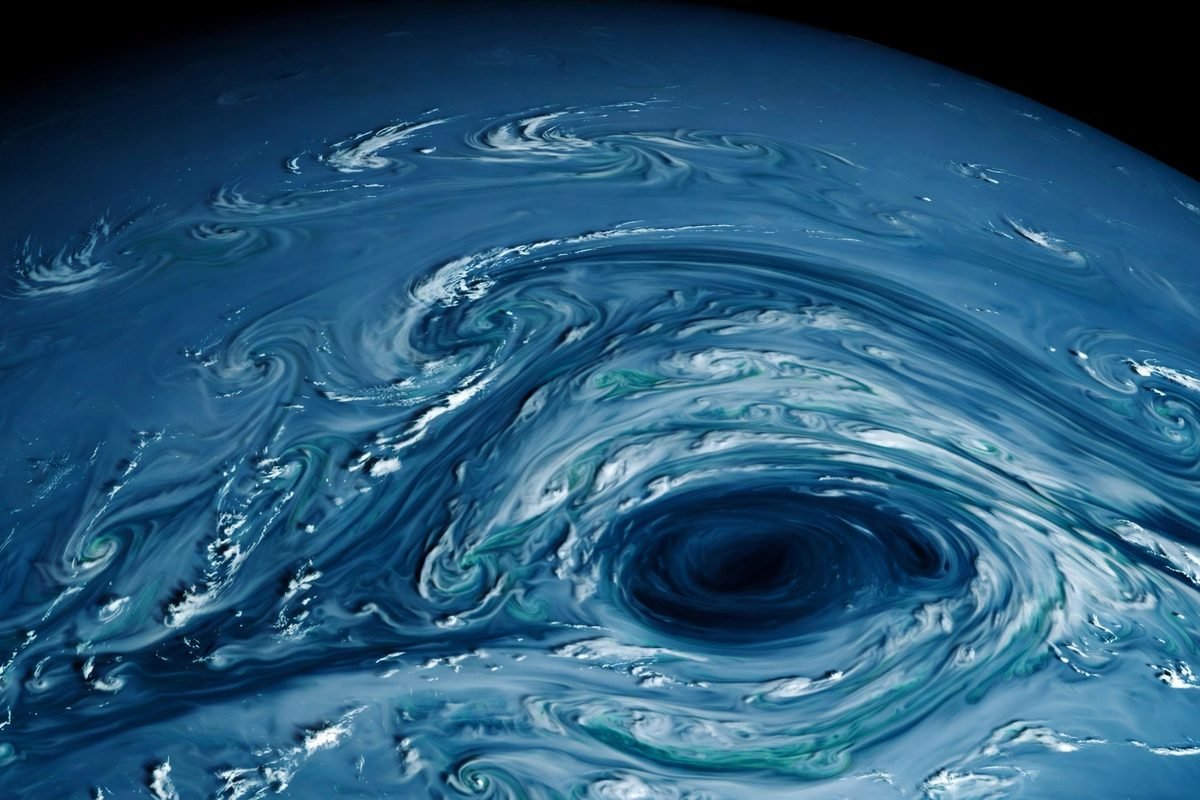
When Voyager 2 flew past in 1989, it spotted a huge dark storm system nicknamed the Great Dark Spot, similar in spirit to Jupiter’s Great Red Spot but smaller and shorter-lived. Later Hubble observations showed that spot had disappeared, and new storms had formed. Neptune’s atmosphere keeps changing, even though it receives only about 1/900th of the sunlight Earth gets.
Why Is Neptune So Cold — and So Windy?
Distance explains the cold, but not the wind. Let us take them one at a time.
Temperatures on Neptune average around minus 200 degrees Celsius. The coldest cloud tops have been measured at about minus 218 degrees Celsius, making Neptune one of the coldest places in the solar system, sometimes colder than Uranus despite being farther out. That is because Uranus has almost no internal heat escaping, while Neptune still radiates more heat than it receives from the Sun — but not nearly enough to warm it up in any way you would notice.
And yet, despite that faint sunlight, Neptune has the fastest winds of any planet we know. Sustained winds can reach 2,100 kilometres per hour, or about 1,300 miles per hour. For comparison, the strongest hurricane winds on Earth top out around 300 kilometres per hour. Neptune’s winds are supersonic, and they whip clouds around the planet in hours.
Scientists are still working out exactly why. One leading idea is that heat rising from Neptune’s interior drives the weather, even though sunlight is weak. The planet is not just passively sitting in the cold; it has its own internal engine stirring things up. That combination — a warm interior and a freezing exterior — seems to power storms that would tear apart anything we could build.
What Do We Know About Neptune’s Moons?
Neptune has 14 known moons, and they are a mixed bunch. Most are small and irregular, probably captured asteroids or Kuiper Belt objects. One stands out above all the rest: Triton.
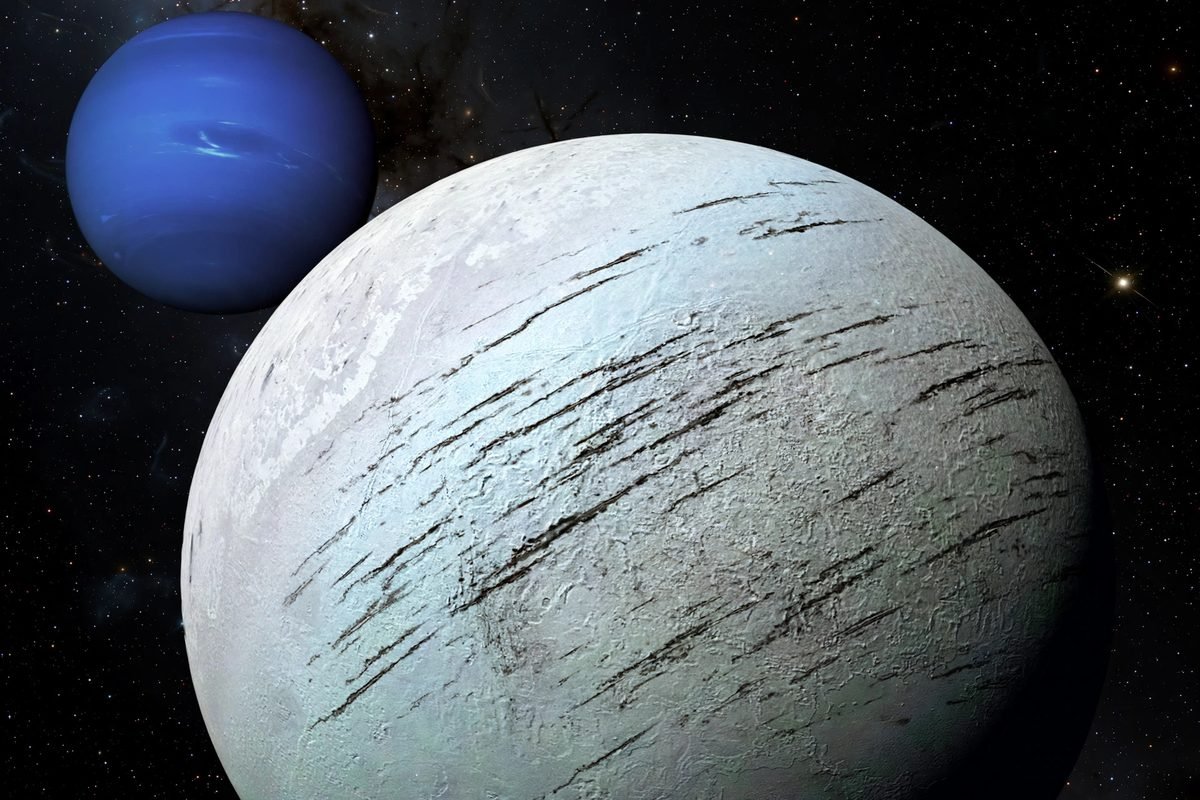
Triton is Neptune’s largest moon, and it is weird in the best way. It orbits Neptune backwards, in the opposite direction to Neptune’s rotation. That retrograde orbit is strong evidence that Triton did not form around Neptune — it was captured by Neptune’s gravity long ago, probably from the Kuiper Belt, the same region Pluto comes from.
Triton is about 2,700 kilometres across, a little smaller than Earth’s Moon, and it is covered in nitrogen ice. Voyager 2 photographed geysers erupting nitrogen gas and dark dust up to 8 kilometres into its thin atmosphere. It is one of only a few worlds in the solar system known to have active geysers, alongside Saturn’s moon Enceladus.
Other notable moons include:
- Proteus — the second-largest Neptunian moon, dark, cratered, and irregularly shaped.
- Nereid — on a highly eccentric orbit that takes it far out and then swings it back in close.
- Larissa, Despina, Galatea, and Thalassa — small inner moons that orbit close to Neptune, shepherding its faint rings.
Yes, Neptune has rings. They are faint, dark, and incomplete in places, nothing like Saturn’s bright rings, but they are there. They were confirmed by Voyager 2 and are made of dust and small particles, probably from collisions between moons.
How Do Scientists Measure Distances This Huge?
You cannot stretch a tape measure to Neptune, so how do we know it is 4.5 billion kilometres away with such confidence?
The basic unit is the astronomical unit, the AU. Astronomers worked out the Earth-Sun distance very precisely using radar bounces off Venus and other planets, and by tracking spacecraft. Once you have that yardstick, you can use geometry.
For nearby planets, parallax helps: observe a planet from two different points in Earth’s orbit, six months apart, and the shift in its apparent position lets you triangulate the distance. For distant planets like Neptune, the main method is orbital mechanics. Once you know a planet’s orbital period — how long it takes to go around the Sun — Kepler’s laws let you calculate its average distance very accurately. Neptune’s 165-year period, measured over more than a century of observations, pins down that 30 AU figure.
Spacecraft tracking adds another check. When Voyager 2 flew to Neptune, navigators tracked its radio signals and timed how long they took to travel back to Earth. At Neptune, that one-way light time was just over four hours. That direct timing confirmed the distance in a way no theory alone could.
Today, telescopes keep refining Neptune’s position night after night. The number 4.5 billion kilometres is not a guess. It is the result of nearly 180 years of observations, maths, and one very long spacecraft journey.
Why Do So Many People Get This Question Wrong?
There are a few honest reasons, and none of them mean you are bad at science.
First, Pluto nostalgia is real. If you grew up learning nine planets, with Pluto proudly last, that list sticks in your head. The 2006 reclassification happened almost 20 years ago, but school memories are stubborn. Many adults still picture the old lineup without thinking about it.
Second, Uranus and Neptune look alike. Both are blue, both are ice giants, both are far away, and their names are easy to mix up if you have not thought about them since school. Uranus is seventh, Neptune is eighth — but unless you recite the order regularly, it is easy to swap them.
Third, the phrase “farthest planet” sounds like it should mean “the most remote, most extreme world we know.” Pluto feels more extreme because it is smaller, stranger, and farther on average. Our brains like a good story, and Pluto’s underdog story beats Neptune’s quiet, steady orbit.
And fourth, textbooks and trivia have not always kept up. You will still find old books, old posters, and old websites listing Pluto as the ninth planet. If that was your source, you were not wrong for trusting it at the time — it is just out of date now.
A quick way to remember it
Use the order: Mercury, Venus, Earth, Mars, Jupiter, Saturn, Uranus, Neptune. The old mnemonic “My Very Excellent Mother Just Served Us Nachos” ends with Nachos for Neptune. If you can remember that last N, you have the answer.
Frequently Asked Questions
Is Neptune or Pluto farther from the Sun?
On average, Pluto is farther — about 5.9 billion kilometres compared with Neptune’s 4.5 billion. But Pluto is a dwarf planet, not a planet, so Neptune is the farthest planet. Pluto’s orbit also crosses inside Neptune’s for about 20 years in every 248-year cycle.
Is Uranus farther than Neptune?
No. Uranus is the seventh planet, at about 2.87 billion kilometres from the Sun. Neptune is eighth, at about 4.5 billion kilometres. Neptune is roughly 1.6 billion kilometres farther out than Uranus.
How long would it take to travel to Neptune?
Voyager 2 took 12 years, with gravity assists from Jupiter, Saturn, and Uranus. A modern spacecraft on a direct trajectory might do it faster, but any trip would still take many years, not months. Light itself takes about four hours to make the journey.
Can you see Neptune without a telescope?
No. Neptune is far too faint to see with the naked eye. Even with binoculars it looks like a faint star. You need a decent telescope and a good star chart to pick it out, and even then it is just a tiny blue dot.
Is Neptune the coldest planet?
Neptune’s cloud tops can reach about minus 218 degrees Celsius, which is extremely cold, but Uranus has recorded even colder temperatures at times, around minus 224 degrees Celsius. Uranus is colder on record despite being closer to the Sun, because it gives off almost no internal heat. Neptune is still one of the two coldest planets.
How many moons does Neptune have?
Neptune has 14 known moons. Triton is by far the largest and most interesting, followed by Proteus. More small moons may still be found as telescopes improve.
Will Neptune always be the farthest planet?
As long as our definition of a planet stays the same, yes. No new planet has been confirmed beyond Neptune, although astronomers have proposed a hypothetical “Planet Nine” based on the strange orbits of distant Kuiper Belt objects. Until such a planet is actually found and confirmed, Neptune keeps the title.
Final Thoughts
So, which planet is farthest from the Sun? Neptune, by a clear and comfortable margin — about 4.5 billion kilometres out, completing one slow orbit every 165 years, battered by the fastest winds in the solar system and orbited by a captured moon that erupts nitrogen geysers.
It is easy to see why Pluto steals the spotlight. Pluto is smaller, stranger, and its demotion felt personal to a lot of people. But Neptune does not need a comeback story. It was predicted by maths before anyone saw it, it has held the outermost spot for nearly two centuries of observation, and it is still revealing new storms, new details, and new questions every time we point a telescope at it.
Next time the question comes up, you will know the answer — and, more importantly, you will know why it is the answer. That is a much better position than just memorising a list.
Read Also: Which Planet Is Closest to the Sun? A Simple Guide

1 Comment