
If someone asked you to point at the planet nearest the Sun, what would you say? Most people pause for a second. Some confidently say Venus, because Venus feels hot and bright in our sky. Others guess Earth, because, well, we live here and the Sun feels close enough on a summer afternoon. Both answers feel reasonable. Both are wrong.
The real answer is a small, crater-covered world that most of us rarely think about. It whips around the Sun faster than any other planet, endures some of the wildest temperature swings in the solar system, and has a year shorter than a single season on Earth. Once you know its story, you will never mix up the order of the planets again.
The short answer: Mercury is the planet closest to the Sun. It orbits at an average distance of about 57.9 million kilometers (0.39 AU) from the Sun, well inside the orbit of Venus. Mercury is the smallest planet in our solar system, it completes one year in just 88 Earth days, and despite sitting nearest the Sun, it is not the hottest planet — that title belongs to Venus.
Which Planet Is Closest to the Sun?
Mercury is the closest planet to the Sun, full stop. No other planet comes nearer, not even at its closest approach to the Sun.
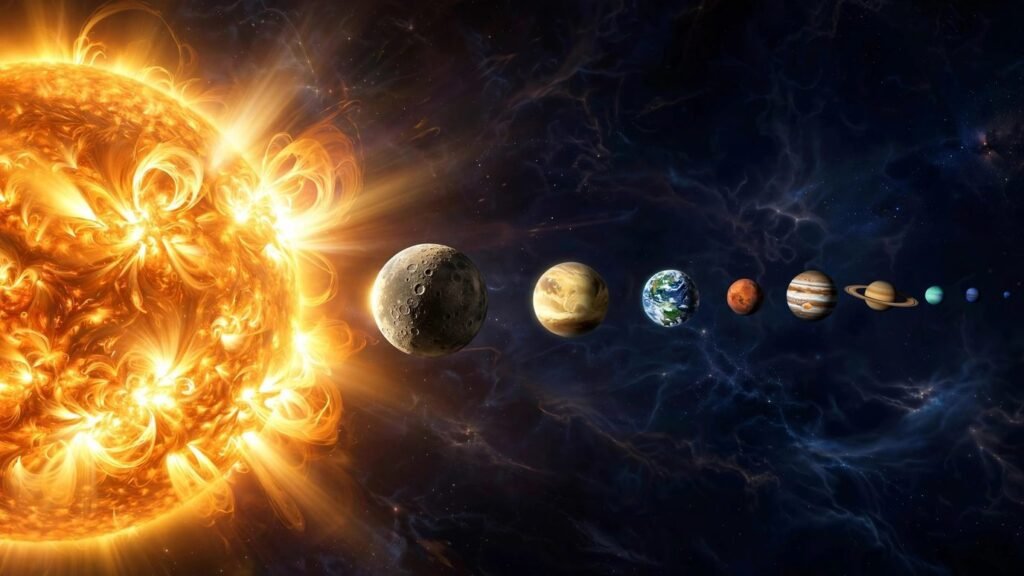
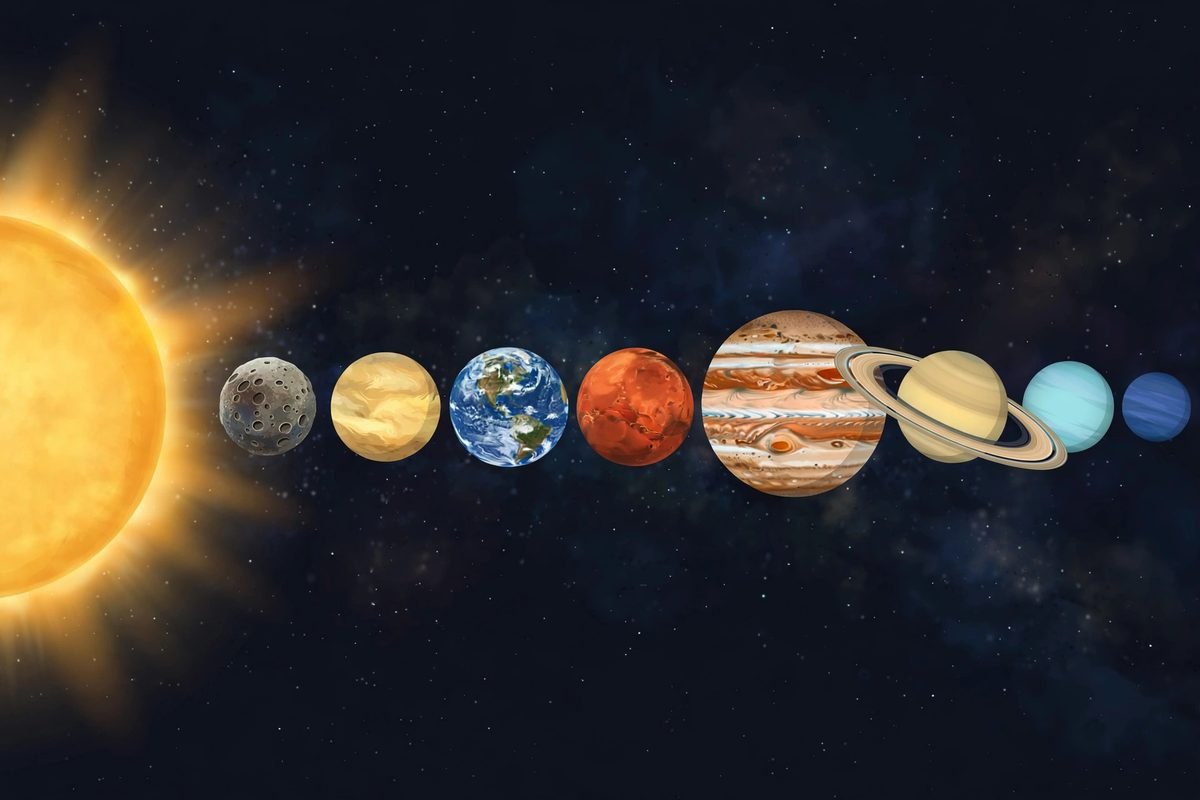
The order of the planets from the Sun outward goes like this: Mercury, Venus, Earth, Mars, Jupiter, Saturn, Uranus, and Neptune. Mercury holds first place in that lineup, and it has held it for the entire 4.6-billion-year history of the solar system. It formed from the leftover material nearest the young Sun, and it has stayed in that innermost lane ever since.
What makes Mercury easy to overlook is its size and its shyness in our sky. It is only slightly larger than Earth’s Moon, and because it never strays far from the Sun as seen from Earth, it is often lost in the Sun’s glare. You can only spot it low near the horizon just after sunset or just before sunrise, and only for a few weeks at a time. So while Mercury is our nearest planetary neighbor toward the Sun, it is also one of the hardest planets to actually see.
How Far Is Mercury From the Sun, Really?
On average, Mercury sits about 57.9 million kilometers from the Sun. In miles, that is roughly 36 million miles. Astronomers often express this distance as 0.39 AU, where one AU (astronomical unit) is the average distance between Earth and the Sun, about 149.6 million kilometers.
That 0.39 figure is a helpful way to picture it. If Earth sits one full step away from the Sun, Mercury sits at less than four-tenths of that step. Venus, the next planet out, sits at about 0.72 AU. So Mercury is dramatically closer to the Sun than Venus is, and less than half as far out as Earth.
But here is a detail that catches people off guard: Mercury’s distance from the Sun is not constant. Its orbit is not a neat circle. It is stretched into an oval, which means Mercury sometimes swings much closer to the Sun and sometimes drifts farther away. At its nearest point, called perihelion, Mercury gets to about 46 million kilometers from the Sun. At its farthest point, called aphelion, it reaches about 70 million kilometers. That is a huge swing for such a small planet, and as you will see, it shapes almost everything about Mercury’s strange climate.
Planets in Order From the Sun
| Position | Planet | Average Distance From the Sun |
|---|---|---|
| 1 | Mercury | 57.9 million km (0.39 AU) |
| 2 | Venus | 108.2 million km (0.72 AU) |
| 3 | Earth | 149.6 million km (1.00 AU) |
| 4 | Mars | 227.9 million km (1.52 AU) |
| 5 | Jupiter | 778.5 million km (5.20 AU) |
| 6 | Saturn | 1.43 billion km (9.58 AU) |
| 7 | Uranus | 2.87 billion km (19.2 AU) |
| 8 | Neptune | 4.50 billion km (30.1 AU) |
Look at that table and one thing jumps out: the gap between Mercury and Venus is enormous compared with Mercury’s own distance from the Sun. Mercury could fit its entire average Sun distance inside the gap between Venus and Earth almost twice over. It really is in a league of its own, tucked right up against the Sun.
Why Is Mercury the Closest Planet?
Mercury is closest because that is where it was born. When the solar system formed from a spinning cloud of gas and dust, heavier materials tended to collect nearer the center, where the young Sun’s gravity was strongest. Mercury gathered from rocky, metal-rich material in that inner region, while lighter gases were pushed farther out by the Sun’s heat and wind.
Over billions of years, Mercury’s orbit has stayed stable in that inner zone. Planets do not generally swap places. Their orbits can wobble and stretch a little, but a planet does not drift from second place to first, or get overtaken by a neighbor. Gravity keeps each planet in its lane, and Mercury’s lane happens to be the innermost one.
There is another reason Mercury’s position matters so much: the Sun’s gravity is far stronger close in. That intense pull is exactly why Mercury moves so fast. To avoid falling into the Sun, a planet close in has to race around it. Mercury travels at an average orbital speed of about 47.9 kilometers per second, faster than any other planet. Earth, for comparison, ambles along at about 29.8 kilometers per second. Mercury is not just closest; it is also the speed champion of the solar system.
If Mercury Is Closest, Why Isn’t It the Hottest?
This is the question that trips up almost everyone, and it is the best part of Mercury’s story. If closeness to the Sun decided temperature, Mercury would be the hottest planet by a wide margin. It is not. Venus is.
Venus holds the hottest-planet title with surface temperatures around 465 degrees Celsius (869 degrees Fahrenheit), hot enough to melt lead. Mercury’s daytime highs reach about 430 degrees Celsius (800 degrees Fahrenheit), which is ferociously hot, but still below Venus. And at night, Mercury plunges to around minus 180 degrees Celsius (minus 290 degrees Fahrenheit). Venus, meanwhile, barely cools down at all, day or night.
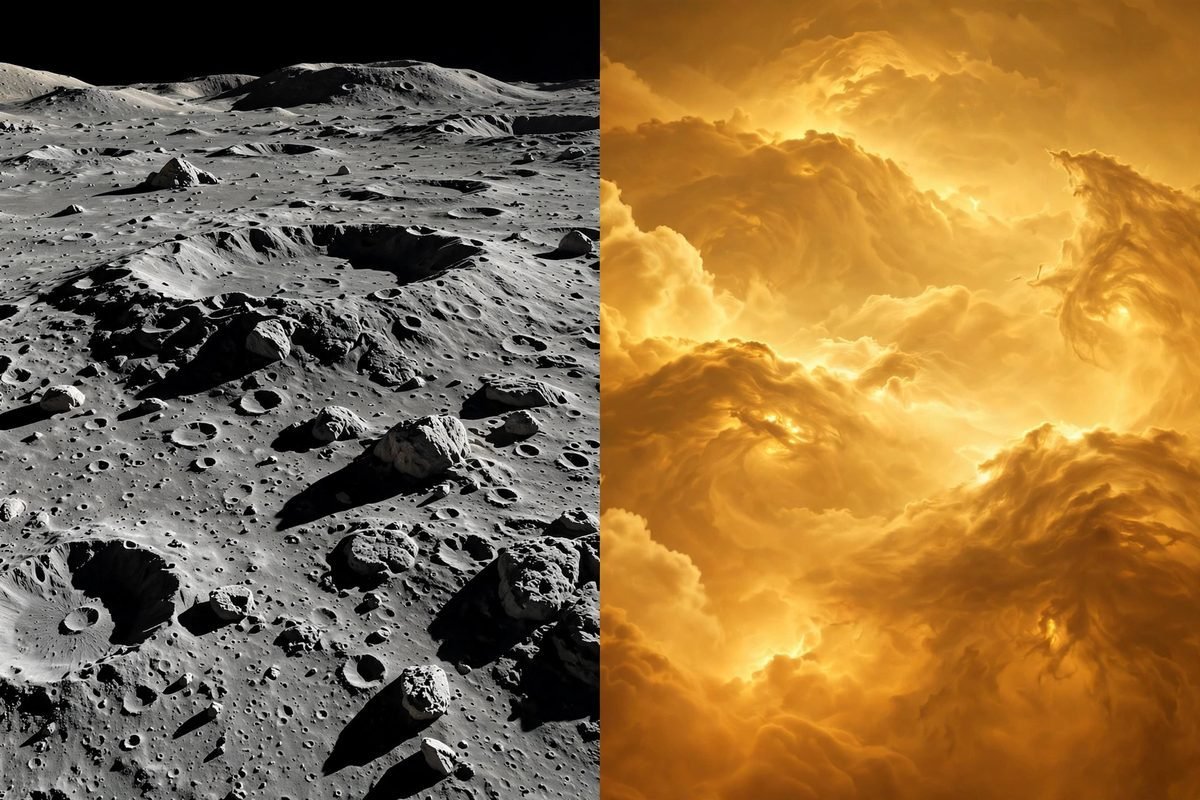
The difference comes down to atmosphere. Mercury barely has one. Its thin exosphere is so wispy that it cannot trap heat. Sunlight hits the surface, bakes it during the day, and then that heat escapes straight back into space at night. Venus, on the other hand, is wrapped in a thick blanket of carbon dioxide clouds. That blanket traps heat in a runaway greenhouse effect, cooking the entire planet evenly, all the time.
Think of it this way: Mercury is like standing next to a campfire wearing nothing but a T-shirt. You feel the heat on your face, but the moment you step back or the fire dies down, you freeze. Venus is like standing next to the same campfire while wrapped in a heavy thermal blanket you can never take off. The blanket does the real work, and it never lets the heat escape.
Mercury vs. Venus at a Glance
| Feature | Mercury | Venus |
|---|---|---|
| Distance from the Sun | 0.39 AU (closest) | 0.72 AU (second) |
| Atmosphere | Extremely thin exosphere | Thick carbon dioxide clouds |
| Daytime high | About 430°C | About 465°C |
| Nighttime low | About −180°C | About 465°C (barely changes) |
| Hottest planet? | No | Yes |
So closeness gets Mercury the heat, but atmosphere decides what happens to that heat. Venus wins the temperature contest because it keeps what it gets.
How Long Is a Year on Mercury?
A year on Mercury lasts just 88 Earth days. That is because a year is simply one full trip around the Sun, and Mercury’s trip is both short and fast. Its orbit is tight, and its speed is high, so it laps the Sun more than four times in a single Earth year.
If you lived on Mercury (and somehow survived the conditions), you would celebrate a birthday roughly every three months by Earth standards. A child born on Mercury would be a teenager in Earth years before finishing a single Earth year of school holidays, at least in terms of birthdays counted.
But Mercury’s day is a different story entirely, and it is wonderfully weird. Mercury rotates very slowly on its axis. One full rotation, one Mercury day measured by its spin, takes about 59 Earth days. And because of the way its spin and orbit interact, a single day-night cycle on Mercury, from one sunrise to the next, lasts about 176 Earth days. That means a single Mercury solar day is twice as long as a Mercury year. You could live through two full years on Mercury before the Sun rises twice in the same spot. It is one of the strangest facts in the solar system, and it comes directly from Mercury being so close to the Sun’s powerful gravity.
How Hot and Cold Does Mercury Actually Get?
Mercury has the most extreme temperature swings of any planet, and it is not close. Daytime temperatures on the side facing the Sun climb to around 430 degrees Celsius. Nighttime temperatures on the dark side fall to around minus 180 degrees Celsius. That is a swing of more than 600 degrees Celsius between day and night.
Why so extreme? Again, it comes back to the missing atmosphere. On Earth, our air acts like a planet-wide blanket, spreading heat around and softening the difference between day and night. Mercury has almost no blanket. The Sun-facing side roasts under direct, unfiltered sunlight, while the night side radiates its heat into space and freezes.
There is one more twist that surprises people: despite those scorching days, Mercury has ice. Deep inside craters near Mercury’s poles, where sunlight never reaches the crater floors, temperatures stay cold enough for water ice to survive permanently. Spacecraft have confirmed bright, reflective deposits in those permanently shadowed craters that behave exactly like ice. So the planet closest to the Sun holds frozen water in its darkest corners. It sounds impossible until you remember that Mercury’s problem was never a lack of cold places, only a lack of air to even things out.
What Is Mercury Made Of?
Mercury is a rocky planet, like Earth, Venus, and Mars, but it is unusually dense for its size. In fact, Mercury is the second-densest planet in the solar system after Earth, which is remarkable for a world so small. The reason is its enormous iron core.
Scientists believe Mercury’s core takes up about 85 percent of the planet’s radius. That is a huge fraction. Earth’s core, by comparison, takes up about half of Earth’s radius. Mercury is essentially a giant iron ball wrapped in a thin rocky shell, only about 400 kilometers thick in places.
How did it end up like that? The leading idea is that Mercury started out larger, but a massive collision early in its history stripped away much of its outer rocky layer, leaving the dense iron heart behind. Another idea is that the intense heat near the young Sun vaporized lighter materials before they could join the planet. Either way, the result is a small, heavy world with a surface covered in craters, cliffs, and ancient lava plains.
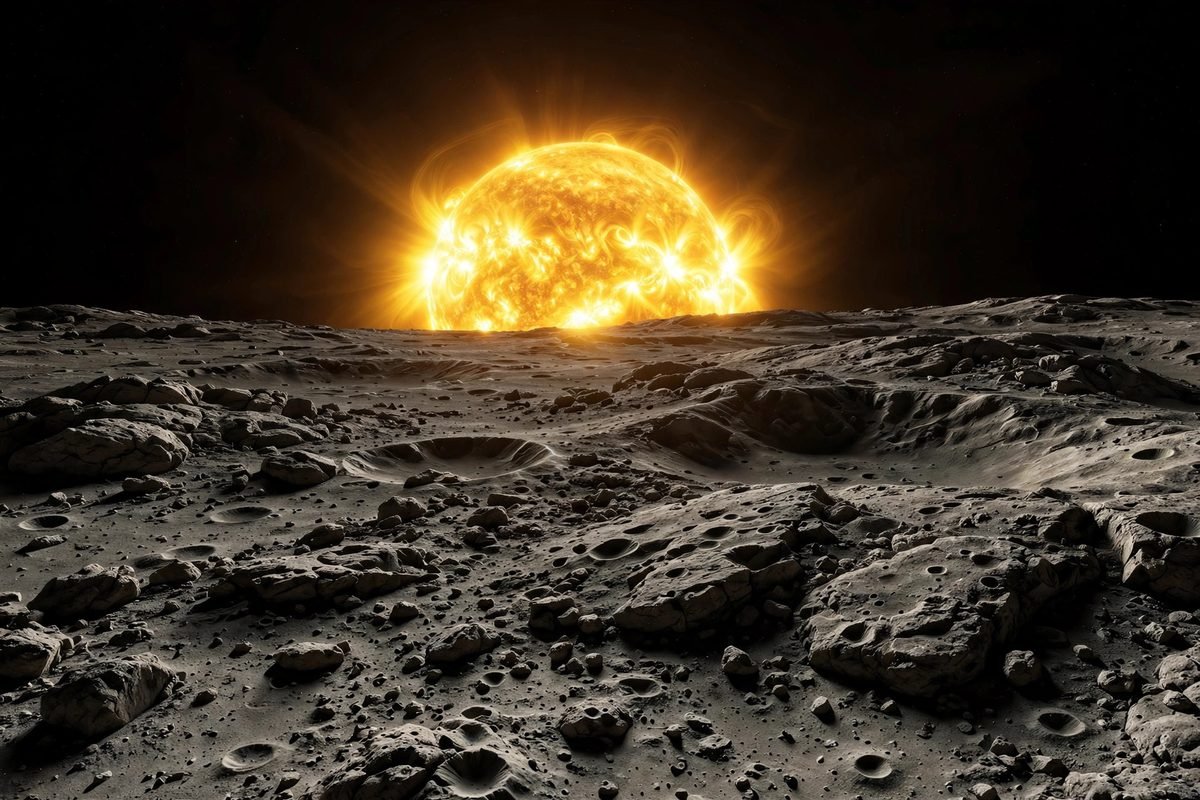
Mercury’s surface tells that violent history plainly. It is pocked with impact craters from billions of years of asteroid and comet strikes, with almost no weather or erosion to smooth them away. Long, steep cliffs called lobate scarps wrinkle across the surface, formed as the planet’s interior cooled and the whole world shrank slightly, cracking its crust like the skin of a drying apple.
How Do Scientists Measure Planet Distances?
You might wonder how we can state Mercury’s distance so precisely when no one has ever stretched a tape measure to the Sun. The answer is a mix of geometry, radar, and spacecraft tracking, built up over centuries.
The basic unit is the astronomical unit, or AU, defined as the average distance between Earth and the Sun: about 149.6 million kilometers. Early astronomers worked out the relative distances of the planets using geometry and the way planets appear to move against the stars. They knew Mercury was closer than Venus long before they knew the exact kilometers, because Mercury never appears far from the Sun in our sky.
Modern measurements are far more precise. Scientists bounce radar signals off Mercury and time how long the signal takes to return. Since radio waves travel at the speed of light, that round-trip time gives an extremely accurate distance. Spacecraft like NASA’s MESSENGER, which orbited Mercury from 2011 to 2015, and the European-Japanese BepiColombo mission, currently en route, refine those numbers further by tracking their own positions with exquisite precision.
For the other planets, the same methods apply, and the results confirm the order every time: Mercury first, then Venus, Earth, Mars, and the gas and ice giants beyond. There is no ambiguity, no close call, and no measurement that puts another planet ahead of Mercury.
Why Do So Many People Guess Venus or Earth?
Venus is the most common wrong answer, and it is an understandable one. Venus is the brightest planet in our sky, it shines with a fierce, steady light, and it is famously hot. When people picture “the planet near the Sun,” they often picture the hottest, brightest one, and Venus fits that image better than tiny, dim Mercury does.
Earth is the other frequent guess, and that one comes from everyday experience. The Sun feels close. On a hot day, it feels like it is right overhead, practically on top of us. But feeling close is not the same as being close in planetary terms. Earth is a comfortable 149.6 million kilometers away, which is why liquid water can exist here and why our climate is livable. If Earth sat where Mercury sits, our oceans would boil away and the surface would be a scorched rock.
There is also a simple visibility problem. Venus is easy to see. It dominates the morning and evening sky as the “morning star” and “evening star.” Mercury is hard to see, often hidden in twilight glare. Out of sight, out of mind is a real effect in astronomy. The planet we notice least is easy to forget, even when it holds first place.
If you want a memory trick, try this: “My Very Excellent Mother Just Served Us Nachos” gives you Mercury, Venus, Earth, Mars, Jupiter, Saturn, Uranus, Neptune. The first word, “My,” is Mercury, and Mercury is first because it starts the whole list. Or simply remember: the smallest planet hugs the Sun the tightest.
Could Another Planet Ever Become the Closest?
In practical terms, no. The order of the planets is stable over timescales far longer than human history. Mercury will remain the closest planet to the Sun for billions of years to come.
It is true that planetary orbits are not perfectly fixed. Mercury’s orbit is eccentric, meaning its distance from the Sun varies, and over very long periods gravitational nudges from other planets cause small changes. Some computer models of the far future suggest Mercury’s orbit could become unstable billions of years from now, but that is a distant, theoretical possibility, not something that would hand the “closest planet” title to Venus in any timeframe that matters to us.
It is also worth clearing up a related confusion: the planet closest to Earth is not always the same world. Because planets move at different speeds, Venus is usually our nearest neighbor, but Mercury is actually Earth’s closest neighbor more often than people realize, simply because its tight, fast orbit keeps it near the Sun and therefore often near Earth’s line of sight. That is a fun piece of trivia, but it does not change the main answer. When the question is “closest to the Sun,” the answer is always Mercury.
Frequently Asked Questions
What planet is closest to the Sun?
Mercury is the planet closest to the Sun. It orbits at an average distance of about 57.9 million kilometers (0.39 AU), closer than Venus, Earth, or any other planet.
Is Mercury the hottest planet?
No. Venus is the hottest planet, with surface temperatures around 465 degrees Celsius, thanks to its thick carbon dioxide atmosphere and runaway greenhouse effect. Mercury is hot during the day but freezes at night because it has almost no atmosphere to trap heat.
How far is Mercury from the Sun in miles?
Mercury’s average distance from the Sun is about 36 million miles. At its closest approach it comes within about 29 million miles, and at its farthest it reaches about 43 million miles.
How long is a year on Mercury?
A year on Mercury is 88 Earth days. Mercury moves faster than any other planet and has the shortest orbit, so it completes more than four laps around the Sun in one Earth year.
Why is Mercury so hard to see from Earth?
Mercury never strays far from the Sun in our sky, so it is usually lost in the Sun’s glare. It only appears low near the horizon shortly after sunset or shortly before sunrise, and only during certain weeks of the year.
Does Mercury have ice if it is so close to the Sun?
Yes. Water ice survives in permanently shadowed craters near Mercury’s poles, where sunlight never reaches. Without an atmosphere to spread heat, those crater floors stay cold enough for ice to persist.
What is the order of the planets from the Sun?
The order is Mercury, Venus, Earth, Mars, Jupiter, Saturn, Uranus, and Neptune. Mercury is first, making it the closest planet to the Sun.
Final Thoughts
Mercury does not get the attention it deserves. It is small, hard to spot, and easy to confuse with its flashier neighbor Venus. But it holds one of the clearest records in the solar system: no planet sits closer to the Sun, none moves faster, and none swings so violently between scorching days and freezing nights.
The next time someone asks which planet is closest to the Sun, you will know the answer instantly, and you will know the twist that makes it interesting. Mercury is first in line, but Venus takes the heat crown. That single contrast, a thin atmosphere versus a thick one, explains more about how planets work than almost any other fact in astronomy. Mercury may be small, but its story is anything but.
Read Also: 9amime Explained: What It Is, Safety and Legal Options

2 Comments