
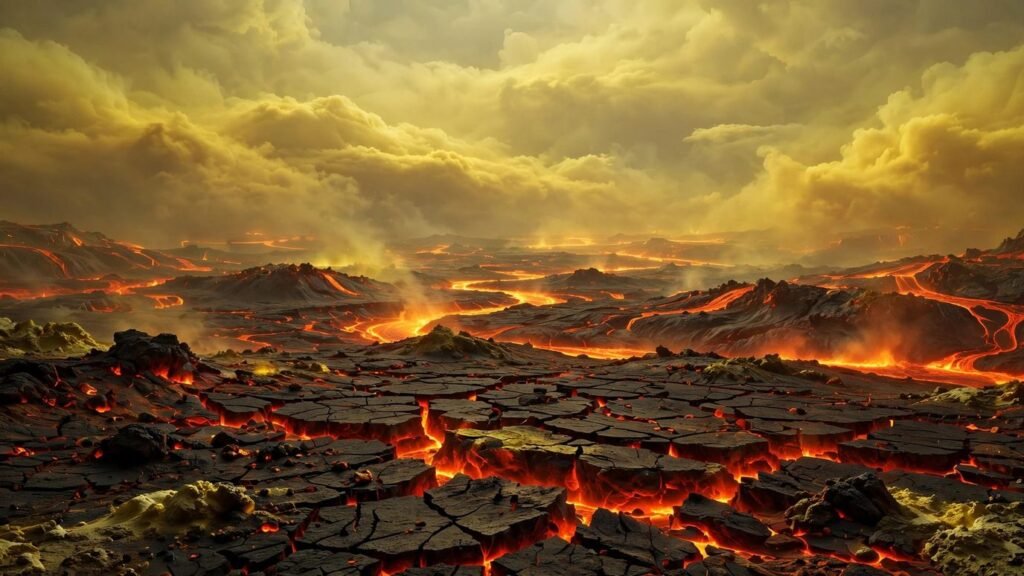
If you stood on Venus — and somehow survived the first few seconds — you would be standing in the hottest place on any planet in our solar system. Not on Mercury, the planet closest to the Sun. On Venus, the second planet out, wrapped in clouds so thick that sunlight barely reaches the ground.
It sounds backwards. It confused astronomers for a long time too. After all, Venus is often called Earth’s twin. It is almost the same size as Earth, almost the same mass, and made of much the same rocky material. Yet while Earth is a comfortable world of oceans and blue skies, Venus is a furnace. The question is not just how hot it gets, but why a planet so similar to ours turned out so completely different.
The answer involves a runaway greenhouse effect, an atmosphere so heavy it would crush you, clouds made of acid, and a day so long that a single Venusian afternoon lasts longer than most holidays. Let’s walk through it simply, one question at a time.
The short answer: The surface of Venus is about 465°C (869°F) — hot enough to melt lead, and hotter than Mercury, even though Mercury is closer to the Sun. The heat comes from a runaway greenhouse effect in Venus’s thick carbon dioxide atmosphere, and it barely changes between day and night because that atmosphere traps heat so effectively.
How Hot Is the Surface of Venus, Exactly?
The average surface temperature on Venus is around 465°C, or 869°F. That is not a brief spike on a hot afternoon. It is the everyday, everywhere temperature, measured across the planet by orbiters and landers over decades.
To put that in perspective, your kitchen oven at its highest setting usually reaches about 250°C. Venus is nearly twice as hot as that. Lead melts at 327°C, so a lump of lead sitting on Venus would turn to liquid. Tin melts at 232°C. Even zinc, which melts at 420°C, would soften and run. This is not a planet with hot spots and cool spots the way Earth has deserts and ice caps. Venus is, to a first approximation, one enormous oven set to the same temperature everywhere.
There is some variation, of course. Higher ground, like the Maxwell Montes mountain range, is a little cooler — perhaps around 380°C — because the air is slightly thinner up there. Low-lying plains may be a touch hotter. But the range is small compared with Earth, where temperatures swing from minus 89°C in Antarctica to nearly 57°C in Death Valley. On Venus, the difference between the hottest and coldest places you could stand is modest, and everywhere is still hot enough to destroy any ordinary machine in short order.
Scientists sometimes quote slightly different averages — 464°C, 465°C, or 467°C — because the exact figure depends on which measurements you average and how you treat altitude. The honest way to say it is “about 465°C.” That level of precision is more than enough: the real story is not the last degree, but the fact that a whole planet sits hundreds of degrees above the boiling point of water.
Why Is Venus Hotter Than Mercury?
This is the question that trips almost everyone up, and it is worth pausing on, because the answer overturns a very natural assumption: that the closer a planet is to the Sun, the hotter it must be.
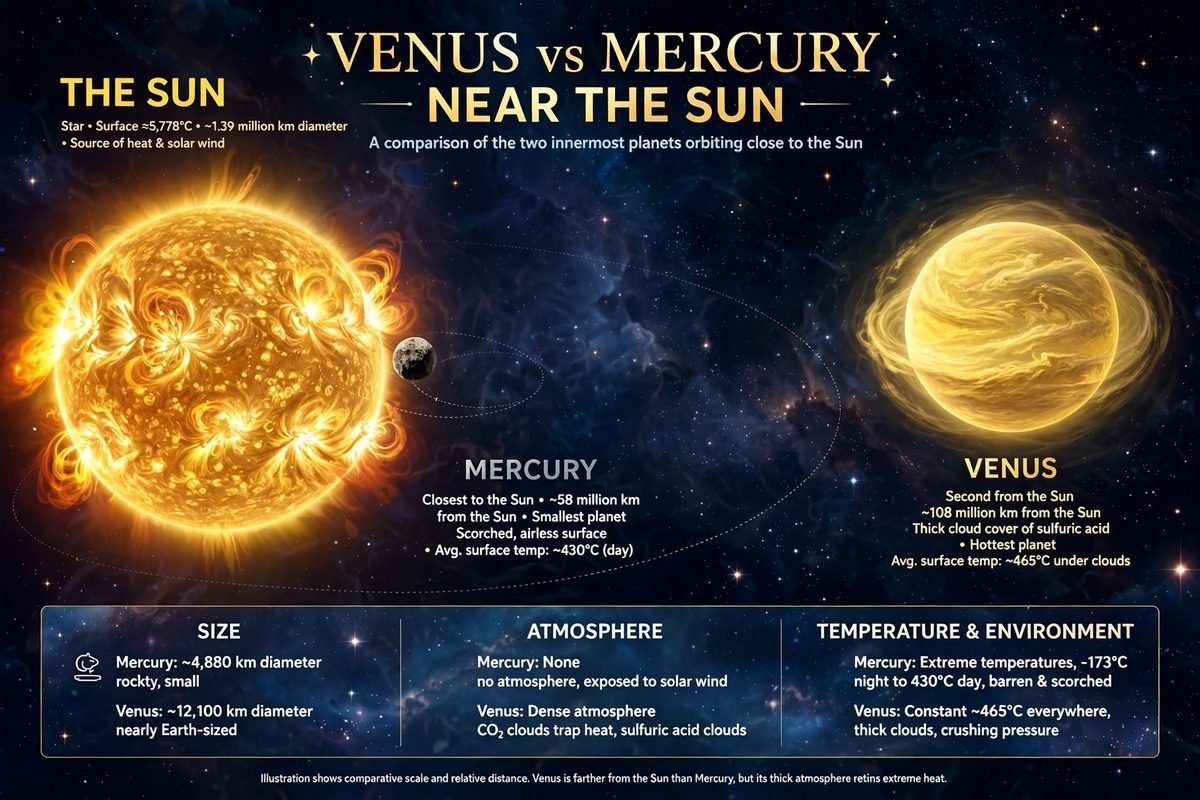
Mercury orbits at an average distance of about 58 million kilometres from the Sun. Venus orbits at about 108 million kilometres — nearly twice as far. Mercury also has almost no atmosphere to speak of, so sunlight hits its surface directly and heats it fiercely. On the sunlit side, Mercury’s surface can reach around 430°C. That is blisteringly hot, but it is still roughly 35 degrees cooler than Venus.
So how does the planet farther from the Sun end up hotter? The answer is the atmosphere. Mercury has essentially nothing to trap heat. When night falls on Mercury — and Mercury’s nights are long — the heat escapes straight back into space, and temperatures plunge to around minus 180°C. Mercury’s temperature swings by more than 600 degrees between day and night.
Venus, by contrast, has an atmosphere about 92 times more massive than Earth’s, made almost entirely of carbon dioxide. Sunlight gets in, in a filtered and scattered form, and warms the ground. But the heat trying to escape gets absorbed and re-radiated by that thick blanket of gas, over and over again. The planet cannot cool itself. So heat builds up until the surface reaches a temperature where the energy escaping finally balances the energy coming in — and that balance point happens to be around 465°C.
Think of it this way: Mercury is like standing next to a bonfire on a freezing night with no coat. You feel the heat on your face, but the moment you step away, you are cold. Venus is like being wrapped in a thick duvet inside a sauna. The heat source matters less than the fact that the heat has nowhere to go.
The distance myth, in one line
Distance from the Sun sets how much sunlight a planet receives, but the atmosphere decides how much heat stays. On Venus, the atmosphere wins the argument.
| Planet | Distance from the Sun | Average surface temperature | Day–night swing |
|---|---|---|---|
| Mercury | ~58 million km | ~167°C | Huge (about −180°C to 430°C) |
| Venus | ~108 million km | ~465°C | Tiny (a few tens of degrees at most) |
| Earth | ~150 million km | ~15°C | Moderate (tens of degrees) |
What Causes the Runaway Greenhouse Effect on Venus?
The greenhouse effect itself is not a villain. Earth has one too, and without it our planet would be frozen solid. Gases in the atmosphere let visible sunlight through, then absorb some of the infrared heat rising from the warmed ground and send part of it back down. That keeps Earth about 33 degrees warmer than it would otherwise be, and that is a good thing.
On Venus, the same process ran out of control. Scientists call this a runaway greenhouse effect, and the leading explanation goes something like this. Early in its history, Venus may have had liquid water on its surface, perhaps even oceans. As the young Sun grew brighter, more water evaporated. Water vapour is itself a powerful greenhouse gas, so more evaporation meant more heat trapped, which meant more evaporation. It was a feedback loop with no brake.
Eventually, the oceans boiled away entirely. Without liquid water, the carbon cycle that regulates Earth’s climate could not work. On Earth, rain washes carbon dioxide out of the air, it gets locked into rocks and ocean sediments, and volcanoes slowly release it again. That thermostat kept Earth’s carbon dioxide levels low. On Venus, once the water was gone, carbon dioxide released by volcanoes simply accumulated in the atmosphere — and stayed there. Today, Venus’s atmosphere is about 96.5 percent carbon dioxide.
There is still debate about the details and the timeline. Some researchers think Venus lost its water very early; others suggest it may have stayed habitable for much longer, perhaps billions of years, before tipping over. What is not in doubt is the end state: a planet whose atmosphere became so loaded with carbon dioxide that the greenhouse effect escalated until the surface reached its current, crushing temperature.
What Is Venus’s Atmosphere Made Of?
If you could scoop up a jar of Venusian air — not that you would want to — it would be mostly carbon dioxide, with a few percent nitrogen and traces of other gases, including sulphur dioxide. That sounds simple, but the behaviour of that air is anything but ordinary.
Because the atmosphere is so thick, the air at the surface behaves almost like a fluid. The pressure is about 92 times Earth’s sea-level pressure, roughly the same as being about 900 metres underwater. The carbon dioxide down there is squeezed so hard that it acts like a supercritical fluid, somewhere between a gas and a liquid. Winds near the surface are slow, more of a creeping crawl than a gale, because the dense air is hard to push around. Higher up, though, the atmosphere races around the planet far faster than the planet itself rotates — a phenomenon called super-rotation.
The nitrogen, about 3.5 percent of the atmosphere, is worth noting because it is the second most abundant gas. On Earth, nitrogen makes up 78 percent of the air we breathe. On Venus it is a minor ingredient, but the sheer total mass of the atmosphere means there is still far more nitrogen above Venus than above Earth in absolute terms. The atmosphere is just that enormous.
| Feature | Venus | Earth |
|---|---|---|
| Main gas | Carbon dioxide (~96.5%) | Nitrogen (~78%) |
| Surface pressure | ~92 times Earth’s | 1 atmosphere |
| Surface temperature | ~465°C | ~15°C average |
| Clouds | Sulphuric acid droplets | Water droplets and ice |
| Length of day | ~243 Earth days (retrograde) | 24 hours |
What Do the Clouds Have to Do With the Heat?
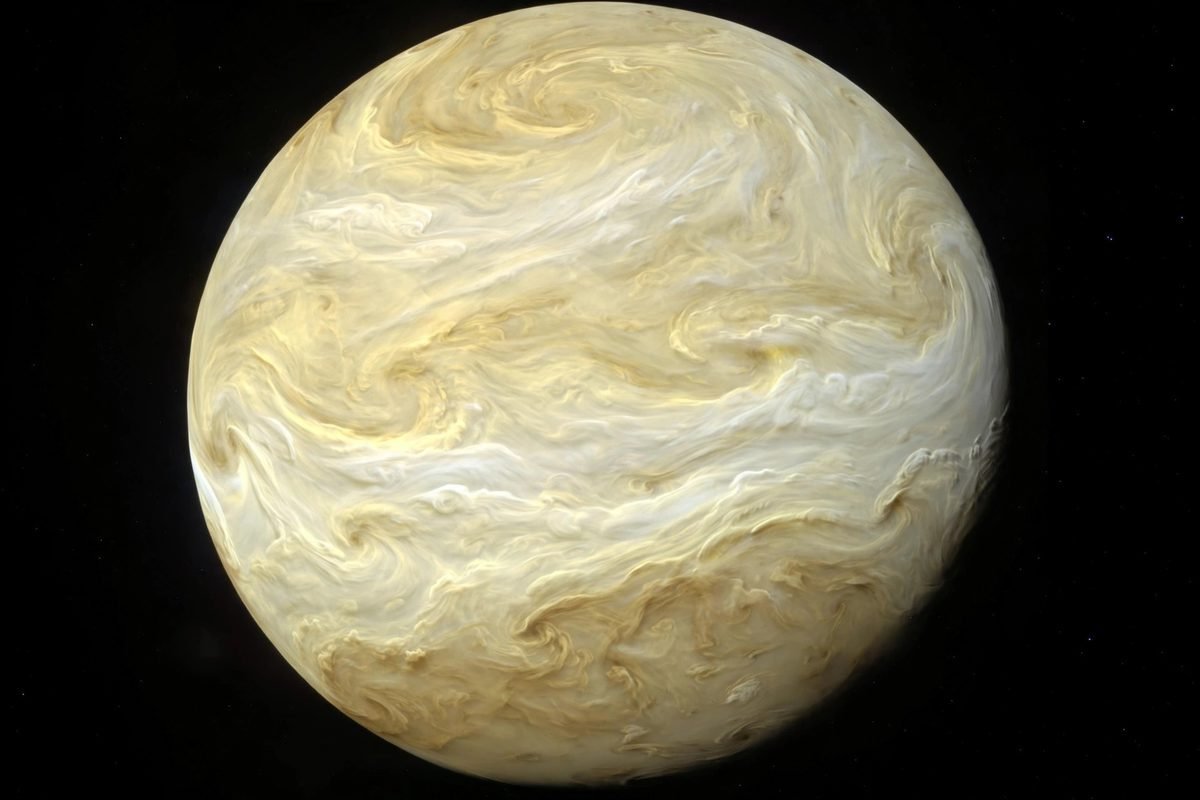
Venus’s clouds are one of the strangest parts of the story, because they pull in two opposite directions at once. The clouds are thick, bright, and highly reflective. They bounce roughly three-quarters of the sunlight that reaches Venus straight back into space. That is why Venus shines so brilliantly in our sky as the morning or evening star — you are seeing sunlight reflected off those clouds, not the surface. By that logic alone, you might expect Venus to be cooler, not hotter.
But the clouds also play a second role. They are made largely of droplets of sulphuric acid, mixed with water, floating in layers tens of kilometres above the surface. They trap heat beneath them, adding to the greenhouse effect rather than relieving it. And the sunlight that does make it through the clouds — a dim, orange, scattered light — still carries enough energy to warm the ground. The surface of Venus, under that permanent overcast, receives only a small fraction of the sunlight Earth gets on a clear day, yet it is far hotter, because the heat that arrives cannot leave.
So the clouds are both a sunshade and a blanket, and the blanket wins. This is a good reminder that a planet’s temperature is not decided by one factor alone. Reflectivity, atmospheric composition, pressure, and circulation all interact, and on Venus they interact in a way that produces the most extreme surface conditions of any planet in the solar system.
Why Doesn’t Venus Cool Down at Night?
On Earth, the difference between a summer afternoon and the small hours of the morning can be 15 degrees or more. On Venus, you would barely notice the difference. Night on Venus is essentially as hot as day, and there are two reasons for that.
The first is the sheer thermal mass of the atmosphere. That thick blanket of carbon dioxide stores an enormous amount of heat and moves it around the planet. Winds in the upper atmosphere circle Venus in just a few Earth days, redistributing warmth far more efficiently than the planet’s own slow rotation can create hot and cold sides. Heat does not get a chance to pile up on the day side or drain away on the night side.
The second reason is the length of the Venusian day itself. Venus rotates incredibly slowly — one full rotation takes about 243 Earth days, and it rotates backwards compared with most planets. A single solar day on Venus, from one sunrise to the next, lasts about 117 Earth days. With a day that long, you might expect brutal extremes. But the atmosphere is so good at spreading heat around that even a night lasting nearly two Earth months stays at oven temperature.
The practical upshot is eerie. There is no cool relief anywhere on Venus, at any time. No evening breeze, no chilly dawn, no polar refuge. The temperature you would face at noon is the temperature you would face at midnight, and it is the temperature you would face at the poles too.
How Much Pressure Is on the Surface of Venus?
Temperature gets most of the attention, but pressure is the other half of what makes Venus so hostile. At about 92 times Earth’s atmospheric pressure, the air on Venus presses down with the weight of roughly a kilometre of ocean water.
For a human, that alone would be fatal, even before the heat got to you. For machines, it is a serious engineering problem. Components that work perfectly in a vacuum or in thin air can be crushed, deformed, or forced out of shape. Seals fail. Structures buckle. Any lander sent to Venus has to be built like a pressure vessel — essentially a miniature submarine — just to survive the squeeze.
Combined with the heat, the pressure also changes how chemistry works at the surface. Rocks weather differently under those conditions. Some scientists suspect that the surface may be slowly reacting with the atmosphere in ways that would not happen on a cooler, lower-pressure world. Venus is not just hot; it is a pressure cooker in the most literal sense, where heat and pressure together create an environment unlike anything on Earth.
How Do We Know How Hot Venus Is?
This is a fair question, because nobody has ever stood on Venus with a thermometer, and the clouds hide the surface from ordinary telescopes. Our knowledge comes from a combination of measurements made over more than half a century.
The first strong hints came from radio astronomy in the 1950s and 1960s. Radio waves can pass through the clouds, and the faint radio glow coming from Venus was consistent with a surface at several hundred degrees — far hotter than anyone had expected. Some scientists initially doubted the result, because it seemed so extreme. Later spacecraft proved it right.
Since then, a fleet of orbiters has mapped Venus with radar, which also penetrates the clouds, and measured the temperature of the lower atmosphere directly with infrared instruments. The Soviet Venera landers of the 1970s and 1980s went further: they actually touched down, took photographs, and measured temperature and pressure on the ground before they failed. Their readings confirmed the orbital data — surface temperatures in the region of 450 to 470°C, depending on the landing site.
Modern missions, including the European Venus Express and Japan’s Akatsuki orbiter, have refined the picture by studying how temperature varies with altitude and latitude. The number “about 465°C” is not a guess from a single instrument. It is the converging result of radio observations, orbital infrared measurements, and landers that sat on the ground and reported back before the planet destroyed them.
How Long Did Landers Survive on Venus?
If the numbers above sound abstract, the story of the Venera landers makes them very real. Between 1970 and the mid-1980s, the Soviet Union sent a series of probes to Venus. Several of them landed successfully, opened their cameras, and sent back data and photographs.
The catch was time. Venera 7, the first to transmit from the surface, lasted about 23 minutes. Venera 8 managed around 50 minutes. Later missions did better as engineers learned to insulate and protect the electronics — Venera 13 survived for about 127 minutes, sending back the first colour photographs from the surface of another planet. That was the record, and it was still barely two hours.
Think about that for a moment. These were tough, purpose-built machines, designed by engineers who knew exactly what they were flying into, and the planet still killed them in about the time it takes to watch a film. The heat slowly cooked their electronics, and no amount of insulation could hold it off forever, because insulation only delays the inevitable when the world outside is 465°C in every direction.
Why so brief?
- Heat soak: Insulation slows heat transfer, but it cannot stop it. Eventually the inside of the lander reaches the outside temperature.
- Electronics limits: Ordinary electronics fail well below 465°C. The landers used specially hardened components and still had a short window.
- No cooling option: There is no cold reservoir to dump heat into. The air, the ground, and the sky are all at oven temperature.
- Pressure stress: Seals and structures degrade faster when heat and crushing pressure act together.
Future missions will try to do better, using high-temperature electronics built from materials like silicon carbide. But even the most optimistic plans talk about surviving for days or weeks, not years. Venus does not forgive visitors.

Could Venus Ever Cool Down Again?
In principle, a planet’s climate can change. Earth has swung between ice ages and warm periods. Mars was once warmer and wetter than it is today. So it is natural to wonder whether Venus could ever reverse its fate.
The honest answer is: not on any timescale that matters to us, and not without something dramatic changing. The carbon dioxide in Venus’s atmosphere is not going anywhere on its own. There are no oceans to dissolve it, no rain to wash it out, and no plate-tectonic cycle as we understand it on Earth to bury it in rocks over geological time. Some researchers have proposed that Venus may have active volcanoes releasing even more gas, which would make the situation worse rather than better.
Human ideas for cooling Venus — such as shading the planet, or somehow removing the carbon dioxide — are, for now, firmly in the realm of speculation. The scale is staggering: you would need to remove an atmosphere 92 times more massive than Earth’s, or keep it shaded for thousands of years, before the surface temperature would drop meaningfully. It is a useful thought experiment, because it shows just how deeply locked-in the runaway greenhouse effect is. Venus is not having a hot spell. It has a hot climate, built into the very structure of its atmosphere.
That is also why Venus matters so much for understanding Earth. It is a cautionary example of what happens when a greenhouse effect runs away — not a prediction for Earth, which is a very different planet with oceans, a carbon cycle, and far less carbon dioxide in its air, but a reminder of why the balance of gases in an atmosphere is something worth taking seriously.
What Would It Feel Like to Stand on Venus?
It is worth pausing to imagine it, because the numbers alone do not quite convey the experience. The sky would be a dim, yellowish-orange gloom, even at midday, because the clouds scatter and absorb most of the sunlight. You would not see the Sun as a sharp disc; you would see a diffuse glow behind the haze. The light level would feel like a heavily overcast afternoon on Earth.
The air around you would be so dense that moving through it would feel like wading through water. Sound would travel differently. And of course, none of this imagining survives contact with reality, because the temperature and pressure would kill an unprotected person almost immediately, and a spacesuit designed for the Moon or Mars would fail within minutes.
That is perhaps the strangest thing about Venus. It is the most Earth-like planet in size and composition, it is our nearest planetary neighbour, and it is also the least survivable place in the solar system. The twin that took the other path is a warning and a wonder at the same time.
Frequently Asked Questions
Is Venus the hottest planet in the solar system?
Yes. Venus has the highest average surface temperature of any planet, at about 465°C. Mercury gets hotter on its day side in the sense of receiving more direct sunlight, but its average temperature is far lower, and its nights are bitterly cold. Venus wins on average — and on consistency.
How hot is Venus in Fahrenheit?
About 869°F. The conversion from 465°C gives 869°F, which is a useful number to remember because it makes the comparison with everyday heat so stark: water boils at 212°F, and most ovens top out around 500°F. Venus is well beyond both.
Why is Venus so hot if it is covered in clouds?
The clouds reflect a lot of sunlight, which should cool the planet, but they also trap heat underneath them. The main cause of the heat is the thick carbon dioxide atmosphere, which produces an extreme greenhouse effect. Sunlight that gets through the clouds warms the surface, and the resulting heat cannot escape back into space. The blanket effect outweighs the sunshade effect.
Does it rain on Venus?
Not in the way we mean it on Earth. Sulphuric acid droplets in the clouds can fall as a kind of acid rain, but the lower atmosphere is so hot that the droplets evaporate long before they reach the ground. This is sometimes called virga. No rain of any kind reaches the surface of Venus.
Has anyone ever landed on Venus?
No person has, and no crewed mission has been attempted. Uncrewed Soviet Venera landers reached the surface in the 1970s and 1980s and sent back photographs and measurements before failing in the heat. They remain the only spacecraft to have operated on the surface of Venus.
How long is a day on Venus?
Venus takes about 243 Earth days to rotate once, and it spins backwards. Because it is also moving around the Sun, the time from one sunrise to the next — a solar day — is about 117 Earth days. Either way, it is the slowest rotation of any planet in the solar system.
Could humans ever live on Venus?
On the surface, no — not with any technology we have or can currently foresee. The combination of 465°C heat, crushing pressure, and corrosive clouds makes surface living effectively impossible. Some scientists have discussed the idea of floating habitats in the upper atmosphere, where temperatures and pressures are much more Earth-like, but that remains a speculative concept, not a plan.
Conclusion
So, how hot is the surface of Venus? About 465°C — hot enough to melt lead, steady day and night, from equator to pole. It is hotter than Mercury despite being farther from the Sun, because a runaway greenhouse effect in its thick carbon dioxide atmosphere traps heat that Mercury simply radiates away.
Venus is a story of a planet that started out similar to Earth and ended up somewhere utterly different. Its clouds, its crushing pressure, its backwards spin, and its brief, heroic landers all belong to the same picture: a world where the atmosphere took charge and never let go. The next time you spot Venus shining in the evening sky, remember that behind that calm, beautiful light is the most extreme surface in the solar system — a furnace wrapped in cloud, waiting for no one.
Read Also: How Cold Is It on Mars? A Simple Temperature Guide

1 Comment