

Picture yourself stepping out of a spacecraft onto Mars. The sky is a pale, butterscotch pink. The ground under your boots is red dust and scattered rock. And the air — well, you would not be breathing it directly, because there is barely any air at all. But if you could feel it through your suit, the first thing you would notice is the cold. Not a crisp winter morning kind of cold. A deep, dry, relentless cold that gets into everything.
That is the part of Mars that photographs do not quite capture. The pictures look warm. All that red and orange makes the planet seem like a desert at sunset. In reality, Mars is a frozen desert, and most of the time it is far colder than the coldest place you have ever stood on Earth.
So, how cold is it on Mars, exactly? The honest answer is that it depends a lot on where you are standing, what time of day it is, and what season it is. Mars does not have one temperature. It has a whole range of them, and the range is wild. Let us walk through it properly, without the jargon getting in the way.
The short answer: Mars averages about -65°C (-85°F). On a warm summer afternoon near the equator, it can climb to around 20°C to 30°C (68°F to 86°F), but at night in the same spot it can plunge well below -70°C (-94°F). At the poles in winter, temperatures can fall to around -140°C (-220°F). In short, Mars is cold almost everywhere, almost all the time — with brief, surprising exceptions.
How Cold Is It on Mars, Really?
When scientists say Mars averages about -65°C, they mean the planet as a whole, averaged over places and seasons. That is roughly -85°F. To put that in everyday terms, the coldest temperature ever recorded on Earth, at Vostok Station in Antarctica, was about -89°C. So the average day on Mars is not far off the coldest day ever measured on our own planet.
But averages can be misleading, and Mars is a perfect example of why. Earth averages around 15°C, yet nobody would describe both a beach in Thailand and a research station in Antarctica with the same word. Mars is the same, only more extreme. The gap between its warmest and coldest spots is enormous, and the gap between day and night in a single location can be just as dramatic.
Think of it this way: if you only remembered one number, -65°C is the one to remember. If you want to actually understand Mars, you need the range, the rhythm of day and night, and the reasons behind them. That is where things get interesting.
Why Is Mars So Cold?
There are a few reasons, and they all work together to keep Mars chilly.
It is farther from the Sun
Mars orbits at about one and a half times Earth’s distance from the Sun. Sunlight spreads out as it travels, so Mars receives less than half the solar energy per square metre that Earth does. Less incoming warmth is the starting point for everything else.
Its atmosphere is incredibly thin
This is the big one. Earth’s atmosphere is like a thick blanket, trapping heat and smoothing out temperature swings. Mars has an atmosphere, but it is roughly one hundred times thinner than Earth’s. It is mostly carbon dioxide, and it does a poor job of holding onto heat. When the Sun goes down, the warmth escapes straight back into space, almost as if there were no blanket at all.
That thin air also means low pressure at the surface — less than one percent of Earth’s sea-level pressure. In practical terms, it is closer to the conditions you would find high in Earth’s stratosphere than anything you would call weather down here.
Dust, distance, and tilt all play a part
Mars also has an elliptical orbit, meaning its distance from the Sun changes more over the year than Earth’s does, and its axial tilt gives it seasons, just as Earth has. Dust in the atmosphere can scatter sunlight and change temperatures locally, sometimes warming the air during big dust storms and sometimes shading the surface. None of these factors alone explains the cold. Together, they add up to a planet that struggles to stay warm.
How Cold Does Mars Get at Night?
Night is when Mars really shows its teeth. Because the atmosphere is so thin, there is almost nothing to store the day’s heat. As soon as the Sun sets, temperatures drop fast — often by tens of degrees within a few hours.
In many places, nighttime temperatures routinely fall below -70°C, and in winter at higher latitudes they can drop far lower. Even at the equator, where daytime temperatures can feel almost pleasant in summer, the night that follows can be bitterly cold. That daily swing, sometimes 60°C or more between afternoon and the early hours of the morning, is one of the most striking things about Martian weather.
If you have ever camped in a desert on Earth, you will recognise a smaller version of this effect. Deserts get hot by day and cold by night because dry air holds little moisture and little heat. Mars takes that same principle and turns it up to an extreme, because its air is far thinner than even the driest desert air on Earth.
What Is the Warmest It Ever Gets on Mars?
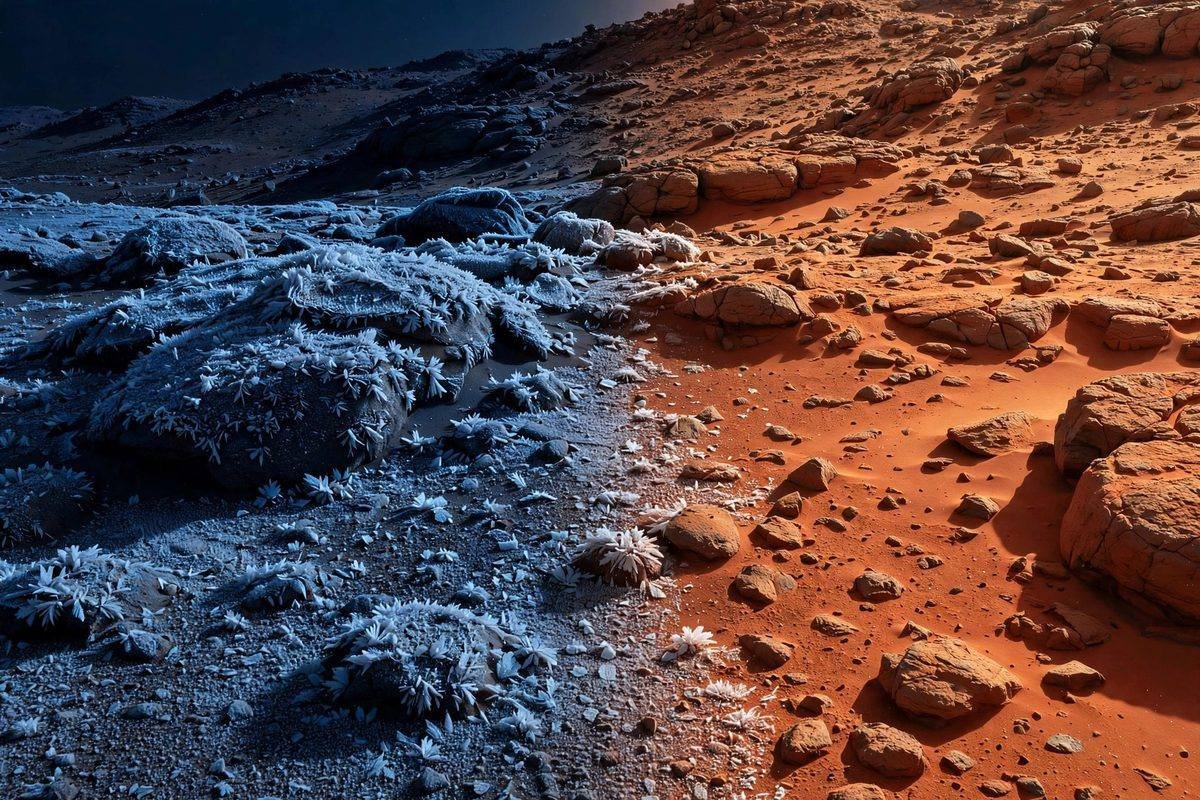
Here is the surprise that catches most people out: Mars is not always freezing. On a summer afternoon near the equator, the temperature at ground level can rise to around 20°C, and in the most favourable spots it has been measured at up to about 30°C. That is a warm spring day by Earth standards. You could, in theory, stand there in the sunshine and feel warmth on your face — if you were not also dealing with the near-vacuum air pressure, the radiation, and the dust.
The catch is how brief and how local that warmth is. It happens at midday, in summer, near the equator, and only at the surface where sunlight hits dark soil directly. A few metres up, the air is still cold. A few hours later, it is cold again everywhere. And in winter, or at higher latitudes, those warm peaks simply do not happen at all.
So yes, Mars can be warm. But “warm on Mars” is a narrow window, not a climate. It is the exception that proves just how cold the rule is.
Mars vs Earth: A Temperature Comparison
A side-by-side look makes the difference easier to grasp.
| Mars | Earth | |
|---|---|---|
| Average temperature | About -65°C (-85°F) | About 15°C (59°F) |
| Warmest recorded at surface | Around 30°C near the equator at midday in summer | Around 56°C in the hottest deserts |
| Coldest extremes | Around -140°C at the poles in winter | Around -89°C in Antarctica |
| Typical day-night swing | Often 60°C or more in one spot | Usually 10–20°C in most places |
The comparison also shows something subtler. Earth’s coldest places are cold because they get little sunlight for months at a time. Mars is cold almost everywhere because its whole system — distance, thin air, low pressure — works against warmth. That is why even its equator, which gets plenty of sunshine, still freezes every single night.
Another difference worth knowing: on Earth, the air temperature and the ground temperature are usually fairly close. On Mars, they can differ a lot. Sunlight heats the dark ground directly, so the soil surface can be much warmer than the air just above it. Rovers measure both, and the gap between them tells scientists a lot about how heat moves — or fails to move — on Mars.
Why Does Mars Feel Even Colder Than the Thermometer Says?
If you have ever stepped out on a windy winter day, you know that the number on the thermometer is not the whole story. Wind chill makes cold air feel colder by stripping away the thin layer of warm air around your skin. Mars has wind, and it has dust, but the “feels like” question works differently there.
In one sense, Mars would feel less cold than the thermometer suggests, because the air is so thin that it carries heat away from your body very slowly. There is simply not much air to steal your warmth. That sounds like good news, until you remember that the same thin air means your suit would lose heat by radiation straight into the cold sky, and that the ground itself would be frozen solid beneath you.
In practice, nobody will ever experience Martian cold with bare skin. Astronauts will live inside pressurised habitats and suits, and engineers design those suits to handle the worst the planet can throw at them. The real question is not how cold it feels, but how much energy it takes to stay warm — and on Mars, the answer is a lot. Heating a habitat through a long, dark, freezing night, season after season, is one of the biggest engineering challenges of any future stay.
The role of dust
Dust deserves a special mention, because it changes the cold in ways you might not expect. Fine Martian dust gets everywhere, and during planet-wide dust storms it can block sunlight for weeks. That cools the surface further, but it can also warm the upper atmosphere slightly by absorbing sunlight. For a rover running on solar power, a dust storm means less energy at exactly the time when temperatures are dropping. Mission teams plan for this, but it is a reminder that cold on Mars is never just a number — it is tied up with dust, light, and power all at once.
How Do We Actually Know the Temperature on Mars?
We know because we have put thermometers there. That sounds obvious, but it is worth pausing on, because for most of human history Mars temperatures were educated guesses based on telescopes and physics. The guesses were roughly right, but the details only arrived with landers and rovers.
Thermometers on the ground
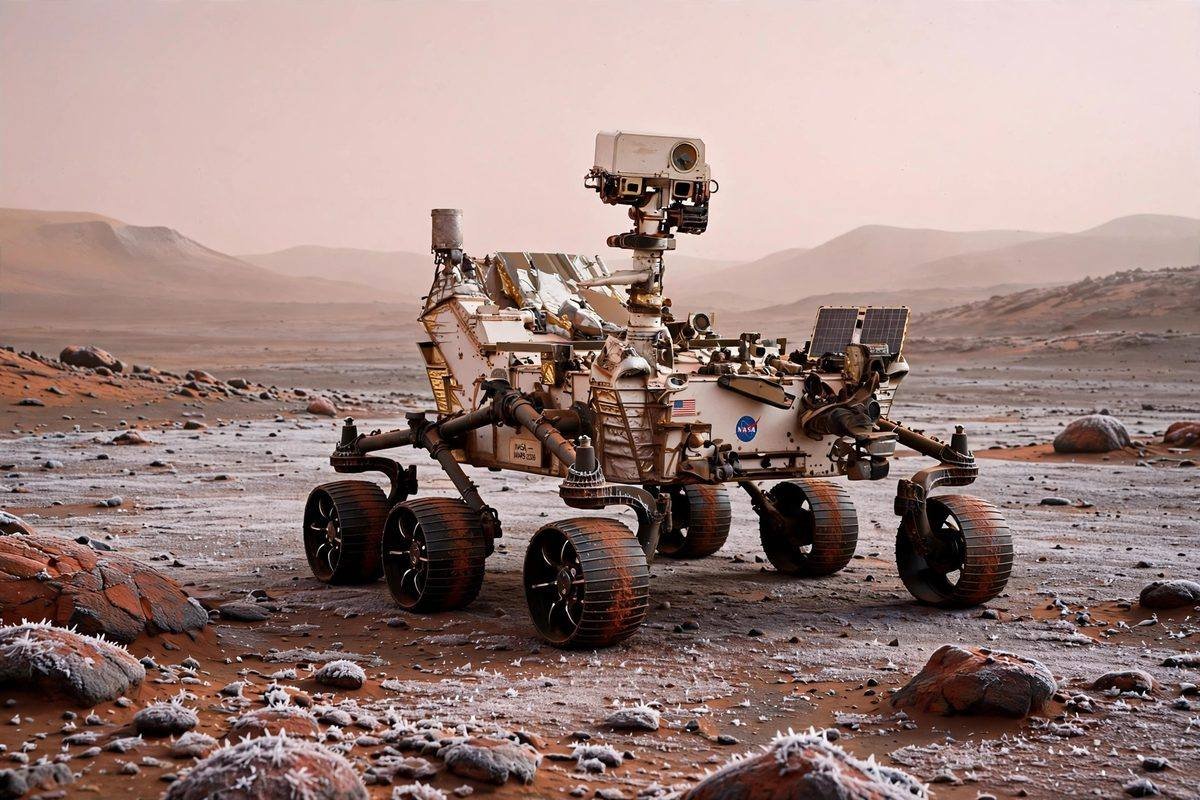
NASA’s Viking landers in the 1970s were the first to measure temperatures directly on the surface. Since then, rovers like Curiosity and Perseverance have carried weather stations that record air temperature, ground temperature, pressure, wind, and humidity every day. Perseverance’s MEDA instrument, for example, measures temperatures at several heights, which is how we know about the gap between warm soil and cold air described above.
Orbiters watching from above
Orbiters add the bigger picture. Instruments like the Thermal Emission Spectrometer on Mars Global Surveyor and later orbiters have mapped surface temperatures across the whole planet, season by season. That is how we know where the coldest spots are, how the polar caps grow and shrink, and how temperatures shift during dust storms.
Why the numbers sometimes differ
You may notice that different sources give slightly different figures for Mars temperatures — one says the average is -63°C, another says -65°C, another says -60°C. That is normal, and it is not a sign that anyone is wrong. The average depends on which places, which seasons, and which years are included, and whether the figure refers to air temperature or ground temperature. The range matters more than any single number, and the range is consistent across missions: bitterly cold on average, with warm summer afternoons near the equator and extreme cold at the poles in winter.
Do Mars Temperatures Change With the Seasons?
Yes, and quite dramatically. Mars has four seasons, like Earth, because its axis is tilted — by about 25 degrees, very close to Earth’s 23.5 degrees. A Martian year lasts about 687 Earth days, so each season is roughly twice as long as ours.
Summer in the southern hemisphere is especially interesting, because Mars is closest to the Sun during southern summer. That makes southern summers shorter but more intense, and it is also when the biggest dust storms tend to form. Northern summers are longer and milder by comparison.
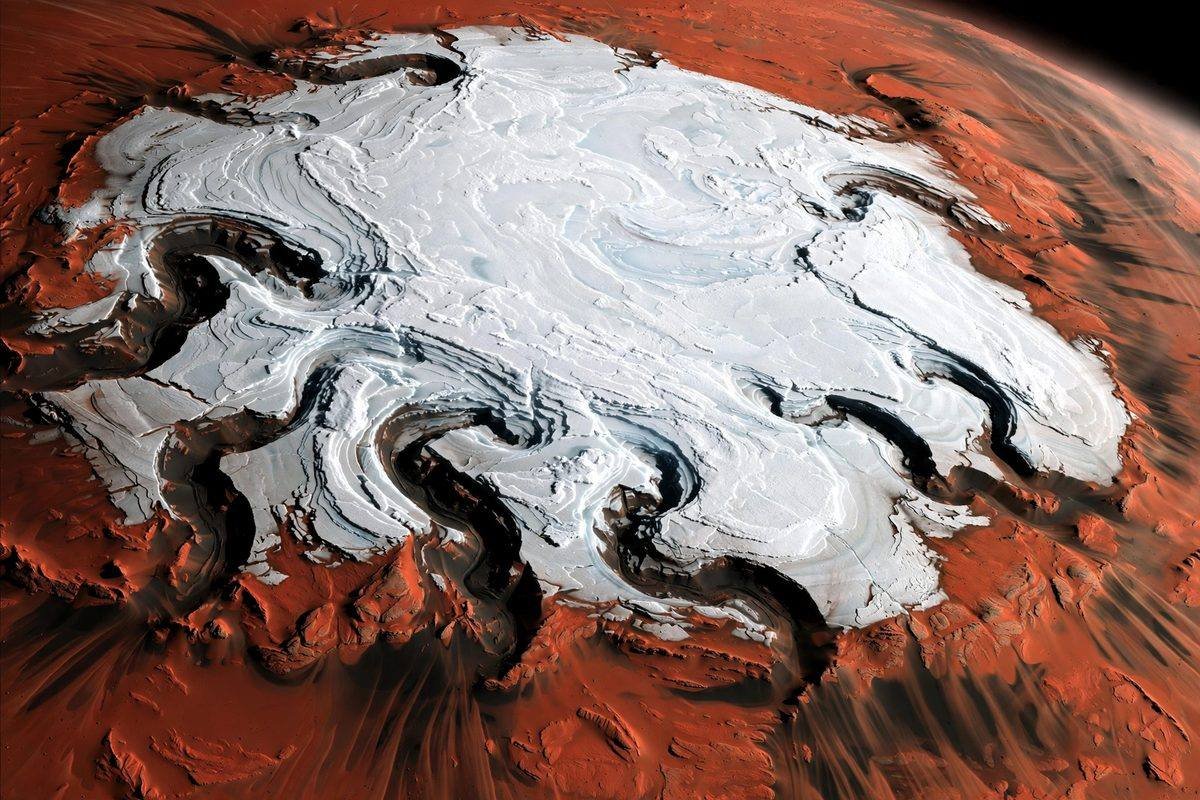
The most visible sign of the seasons is the polar caps. In winter, carbon dioxide freezes out of the atmosphere and adds a seasonal layer of frost to the permanent water-ice caps. In spring, that frost sublimates — turns straight from solid to gas without melting — and the caps shrink back. From orbit, you can watch the white caps grow and retreat each year, like a slow heartbeat.
Seasonal change also matters for water. In the coldest months, water is locked away as ice. In warmer months and warmer places, there are hints that salty water might briefly flow or form, though this is still an active area of research and scientists are careful about claiming too much. What is certain is that temperature controls where water can exist, and therefore where life, if it ever existed, could have survived.
What Do Freezing Temperatures Mean for Water on Mars?
This is where the cold stops being a curiosity and starts being a story about the planet’s past.
Long ago, Mars was warmer and wetter. Rivers carved channels that are still visible today, and lakes left behind sediments that rovers are now studying. Something changed — Mars lost much of its atmosphere, the pressure dropped, and liquid water could no longer survive on the surface for long. At today’s pressures and temperatures, water exposed on the surface would either freeze or boil away very quickly, depending on the exact conditions.
That is why water on Mars today is mostly ice: in the polar caps, buried in the soil, and possibly in glaciers hidden under dust. The cold preserves it. If humans ever live on Mars, that ice is a resource — for drinking water, for oxygen, and potentially for rocket fuel. But getting to it and using it in temperatures that regularly fall below -70°C is a serious engineering problem, not a simple matter of digging a well.
The cold also matters for the search for life. If microbes ever existed on Mars, the most likely places to find traces of them are where water was once liquid and where it is now protected from the worst of the cold and radiation — underground, or in sheltered spots. Temperature maps help scientists choose where to look.
Could Humans Survive the Cold on Mars?
In short: yes, but only with a lot of help. The cold itself is not the hardest problem humans would face on Mars — the thin air, radiation, and dust are arguably tougher. But cold shapes almost every solution.
A habitat on Mars would need constant heating, excellent insulation, and a reliable power source that works through the night and through dust storms. Spacesuits would need heating systems that keep astronauts warm during surface walks that might last hours. Vehicles would need to cope with materials becoming brittle in extreme cold, batteries losing capacity, and moving parts seizing up.
None of this is impossible. We already operate rovers through Martian winters, and engineers test equipment in cold chambers that mimic Mars conditions. The challenge is doing all of it at human scale, for months or years at a time, with no quick rescue if something fails. That is why every temperature measurement from a rover matters: it tells future mission planners exactly what their hardware — and their people — will have to endure.
There is also a psychological side that rarely gets mentioned. Living in a place where you can never simply step outside, where the world beyond the airlock is always lethally cold, would be a strange and isolating experience. The cold is not just a technical constraint. It is part of what would make Mars feel alien, every single day.
Frequently Asked Questions
Is Mars colder than Antarctica?
On average, yes. Mars averages about -65°C, while even the coldest Antarctic research stations average much warmer than that over a year. However, the coldest single temperature ever recorded on Earth, about -89°C at Vostok Station, is colder than a typical Martian day in many places. The difference is that Antarctica has summers; Mars has cold almost everywhere, almost all the time.
What is the average temperature on Mars in Fahrenheit?
About -85°F. That is the Fahrenheit equivalent of the commonly quoted average of about -65°C. Remember that this is a planetary average — actual temperatures at any given place and time can be far warmer or far colder.
Does it ever snow on Mars?
Yes, in a sense. Mars has snowfall, but it is mostly carbon dioxide snow at the poles in winter, not the water snow we know on Earth. Orbiters have observed clouds and falling snow over the polar regions. Water-ice snow is rarer, but water frost forming on the ground overnight is common, and rovers have photographed frosty mornings.
Why is Mars so cold if it has carbon dioxide in its atmosphere?
Carbon dioxide is a greenhouse gas, but Mars has far too little atmosphere for it to do much warming. Earth has a thick atmosphere that traps heat effectively. Mars has a thin one, so most heat escapes to space. It is a good reminder that it is not just which gases are present, but how much of them there are, that decides how warm a planet stays.
How cold is it on Mars at night?
Very cold, and the exact figure depends on location and season. In many places, nighttime temperatures fall below -70°C. Near the equator in summer, nights are still freezing by Earth standards. At the poles in winter, nights — which can last for months during polar night — can reach around -140°C.
What is the hottest temperature ever recorded on Mars?
Around 30°C, measured at the surface near the equator on a summer afternoon. This is a ground temperature, where dark soil absorbs direct sunlight. Air temperatures are generally lower. These warm peaks are brief, local, and do not change the overall picture of a frozen planet.
Could you survive on Mars without a heated suit?
No. Even on the warmest Martian afternoon, the air pressure is far too low to breathe, the radiation is dangerous, and temperatures would drop rapidly as soon as the Sun lowered. A heated, pressurised suit is essential for any time outside, no matter the season.
Conclusion
So, how cold is it on Mars? Cold enough that -65°C is the average, cold enough that -140°C is possible at the poles in winter, and yet — just occasionally, in just the right place at just the right time — warm enough for a summer afternoon that would not feel out of place on Earth.
That range is what makes Mars fascinating. It is not a uniformly frozen world, and it is not a warm desert either. It is a planet of extremes, where a single day can swing from pleasant sunshine to deep freeze, and where the thin air that makes those swings possible also makes the planet so hard to live on.
The next time you see a photograph of Mars, all red rock and pink sky, remember the number behind the image. Beneath that warm-looking landscape lies a world that is, most of the time, one of the coldest places humans have ever explored. And understanding exactly how cold — and why — is one of the first steps toward ever setting foot there ourselves.
Read Also: Macy’s Insite Login: Employee Portal Guide (2026 Guide)

1 Comment