
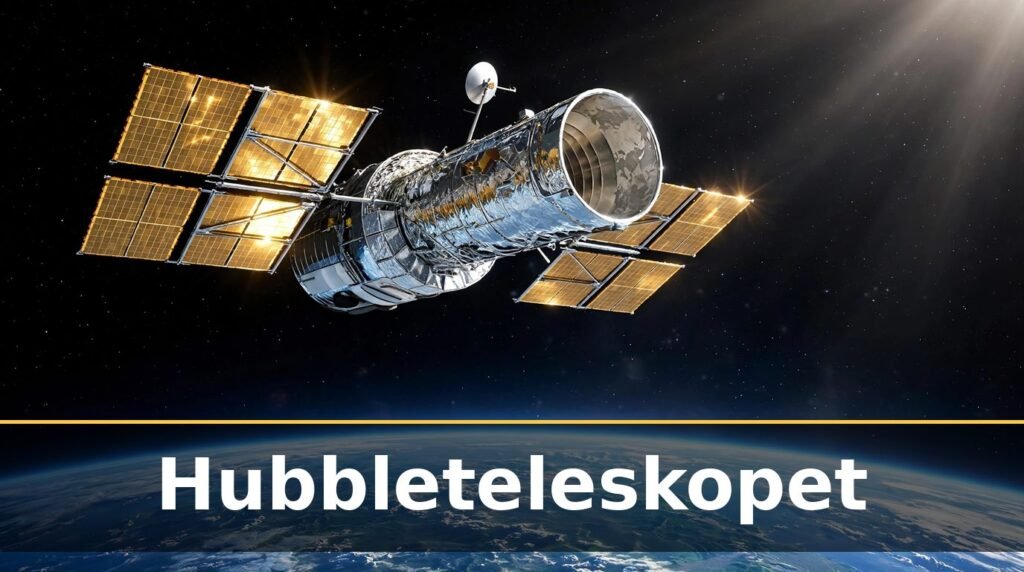
The hubbleteleskopet is the telescope behind many of the most famous space photographs. If you have ever seen a photograph of the Pillars of Creation, those towering columns of gas and dust in the Eagle Nebula, you have seen the work of the hubbleteleskopet. The same goes for the glittering spiral of a distant galaxy, the glow of a newborn star, or the deep-field image that revealed thousands of galaxies hiding in a patch of sky no bigger than a grain of sand held at arm’s length. For more than three decades, one telescope has produced the images that define how the public pictures the universe, and it has done it from orbit, hundreds of kilometres above the blurring effect of Earth’s atmosphere.
The name might look unfamiliar. “Hubbleteleskopet” is simply the compound form of “Hubble telescope” used in several languages, and it points to the same machine: the Hubble Space Telescope, NASA’s great observatory that has been circling the Earth since 1990. It was named after Edwin Hubble, the American astronomer who proved in the 1920s that the universe extends far beyond our own Milky Way and that galaxies are rushing away from each other as space itself expands. Fittingly, the telescope that carries his name has spent its whole working life measuring exactly the kind of universe he first described.
What makes Hubble’s story worth telling is not just what it discovered. It is the fact that it almost failed. The telescope was launched with a flawed mirror, its first images were blurry, and it became a national punchline before it ever became a legend. Then astronauts flew up to it, fixed it by hand in orbit, and turned a very public embarrassment into one of the greatest scientific instruments ever built. That is the story this article tells, from the launch to the repair, the discoveries, and the question of how much longer Hubble can keep going. The hubbleteleskopet is the telescope at the centre of that story.
The short answer: The hubbleteleskopet is the Hubble Space Telescope, a 2.4-metre observatory launched into low Earth orbit by NASA on April 24, 1990. Its primary mirror was ground to the wrong shape, which blurred its early images, but a 1993 servicing mission by Space Shuttle astronauts installed corrective optics that fixed the problem. Since then Hubble has measured the age of the universe at about 13.8 billion years, helped discover that the expansion of the universe is accelerating, photographed the deepest views of the cosmos ever taken, and observed planets around other stars. More than 35 years after launch, it is still working.
What Is the Hubbleteleskopet?
The hubbleteleskopet is the Hubble Space Telescope, often shortened to HST or simply Hubble. It is a space telescope, which means it does not sit on a mountaintop like the telescopes you might picture. Instead, it flies in low Earth orbit, circling the planet roughly every 95 minutes at an altitude that began at about 547 kilometres (340 miles) and has gradually fallen to around 470 kilometres as atmospheric drag slowly pulls it down.
The telescope itself is about 13.2 metres (43 feet) long, roughly the size of a school bus, and about 4.2 metres (14 feet) wide at its widest point. At launch it weighed around 11,100 kilograms (24,500 pounds). Its heart is a primary mirror 2.4 metres (7 feet 10 inches) across, which collects light and focuses it onto the telescope’s scientific instruments. Those instruments observe in ultraviolet, visible, and near-infrared light, letting Hubble see things the human eye never could, including the hot glow of young stars and the faint light of galaxies billions of light-years away.
Hubble was built by NASA with a major contribution from the European Space Agency, which supplied the solar arrays and one of the early instruments in exchange for observing time. It was designed from the start to be serviced by astronauts, a decision that would later save the entire mission. Without that design choice, Hubble’s story would have ended in disappointment within months of launch.
Why Was the Hubble Telescope Built in the First Place?
Ground-based telescopes have one unavoidable problem: Earth’s atmosphere. The same air that lets us breathe also blurs starlight, absorbs ultraviolet light, and glows faintly at night. Astronomers call the blurring effect “seeing,” and it is the reason stars twinkle. A telescope on the ground can have a mirror far larger than Hubble’s, yet still produce a fuzzier image of a distant galaxy, because the light has to fight its way through kilometres of turbulent air. The hubbleteleskopet was built to get above that blur.
The idea of putting a telescope above the atmosphere dates back to 1946, when the astronomer Lyman Spitzer wrote a paper arguing that a space observatory could transform astronomy. It took decades of lobbying, engineering, and politics before the idea became a real project. The telescope was originally planned for launch in the early 1980s, but delays, including the loss of the Space Shuttle Challenger in 1986, pushed the schedule back again and again.
What scientists hoped Hubble would do
When Hubble was finally ready, astronomers had a long wish list for it. They wanted it to measure the distances to faraway galaxies precisely, so the expansion rate of the universe could finally be pinned down. They wanted it to photograph galaxies in their youth, when the universe was a fraction of its current age. They wanted it to study how stars are born and die, and to look for planets around other stars. In short, they wanted a telescope that could see the universe as it really is, without the atmosphere in the way.
Hubble delivered on nearly all of that, though not on the schedule anyone expected. The science came, but only after a very public disaster.
The 1990 Launch: A Triumph That Turned Sour
On April 24, 1990, the Space Shuttle Discovery lifted off from the Kennedy Space Center carrying Hubble in its cargo bay. The next day, the shuttle’s robotic arm gently released the telescope into orbit, its solar arrays unfolded, and NASA declared the mission a success. The world waited for the first pictures.
They came, and they were blurry. Stars that should have appeared as sharp points looked like fuzzy blobs. The images were better than nothing, but they were nowhere near the quality astronomers had been promised. Within weeks, NASA confirmed the problem: the telescope’s primary mirror had been ground to the wrong shape. The outer edge of the mirror was too flat by about 2.2 microns, roughly one-fiftieth the width of a human hair. That tiny error was enough to cause severe spherical aberration, a flaw in which light reflecting off the edge of a mirror focuses at a different point from light reflecting off its centre. The hubbleteleskopet could not yet show the sharp universe it was built for.
The cause turned out to be a testing device called a null corrector, which had been assembled incorrectly by a distance of about 1.3 millimetres during the mirror’s manufacture. The mirror itself had been polished to extraordinary precision, but it was polished to the wrong shape. The result was a telescope that could not focus properly, and the jokes wrote themselves. Late-night comedians mocked NASA. Congress held hearings. For a while, Hubble looked like a billion-dollar mistake.
The 1993 Repair: Astronauts Fix a Telescope in Orbit
Here is where the story turns. Because Hubble had been designed to be serviced in space, NASA could do something no one had ever attempted at this scale: send astronauts up to repair a telescope in orbit. In December 1993, the Space Shuttle Endeavour carried a crew of seven astronauts to Hubble on mission STS-61. Over five spacewalks totalling more than 35 hours, they installed a device called COSTAR, the Corrective Optics Space Telescope Axial Replacement.
COSTAR was essentially a pair of glasses for the telescope. It carried five pairs of small mirrors that corrected the flawed light before it reached Hubble’s instruments. The astronauts also installed a new camera, the Wide Field and Planetary Camera 2, which had its own corrective optics built in. They replaced solar arrays and made other repairs while they were at it.
When the first images came back after the repair, the difference was dramatic. Stars were sharp points. Galaxies showed spiral arms and fine detail. The telescope that had been a punchline was suddenly producing the sharpest images of the universe anyone had ever seen. The repair worked so well that Hubble’s scientific program accelerated immediately, and the mission that had looked doomed became the most productive observatory in history. The hubbleteleskopet was back in business.
How the Hubbleteleskopet Actually Sees the Universe
To understand why Hubble’s pictures look the way they do, it helps to know a little about how the telescope works. Hubble does not take photographs the way a camera on your phone does. Its instruments detect light and turn it into digital data, which is sent to the ground and processed into the images we see.
The instruments that do the work
Hubble has carried several generations of instruments over its life, swapped in and out during servicing missions. Today its working instruments include the Wide Field Camera 3, which takes the broad, colourful images most people recognise; the Advanced Camera for Surveys; the Cosmic Origins Spectrograph, which studies ultraviolet light; and the Space Telescope Imaging Spectrograph. Together they cover ultraviolet, visible, and near-infrared wavelengths.
That range matters. Ultraviolet light reveals hot young stars and the energetic gas around them. Visible light shows us the universe much as our eyes would see it, only far sharper and deeper. Near-infrared light passes through dust clouds that block visible light, letting Hubble peer into stellar nurseries and see galaxies whose light has been stretched by the expansion of the universe.
Why being in space matters so much
Above the atmosphere, Hubble enjoys two enormous advantages. First, there is no twinkling, so its images stay sharp. Second, ultraviolet light reaches it unimpeded, whereas the ozone layer blocks most ultraviolet light before it can reach a ground-based telescope. That is why Hubble remains valuable even though ground telescopes today have much larger mirrors. Size is not everything. A clear view counts for at least as much, and Hubble’s view has no atmosphere in the way at all.
The Hubble Deep Field: A Tiny Patch of Sky Full of Galaxies
In December 1995, Hubble’s director made a bold decision. He pointed the telescope at a tiny, apparently empty patch of sky near the Big Dipper and left it staring there for ten days. The patch was about the size of a grain of sand held at arm’s length, and ground-based telescopes had shown nothing in it at all.
The resulting image, the Hubble Deep Field, revealed around 3,000 galaxies. Some were spirals like our Milky Way. Others were irregular blobs, galaxies caught in the act of forming and colliding in the young universe. The image became one of the most famous in astronomy, and follow-up deep fields in later years pushed the count even higher. The lesson was simple and staggering: wherever you look in the sky, even at a spot that seems empty, the universe is full of galaxies.
That single image changed how astronomers thought about the scale of the cosmos. It also became a powerful tool for studying how galaxies grow and change over billions of years, because the most distant galaxies in the image are also the youngest, seen as they were when the universe was only a small fraction of its present age. The hubbleteleskopet revealed all of them.
How Hubble Measured the Age of the Universe
One of Hubble’s original jobs was to measure the Hubble constant, the number that describes how fast the universe is expanding. Before Hubble, estimates of this number disagreed wildly, and that meant estimates of the age of the universe ranged anywhere from about 10 billion to about 20 billion years. That is not a small uncertainty. It is the difference between a universe younger than its oldest stars, which would be impossible, and a universe old enough to contain them.
Hubble attacked the problem by measuring the distances to Cepheid variable stars, a type of star whose brightness pulses in a regular rhythm that reveals its true luminosity. By comparing how bright these stars really are with how bright they appear, astronomers could work out their distances, and from those distances, the expansion rate of the universe. After years of careful observations, Hubble’s key project settled the value, and the age of the universe came out at about 13.8 billion years, a figure that has held up against later measurements from other observatories.
This was not a small achievement. It resolved a decades-old argument and gave cosmology a firm number to build on. It is one of the reasons Hubble is often called the most important telescope ever built. The hubbleteleskopet made that number possible.
The Discovery That the Universe’s Expansion Is Accelerating
In 1998, two teams of astronomers using distant exploding stars called Type Ia supernovae, with Hubble providing crucial measurements, made a discovery that shocked the field: the expansion of the universe is not slowing down under the pull of gravity, as almost everyone had assumed. It is speeding up.
The finding implied the existence of a mysterious force, later called dark energy, that pushes space apart. It was so unexpected that many scientists initially suspected an error in the data. But the evidence held up, and in 2011 the leaders of the two teams received the Nobel Prize in Physics. Hubble’s role was central, because its sharp vision above the atmosphere let astronomers measure the faint light of those distant supernovae with a precision no ground telescope could match at the time.
Dark energy remains one of the biggest unsolved mysteries in physics. It makes up roughly two-thirds of the energy content of the universe, and nobody knows what it is. Hubble helped discover it, and it is still studying it today.
The Pillars of Creation and Hubble’s Most Famous Images
Ask a random person to name a Hubble image, and there is a good chance they will name the Pillars of Creation. Taken in 1995, the image shows towering columns of cold gas and dust in the Eagle Nebula, about 6,500 light-years from Earth, where new stars are being born inside the pillars. Hubble revisited the scene in 2014 with a sharper camera, and the new version became famous all over again.
The Pillars are not Hubble’s only iconic image. There is the Bubble Nebula, a sphere of gas blown by a hot star’s wind. There is the glittering globular cluster Omega Centauri, packed with millions of stars. There is the image of the galaxy pair known as the Antennae, two galaxies in the middle of a slow-motion collision. Each of these pictures did double duty: they were scientific data, and they were also public art, bringing astronomy to people who had never looked through a telescope.
That public impact matters. Hubble’s images appear in textbooks, on classroom walls, and in museums around the world. They made deep space feel close and real in a way that charts and equations never could. The hubbleteleskopet gave astronomy that public face.
Hubble and the Search for Planets Around Other Stars
Hubble has also played a major role in the study of exoplanets, planets orbiting stars other than our Sun. In 2001, Hubble made the first detection of an atmosphere around an exoplanet, finding sodium in the air of a planet called HD 209458 b, a gas giant about 150 light-years away. It was the first time anyone had directly measured the chemical makeup of an atmosphere on a world beyond our solar system.
Since then, Hubble has studied the atmospheres of dozens of exoplanets, detecting water vapour, clouds, and haze on some of them. It has also taken direct images of a few exoplanets, including one called Fomalhaut b, and it has observed planets as they pass in front of their stars, a technique that lets astronomers filter starlight through a planet’s atmosphere and read its composition. These studies laid the groundwork for the exoplanet science that the James Webb Space Telescope is now carrying much further.
Hubble vs. Ground-Based Telescopes: A Fair Comparison
It is tempting to assume that a telescope in space must beat every telescope on the ground, but the truth is more interesting. Ground telescopes have grown enormously since 1990, and the largest now have mirrors ten metres across or more. Hubble’s mirror is only 2.4 metres. So what does each do better?
| Feature | Hubble Space Telescope | Large Ground-Based Telescopes |
|---|---|---|
| Location | Low Earth orbit, above the atmosphere | Mountain observatories on Earth |
| Primary mirror | 2.4 metres | Up to 10 metres or more |
| Image sharpness | Extremely sharp, no atmospheric blur | Blurred by air, partly fixed with adaptive optics |
| Ultraviolet light | Can observe it directly | Mostly blocked by the ozone layer |
| Cost and upkeep | Serviced by astronauts (until 2009), now ageing in orbit | Can be repaired and upgraded by technicians on site |
| Best for | Deep, sharp images and ultraviolet science | Collecting huge amounts of light from faint objects |
The honest answer is that the two kinds complement each other. Ground telescopes gather more light and can be upgraded easily. Hubble sees more sharply and in wavelengths the ground cannot reach. Modern astronomy uses both, and many discoveries combine data from each.
Hubble vs. the James Webb Space Telescope
Since the James Webb Space Telescope began science operations in 2022, people often ask whether Hubble is now obsolete. It is not. The two telescopes are designed to do different jobs, and they often observe the same objects together, each contributing what the other cannot.
| Feature | Hubble Space Telescope | James Webb Space Telescope |
|---|---|---|
| Launched | April 24, 1990 | December 25, 2021 |
| Primary mirror | 2.4 metres | 6.5 metres |
| Main wavelengths | Ultraviolet, visible, near-infrared | Infrared |
| Orbit | Low Earth orbit, about 540 km up | Lagrange point L2, about 1.5 million km away |
| Servicing | Serviced five times by astronauts | Cannot be serviced |
| Key strengths | Sharp visible and ultraviolet images | Seeing the earliest galaxies through dust and cosmic expansion |
Webb is far better at looking at the most distant, earliest galaxies, because their light has been stretched into the infrared by the expansion of the universe. Hubble is better at visible and ultraviolet light, which Webb cannot see at all. When the two observe the same galaxy cluster, Hubble shows the visible structure while Webb reveals the dust and the most distant objects behind it. Astronomers describe them as partners, not rivals, and Hubble’s observations remain in demand even in the Webb era.
Can You See the Hubbleteleskopet From Earth?
Yes, and it is easier than you might think. Hubble is large, bright, and in a relatively low orbit, so under the right conditions it is visible to the naked eye as a steady point of light moving across the sky. It travels at roughly 17,000 miles per hour (about 27,000 kilometres per hour), circling the Earth about every 95 minutes, and it can appear about as bright as a moderately bright star.
The best time to look is just after sunset or just before sunrise, when the sky is dark but the telescope is still catching sunlight. Satellite-tracking websites and apps can predict exactly when Hubble will pass over your location and where to look. It will not look like a telescope, of course. It will look like a star that is moving, steadily and silently, across the sky. But knowing what it is makes the sight feel different. That bright dot has photographed galaxies billions of light-years away.
How Long Will Hubble Keep Working?
Hubble is old. It was launched in 1990 with an expected lifetime of about 15 years, and it has now been working for more than 35. It has survived five servicing missions, the last in May 2009, when astronauts installed new instruments and replaced batteries and gyroscopes. There will be no more servicing missions, because the Space Shuttle that carried the astronauts has retired, so Hubble must now work with what it has.
The telescope is gradually losing altitude as thin air at the edge of the atmosphere drags on it. NASA expects it to keep working through the 2020s, and possibly into the 2030s, as long as its remaining gyroscopes and instruments hold out. Eventually it will re-enter the atmosphere, most likely sometime in the 2030s or 2040s, and burn up. NASA has studied options for a controlled re-entry, but no decision has been announced.
For now, though, Hubble is still doing science every day. Its observing schedule remains full, and astronomers continue to propose more observations than it can carry out. A telescope that was supposed to last 15 years has lasted more than twice that long, and it is still producing discoveries.
Why the Hubbleteleskopet Still Matters
There is a temptation to treat Hubble as a museum piece now that Webb is flying, but that misses what Hubble actually is. It is the telescope that taught us the age of the universe, showed us that its expansion is accelerating, and gave us our first deep look at the galaxies that fill the cosmos. It did all of that after starting its career as a failure.
Its story also matters beyond astronomy. Hubble is a reminder that a public failure can be repaired, that careful engineering and brave astronauts can rescue a mission everyone had written off, and that a scientific instrument can keep paying dividends for decades longer than anyone planned. The images it produced changed how ordinary people think about the universe, and the science it produced changed how professionals think about it too.
When Hubble finally falls silent, it will leave behind an archive of more than a million observations, a library that astronomers will mine for decades. New discoveries will keep coming out of old Hubble data long after the telescope itself has gone. That is a strange and wonderful kind of immortality for a machine: it will keep teaching us about the universe even after it stops looking at it. The hubbleteleskopet will keep teaching us long after that.
Frequently Asked Questions About the Hubbleteleskopet
What does “hubbleteleskopet” mean?
“Hubbleteleskopet” is a compound form of “Hubble telescope” used in several languages, including Danish and Norwegian. It refers to the Hubble Space Telescope, NASA’s observatory in low Earth orbit. If you searched for the term in English, you are looking for the same telescope this article describes.
When was the Hubble telescope launched?
Hubble was launched on April 24, 1990, aboard the Space Shuttle Discovery on mission STS-31. It was deployed into orbit the next day, April 25, 1990, and entered service on May 20, 1990. It has been operating ever since, for more than 35 years.
How big is Hubble’s mirror?
Hubble’s primary mirror is 2.4 metres (7 feet 10 inches) across. The telescope itself is about 13.2 metres (43 feet) long. The mirror was ground to the wrong shape by about 2.2 microns, a flaw that blurred its early images until astronauts installed corrective optics in 1993.
What went wrong with Hubble after launch?
The primary mirror had spherical aberration, meaning light from its edge focused at a different point from light at its centre, which blurred every image. The flaw was caused by a testing device called a null corrector that had been assembled incorrectly. Astronauts fixed it in December 1993 by installing the COSTAR corrective optics unit and a new camera.
How far away can Hubble see?
Hubble can see galaxies billions of light-years away. Its deep-field images revealed galaxies whose light had travelled for more than 13 billion years to reach us, showing the universe as it was when it was only a few hundred million years old. The exact distance of the farthest object depends on the observation, but Hubble routinely studies galaxies at distances of 10 billion light-years and more.
Is Hubble still working in 2026?
Yes. Hubble is still operating and doing science in 2026, more than 35 years after its launch. Its observing schedule remains full, and it works alongside the James Webb Space Telescope, observing in visible and ultraviolet light that Webb cannot see. NASA expects it to keep working into the 2030s if its remaining hardware holds out.
What is the difference between Hubble and the James Webb telescope?
Hubble observes mainly in ultraviolet, visible, and near-infrared light from low Earth orbit, with a 2.4-metre mirror. Webb observes mainly in infrared light from a point about 1.5 million kilometres away, with a 6.5-metre mirror. Webb sees the earliest galaxies better, while Hubble sees visible and ultraviolet light better. They complement each other rather than replacing each other.
Final Thoughts
The hubbleteleskopet began as a dream in a 1946 paper, became a telescope in 1990, nearly failed on arrival, and was rescued by astronauts working in spacesuits hundreds of kilometres above the Earth. Since then it has measured the age of the universe, helped discover dark energy, photographed thousands of galaxies in a speck of empty sky, and studied the atmospheres of planets around other stars. It has lasted more than twice its planned lifetime and is still going.
If you ever doubt that science is worth the trouble, think about Hubble. It is a machine that was built wrong, fixed in orbit by human hands, and then spent three decades showing us a universe far bigger, stranger, and more beautiful than anyone had imagined. That is a story worth remembering, and it is still being written, one orbit at a time.
Read Also: How Many Moons Does Saturn Planet Have? (2026 Guide)
