
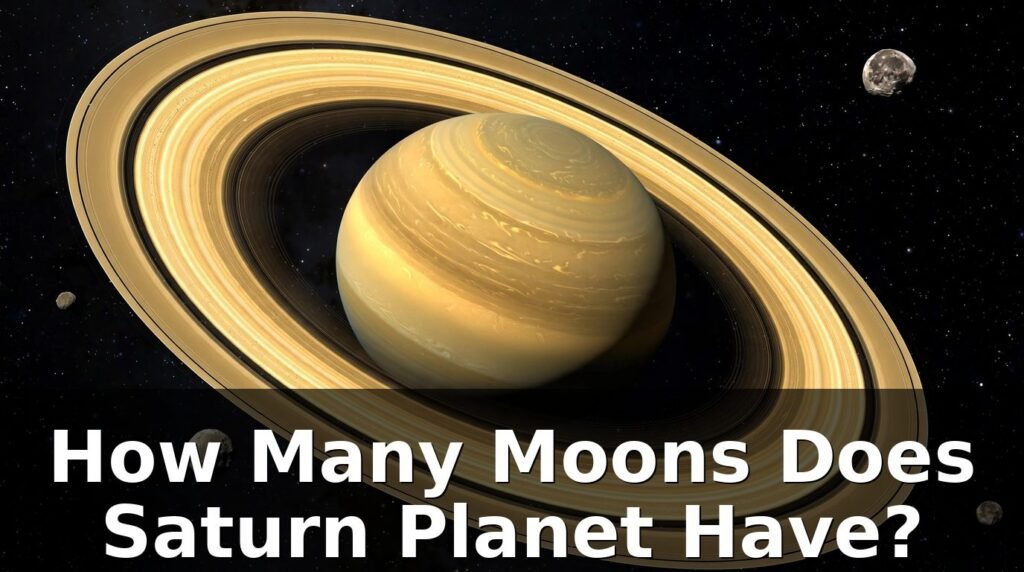
How many moons does Saturn planet have? Ask ten people and you will probably get ten different answers. A few years ago, the safe answer was 82. Then it was 146. Today the answer is bigger still, and it changed again this year. Saturn does not just own the most spectacular rings in the solar system. It also has the largest family of moons of any planet, and astronomers keep finding more of them hiding in the dark, far beyond the rings.
That is what makes this question trickier than it looks. Counting Saturn’s moons is not like counting the chairs in a room. Some moons are giants with thick atmospheres and hidden oceans. Others are lumps of rock and ice only a couple of kilometres wide, orbiting so far from the planet that they take years to complete a single lap. Drawing the line between a moon and a piece of ring debris is a genuine scientific decision, and every time telescopes get better, the line moves a little further out.
In this guide, you will get the current confirmed number, the story of how it jumped so dramatically in 2025 and again in 2026, a tour of the moons that actually matter, and a realistic look at which ones you can spot yourself on a clear night.
The short answer: Saturn has 293 confirmed moons as of June 2026 — more than any other planet in the solar system. The total jumped from 146 to 274 in March 2025, when astronomers announced 128 new moons at once, and rose again during 2026 with 19 further confirmations. Most of the newcomers are tiny, distant, irregular satellites only a few kilometres across.
More Information: What Is a Supermoon? Meaning, Causes and When to See One
Why Does Saturn’s Moon Count Keep Changing?
Part of the answer is technology. The other part is definition. Saturn’s moons were once counted on one hand. Titan, found in 1655, was the only known moon for more than a century. Rhea, Iapetus, Dione and Tethys followed in the 1670s and 1680s, discovered by Giovanni Cassini. Mimas and Enceladus turned up in 1789, spotted by William Herschel. For a long time, that was more or less it — a handful of bright, close-in moons that a good telescope could pick out.
The twentieth century added a few more, and the space age added many. The Voyager flybys of 1980 and 1981 found new small moons tucked among the rings, and the Cassini spacecraft, which orbited Saturn from 2004 to 2017, found several more. But the real explosion came from the ground. Modern telescopes can photograph patches of sky around Saturn for hours, and computers can stack those images to reveal objects far too faint to see in a single frame.
Each improvement pushes the detection limit a little fainter, and every time it does, new specks of light turn out to be moons. That is why the number has climbed in steps — 82, then 146, then 274, now 293 — rather than growing smoothly. The moons were always there. We simply could not prove it until the tools caught up.
The 128 New Moons Announced in March 2025
On 11 March 2025, the International Astronomical Union announced 128 new moons of Saturn in a single day. It was the largest batch of moons ever confirmed at once, and it nearly doubled the planet’s known total overnight, from 146 to 274.
None of these moons had suddenly appeared. They had been hiding in deep images taken over several years with the Canada-France-Hawaii Telescope on Mauna Kea in Hawaii. The survey team, led by researchers at the University of British Columbia including Dr Edward Ashton, revisited the same fields around Saturn again and again, watching for tiny points of light that moved at exactly the pace a distant moon should move.
The trick is called shift and stack. Astronomers take many long exposures, shift each frame to follow Saturn’s expected motion through the sky, and then add them together. A faint moon that is invisible in any single image slowly emerges from the noise. It is the same basic idea as stacking photos to bring out a dim galaxy — patient, unglamorous work that only pays off after years of observations.
Only after each candidate had been tracked long enough for its orbit to be pinned down did the International Astronomical Union formally recognise it. That is an important detail. A single sighting is not enough. A moon only joins the official count once astronomers can predict where it will be in the future, which means watching it complete enough of its orbit to be sure it is really circling Saturn.
What Actually Counts as a Moon?
Here is the awkward question behind the headline number: where does a moon end and a piece of ring begin?
Saturn’s rings are made of countless chunks of ice, ranging from grains of dust to boulders the size of houses, along with a few moonlets hundreds of metres across, each travelling in its own orbit around the planet. There is no sharp, objective boundary between the smallest objects we call moons and the largest objects we call ring particles.
In practice, astronomers count an object as a confirmed moon when it has a stable, well-measured orbit around Saturn and sits outside the main ring system. The ring moonlets embedded inside the rings themselves are generally not included in the headline total. Neither are the hundreds of possible kilometre-sized distant objects that have been seen on only one occasion and never tracked again.
That is why you will sometimes see different totals quoted in different places. An older article may still say 146 or 274, while a source updated this summer says 293. None of them is lying. They are simply snapshots from different dates, and the count only moves in one direction. If a source does not give a date with its number, treat it with suspicion.
Regular Moons vs Irregular Moons
Saturn’s 293 confirmed moons fall into two very different families, and the split tells you a lot about how the system formed.
Regular moons are the well-behaved ones. They orbit close to Saturn, travel in the same direction as the planet’s rotation, and stay roughly in line with Saturn’s equator. There are 25 of them, and they include every moon you have heard of: Titan, Rhea, Iapetus, Dione, Tethys, Enceladus and Mimas. These moons probably formed from the same disc of gas and dust that surrounded young Saturn, which is why their orbits are so neat.
Irregular moons are the wild bunch. There are 268 of them, and they orbit much further out, on tilted, stretched-out paths. Many travel backwards — retrograde — around the planet. Most are only a few kilometres across. Astronomers believe these are captured objects: asteroids or fragments of larger bodies that wandered too close to Saturn and were caught by its gravity, or the shattered remains of bigger moons that collided long ago.
The irregular moons are grouped by their orbits into three families, named after the mythologies their names come from: the Inuit group, the Gallic group and the Norse group. The Norse group is by far the largest, and it holds most of the moons found in 2025. As of April 2026, 228 of Saturn’s irregular moons still have no name at all, just a catalogue designation. Naming 228 moons takes time, and the queue is long.
| Feature | Regular moons | Irregular moons |
|---|---|---|
| How many | 25 | 268 |
| Distance from Saturn | Close in | Far out |
| Orbit direction | Prograde, same way Saturn spins | Mixed, many retrograde |
| Orbit shape | Near-circular, near Saturn’s equator | Tilted and stretched out |
| Typical size | Hundreds to thousands of km | A few km across |
| Likely origin | Formed with Saturn | Captured asteroids or collision fragments |
The Seven Moons You Should Actually Know
Of the 293 confirmed moons, only a handful are big enough to have real character. These seven are the ones worth remembering, and they are the reason Saturn’s system is so interesting to scientists.
Titan
The giant of the family. Titan is larger than the planet Mercury and the second-largest moon in the solar system. It holds more than 96 percent of all the mass orbiting Saturn, which means that in weight terms, Saturn’s moon system is really Titan plus a rounding error.
Rhea
Saturn’s second-largest moon, a heavily cratered ball of ice. Rhea is quiet and ancient, and its bright, battered surface is one of the most cratered landscapes anywhere in the solar system.
Iapetus
The two-faced moon. One side of Iapetus is bright ice, the other is coated in dark dust, so it looks like two different worlds stitched together. It also carries a ridge of mountains around its equator that makes it look, from some angles, like a walnut.
Dione
A dense, icy moon with bright cliffs and wispy streaks across its surface. Cassini’s close flybys showed a world shaped by ancient fractures and, possibly, a subsurface ocean of its own.
Tethys
A bright, icy moon with a vast canyon called Ithaca Chasma running most of the way around it, and a giant crater named Odysseus. Tethys is mostly water ice, and it reflects sunlight so well that it is one of the brightest objects in the Saturn system.
Enceladus
Small, bright and restless. Enceladus sprays jets of salty water from cracks at its south pole, feeding Saturn’s faint E ring and hinting at a global ocean beneath its ice. It is one of the most promising places in the solar system to look for life.
Mimas
The smallest of the seven, famous for a single feature: the Herschel crater, so large relative to the moon that Mimas looks uncannily like the Death Star from Star Wars. The impact that made it nearly shattered the little moon apart.
Titan: A Moon Bigger Than Mercury
Titan deserves a section of its own, because it is less like a moon and more like a small planet that happens to orbit Saturn. It is the only moon in the solar system with a thick atmosphere, and that atmosphere is mostly nitrogen, like Earth’s, with a haze of orange smog that hides the surface from view.
Under the haze, Titan has rivers, lakes and seas — but they are filled with liquid methane and ethane, not water. Rain falls from methane clouds, carves channels through water-ice bedrock, and pools in polar lakes. It is the only place besides Earth where liquid flows across a surface in the open air, even if the liquid itself is very different.
Titan was discovered in 1655 by the Dutch astronomer Christiaan Huygens, and it waited more than three centuries for a close look. In January 2005, the Huygens probe, carried to Saturn by the Cassini spacecraft, parachuted through Titan’s atmosphere and landed on its surface, sending back pictures of rounded pebbles of water ice lying in what looked like a dry riverbed. It remains the most distant landing ever made.
NASA’s Dragonfly mission will send a rotorcraft to Titan to explore its surface and chemistry up close, flying from site to site in the thick air. Titan’s mix of organic chemistry, liquid and energy is one of the best natural laboratories we have for understanding how the building blocks of life behave on another world.
Enceladus: The Little Moon With a Hidden Ocean
Enceladus is only about 500 kilometres wide, yet it may be the most exciting moon in the Saturn system. Its south pole is striped with deep cracks nicknamed tiger stripes, and from those cracks shoot jets of salty water vapour and ice grains, hundreds of kilometres into space.
Cassini flew through those plumes and tasted them. The spray contains water, salts and simple organic molecules, and it comes from a global ocean of liquid water hidden beneath the moon’s icy crust, kept warm by tidal flexing as Saturn’s gravity squeezes the little moon on every orbit. The plumes are so productive that they feed Saturn’s E ring, a faint, wide ring made almost entirely of Enceladus’s spray.
That makes Enceladus one of the strongest candidates in the solar system for finding life beyond Earth. It has liquid water, heat, chemistry and a way for us to sample its ocean without drilling through kilometres of ice — we just fly through the spray. Future missions are being designed to do exactly that, and to look for the chemical fingerprints of biology in the plume particles.
The Shepherd Moons That Sculpt the Rings
Not all of Saturn’s important moons are big. Some of the smallest do the most visible work, herding the ring particles into place.
Shepherd moons orbit at the edges of rings and gaps, and their gravity keeps the ring material in line. Prometheus and Pandora patrol either side of the narrow F ring, stirring up kinks and braids in the ring material as they pass. Pan orbits inside the Encke Gap, a clear lane in the A ring, sweeping the gap clean. Daphnis does the same job in the Keeler Gap, and its passages raise ripples of ring material that cast shadows across the rings. Atlas, a small moon with a flying-saucer shape, rides the outer edge of the A ring and gathers ring dust around its equator.
Without these little guardians, the rings would spread out and blur over time. The sharp edges, narrow gaps and fine structure that make Saturn’s rings so photogenic exist because small moons are constantly patrolling them. It is a reminder that in the Saturn system, size is not the same as importance.
Saturn vs Jupiter: Who Really Has More Moons?
For years, Jupiter and Saturn traded the lead in the moon race. Jupiter held the record for a long time, then Saturn pulled ahead in 2019, and the 2025 announcement blew the contest wide open.
| Planet | Confirmed moons (2026) | Largest moon | Notes |
|---|---|---|---|
| Saturn | 293 | Titan | Most moons of any planet; 268 are irregular |
| Jupiter | 115 | Ganymede | Largest moon in the solar system |
| Uranus | 28 | Titania | Most moons orbit on their side with the planet |
| Neptune | 16 | Triton | Triton orbits backwards, likely captured |
| Mars | 2 | Phobos | Both small and lumpy |
| Earth | 1 | The Moon | The only moon most of us ever see |
The gap is now so wide that Saturn alone has more confirmed moons than all the other planets combined. That says less about Saturn being special and more about how thoroughly its neighbourhood has been surveyed. Jupiter’s distant moons are just as hard to find, and its count will probably climb too as the same shift-and-stack techniques are aimed at it. For now, though, Saturn’s lead is emphatic.
Can You See Saturn’s Moons Yourself?
Most of Saturn’s 293 moons are far beyond the reach of any amateur telescope. The 128 moons found in 2025 are specks a few kilometres wide, orbiting millions of kilometres from Saturn, and even professional observatories need hours of stacked exposures to spot them.
But Titan is a different story. At magnitude 8 or so, Titan is bright enough to show up in a small telescope or even a good pair of binoculars on a steady night, shining as a tiny star close to the planet. Rhea, Dione, Tethys and Iapetus are fainter but reachable with a modest telescope of 150mm or more under dark skies, especially when they sit well away from Saturn’s glare.
The best time to look is around opposition, when Saturn is closest to Earth and up all night. Saturn reached opposition on 4 October 2026, so through the autumn of 2026 it has been a fine evening object, glowing golden in the south after dark. A planetarium app will tell you exactly where Titan and its companions sit on any given night, which takes the guesswork out of identifying them.
Start with Titan. Find Saturn’s rings first, then look for a faint point of light a little way from the planet, roughly in line with the rings. That is a world bigger than Mercury, with lakes of liquid methane and rain in its skies — and you are looking at it from your back garden.
More Information: Brooks Men’s Ghost Max 3 Neutral Running (2026 Guide)
Will Saturn’s Moon Count Keep Growing?
Almost certainly yes. The 2026 announcements — eleven irregular moons on 16 March, seven more on 9 April, and one new regular moon on 17 June — show that the survey work is still paying off, and there is no reason to think the sky around Saturn has been emptied.
Astronomers estimate that hundreds more kilometre-sized objects may be orbiting Saturn, seen once and never confirmed, or still too faint to have been spotted at all. Each new survey with a bigger telescope or a smarter stacking method will likely add another batch, and each batch will need years of follow-up before the International Astronomical Union accepts it.
That is the honest state of the science: 293 is the confirmed total today, in November 2026, and it is the most accurate answer anyone can give. It is also almost certainly not the final answer. The next announcement could come at any time, and when it does, this guide’s number will need updating. That is not a weakness in the science. It is how discovery works — slowly, carefully, and then all at once, 128 moons in a single day.
Frequently Asked Questions
How many moons does Saturn planet have in 2026?
Saturn has 293 confirmed moons as of June 2026, according to NASA and the International Astronomical Union. The total rose from 146 to 274 in March 2025, when 128 new moons were announced, and climbed to 293 during 2026 with 19 further confirmations.
What is Saturn’s largest moon?
Titan is Saturn’s largest moon. It is bigger than the planet Mercury and the second-largest moon in the solar system, after Jupiter’s Ganymede. Titan holds more than 96 percent of all the mass orbiting Saturn, and it is the only moon with a thick atmosphere.
Does Saturn have more moons than Jupiter?
Yes, by a wide margin. Saturn has 293 confirmed moons, while Jupiter has 115. Saturn alone has more moons than all the other planets in the solar system combined.
How many moons did Saturn have before 2025?
Before the March 2025 announcement, Saturn had 146 confirmed moons. The announcement of 128 new moons in a single day nearly doubled the total to 274, and further discoveries in 2026 brought it to 293.
Are Saturn’s rings made of moons?
Not exactly. The rings are made of countless chunks of water ice, from dust grains to house-sized boulders, plus a few moonlets hundreds of metres across. These ring particles are not counted in the official moon total of 293, which only includes objects with stable, measured orbits outside the main rings.
Can you see Titan with a telescope?
Yes. Titan is bright enough to spot with a small telescope or good binoculars on a clear night, appearing as a tiny star near Saturn. Rhea, Dione, Tethys and Iapetus are also visible in a modest telescope under dark skies. The other 280-plus moons are far too small and faint for amateur equipment.
Will more Saturn moons be discovered?
Very likely. Hundreds more kilometre-sized objects are thought to orbit Saturn, and new surveys keep finding more. Each candidate needs years of tracking before it can be confirmed, so the official total grows in batches rather than one moon at a time.
Final Thoughts
So, how many moons does Saturn planet have? As of June 2026, the confirmed answer is 293 — a number that would have sounded absurd just a few years ago, when 82 seemed like a lot. The jump to 274 in March 2025, and then to 293 in 2026, is a story about better telescopes and patient astronomers as much as it is about Saturn itself.
Remember the shape of that number, though. Twenty-five regular moons, including Titan and Enceladus, do almost all of the interesting work. The other 268 are tiny, distant, irregular fragments — captured asteroids and collision debris that tell us how giant planets gather and lose their companions over billions of years. Both groups matter, but they matter for different reasons.
If you take one thing from this guide, make it this: the next time someone tells you Saturn has 82 moons, or 146, or 274, ask them when they heard it. In the Saturn system, the count has a date attached to it, and the date matters as much as the number.
Read Also: Our Earth From Space: What Astronauts See and Why It Matters

2 Comments