
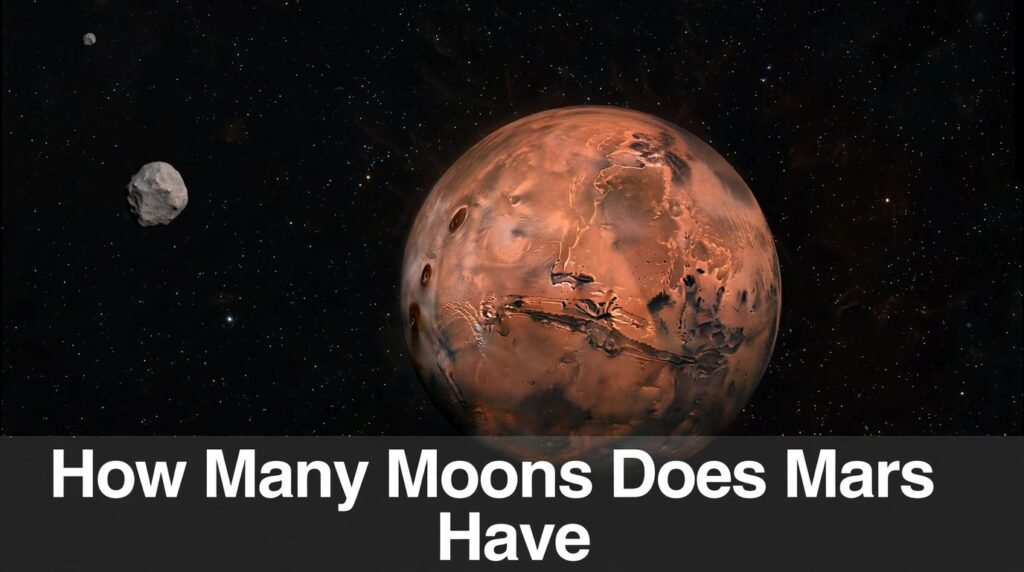
Look up at the night sky from Earth and you will see one bright, familiar Moon. Look up from Mars and the view is very different. There is no big, glowing disc lighting up the night. Instead, you would see two small, fast-moving specks — one racing across the sky in a matter of hours, the other drifting slowly like a distant star. If you have ever wondered how many moons does Mars have, the view from Mars is your first clue.
That is one of the first surprises about Mars. For a planet that feels so much like Earth in other ways — it has seasons, polar ice caps, volcanoes, canyons, and a day almost the same length as ours — its moons are nothing like ours. They are tiny, dark, lumpy, and oddly placed. And there are only two of them. That surprise is part of why so many people ask how many moons does Mars have.
So how many moons does Mars have, and why does it have so few? The answer is simple, but the story behind it is far more interesting.
The short answer: Mars has two moons — Phobos and Deimos. Phobos is the larger and closer of the two, about 22 km across. Deimos is smaller, about 12 km across, and orbits much farther away. Both were discovered in 1877 by American astronomer Asaph Hall.
How Many Moons Does Mars Have?
If you ask how many moons does Mars have, the answer is exactly two moons: Phobos and Deimos.
That number has not changed since they were discovered in 1877. Astronomers have searched carefully since then, using ground-based telescopes and spacecraft orbiting Mars, and no other moon has been found. If Mars had another moon of any real size, we would almost certainly have spotted it by now.
This makes Mars unusual, but not unique. Mercury and Venus have no moons at all. Earth has one. Mars has two. Then the numbers jump sharply as you move farther from the Sun — Jupiter has 95 confirmed moons, Saturn has more than 140, and even Uranus and Neptune have dozens each.
So Mars sits in a strange middle ground. It is not moonless, but it is a long way from the crowded systems of the gas giants.
Here is the quick picture:
- Phobos: The inner moon, larger, closer, and faster
- Deimos: The outer moon, smaller, farther away, and slower
- Total moons: 2
- Discovered: Both in August 1877
If you remember only one fact from this guide, make it this: two moons, both small, both irregular in shape, and both very different from Earth’s Moon.
Who Discovered Mars’s Moons?
Both moons were discovered by Asaph Hall, an astronomer working at the United States Naval Observatory in Washington, D.C. His discovery answered how many moons does Mars have for the first time.
Hall found Deimos first, on 12 August 1877, and Phobos a few days later, on 18 August 1877. The timing was no accident. Mars was making a particularly close approach to Earth that summer, which made it brighter and easier to observe in detail than usual.
Even then, the discovery was not easy. Mars itself is bright, and its glare can easily hide small objects sitting close to it. Hall had to look carefully, night after night, and use a large telescope to pick out the faint points of light moving around the planet.
He named them after the sons of Ares, the Greek god of war — fitting, since Mars is named after the Roman god of war. Phobos means fear or panic. Deimos means dread or terror. In Greek mythology, the two rode into battle with their father. The names suit two small moons circling a planet named for war.
Before 1877, some writers had guessed that Mars might have moons. Jonathan Swift, in Gulliver’s Travels in 1726, even described Mars as having two small moons, more than 150 years before they were actually found. That was a lucky guess, not a prediction based on evidence — but it has become one of the most famous coincidences in astronomy.
Phobos: The Larger, Closer Moon
Phobos is the star of the pair, if a 22-km lump of rock can be a star. It is the larger moon, the closer moon, and the one that does the most interesting things, and the first moon most people picture when they ask how many moons does Mars have.
How big is Phobos?
Phobos is about 22 km across at its widest point. That sounds big until you compare it with Earth’s Moon, which is about 3,474 km across. Phobos is less than one-hundredth the size.
You could drive across Phobos in less than half an hour, if you could drive on its surface. In fact, its whole surface area is smaller than many cities on Earth. It is not round. It is lumpy and potato-shaped, with a noticeably uneven surface.
Its most famous feature is Stickney, a huge crater about 9.5 km across — nearly half the width of the moon itself. The impact that made Stickney must have almost shattered Phobos. You can still see grooves and streaks running across its surface, probably caused by that same impact.
How close is Phobos to Mars?
Very close. Phobos orbits only about 6,000 km above the surface of Mars. That is closer than any other moon orbits its planet in the Solar System.
Because it is so close, it moves fast. Phobos completes one orbit around Mars in just 7 hours and 39 minutes. That is faster than Mars itself rotates. Mars takes about 24 hours and 37 minutes to spin once on its axis.
The result is strange. From the surface of Mars, Phobos rises in the west and sets in the east — the opposite direction to our Moon. And it crosses the sky so quickly that you could watch it rise and set twice in a single Martian day.
Why is Phobos slowly falling towards Mars?
Phobos is spiralling inward, very slowly, pulled by Mars’s gravity. It gets a little closer every year. The change is tiny on a human timescale — only a few centimetres per year — but over millions of years, it adds up.
In tens of millions of years, Phobos will get so close to Mars that the planet’s gravity will pull it apart. It will not crash into Mars in one piece. Instead, it is likely to break up and form a ring around the planet, much like Saturn’s rings, only fainter and made of rock.
That makes Phobos a moon with a deadline. It is not a permanent part of Mars’s sky.
Deimos: The Smaller, Farther Moon
Deimos is the quieter of the two moons. It is smaller, dimmer, farther away, and far less dramatic than Phobos — but it has its own charm. Together with Phobos, Deimos completes the answer to the question of how many moons does Mars have.
How big is Deimos?
Deimos is about 12 km across, roughly half the size of Phobos. Like Phobos, it is irregular in shape, dark, and covered in craters. Its surface is smoother than Phobos, though, with a thick layer of fine dust that has softened many of its craters over time.
If Phobos looks battered, Deimos looks worn down and dusty. It reflects very little sunlight, which is one reason it was so hard to spot from Earth.
How far away is Deimos?
Deimos orbits about 20,000 km above the surface of Mars — more than three times farther out than Phobos. It takes about 30 hours and 18 minutes to complete one orbit, which is longer than a Martian day.
From Mars, Deimos would look like a bright star, not a disc. It moves slowly across the sky, taking days to cross from one side to the other. It is easy to miss if you are not looking for it.
Deimos is also in a much safer position than Phobos. It is not spiralling inward. Its orbit is stable, and it is likely to stay where it is for a very long time.
Phobos vs Deimos: Side by Side — How Many Moons Does Mars Have in Total
The two moons look like a pair, but they behave very differently. This table puts the main facts together:
| Feature | Phobos | Deimos |
|---|---|---|
| Size | About 22 km across | About 12 km across |
| Distance from Mars | About 6,000 km above the surface | About 20,000 km above the surface |
| Time to orbit Mars | 7 hours 39 minutes | 30 hours 18 minutes |
| Discovered | 18 August 1877 | 12 August 1877 |
| Surface | Lumpy, cratered, with Stickney crater | Smoother, dust-covered, cratered |
| Future | Slowly spiralling inward, may break into a ring | Stable orbit, likely to stay put |
One way to think of them is this: Phobos is the restless inner moon, racing around Mars and slowly falling towards it. Deimos is the calm outer moon, keeping its distance and moving at a steady pace.
What Do Mars’s Moons Look Like?
Neither moon looks anything like Earth’s Moon. Once you know how many moons does Mars have, the next question is what those two moons look like up close.
Earth’s Moon is large, round, and bright. Its shape comes from its own gravity pulling it into a sphere. Phobos and Deimos are too small for that. Their gravity is too weak to smooth them out, so they keep the irregular, lumpy shapes they formed with.
Both are also very dark. Their surfaces are covered in dark, carbon-rich rock that reflects only a small amount of sunlight. From Earth, they are faint even through a good telescope, which is why they stayed hidden until 1877.
Close-up photos from spacecraft show a surface covered in craters, boulders, and dust. Phobos has clear grooves and chains of craters. Deimos is covered in a fine layer of dust, known as regolith, which is several metres thick in places. That dust has filled in many smaller craters, giving Deimos a softer look.
Neither moon has an atmosphere. There is no air, no weather, and no water on the surface. Standing on either one, you would see a dark, rocky landscape under a black sky, with huge Mars hanging overhead.
From Phobos, Mars would look enormous — filling a large part of the sky. From Deimos, it would look smaller, but still far larger than our Moon looks from Earth.
Where Did Phobos and Deimos Come From?
This is one of the biggest open questions about Mars’s moons, and astronomers still debate it.
There are two main ideas:
- They are captured asteroids. Phobos and Deimos look a lot like asteroids — small, dark, irregular, and rich in carbon. Mars’s gravity may have pulled them in from the nearby asteroid belt long ago and trapped them in orbit.
- They formed from debris around Mars. A large impact on Mars may have thrown material into orbit, which then clumped together to form the two moons. In this idea, they are made from Mars itself, not from passing asteroids.
Each idea explains some of the evidence, but neither explains all of it.
The captured-asteroid idea fits their appearance, but it is hard to explain how two asteroids ended up in such neat, near-circular orbits close to Mars’s equator. Captured objects usually end up in tilted, stretched-out orbits.
The impact idea fits their orbits better, but it is harder to explain why their surfaces look so much like asteroids and so little like Mars rock.
A third possibility is a mix of both — perhaps material from an impact mixed with captured material, or an early moon broke apart to form the two we see today.
Japan’s Martian Moons eXploration (MMX) mission, planned to visit Phobos and bring a sample back to Earth, should help settle this. A piece of Phobos in a laboratory on Earth would tell us directly what it is made of, and where it came from.
What Have Spacecraft Learned About Mars’s Moons?
We know far more about Phobos and Deimos now than Asaph Hall could have imagined, thanks to spacecraft that have flown past them or orbited Mars. Those spacecraft have also confirmed how many moons does Mars have, finding no others beyond Phobos and Deimos.
Early flybys in the 1960s and 1970s gave us our first close-up photos. Later orbiters — including NASA’s Mars Reconnaissance Orbiter and Mars Odyssey, and the European Space Agency’s Mars Express — have taken detailed images, mapped their surfaces, and measured their size, shape, and gravity.
Here is what those missions have taught us:
- Their exact shapes and sizes. We now have detailed 3D models of both moons, including the grooves on Phobos and the smooth, dusty plains on Deimos.
- Their composition. Both moons are dark and rich in carbon, similar to a type of asteroid called a C-type asteroid. They are not made of the same bright rock as Earth’s Moon.
- Their orbits are changing. Phobos is measurably moving closer to Mars. The change is small each year, but it is real, and it confirms the prediction that Phobos will eventually break apart.
- Their surfaces are ancient. Both moons are covered in craters from billions of years of impacts. They have not been resurfaced by volcanoes or weather, so their surfaces are a record of the early Solar System.
Rovers on the surface of Mars have also photographed the moons. NASA’s Curiosity and Perseverance rovers have caught Phobos passing in front of the Sun — a tiny, lumpy eclipse — and have taken pictures of both moons in the Martian night sky.
These images remind us that Phobos and Deimos are not just points of light in a telescope. They are real places, with craters, boulders, and dust, and we are slowly learning their history.
What Will Happen to Phobos?
Phobos has a dramatic future ahead of it.
As it spirals inward, Mars’s gravity will pull harder and harder on it. The side of Phobos facing Mars will feel a stronger pull than the far side. That stretching force is called a tidal force, and it will grow as Phobos gets closer.
In about 30 to 50 million years, Phobos will reach a point known as the Roche limit — the distance at which Mars’s gravity will be stronger than the forces holding Phobos together. At that point, Phobos will start to break apart.
It will not fall to Mars in one piece. Instead, it will crumble into a ring of dust and rock circling the planet. That ring may last for millions of years before the material slowly falls onto Mars or drifts away.
Mars will then have only one moon — Deimos — until, perhaps, a new moon forms from the ring material, or another asteroid is captured. Until then, how many moons does Mars have will remain two.
It is a strange thought: Mars once had two moons, then for a time it will have a ring like Saturn, and then it may have only one moon left. The Solar System is not fixed. It changes, slowly, over timescales that are hard for us to imagine.
Deimos, by contrast, has no such drama ahead. It will keep orbiting quietly, far from Mars, for the foreseeable future.
Why Does Mars Have Only Two Moons? How Many Moons Does Mars Have and Why So Few
Why two, and not twenty, or none at all? The answer comes down to size, position, and history.
Mars is small
Mars is about half the size of Earth and has much weaker gravity. It simply cannot hold onto as many moons as Jupiter or Saturn. A small planet has a smaller region where moons can orbit safely without being pulled away by the Sun or another planet.
Mars is close to the asteroid belt, but not in it
Mars sits just inside the asteroid belt, the ring of rocky debris between Mars and Jupiter. That means asteroids pass nearby, and Mars can sometimes capture one. But captures are rare and hard to keep. Most passing asteroids fly straight past.
Jupiter and Saturn had a different start
Jupiter and Saturn are gas giants. They formed with huge discs of gas and dust around them, and many small moons formed in those discs. They also have enormous gravity, so they could capture many passing objects and keep them. Mars never had that kind of disc, or that kind of gravity.
The table below shows how different the picture is across the planets:
| Planet | Number of confirmed moons | Largest moon |
|---|---|---|
| Mercury | 0 | — |
| Venus | 0 | — |
| Earth | 1 | The Moon |
| Mars | 2 | Phobos |
| Jupiter | 95 | Ganymede |
| Saturn | 146 | Titan |
Mars, in other words, is closer to Earth than to Jupiter in how its moon system works. It has a small, simple system, not a crowded family.
Can You See Mars’s Moons From Earth?
Yes, but it is not easy — and you will need a good telescope.
Phobos and Deimos are faint and sit very close to bright Mars, which makes them hard to separate in the glare. The best time to try is when Mars is at opposition — when Earth passes between Mars and the Sun, and Mars is at its closest and brightest. That happens roughly every 26 months.
Even then, you will need:
- A telescope with at least 150–200 mm of aperture
- Steady, clear skies with little turbulence
- Mars high in the sky, away from the horizon haze
- Patience — and a way to block out some of Mars’s glare
Photographers often take a short exposure of Mars itself, then a longer exposure to bring out the moons, and combine the two images. Visually, Deimos is usually the easier of the two to spot, because it sits farther from Mars’s glare. Phobos is brighter, but it hides closer to the planet.
From a dark site with a good telescope, seeing Phobos or Deimos for yourself is a real achievement. You are looking at the same two small worlds that Asaph Hall first picked out in 1877. Seeing one of them for yourself is the best way to remember how many moons does Mars have.
Frequently Asked Questions
How many moons does Mars have?
When asked how many moons does Mars have, the answer is two: Phobos and Deimos. No other moons have been found around Mars, despite careful searches by telescopes and spacecraft.
Which is the biggest moon of Mars?
Phobos is the biggest moon of Mars. It is about 22 km across, roughly twice the size of Deimos, which is about 12 km across. Both are tiny compared with Earth’s Moon.
Who discovered the moons of Mars?
American astronomer Asaph Hall discovered both moons in August 1877. He found Deimos on 12 August and Phobos on 18 August, using a telescope at the United States Naval Observatory.
Is Phobos going to crash into Mars?
Not in one piece. Phobos is slowly spiralling inward, and in tens of millions of years it is likely to break apart under Mars’s gravity and form a ring around the planet, rather than crashing down as a single body.
Why is Mars’s moon called Phobos?
Phobos is named after the Greek god Phobos, son of Ares, the god of war, and means fear or panic. Deimos, his brother, means dread. The names fit the planet Mars, named after the Roman god of war.
Can humans land on Phobos or Deimos?
No human has visited either moon yet, but both are considered possible targets for future missions. Their low gravity would make landing and taking off easier than on Mars itself, and Phobos in particular could serve as a base for exploring Mars from orbit.
Why does Mars have only two moons while Jupiter has 95?
Mars is much smaller than Jupiter, with much weaker gravity, so it can hold onto fewer moons. Jupiter and Saturn also formed with large discs of material around them, which produced many moons, while Mars did not. That is why the answer to how many moons does Mars have is only two, while Jupiter has 95.
Conclusion
So how many moons does Mars have? Mars has two moons — Phobos and Deimos — and that simple fact hides a lot of history.
Phobos, the larger, closer moon, races around Mars in less than eight hours and is slowly falling towards the planet. One day, in tens of millions of years, it will break apart and become a ring. Deimos, the smaller, farther moon, drifts quietly in a stable orbit and will likely outlast its companion by a long time.
Both were found in 1877 by Asaph Hall, both are dark, lumpy, and irregular, and both still hold secrets about where they came from. Were they captured asteroids, or were they born from Mars itself after a giant impact? Future missions, especially a sample return from Phobos, may finally give us the answer.
For now, Mars remains a planet with a small, strange, and temporary moon system — two tiny worlds circling a red planet, one racing towards its end and one keeping its distance. That is what makes them worth knowing about, and worth watching. That is why the question of how many moons does Mars have continues to fascinate astronomers and stargazers alike.
Read Also: Types of Stars Explained: Dwarfs, Giants and More
1 Comment