
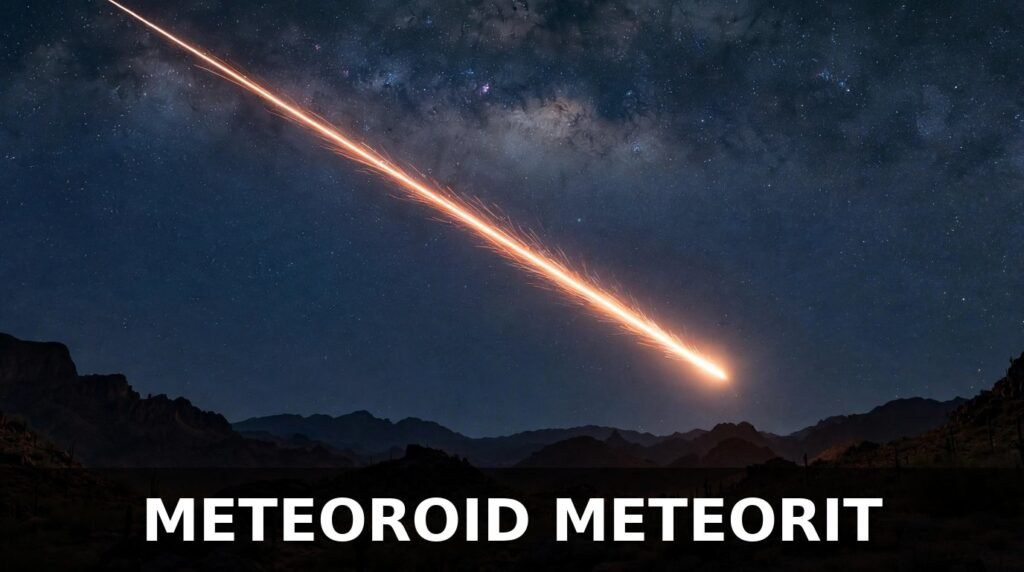
On a clear night, a streak of light crosses the sky and is gone in a second. Most people call it a shooting star. Astronomers call it a meteor. But the story of that flash of light starts long before it reaches our sky, and in rare cases it does not end when the light fades. The object that made it began its journey as a meteoroid, a small piece of rock or metal drifting through space. If it survives the violent trip through our atmosphere and lands on the ground, it earns a third name: a meteorite. That flash is the start of the meteoroid meteorit story.
That is the simple version. The full picture is more interesting, because these three words describe one object at three different stages of its life, and each stage tells us something different about the Solar System. The phrase “meteoroid meteorit” shows up in searches for exactly this reason: people want to know what a meteoroid is, what a meteorite is, and how the two are connected. You may also come across the spelling “meteorit” on its own. That is simply the German word for a meteorite, and German museums and collectors use it often, which is why the term appears in search results around the world.
This meteoroid meteorit guide explains each term in plain language, compares them side by side, looks at where meteoroids come from, walks through the main types of meteorites, and retells the most famous falls in history, from the fireball over Chelyabinsk to the giant iron mass sitting in a Namibian field. By the end, you will know how to tell a meteorite from an ordinary rock, and why scientists treasure these visitors from space.
The short answer: A meteoroid is a small rock or piece of metal travelling through space. When it hits Earth’s atmosphere and burns up, the streak of light it makes is called a meteor. If any part of it survives the fall and reaches the ground, that piece is called a meteorite. Same object, three names, three stages.
What Is a Meteoroid?
A meteoroid is a small solid object moving through interplanetary space. It is bigger than a speck of dust and smaller than an asteroid. Most meteoroids are between the size of a grain of sand and about a metre across, and they are made of rock, metal, or a mix of the two.
Think of meteoroids as the Solar System’s leftover rubble. They are fragments chipped off asteroids in collisions, dust and pebbles shed by comets, and chips knocked off the Moon and Mars by ancient impacts. There are countless billions of them drifting between the planets, most of them far too small ever to be seen. They only become visible when one of them crosses Earth’s path. They are the raw material of the meteoroid meteorit story.
A meteoroid does nothing spectacular while it is in space. It drifts silently in the dark, sometimes for billions of years, on an orbit around the Sun. Nothing about it glows or shines. It only becomes a spectacle when Earth’s gravity pulls it into our atmosphere at tremendous speed.
One thing that surprises people is how small most meteoroids are. A particle the size of a grain of sand can produce a bright shooting star. The ones that make the news are the exception. A meteoroid the size of a football is already a rare and dangerous visitor, and one the size of a house is a once-in-a-century event. That range is why the meteoroid meteorit story covers everything from dust to house-sized rocks.
What Is a Meteor?
A meteor is not an object at all. It is the streak of light produced when a meteoroid slams into Earth’s atmosphere. The word describes the event, the flash in the sky, rather than the rock itself.
When a meteoroid enters the atmosphere, it is travelling at somewhere between 11 and 72 kilometres per second. At that speed, the air in front of it cannot get out of the way fast enough. The air is compressed, heated to thousands of degrees, and the surface of the rock begins to vaporise. The glowing trail you see is mostly heated air and vaporised rock, not the rock burning like a piece of wood.
Most meteors appear about 80 to 100 kilometres above the ground and burn out completely within a second or two. That is why shooting stars vanish so quickly. The meteoroid never reaches the ground. It is gone, turned into dust and gas high above your head.
On any clear, dark night away from city lights, you can expect to see a few meteors every hour. During a meteor shower, when Earth passes through a dense trail of comet debris, that number can climb into the dozens or even hundreds per hour. The Perseids in mid-August and the Geminids in mid-December are the most reliable shows of the year. Each one is a small chapter in the meteoroid meteorit story.
A particularly bright meteor is called a fireball. If it is bright enough to cast shadows or be seen in daylight, astronomers call it a bolide. The fireball over Chelyabinsk in 2013 was a superbolide, bright enough to be seen in broad daylight and powerful enough to damage buildings. That daylight fireball is a famous example in the meteoroid meteorit story.
What Is a Meteorite?
A meteorite is what is left when a meteoroid survives its passage through the atmosphere and lands on the ground. It is the same object, renamed for its new home on Earth’s surface. It is the final stage of the meteoroid meteorit journey.
Survival is rare. Most meteoroids burn up completely. To become a meteorite, a rock has to be large enough, tough enough, and slow enough that part of it is still solid when it stops falling. The outside melts during the fiery descent, forming a thin, dark, glassy coating called a fusion crust. Inside, the rock is usually untouched, which is exactly why scientists value meteorites so much: the interior is a pristine sample of the early Solar System, delivered free of charge.
Meteorites are found in two ways. A “fall” is a meteorite seen falling and recovered soon afterwards, sometimes within hours. A “find” is a meteorite discovered long after it landed, often by someone who had no idea what it was. Deserts and the ice fields of Antarctica are the best hunting grounds, because a dark rock stands out clearly against pale sand or white ice, and the dry conditions preserve it.
Once a meteorite has been on Earth for a while, weather starts to change it. Iron meteorites rust. Stony ones crack and crumble. That is why a fresh fall is worth far more to science than a rock that has sat in a field for a thousand years. Collectors and researchers both want the freshest material they can get.
Meteoroid vs Meteor vs Meteorite: The Difference at a Glance
The three words confuse people because they sound alike and describe the same object. The difference is simply where the object is and what it is doing. This meteoroid meteorit table makes it easy to keep them straight.
| Term | Where it is | What it means |
|---|---|---|
| Meteoroid | In space | A small rock or metal fragment drifting between the planets |
| Meteor | In the atmosphere | The streak of light made when a meteoroid burns up in the sky |
| Meteorite | On the ground | The surviving piece of a meteoroid that lands on Earth |
A helpful way to remember it is to think of a journey. The meteoroid is the traveller in space. The meteor is the dramatic arrival, the flash of light as it hits the atmosphere. The meteorite is what is left standing on the ground after the journey ends.
There is one more related term worth knowing. An asteroid is a much larger rocky body, generally anything bigger than about a metre across, orbiting the Sun. The line between a large meteoroid and a small asteroid is blurry, and astronomers argue about exactly where to draw it. In practice, if it is big enough to track with a telescope and give a name to, it is usually called an asteroid. If it is small rubble, it is a meteoroid.
Where Do Meteoroids Come From?
Meteoroids have three main sources, and each one tells a different story about the Solar System. Each one adds a chapter to the meteoroid meteorit story.
Fragments of asteroids
Most meteoroids are chips knocked off asteroids when they collide with each other. The asteroid belt between Mars and Jupiter is a crowded place, and over billions of years, countless collisions have shattered larger bodies into smaller pieces. Some of those pieces drift into orbits that cross Earth’s path. Stony and iron meteorites mostly come from this source, and they are fragments of asteroids that never grew into planets. Those chips are the main source of the meteoroid meteorit material that reaches Earth.
Dust and pebbles from comets
Comets shed dust and small stones every time they swing close to the Sun and their ice begins to vaporise. That debris spreads out along the comet’s orbit like a river of gravel. When Earth passes through one of these debris streams, the result is a meteor shower. The Perseid meteors of August come from Comet Swift-Tuttle, the Leonids of November come from Comet Tempel-Tuttle, and the Geminids of December come from an odd rocky object called 3200 Phaethon, which behaves like an asteroid but sheds dust like a comet. That debris stream is a classic meteoroid meteorit source.
Rocks blasted off the Moon and Mars
Every so often, a large impact on the Moon or Mars throws rocks into space with enough force to escape that world entirely. Some of those rocks eventually fall to Earth as meteorites. Scientists have identified hundreds of meteorites that came from the Moon and Mars, and they are among the most valuable rocks in the world. A Martian meteorite is a free sample-return mission: a piece of another planet that arrived here on its own. Studying these rocks is how we learned that Mars once had liquid water on its surface, long before any rover landed there. Those rocks are a rare part of the meteoroid meteorit story.
The Main Types of Meteorites
Not all meteorites are alike. In this meteoroid meteorit guide, scientists sort them into three broad families, based on what they are made of.
| Type | What it is made of | Share of observed falls |
|---|---|---|
| Stony meteorites | Mostly silicate rock, similar to Earth’s crust | About 94% |
| Iron meteorites | Almost entirely iron and nickel metal | About 5% |
| Stony-iron meteorites | A mix of rock and metal in roughly equal parts | About 1% |
Stony meteorites
Stony meteorites are the most common kind to fall, and they split into two groups. Chondrites are the most primitive rocks known to science. They contain tiny round grains called chondrules, droplets of molten rock that formed in the solar nebula more than 4.5 billion years ago, before the planets existed.
Holding a chondrite is holding material older than Earth itself. Achondrites are stony meteorites that have been melted and reformed, usually on a larger body like the Moon, Mars, or a big asteroid. They look more like volcanic rocks from Earth.
Iron meteorites
Iron meteorites are chunks of metal, mostly iron with some nickel mixed in. They come from the cores of asteroids that were large enough to melt early in their history, letting heavy metal sink to the centre. When those asteroids were later smashed apart, their cores were exposed as fragments of solid metal.
Iron meteorites are heavy, magnetic, and often show a beautiful crystalline pattern called a Widmanstätten pattern when they are cut and etched with acid. That pattern can only form when metal cools incredibly slowly, over millions of years, deep inside an asteroid. It cannot be faked.
Stony-iron meteorites
Stony-iron meteorites are the rarest and, to many collectors, the most beautiful. They contain crystals of the green mineral olivine set in a matrix of iron-nickel metal, like jewels in a metal setting. The best-known variety is called a pallasite, and a polished slice of one looks more like jewellery than a rock. Pallasites are thought to come from the boundary between the core and the mantle of a shattered asteroid, where metal and rock met. That mix makes the meteoroid meteorit family easy to recognise.
How a Meteoroid Becomes a Meteorite
The journey from space rock to museum specimen is violent and fast. It takes only a few seconds, and most meteoroids do not survive it. That is the meteoroid meteorit journey in a few seconds.
First comes the fiery entry. The meteoroid hits the top of the atmosphere at tens of kilometres per second. Air pressure builds up in front of it, temperatures soar, and the outer layers melt and peel away in a process called ablation. The glowing trail we see as a meteor is this stage. A typical meteoroid loses most of its mass in these few seconds.
Then comes the slowdown. As the rock gets lower, the thicker air brakes it hard. The light fades, usually at an altitude of 20 to 30 kilometres, and the rock enters what scientists call dark flight. It is no longer glowing. It is simply falling, cooling as it drops, and the wind pushes it sideways from its original path. This is why the place where meteorites land, the strewn field, can be several kilometres long and offset from the direction the fireball was travelling. That drift is part of the meteoroid meteorit landing.
Finally comes the landing. A meteorite usually hits the ground at a few hundred kilometres per hour, fast enough to bury itself in soft ground or shatter on rock, but far slower than its entry speed. Large ones can leave a small pit. Small ones may simply sit on the surface, dark and unremarkable, waiting to be found.
Whether a meteoroid survives depends on its size, its speed, its angle of entry, and what it is made of. Iron meteoroids are tougher than stony ones. A steep entry burns up faster but spends less time in the atmosphere. A shallow entry can skip back into space like a stone skipping across water. Most of the time, the answer is that nothing survives, which makes every meteorite on Earth a survivor of a journey that kills nearly all of its kind.
Famous Meteorite Falls and Events
A few falls are so dramatic or so scientifically important that they have become landmarks in astronomy. These are the ones worth knowing.
Chelyabinsk, Russia, 2013
On the morning of 15 February 2013, a rock about 19 metres across and weighing roughly 12,000 to 13,000 tonnes entered the atmosphere over Russia at about 19 kilometres per second. It exploded about 30 kilometres above the city of Chelyabinsk with the energy of around 500 kilotons of TNT, roughly 30 times the bomb dropped on Hiroshima. The flash was brighter than the Sun.
The shockwave that followed shattered windows across six cities, damaged more than 7,200 buildings, and injured about 1,500 people, almost all of them cut by flying glass. There were no deaths. The largest recovered fragment, a 654-kilogram stone pulled from the frozen Lake Chebarkul, was an ordinary chondrite, a common type of stony meteorite. Chelyabinsk was a wake-up call: it was the largest object to enter Earth’s atmosphere since 1908, and nobody had seen it coming, because it approached from the direction of the Sun.
Tunguska, Siberia, 1908
On 30 June 1908, something exploded over a remote forest near the Tunguska River in Siberia. The blast flattened around 80 million trees across roughly 2,150 square kilometres and released energy estimated at about 15 megatons of TNT. No crater was ever found, and no meteorite fragments were ever recovered, which tells scientists the object, probably a stony asteroid or comet fragment about 50 metres across, exploded in the air 5 to 10 kilometres above the ground.
Tunguska is the benchmark for what a medium-sized impactor can do, and it is the reason astronomers take the search for near-Earth objects seriously. The area was so remote that the wider world did not hear a full account of it for nearly two decades.
Hoba, Namibia
The largest known meteorite on Earth sits where it fell, in a field in Namibia, because it is far too heavy to move. Hoba is a slab of iron-nickel metal weighing about 60 tonnes, and it was discovered in 1920 by a farmer ploughing his field. It fell long before recorded history, perhaps 80,000 years ago, and its flat shape and shallow entry angle meant it slowed down gently and landed without digging a crater. Today it is a national monument, and visitors can walk up and touch a piece of an asteroid’s core. It is the largest meteoroid meteorit survivor on Earth.
Allende, Mexico, 1969
On 8 February 1969, a brilliant fireball exploded over the Mexican state of Chihuahua, scattering tonnes of black stones across a huge area. The Allende meteorite is a carbonaceous chondrite, a rare type rich in carbon and organic compounds, and it contains calcium-aluminium-rich inclusions dated to 4.567 billion years old, the oldest solid material ever dated in the Solar System.
Allende gave scientists their first good look at the raw ingredients the planets formed from, and it remains one of the most studied meteorites in history.
Murchison, Australia, 1969
Seven months after Allende, on 28 September 1969, another carbonaceous chondrite fell near the town of Murchison in Victoria, Australia. The Murchison meteorite became famous for a different reason: it contains dozens of amino acids, the building blocks of proteins, including several not found in life on Earth. That discovery showed that the ingredients of life can form in space and be delivered to planets by meteorites, and it is still cited in debates about how life began on Earth.
Chicxulub, Mexico, 66 million years ago
The most consequential impact in Earth’s history left no eyewitnesses, because it happened about 66 million years ago. An asteroid roughly 10 to 12 kilometres across struck the Yucatan Peninsula in Mexico, carving out a crater about 180 kilometres wide.
The impact threw dust and sulphur into the atmosphere, blocked sunlight, and triggered the mass extinction that ended the reign of the dinosaurs and cleared the way for mammals. The crater, named Chicxulub, was only confirmed in the 1990s, when geologists matched a layer of iridium-rich clay found all over the world to the buried impact structure. It is a reminder that meteoroids and asteroids are not just a curiosity. They have shaped the history of life on Earth.
How to Tell a Meteorite from an Ordinary Rock
People find strange dark rocks and wonder whether they have a meteorite. Most of the time, the answer is no. But meteorites do have a set of clues that set them apart, and knowing them saves a lot of false excitement. Knowing the meteoroid meteorit clues is a good place to start.
A fresh meteorite usually has a dark fusion crust, a thin, smooth, almost black coating formed when the surface melted during entry. Under the crust, the inside is usually lighter in colour. The rock often feels heavier than an ordinary stone of the same size, because iron meteorites and many stony ones are dense. A magnet will usually stick to it, or at least be attracted to it, because most meteorites contain iron-nickel metal. The surface may show shallow, thumbprint-like dents called regmaglypts, left by the airflow during entry.
There are also things a real meteorite is not. It is not full of holes like a sponge, it does not have shiny quartz crystals, and it is not light and glassy like slag from a furnace. Slag, the waste from iron smelting, is the most common impostor. It is full of bubbles, often brightly coloured, and it is magnetic, which fools a lot of people. That test helps sort a real meteoroid meteorit find from slag.
If you think you have found one, the honest advice is to take clear photos, note exactly where you found it, and contact a local university geology department or natural history museum. They can test it properly. Do not cut it open, wash it in acid, or try to clean it aggressively, because that can destroy the very features scientists use to identify it.
Why Meteorites Matter to Science
Meteorites are the cheapest space missions ever flown, and in some ways the most valuable. A spacecraft sample-return mission costs billions and brings back grams of material. Meteorites arrive on their own, and museums hold tens of thousands of them.
They matter for three big reasons. First, they are time capsules. Chondrites contain material that has barely changed since the Solar System formed 4.567 billion years ago, so they tell us what the Sun’s raw ingredients were.
Second, they are the only direct samples we have of most of the Solar System’s bodies. We have never visited an asteroid’s core, but iron meteorites are pieces of one. Third, they carry the chemistry of life’s beginnings. The amino acids in Murchison and the water locked inside some carbonaceous chondrites suggest that meteorites may have helped deliver water and organic molecules to the young Earth.
Planetary defence is the practical side. Chelyabinsk showed that a rock only 19 metres across can injure more than a thousand people. Telescopes now scan the sky for larger near-Earth objects, and space agencies have begun testing ways to deflect one, most famously with NASA’s DART mission, which successfully nudged an asteroid in 2022. The more we learn from meteorites about what these objects are made of, the better we can predict how one would behave if we ever needed to push it aside. That work depends on understanding the meteoroid meteorit material.
Frequently Asked Questions
What is the difference between a meteoroid and a meteorite?
A meteoroid is a small rock or metal fragment travelling through space. A meteorite is the same kind of object after it has survived entry through Earth’s atmosphere and landed on the ground. The word meteor, meanwhile, describes the streak of light the object makes while it burns up in the atmosphere. Meteoroid is the object in space, meteor is the light in the sky, meteorite is the rock on the ground. That is the meteoroid meteorit difference in one sentence.
What does “meteoroid meteorit” mean?
“Meteorit” is the German word for a meteorite. It appears in searches because German museums, collectors, and researchers use it in catalogues and articles, and search engines surface those pages worldwide. In English, the correct term is meteorite. Searches for meteoroid meteorit often lead to those German catalogues and articles.
How big is a meteoroid?
Most meteoroids are tiny, from dust-grain size up to about a metre across. A grain of sand can make a visible shooting star. Meteoroids larger than a metre are usually classed as asteroids. The Chelyabinsk object, at about 19 metres across, was exceptionally large, and objects of that size hit Earth only about once a century.
How often do meteorites hit Earth?
Small meteorites land somewhere on Earth every day, but most fall into the oceans or onto empty land and are never found. Tens of tonnes of cosmic dust and small debris reach Earth daily, but the vast majority of it is dust too small to notice. A fall large enough to be seen and recovered is rare, and scientists estimate only a handful of significant meteorite falls are recovered each year.
Can a meteorite hurt you?
A direct hit by a meteorite is extremely unlikely, and no person in recorded history is confirmed to have been killed by one. The real danger comes from the airburst of a larger object, like Chelyabinsk in 2013, where the shockwave injured about 1,500 people, or Tunguska in 1908, which flattened a forest. Those events are rare, happening on a scale of decades to centuries.
Are meteorites worth money?
Some are, but most are not. A common stony meteorite might be worth a few dollars per gram, while rare types, fresh falls, and Martian or lunar meteorites can be worth far more. Value depends on type, rarity, condition, and whether the fall was witnessed. If you find a suspected meteorite, have it identified by experts before assuming it has value, and check local laws, because in some countries meteorites belong to the state or the landowner.
What should I do if I see a bright fireball?
Enjoy it, and if you can, note the time, direction, and how long it lasted. If you think pieces may have fallen nearby, do not go searching on private land without permission. Bright fireball reports can be sent to meteor observation networks, which use them to calculate where fragments may have landed. A daylight fireball bright enough to be noticed is rare and worth reporting.
Final Thoughts
Meteoroid, meteor, and meteorite are not three different things. They are three chapters of one story: a small piece of the Solar System drifting through space, flaring briefly as it meets our atmosphere, and sometimes surviving to rest on the ground as a rock older than the Earth itself. That meteoroid meteorit story connects shooting stars on a summer night to the extinction of the dinosaurs, the water in our oceans, and the building blocks of life.
The next time you see a meteor, you will know what you are looking at. It is a meteoroid burning up, and on very rare nights, a piece of it will make it all the way down. If it does, it will be one of the oldest things you will ever touch.
Read Also: How Many Moons Does Mars Have? (2026 Guide)
1 Comment