
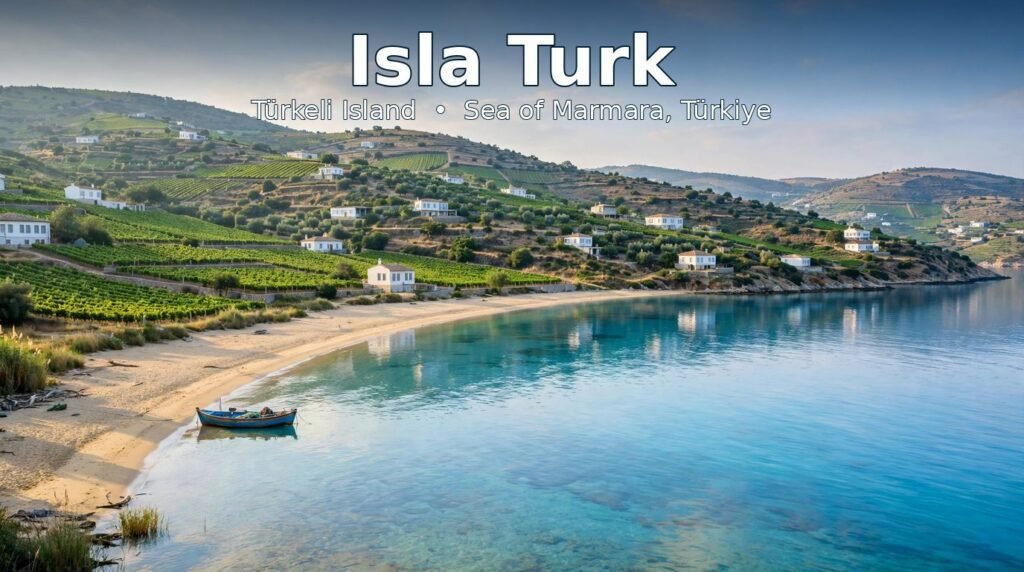
If you have ever typed “isla turk” into a search box, you probably already know the feeling: the results are a mix of Turkish islands, travel guides and place names that almost — but never quite — match what you typed. The phrase itself is a small puzzle. “Isla” is the Spanish word for island, and “Turk” points at Türkiye. Put together, people use it to mean a Turkish island, and the island they almost always mean is Türkeli Island, the place most maps today call Avşa.
It is a fair question to ask, because the island has had more names than most places its size. Over the centuries it has been Aphousia, Türkeli and Avşa, and each name belongs to a different chapter of its history. The island itself, though, has barely changed: a low, green island in the southern Sea of Marmara, ringed by sandy beaches, covered in vineyards, and close enough to Istanbul that thousands of people cross the water to it every summer weekend.
This guide sorts out the name, the location and everything worth knowing before you go — the history, the beaches, the wine, the ferries, and the best time to visit.
The short answer: Isla Turk is Türkeli Island, known today as Avşa Island, in the southern Sea of Marmara, Türkiye. It belongs to Balıkesir Province, covers about 20.6 square kilometres, and is a popular summer island reached by ferry from Istanbul, Tekirdağ, Erdek and Bandırma.
What Does “Isla Turk” Mean?
The phrase “isla turk” is not an official name you will find on a map of Türkiye. It is a search phrase, and like a lot of search phrases it is a mix of two languages. “Isla” is Spanish for island, and “Turk” is the English shorthand for Turkish. Someone typing it is usually a Spanish speaker — or someone thinking in Spanish — looking for an island in Türkiye.
That matters, because the answer depends on which island the searcher has in mind. Türkiye has around 500 islands and islets, scattered across the Aegean Sea, the Mediterranean Sea, the Sea of Marmara and the Black Sea, as well as in its lakes. Most of them are tiny, uninhabited rocks. Only a handful are places people actually visit, and of those, the one whose old name matches “Turk” most directly is Türkeli Island.
Türkeli literally means “Turkish land” or “land of the Turks” in Turkish, and it was the island’s name for a long part of its modern history. Today the same island is officially called Avşa, and that is the name you will see on ferry timetables, road signs and hotel bookings. But the old name has not disappeared. Travel writers still mention it, older maps still carry it, and people still search for it — which is how a phrase like “isla turk” keeps turning up.
So when this article talks about Isla Turk, it means Türkeli Island, also known as Avşa Island. If you were looking for a different Turkish island, the comparison near the end of this guide should help you tell them apart.
Where Is Isla Turk Located?
Isla Turk sits in the southern part of the Sea of Marmara, the inland sea that separates the European and Asian sides of Türkiye and connects the Black Sea to the Aegean through the Bosphorus and the Dardanelles. It is in the north-west of the country, in Balıkesir Province, and it belongs to the Marmara District of that province.
Its neighbours give you a good sense of the map. The island of Marmara — the largest island in the Sea of Marmara, and the one the sea is named after — lies to the north. The Kapıdağ Peninsula is to the south, on the mainland. The island of Paşalimanı sits to the east. And Istanbul, the city most visitors start from, is a ferry ride away to the north-east.
The location is the whole point of the island’s popularity. It is close enough to Istanbul to be a weekend trip, but far enough out in the Marmara that the water is clean, the beaches are sandy, and the pace slows right down. That combination — easy to reach, easy to relax on — is why the island fills up every summer.
| Fact | Detail |
|---|---|
| Current name | Avşa Island (Avşa Adası) |
| Historic name | Türkeli Island |
| Ancient name | Aphousia |
| Sea | Southern Sea of Marmara |
| Province | Balıkesir, Marmara District |
| Area | About 20.6 square kilometres |
| Neighbouring islands | Marmara Island to the north, Paşalimanı to the east |
| Nearest mainland | Kapıdağ Peninsula to the south |
Isla Turk or Avşa — Which Name Is Correct?
Both names are correct, but they belong to different eras, and using the right one at the right time will save you confusion.
Avşa is the current, official name. It is the name on the ferry tickets, the name the locals use, and the name you should search for when you are booking a trip. If you ask for a ferry to Türkeli at the Istanbul docks, you may well be understood — but you may also get a blank look from a younger ticket seller who has only ever known the island as Avşa.
Türkeli is the historic name, and it is the one that explains the “Turk” in “isla turk”. The island was called Türkeli for much of its modern history, and the name still appears in older guidebooks, older maps and plenty of travel writing. It is not wrong; it is simply the island’s former name, kept alive the way old names often are.
Before either of those, in the classical and Byzantine periods, the island was known as Aphousia. It was a place of exile during the Byzantine era — a remote spot where people were sent away from the capital — and the tomb of St. Macarius of Pelecete, a Byzantine saint, was on the island. That is a long way from a summer beach destination, and it is a useful reminder that this small island has been inhabited, fought over and renamed for a very long time.
The practical rule is simple. Use Avşa when you are travelling, booking or asking directions. Use Türkeli — and understand “isla turk” — when you are reading about the island’s history or searching in Spanish.
A Short History of Türkeli Island
The island’s history is longer and more mixed than its size suggests. People have lived on it since ancient times, drawn by the same things that draw visitors today: a sheltered position in the Marmara, good fishing, and land that grows vines and olives well.
In the classical and Byzantine world it was Aphousia, and it served at times as a place of exile. Exile islands were a feature of Byzantine politics — inconvenient people were sent to quiet islands where they could cause no trouble — and Aphousia was one of them. The tomb of St. Macarius of Pelecete stood on the island, which tells you it also had a religious life of its own.
The island’s population changed completely in the twentieth century. Until the population exchange of 1923 between Greece and Türkiye, its inhabitants were Greek. After the exchange, the Greek residents left for Greece — many settling in Sarti, in Chalkidiki — and Turkish settlers arrived in their place. That exchange redrew the island’s identity, and the name Türkeli, “land of the Turks”, fits that chapter of its story.
In the decades since, the island has reinvented itself again, this time as a holiday place. Its permanent population is small, around 2,000 people, but in the summer season that number swells enormously. Estimates put the summer crowd at forty to fifty thousand visitors, drawn by the beaches, the wine and the short hop from Istanbul. The old stone houses, the monastery and the vineyards are still there, but the island’s economy now runs on the summer.
How Big Is Isla Turk?
Isla Turk is a small island by any measure. It covers about 20.6 square kilometres, which is roughly 8 square miles. To put that in perspective, it is less than a tenth of the size of Gökçeada, Türkiye’s largest island, which covers about 297 square kilometres. It is also smaller than its neighbour Marmara Island, which is the largest island in the Sea of Marmara.
The island’s shape is low and rolling rather than mountainous. There are hills, vineyards and olive groves, rocky cliffs and hidden coves around the edges, and long sandy beaches where the ground flattens out toward the sea. Nothing on the island is a long walk from anything else, which is part of its charm — you can cross it on foot or by bicycle, and most visitors do exactly that.
The small size has a practical consequence for visitors: the island never feels empty, but it never feels overwhelming either. In winter it is quiet, with just its couple of thousand residents. In summer it is busy, with tens of thousands of visitors sharing twenty square kilometres of beaches, streets and vineyards. If you want space to yourself, that is worth knowing before you pick your dates.
What Is the Island Known For?
Ask someone who has been to Avşa what the island is known for, and you will get the same three answers almost every time: beaches, wine and a lively summer atmosphere.
The beaches are the main draw. The island is known for its long sandy beaches and clear water, which is unusual enough in the Sea of Marmara to be worth noting. The water is calm and shallow in the main bays, which makes it popular with families, and the sand is soft rather than the pebble beaches you find on many Aegean islands. Swimming, sunbathing and water sports fill most days in the summer.
The wine is the second draw, and it is the older one. The island has grown grapes for a very long time, and its vineyards are part of the landscape — rows of green vines running up the hillsides behind the beaches. Locally produced wine is one of the island’s signatures, and the vineyards themselves are one of the prettiest sights on the island, especially in the late afternoon when the light turns the rows gold. Wine tasting and buying directly from local producers is one of the quieter pleasures of a visit, and it is very different from the beach crowds.
The third thing is the atmosphere. In summer the island is lively: restaurants and cafés along the waterfront, music in the evenings, and a holiday crowd that is mostly Turkish families and young people from Istanbul. It is not a party island in the way some Mediterranean resorts are, but it is not a sleepy hideaway either. It sits somewhere in between, and that balance is exactly what its regular visitors come back for.
The island’s most important historic landmark is the Monastery of the Virgin Mary, known locally as the Meryem Ana Monastery, in the Manastır district. It is a reminder of the island’s Greek and Byzantine past, and it is worth a visit even if old buildings are not usually your thing — the setting, on the hills above the sea, is lovely on its own.
How to Get to Isla Turk
There is only one way to reach Isla Turk: by sea. The island has no bridge, no airport and no causeway, and that is a deliberate part of its appeal. You get there by ferry or fast catamaran, and the crossing is part of the trip.
Ferries run to the island from Istanbul, and from the mainland ports of Tekirdağ, Erdek and Bandırma. The Istanbul crossing is the one most visitors use, and it is a straightforward trip across the southern Marmara. Tekirdağ, on the European shore west of Istanbul, is another common starting point, while Erdek and Bandırma on the southern shore are the natural departure points if you are travelling by road through Balıkesir Province.
A few practical points are worth knowing before you travel:
- Book ahead in summer. The island’s summer population of forty to fifty thousand people all arrive by boat, and the most popular crossings sell out on Friday evenings and Saturday mornings.
- Check the timetable on the day. Marmara weather can disrupt crossings, particularly in the winter, when services are thinner and rougher seas can cancel sailings.
- Travel light if you can. The island is small and easy to walk, and most accommodation is a short walk from the ferry pier.
- If you are driving, check whether your crossing takes cars. Some services are passenger-only, and if you bring a car you may need a different sailing or a different port.
Once you arrive, the island is easy to get around on foot, by bicycle or by the small local transport that runs between the settlements. There is no need for a car on an island of twenty square kilometres, and most visitors do not bring one.
The Best Time to Visit Isla Turk
The honest answer depends on what you want from the trip, because the island changes completely between winter and summer.
June to September is the main season, and it is when the island is at its best for swimming and beach life. The weather is warm, the sea is at its warmest, and everything is open — the restaurants, the beach facilities and the ferry services all run at full capacity. This is also when the island is at its busiest, and when prices and crowds peak. If you want the full lively island experience, come in July or August. If you want the same weather with fewer people, aim for June or September, when the sea is still warm but the biggest crowds have not arrived or have already left.
Late spring, in May and early June, is the quiet choice. The island is green, the vineyards are in leaf, the ferries are running but not packed, and you can walk the beaches almost alone. The sea is cooler, but the walking and sightseeing are better, and the island feels more like itself.
Winter is a different place altogether. Most of the summer businesses close, the ferry timetable thins out, and the island goes back to its permanent population of around 2,000 people. That is not a bad time to visit if you want quiet, cheap rooms and long walks — but it is not a beach holiday, and you should check the ferry times carefully before you go.
Things to See and Do on Isla Turk
A day on the island has a natural shape: beach in the morning, a long lunch, a walk or a swim in the afternoon, and dinner by the water in the evening. But there is more to do than sit on the sand.
The beaches come first. The island’s long sandy beaches are its main attraction, and the best way to enjoy them is to pick one and settle in. The water is clear and calm, the sand is soft, and the beachfront cafés mean you never have to go far for lunch. Families with children will like the shallow, sheltered bays best.
The vineyards come second. Walk up into the hills behind the coast and you are in wine country: rows of vines, olive groves and farm tracks with views back down to the sea. Local wine is sold on the island, and tasting it where it was grown is one of the small pleasures that makes the trip feel different from any other beach holiday.
The Monastery of the Virgin Mary, the Meryem Ana Monastery in the Manastır district, is the island’s main historic site. It dates from the island’s Greek past, and even if you are not interested in the history, the walk up to it and the view from it are worth the effort.
Then there is the simple pleasure of walking the island. Because it is only about twenty square kilometres, you can walk from one side to the other, and the coastal paths link the beaches, the coves and the small settlements. The rocky cliffs and hidden coves around the island’s edges are the places most visitors never see, and they are the best reward for getting off the main beach.
Finally, eat and drink like a local. The island’s food is straightforward Turkish coastal cooking — fresh fish, grilled meats, salads and bread — and the local wine is the thing to drink with it. The waterfront restaurants fill up on summer evenings, so eat early or book if you can.
Isla Turk Compared With Other Turkish Islands
Türkiye has around 500 islands and islets, but only a small number are real holiday destinations. Here is how Isla Turk — Avşa — compares with the best-known alternatives, so you can tell whether it is the island you actually had in mind.
| Island | Sea | Size | Best for |
|---|---|---|---|
| Avşa (Isla Turk / Türkeli) | Sea of Marmara | About 20.6 sq km | Beaches, wine, easy weekend trip from Istanbul |
| Gökçeada | Aegean Sea | About 297 sq km | Türkiye’s largest island, quiet villages, windsurfing |
| Büyükada (Princes’ Islands) | Sea of Marmara | About 5.4 sq km | Car-free day trip from Istanbul, historic mansions |
| Bozcaada | Aegean Sea | About 40 sq km | Wine, castle, slow island life |
| Kekova | Mediterranean Sea | Small, uninhabited | Sunken ruins, kayaking, boat trips |
| Marmara Island | Sea of Marmara | About 117 sq km | Quieter Marmara island, marble quarries, beaches |
Two comparisons are worth spelling out. If you want a car-free island right next to Istanbul, Büyükada in the Princes’ Islands is the day trip; Avşa is the longer stay, with better beaches and an overnight feel. And if you want wine and a slower pace, Bozcaada in the Aegean is the classic choice — but Avşa is closer to Istanbul and easier to reach on a weekend, which is why so many Istanbul families pick it instead.
Frequently Asked Questions
Is Isla Turk a real place?
Yes — but not under that exact name. “Isla turk” is a search phrase, not an official place name. The real place is Türkeli Island, known today as Avşa Island, in the southern Sea of Marmara, Türkiye. “Isla” is Spanish for island, and “Turk” points at Türkiye, so the phrase means “Turkish island” — and Türkeli is the island it points to.
Where is Isla Turk located?
Isla Turk, or Avşa Island, is in the southern Sea of Marmara in north-western Türkiye. It belongs to the Marmara District of Balıkesir Province. Marmara Island lies to its north, Paşalimanı Island to its east, and the Kapıdağ Peninsula to its south on the mainland. Istanbul is a ferry ride away to the north-east.
What is the island called today?
Today the island is officially called Avşa, or Avşa Adası in Turkish. Türkeli is its historic name, and Aphousia was its name in the classical and Byzantine periods. Use Avşa for ferries, bookings and directions; Türkeli is the name you will meet in history and older travel writing.
How do you get to Isla Turk?
By ferry or fast catamaran only — there is no bridge or airport. Ferries run from Istanbul, Tekirdağ, Erdek and Bandırma. Book ahead in the summer season, when the most popular crossings sell out, and check the timetable on the day in case of rough weather.
How big is Isla Turk?
The island covers about 20.6 square kilometres, or roughly 8 square miles. It is small enough to cross on foot or by bicycle, and its permanent population is around 2,000 people — though forty to fifty thousand visitors arrive in the summer season.
When is the best time to visit?
June to September is the best time for swimming and beach weather, with the warmest sea and everything open. June and September are the sweet spot if you want good weather with fewer crowds. May and early June suit walkers and sightseers, while winter is quiet and cheap but not a beach holiday.
Is Isla Turk good for a family holiday?
Yes. The island is popular with Turkish families for exactly that reason: sandy beaches, shallow calm water in the main bays, short distances, and an easy ferry from Istanbul. It is livelier than a remote island and calmer than a big resort, which is a combination many families come back for year after year.
Final Thoughts
Isla Turk is a small island with a long name history and a simple appeal. It is Türkeli Island, it is Avşa Island, and it was once Aphousia — three names for the same twenty square kilometres of sand, vineyards and clear water in the Sea of Marmara. The name you use depends on when you are talking about it and what language you are searching in, but the place itself has not changed: a close, easy island that turns a weekend into a proper holiday.
If you go, go with the right expectations. Come in June or September for the best balance of weather and space, book your ferry early in the high season, walk up into the vineyards at least once, and try the local wine where it was grown. And remember the name that matters when you travel: Avşa. That is the name on the ticket, and it is the one that will get you there.
Read Also: Great Basin Located: Where It Is and What to Know
1 Comment