
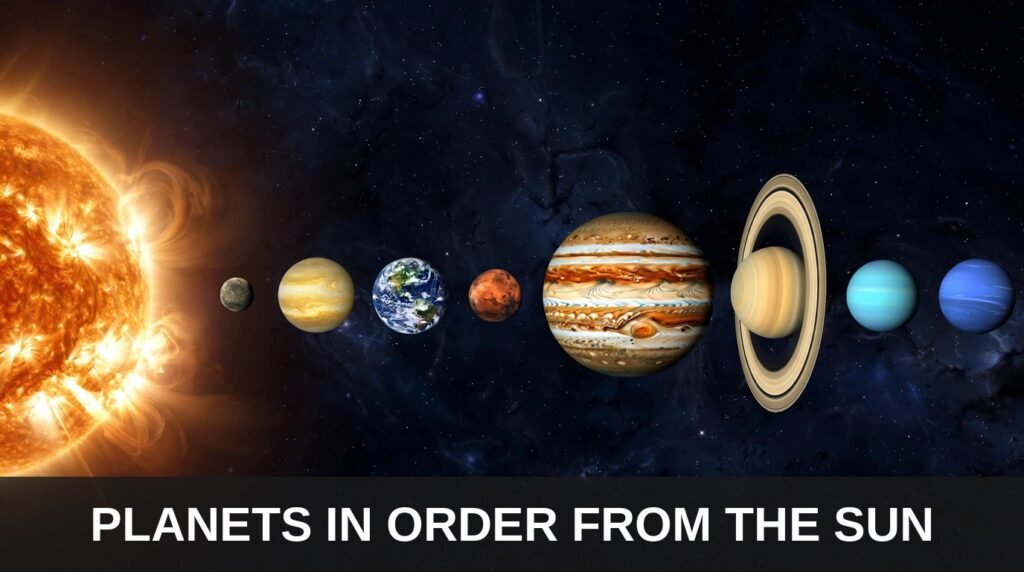
If someone asked you to name the planets in order from the Sun, could you do it without stopping to think? Most of us learned the list in school, then quietly forgot half of it somewhere between exams and adult life. And even when the names come back, the follow-up questions start: which one is biggest, which is closest, and why does Pluto never seem to make the list anymore?
This guide answers all of that in plain language. You will get the order first, then a quick look at each planet — how far it sits from the Sun, how long its year lasts, and the one fact that makes it memorable. No jargon, no maths degree required.
The short answer: The planets in order from the Sun are Mercury, Venus, Earth, Mars, Jupiter, Saturn, Uranus and Neptune. Mercury is closest to the Sun and Neptune is farthest away. The first four are small, rocky worlds; the last four are giants made mostly of gas and ice. Pluto is not on the list because it is classed as a dwarf planet.
For more everyday guides and explainers, visit DailyOrvix.
The Planets in Order from the Sun at a Glance
Here is the full list in one place. The table also shows each planet’s average distance from the Sun in astronomical units — one AU is the distance from the Earth to the Sun, about 150 million kilometres — along with its diameter and the length of its year.
| Order | Planet | Distance from the Sun | Diameter | Length of year |
|---|---|---|---|---|
| 1 | Mercury | 0.39 AU (58 million km) | 4,879 km | 88 days |
| 2 | Venus | 0.72 AU (108 million km) | 12,104 km | 225 days |
| 3 | Earth | 1.00 AU (150 million km) | 12,742 km | 365.25 days |
| 4 | Mars | 1.52 AU (228 million km) | 6,779 km | 687 days |
| 5 | Jupiter | 5.20 AU (779 million km) | 139,820 km | 11.9 years |
| 6 | Saturn | 9.58 AU (1.43 billion km) | 116,460 km | 29.4 years |
| 7 | Uranus | 19.2 AU (2.87 billion km) | 50,724 km | 84 years |
| 8 | Neptune | 30.1 AU (4.50 billion km) | 49,244 km | 164.8 years |
Notice the pattern. The first four planets sit close together, within about one and a half AU of the Sun. Then there is a huge jump to Jupiter, and the gaps keep growing. Neptune is roughly thirty times farther from the Sun than Earth is, which is why sunlight there is about nine hundred times dimmer than the sunshine on a summer afternoon here.
The Four Rocky Planets
Mercury, Venus, Earth and Mars are the terrestrial planets. They are small, dense and solid, with rocky surfaces you could — in theory — stand on. They also sit in the warmer, inner part of the solar system, where the Sun’s heat was too strong for light gases to stick around when the planets were forming.
1. Mercury — the Closest Planet to the Sun
Mercury is the smallest planet and the one nearest the Sun, orbiting at an average of just 58 million kilometres. A year there lasts only 88 Earth days, so Mercury rushes around the Sun more than four times while Earth completes a single lap.
Being close to the Sun does not make Mercury the hottest planet, though. It has almost no atmosphere to trap heat, so temperatures swing wildly — from around 430°C in the daytime to about −180°C at night. Its surface is covered in craters, much like our Moon, because there is no air to burn up incoming space rocks. Mercury has no moons, and one day there — a single rotation — lasts about 59 Earth days.
2. Venus — the Hottest Planet
Venus is often called Earth’s sister because the two are almost the same size, but that is where the family resemblance ends. Venus is wrapped in thick clouds of carbon dioxide and sulphuric acid, and its crushing atmosphere traps heat so effectively that the surface sits at around 465°C — hotter than Mercury, even though Venus is farther from the Sun.
Venus also spins backwards compared with most planets, and it spins very slowly: one day on Venus lasts about 243 Earth days, longer than its year of 225 days. From the surface, the Sun would rise in the west and set in the east — if you could ever see it through the clouds. Like Mercury, Venus has no moons.
3. Earth — the Only Known Planet with Life
Earth is the third planet from the Sun and, as far as we know, the only world in the universe that supports life. Its position is the key reason: not too hot, not too cold, with liquid water on the surface and an atmosphere that shields us from the worst of the Sun’s radiation.
Earth is the largest of the rocky planets, at 12,742 kilometres across, and it takes 365.25 days to orbit the Sun — the extra quarter-day is why we add a leap day every four years. Our planet has one moon, which steadies Earth’s tilt and drives the tides. Compared with its neighbours, Earth is the odd one out in the best possible way: blue oceans, breathable air and mild temperatures averaging around 15°C.
4. Mars — the Red Planet
Mars gets its rusty red colour from iron oxide — essentially rust — covering much of its surface. It is about half the size of Earth and sits 228 million kilometres from the Sun, so it is cold, with an average temperature of around −63°C.
Mars is the planet we know best after Earth. Rovers have driven across its deserts, orbiters have mapped it in detail, and it hosts the tallest volcano in the solar system: Olympus Mons, which stands about 22 kilometres high — roughly two and a half times the height of Mount Everest. A day on Mars lasts 24.6 hours, remarkably close to an Earth day, and a year there is 687 Earth days. Mars has two small moons, Phobos and Deimos.
The Four Giant Planets
Beyond Mars lies the asteroid belt, and past it the character of the solar system changes completely. Jupiter, Saturn, Uranus and Neptune are giants, made mostly of hydrogen, helium and ices rather than rock. They have no solid surface to stand on, they spin fast, and they collect moons by the dozen.
5. Jupiter — the Largest Planet
Jupiter is the giant of the family. At 139,820 kilometres across, it is wider than eleven Earths side by side, and it holds more mass than all the other planets combined. Despite its size, it spins faster than any other planet — one day on Jupiter lasts just under ten hours.
Jupiter’s most famous feature is the Great Red Spot, a storm wider than Earth that has been raging for centuries. The planet has 95 known moons, including Ganymede, which is larger than the planet Mercury, and Europa, whose hidden ocean makes it one of the most promising places to search for life beyond Earth. Jupiter orbits at 779 million kilometres from the Sun and takes 11.9 Earth years to complete one lap.
6. Saturn — the Ringed Planet
Saturn is the showpiece of the solar system. Its rings stretch more than 280,000 kilometres across yet are only about ten metres thick in places, and they are made mostly of chunks of ice, some as small as grains of sand and others as large as houses.
Saturn is the second-largest planet, but it is also the least dense — it is made mostly of hydrogen and helium, and it would float if you could find a bathtub big enough. A year on Saturn lasts 29.4 Earth years, and the planet has 146 known moons, more than any other planet. Its largest moon, Titan, has a thick atmosphere and lakes of liquid methane, making it one of the strangest worlds we know.
7. Uranus — the Planet on Its Side
Uranus is the oddball of the outer planets. It orbits on its side, tilted about 98 degrees, probably because of a huge collision long ago. That tilt means each of its poles spends 21 years in continuous sunlight, followed by 21 years of darkness.
Uranus looks like a pale blue-green ball, a colour that comes from methane in its atmosphere. It is an ice giant rather than a gas giant, with a cold, slushy interior, and it holds the record for the coldest atmosphere ever measured on a planet — around −224°C. It sits 2.87 billion kilometres from the Sun, takes 84 years to orbit, and has 28 known moons.
8. Neptune — the Farthest Planet from the Sun
Neptune is the eighth and farthest planet, orbiting about 4.5 billion kilometres from the Sun. It was found through maths before it was ever seen through a telescope: astronomers noticed Uranus wobbling in its orbit and predicted where another planet must be pulling on it.
Neptune is a deep blue world with the fastest winds in the solar system, reaching speeds of about 2,100 kilometres per hour. A year there lasts 164.8 Earth years, so Neptune has completed only one full orbit since it was discovered in 1846. It has 16 known moons, the largest of which, Triton, orbits backwards and may once have been a dwarf planet captured by Neptune’s gravity.
How Far Apart Are the Planets, Really?
Numbers in a table can be hard to picture, so it helps to shrink the solar system down. Imagine the Sun is the size of a football. On that scale, Earth would be a peppercorn about 26 metres away, and Neptune would be another peppercorn more than 780 metres away — about eight football pitches. The inner planets cluster close to the Sun, while the outer planets are separated by enormous stretches of nearly empty space.
This is also why travelling between planets takes so long. Light from the Sun reaches Earth in about eight minutes, but it takes more than four hours to reach Neptune. A spacecraft flying to Neptune needs roughly a decade to get there, even with gravity assists from other planets along the way.
How to Remember the Order of the Planets
The classic trick is a mnemonic — a sentence where the first letter of each word matches the first letter of each planet, in order. The most popular one is:
My Very Excellent Mother Just Served Us Nachos
That gives you Mercury, Venus, Earth, Mars, Jupiter, Saturn, Uranus, Neptune. If you prefer something sillier, try “My Very Excited Monkey Jumped Straight Up Neptune” — whatever sticks in your memory is the right one.
A few other memory aids help too. The first four planets are the small rocky ones, and the last four are the giants. You can also remember that the order of size roughly matches the order of distance once you pass Mars: Jupiter is the biggest, then Saturn, then Uranus and Neptune. And if you can spot Venus in the evening sky — it is the brightest “star” after sunset — you have already found the second planet from the Sun.
Why Is Pluto Not on the List?
Many people learned nine planets in school, with Pluto as the ninth. In 2006, the International Astronomical Union reclassified Pluto as a dwarf planet, because it had not cleared its orbit of other objects — one of the three conditions for being called a planet.
Pluto is still out there, of course, orbiting at an average of 5.9 billion kilometres from the Sun. It is smaller than our Moon and shares its region of space with many similar icy bodies in the Kuiper Belt. The other official dwarf planets are Ceres, Haumea, Makemake and Eris. Pluto’s demotion was controversial, but it was based on a real discovery: the outer solar system is full of Pluto-sized worlds, and keeping Pluto as a planet would have meant adding dozens more.
What Counts as a Planet, Anyway?
The 2006 definition has three parts. A planet must orbit the Sun, it must be round because of its own gravity, and it must have cleared its neighbourhood of other objects. The eight planets pass all three tests. Dwarf planets pass the first two but fail the third — they share their orbital zone with other bodies of similar size.
This is also why the list of eight is stable. New dwarf planets may be found in the distant solar system, but no new planet has been discovered since Neptune in 1846, and the eight we have are firmly established.
Which Planet Can You See Tonight?
Five planets are visible to the naked eye: Mercury, Venus, Mars, Jupiter and Saturn. Venus is the easiest to find — look for a brilliant white “star” low in the west just after sunset, or low in the east before sunrise. Jupiter is the second-brightest planet and looks like a steady, creamy-white point of light that does not twinkle the way stars do.
Mars shows a distinct orange-red tint, while Saturn is a pale gold colour. Mercury is the trickiest, because it never strays far from the Sun and only appears briefly at dawn or dusk. Uranus and Neptune are too faint to see without binoculars or a telescope, though Uranus can just be spotted from a very dark sky if you know exactly where to look.
Frequently Asked Questions
What are the planets in order from the Sun?
Mercury, Venus, Earth, Mars, Jupiter, Saturn, Uranus and Neptune. This order is based on each planet’s average distance from the Sun, and it has not changed since Neptune was discovered in 1846.
Which planet is closest to the Sun?
Mercury is the closest planet to the Sun, orbiting at an average distance of 58 million kilometres. A year on Mercury lasts just 88 Earth days, the shortest year of any planet.
Which planet is farthest from the Sun?
Neptune is the farthest planet from the Sun, at about 4.5 billion kilometres — roughly 30 times Earth’s distance. Sunlight takes more than four hours to reach it, and one year there lasts 164.8 Earth years.
What is the order of the planets by size?
From largest to smallest: Jupiter, Saturn, Uranus, Neptune, Earth, Venus, Mars and Mercury. Jupiter is more than eleven times wider than Earth, while Mercury is the smallest planet at 4,879 kilometres across.
How many planets are in the solar system?
There are eight planets in the solar system. Pluto was reclassified as a dwarf planet in 2006, along with Ceres, Haumea, Makemake and Eris, so it no longer counts as a planet.
Which planet is the hottest?
Venus is the hottest planet, with a surface temperature of around 465°C. Its thick carbon dioxide atmosphere traps heat so effectively that it stays hotter than Mercury, even though Mercury is closer to the Sun.
Is Pluto a planet?
No. Pluto is officially a dwarf planet. It orbits the Sun and is round, but it has not cleared its orbit of other objects, so it does not meet the full definition of a planet set by the International Astronomical Union in 2006.
Final Thoughts
The order of the planets — Mercury, Venus, Earth, Mars, Jupiter, Saturn, Uranus, Neptune — is one of those facts that is worth knowing properly, because it anchors everything else you learn about space. Once you know the order, the distances, sizes and temperatures all start to make sense: small rocky worlds close to the Sun, then enormous giants spread across the cold outer dark.
If you remember one thing, remember the mnemonic: My Very Excellent Mother Just Served Us Nachos. And if you get a clear evening, step outside and look for Venus after sunset. You will be looking at the second planet from the Sun, shining brighter than anything else in the sky — a good reminder that the solar system is not just a list in a book, but something you can see with your own eyes.
Read Also: Isla Turk: Meaning, Location and What to Know in 2026
1 Comment