
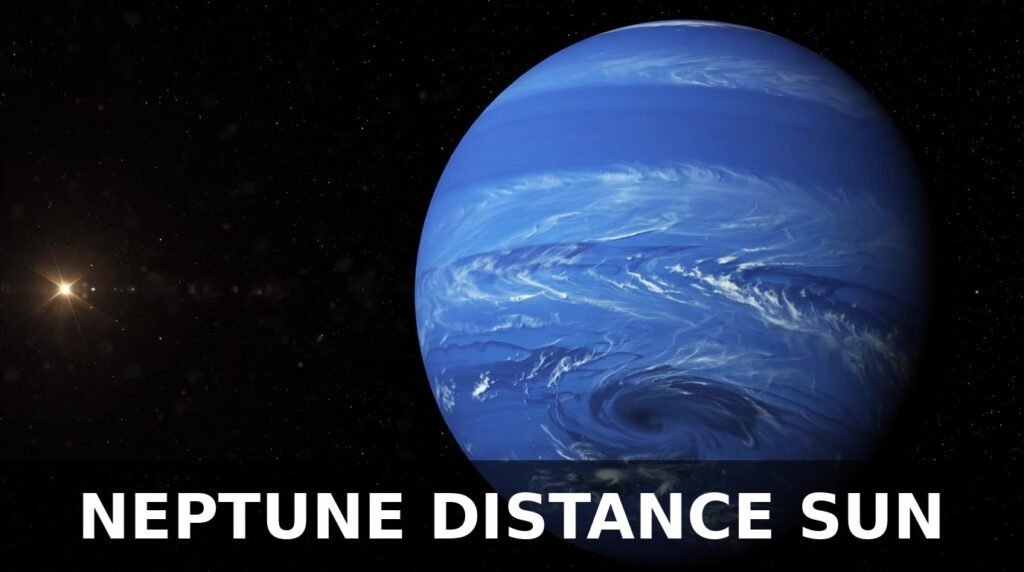
The neptune distance sun figure is a good place to start. If you have ever looked at a picture of the solar system, you have probably noticed how far Neptune sits from everything else. It is the last planet in the line, a small blue dot floating in the dark, a long way from the warmth of the Sun. The neptune distance sun question sounds simple, but the answer opens up a much bigger story about orbits, light, time, and how we learned to measure a world we have only visited once.
Most of us can picture the distance from Earth to the Sun. Light takes about eight minutes to make that trip. Neptune is roughly thirty times farther away. That changes everything about the planet: how cold it is, how long its year lasts, how bright it looks from Earth, and how hard it is to explore.
The short answer: Neptune sits at an average distance of about 4.5 billion kilometres (2.8 billion miles) from the Sun, which is about 30.1 astronomical units (AU). Because its orbit is slightly oval-shaped, that distance changes a little as it travels around the Sun. Sunlight takes about 4 hours and 6 minutes to reach Neptune, and one full orbit takes about 164.8 Earth years.
When you picture the neptune distance sun gap, it helps to think in journeys rather than numbers. A signal travelling at the speed of light still needs more than four hours to make the trip, so anything we learn about Neptune is always a little out of date.
The neptune distance sun figure also explains why the planet looks so faint from Earth, even through a good telescope, and why only one spacecraft has ever flown past it. Yet that same distance makes Neptune a useful test of what we know about planets: if our ideas about orbits, light and gravity hold true out there, at thirty times Earth’s distance from the Sun, they are probably sound everywhere else in the solar system too.
Neptune Distance Sun: How Far Is Neptune From the Sun?
Neptune is the eighth and farthest planet from the Sun. Its average distance is about 4.5 billion kilometres, or about 2.8 billion miles. Astronomers usually write this as 30.1 AU, where one AU is the average distance from Earth to the Sun.
That number is an average for a good reason. Neptune does not travel around the Sun in a perfect circle. Its orbit is a gentle oval, so it moves a little closer at one part of its journey and a little farther away at another. The difference is small compared with the total distance, but it is real, and it is one reason you will see slightly different figures in different books and websites.
When Neptune is at its closest point to the Sun, known as perihelion, it is about 4.45 billion kilometres away. When it is at its farthest point, known as aphelion, it is about 4.55 billion kilometres away. That is a swing of roughly 100 million kilometres. It sounds huge, and in everyday terms it is, but against a total distance of 4.5 billion kilometres, it is only a small variation.
For most purposes, the average figure is the one to remember: about 4.5 billion kilometres, or 30.1 AU. If someone asks how far Neptune is from the Sun, that is the answer.
It helps to put that number into a picture you can feel. If you could drive at motorway speed without stopping, day and night, it would take you thousands of years to cover the distance. A passenger jet would take even longer in practical terms, and even a fast spacecraft needs years. The Voyager 2 spacecraft, which flew past Neptune in 1989, took twelve years to get there after leaving Earth.
What Is an Astronomical Unit, and Why Do Astronomers Use It?
When distances get this large, kilometres and miles become hard to picture. Astronomers use a simpler unit called the astronomical unit, usually shortened to AU. One AU is the average distance from Earth to the Sun, about 150 million kilometres, or about 93 million miles.
Using AU makes comparisons much easier. Earth is 1 AU from the Sun. Mars is about 1.5 AU away. Jupiter is about 5.2 AU away. Saturn is about 9.6 AU away. Uranus is about 19.2 AU away. Neptune, at 30.1 AU, is about thirty times farther from the Sun than we are.
Neptune Distance Sun: Neptune’s Orbit Is Not a Perfect Circle
Many diagrams show the planets moving in neat circles around the Sun. In reality, most orbits are ellipses, which are slightly squashed circles. Neptune’s orbit is one of the most circular of all the planets, but it is still not perfect.
This matters for two reasons. First, it explains why the distance changes slightly over time. Second, it reminds us that a single number can only ever be an average. Neptune is not fixed at 4.5 billion kilometres. It drifts in and out by tens of millions of kilometres as it goes around.
The shape of an orbit is described by a number called eccentricity. A perfect circle has an eccentricity of zero. Neptune’s eccentricity is very low, which means its orbit is close to circular. Mercury, by comparison, has a much more stretched-out orbit, so its distance from the Sun changes a lot more during its year.
Neptune’s nearly circular orbit is one reason its seasons are steadier than they might otherwise be, at least in terms of distance from the Sun. The planet still has seasons because its axis is tilted, just like Earth’s, but the change in distance does not drive big swings in temperature the way it can on a planet with a more eccentric orbit.
Neptune Distance Sun: How Long Does Sunlight Take to Reach Neptune?
Light travels fast, but space is vast. Sunlight takes about eight minutes to reach Earth. It takes about four hours and six minutes to reach Neptune.
That delay has real consequences. When we look at Neptune through a telescope, we are seeing it as it was about four hours ago, not as it is right now. The light that reaches our eyes left the Sun, travelled to Neptune, bounced off its clouds, and then travelled back to Earth.
The same delay affects spacecraft. When Voyager 2 flew past Neptune in 1989, signals from the spacecraft took about four hours to reach Earth. Mission controllers could not steer it in real time. They had to send instructions in advance and wait hours to find out whether they had worked.
Sunlight also gets much weaker with distance. The amount of sunlight falling on a planet drops with the square of the distance. At thirty times Earth’s distance from the Sun, Neptune receives only a tiny fraction of the sunlight we enjoy. That is a major reason why Neptune is so cold, and why its atmosphere behaves the way it does.
| Planet | Average distance from the Sun | Time for sunlight to arrive |
|---|---|---|
| Earth | 1 AU (150 million km) | About 8 minutes |
| Uranus | 19.2 AU (2.9 billion km) | About 2 hours 40 minutes |
| Neptune | 30.1 AU (4.5 billion km) | About 4 hours 6 minutes |
Neptune Distance Sun: How Long Is a Year on Neptune?
A year on Neptune lasts about 164.8 Earth years. That is how long it takes Neptune to complete one full orbit around the Sun at its average distance of 30.1 AU.
To put that in perspective, Neptune has completed only one full orbit since it was discovered in 1846. It finished that first observed orbit in 2011. Before that, astronomers had never seen Neptune return to the same place in its orbit where it was found. A single Neptunian year is longer than a human lifetime, and longer than the whole history of modern astronomy’s study of the planet.
Neptune moves slowly because it is far from the Sun and because gravity is weaker at that distance. Its average orbital speed is about 5.4 kilometres per second. Earth, by comparison, travels at about 30 kilometres per second. Neptune is not lazy; it is simply following the rules of orbital motion. The farther a planet is from the Sun, the slower it moves and the longer its year lasts.
A day on Neptune is much shorter than its year, which can feel strange. Neptune spins once on its axis in about 16 hours. So a Neptunian day is shorter than an Earth day, while a Neptunian year is more than a hundred and sixty Earth years long.
Neptune Distance Sun vs Earth: How Different Is the Distance?
Comparing Neptune with Earth is the quickest way to understand just how far out it is. Earth sits at 1 AU from the Sun. Neptune sits at 30.1 AU. That means Neptune is about thirty times farther away. Sunlight that reaches Earth in eight minutes needs more than four hours to reach Neptune. A year that lasts 365 days on Earth lasts 164.8 years on Neptune.
The difference in sunlight is dramatic. Neptune receives roughly one nine-hundredth of the sunlight per square metre that Earth receives. That is not a small difference. It is the difference between a planet that can support liquid water on its surface and a planet where temperatures are far below freezing.
Earth’s average temperature is comfortable for life as we know it. Neptune’s cloud tops are bitterly cold, far colder than the coldest places on Earth. The exact temperature varies with altitude and location, but the overall picture is clear: Neptune is a frozen world, and its distance from the Sun is the main reason why.
Size is another useful comparison. Neptune is about four times wider than Earth. It is the smallest of the giant planets, but it is still much larger than our home planet. Its mass is about seventeen times Earth’s mass. That extra mass, combined with its distance, gives Neptune a very different character: a deep atmosphere, strong winds, and no solid surface to stand on.
Neptune vs Uranus: The Two Ice Giants
Neptune and Uranus are often grouped together as the ice giants. They are similar in size, similar in composition, and both sit far from the Sun. But their distances are quite different.
Uranus orbits at about 19.2 AU, or 2.9 billion kilometres, from the Sun. Neptune orbits at about 30.1 AU, or 4.5 billion kilometres. The gap between them is about 10.9 AU, which is about 1.6 billion kilometres. That gap alone is more than ten times the distance from Earth to the Sun.
In other words, Neptune is much farther from Uranus than Uranus is from Saturn, and much farther from Uranus than Earth is from the Sun. The outer solar system is spacious, and the ice giants are not close neighbours in the way the inner planets are.
| Planet | Average distance | Orbital period | Diameter (approx.) |
|---|---|---|---|
| Earth | 1 AU | 1 year | 12,742 km |
| Uranus | 19.2 AU | 84 Earth years | 50,724 km |
| Neptune | 30.1 AU | 164.8 Earth years | 49,244 km |
Both ice giants have deep atmospheres rich in hydrogen, helium, and methane. Methane gives both planets their blue colour, although Neptune’s blue is deeper and more vivid than Uranus’s pale blue-green. Neptune is slightly smaller than Uranus but slightly heavier, which means it is a little denser.
Neptune also has stronger winds. Its supersonic winds are the fastest in the solar system, reaching speeds far beyond anything on Earth. Scientists think Neptune’s greater distance, combined with heat rising from its interior, helps drive those powerful winds, although the full story is still being studied.
Neptune Distance Sun: Why Is Neptune So Cold and So Windy?
Distance from the Sun is the main reason Neptune is cold, but it is not the whole story. Neptune also generates some heat from inside, and that internal heat plays a big part in its weather.
The temperature at Neptune’s cloud tops is extremely low, far below anything we experience on Earth. Sunlight alone would leave the planet even colder, but heat rising from deep inside helps power its atmosphere. That combination of weak sunlight from above and heat from below creates strong contrasts, and those contrasts drive winds.
Neptune’s winds are famous. They are the fastest in the solar system, with gusts measured at supersonic speeds. On Earth, a strong hurricane might reach a few hundred kilometres per hour. On Neptune, winds can move much faster than that, sweeping clouds around the planet in a matter of days.
The Great Dark Spot, a large storm seen by Voyager 2 in 1989, was a vivid example of Neptune’s weather in action. It was a huge, dark oval in the atmosphere, similar in spirit to Jupiter’s Great Red Spot, although smaller and shorter-lived. Later observations with the Hubble Space Telescope have shown other dark spots forming and fading, which suggests that Neptune’s atmosphere is active and changeable, even in the deep cold.
Neptune Distance Sun: How Do We Know Neptune’s Distance?
We know Neptune’s distance today because we can track it precisely, but the story of how we found Neptune in the first place is one of the most remarkable in astronomy.
Neptune was discovered in 1846, not by accident, but by mathematics. Astronomers had noticed that Uranus was not quite following the orbit predicted for it. Something was pulling on it. Two mathematicians, working independently, calculated where an unseen planet must be to cause those small deviations. One of them was Urbain Le Verrier in France. His calculations pointed to a specific part of the sky.
On the night of 23 September 1846, Johann Galle at the Berlin Observatory pointed his telescope at the predicted position and found Neptune, very close to where Le Verrier had said it would be. It was a triumph for the idea that the laws of physics could predict the existence of a world no one had ever seen.
In the years that followed, astronomers refined Neptune’s orbit by watching it move against the background stars. Each observation helped pin down its distance, speed, and orbital shape. Today, we can measure its position with great accuracy using telescopes on Earth and in space, and we can track spacecraft that have flown through the outer solar system.
Neptune Distance Sun: Frequently Asked Questions
Neptune Distance Sun: How far is Neptune from the Sun in kilometres?
Neptune is about 4.5 billion kilometres from the Sun on average, or about 2.8 billion miles. The exact distance changes slightly as Neptune moves around its orbit, from about 4.45 billion kilometres at its closest to about 4.55 billion kilometres at its farthest.
Neptune Distance Sun: How far is Neptune from the Sun in AU?
Neptune is about 30.1 AU from the Sun. One AU is the average distance from Earth to the Sun, about 150 million kilometres. Neptune is therefore about thirty times farther from the Sun than Earth is.
How long does it take sunlight to reach Neptune?
Sunlight takes about 4 hours and 6 minutes to reach Neptune. By comparison, sunlight takes about 8 minutes to reach Earth and about 2 hours and 40 minutes to reach Uranus.
How long is a year on Neptune?
One year on Neptune lasts about 164.8 Earth years. Neptune has completed only one full orbit since its discovery in 1846, finishing that orbit in 2011. A day on Neptune is much shorter, lasting about 16 hours.
Is Neptune the farthest planet from the Sun?
Yes. Neptune is the eighth and farthest planet from the Sun. Pluto was once considered the ninth planet, but it is now classified as a dwarf planet. Among the eight planets, Neptune is the most distant.
Why is Neptune so cold?
Neptune is cold mainly because it is so far from the Sun. At 30.1 AU, it receives only a tiny fraction of the sunlight that Earth receives. Its cloud tops are far below freezing, although heat from inside the planet helps drive its strong winds and storms.
Can Neptune be seen without a telescope?
No. Neptune is too faint to see with the naked eye. You need a telescope and a star chart to find it. Even through a telescope, it appears as a small blue disc. The Hubble Space Telescope and ground-based telescopes provide much clearer views.
Final Thoughts
The neptune distance sun figure, about 4.5 billion kilometres or 30.1 AU, is more than a number to memorise. It explains why Neptune is cold, why its year lasts 164.8 Earth years, why sunlight takes over four hours to reach it, and why we have only visited it once.
Neptune sits at the edge of the planetary solar system, a deep blue ice giant moving slowly through the dark. Its orbit is nearly circular, its winds are the fastest we know, and its largest moon orbits backwards. It was found by mathematics before it was seen through a telescope, and it completed its first observed orbit only in 2011.
If you remember one thing, remember this: Neptune is about thirty times farther from the Sun than Earth, and that single fact shapes almost everything about the planet. The next time you see a picture of the solar system, look at that small blue dot at the far end, and think about the four hours of sunlight, the 164-year orbit, and the twelve-year journey that Voyager 2 made to reach it.
Read Also: Closest Planet Sun: Mercury and Its Extreme Orbit
1 Comment