
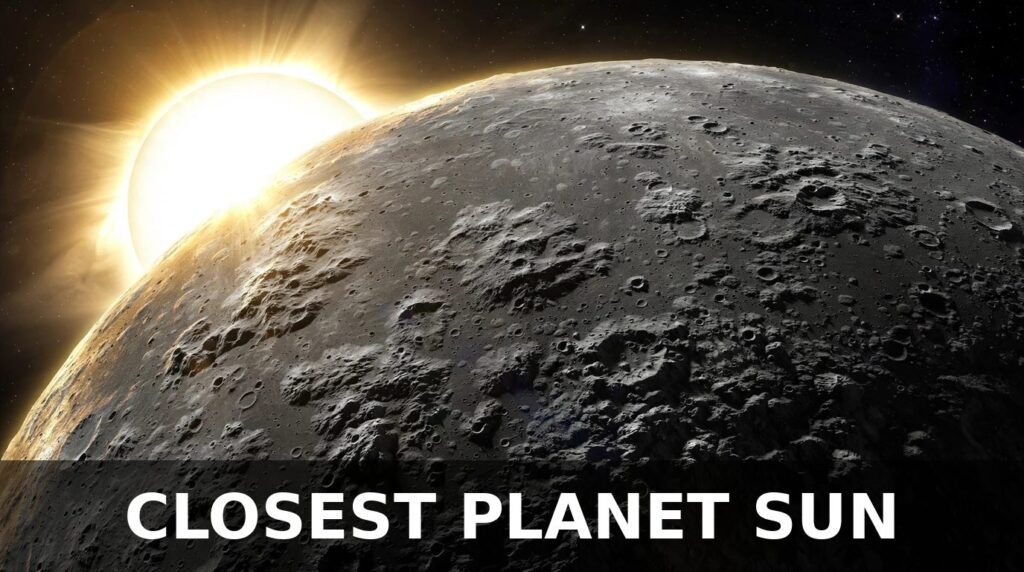
If you have ever looked at a diagram of the solar system, you probably noticed one small planet sitting right next to the Sun. That planet is Mercury, and it holds a record no other planet can claim. The closest planet Sun watchers always ask about is Mercury, and it lives in a part of space where the heat is fierce, the days are strange, and the landscape looks more like the Moon than Earth.
Mercury is easy to overlook. It is small, it never strays far from the Sun in our sky, and it has no moons, no rings, and no thick atmosphere to soften its harsh conditions. Yet it is one of the most interesting worlds in the solar system, precisely because it survives so close to our star. Its orbit is fast and stretched, and it gives Mercury a year, a day, and a climate unlike anything we know on Earth.
The short answer: Mercury is the closest planet to the Sun. It orbits at an average distance of about 57.9 million kilometres (0.387 AU), completes one orbit in just 88 Earth days, and is the smallest planet in the solar system. It has no moons, a very thin exosphere instead of a real atmosphere, and temperatures that swing from around -180°C at night to around 430°C in the daytime.
What Is the Closest Planet Sun?
The closest planet Sun is Mercury. It is the first planet out from the Sun, ahead of Venus, Earth, and Mars. That position shapes almost everything about it, from its scorched surface to its rapid orbit and its thin, wispy exosphere.
Mercury is also the smallest planet in the solar system. It is only slightly larger than Earth’s Moon, and its surface is covered in craters left by billions of years of impacts. Because it has almost no atmosphere to burn up incoming space rocks, those craters stay visible for a very long time.
Despite its size, Mercury is a dense world. A huge iron core fills much of its interior, which gives it a surprisingly strong pull for such a small planet. Scientists think that core formed early in the solar system’s history, and it still influences Mercury’s weak magnetic field today.
How Close Is Mercury to the Sun Really?
Mercury orbits the Sun at an average distance of about 57.9 million kilometres. Astronomers often describe that distance as 0.387 AU, where one AU, or astronomical unit, is the average distance between Earth and the Sun. In simple terms, Mercury sits a little more than one-third as far from the Sun as Earth does.
That average hides an important detail. Mercury does not travel around the Sun in a neat circle. Its orbit is stretched into an oval, so its distance changes a lot during a single year. At its nearest point, it comes much closer to the Sun. At its farthest point, it moves noticeably further away, and that swing adds to the planet’s already extreme conditions.
Closest Planet Sun: Mercury’s Distance Compared With the Other Planets
| Planet | Average distance from the Sun |
|---|---|
| Mercury | 57.9 million km (0.387 AU) |
| Venus | 108.2 million km (0.723 AU) |
| Earth | 149.6 million km (1.00 AU) |
| Mars | 227.9 million km (1.52 AU) |
| Jupiter | 778.5 million km (5.20 AU) |
Mercury is not just first in line. It is much closer to the Sun than Venus, the next planet out, and that gap is one reason its environment is so different from every other rocky planet.
Closest Planet Sun: Mercury’s Extreme Orbit Explained
Mercury’s orbit is extreme in two ways. It is fast, and it is stretched. Together, those traits give the planet a year that lasts only 88 Earth days and a path around the Sun that never stays at the same distance.
A year on Mercury is short because the planet is close to the Sun. Gravity pulls it around quickly, and it completes a full lap in less than three Earth months. If you lived on Mercury, your birthday would come around four times as often as it does on Earth.
Why Mercury’s Orbit Is Not a Circle
Most planets follow paths that are close to circular. Mercury is the exception: its orbit is noticeably elliptical, shaped more like an oval than a circle. At perihelion, its closest point, it is about 46 million kilometres from the Sun; at aphelion, its farthest point, about 70 million kilometres.
Closest Planet Sun: What 88 Earth Days Really Means
An 88-day year sounds simple, but it hides a strange detail. Because Mercury spins so slowly and moves so quickly around the Sun, a single solar day on Mercury, from one sunrise to the next, lasts about 176 Earth days.
That means one full day-night cycle on Mercury lasts about twice as long as its entire year. A person standing on Mercury would see the Sun rise, crawl slowly across the sky, set, and then stay down for a very long time before the next sunrise. At certain points in its orbit, the Sun even appears to slow down, pause, and briefly move backwards before continuing forward, a real effect of Mercury’s changing orbital speed and slow rotation.
Why Mercury Is So Hard to See From Earth
If Mercury is the closest planet Sun, you might expect it to be easy to spot. In practice, it is one of the hardest planets to see with the naked eye. The reason is simple: it never moves far from the Sun in our sky.
From Earth, Mercury always appears close to the Sun. It is only visible for a short time just after sunset or just before sunrise, low on the horizon. At other times, it is lost in the Sun’s glare. Even when it is visible, you need a clear, flat horizon and good timing, because city lights, haze, hills, and buildings can hide it completely.
A World of Extremes: Mercury’s Temperatures
Mercury has the largest temperature swing of any planet in the solar system. Daytime temperatures can reach around 430°C, hot enough to melt some metals. Night-time temperatures can fall to around -180°C, cold enough to freeze many gases. That is a swing of more than 600 degrees between day and night on the same planet.
The cause is Mercury’s lack of a thick atmosphere. On Earth, air carries heat around the planet and softens the difference between day and night. Mercury has only a very thin exosphere, which cannot store or move heat in the same way. When the Sun shines on a patch of ground, it heats up quickly, and when that patch turns away into darkness, it cools down just as fast. Its slow rotation makes the effect stronger, because one spot can spend weeks in sunlight, then weeks in darkness.
There is one surprising exception to all that heat. Scientists have found water ice in permanently shadowed craters near Mercury’s poles. Those craters never receive direct sunlight, so they stay cold enough for ice to survive, even on a planet famous for extreme heat. It is a striking reminder that Mercury is a world of contrasts, where boiling plains and frozen shadows exist side by side.
Mercury’s Surface: Craters, Plains and Cliffs
Mercury’s surface looks a lot like the Moon at first glance. It is grey, dusty, and covered in craters of many sizes, made by asteroids and comets striking the surface over billions of years. Because Mercury has almost no atmosphere and no weather like rain or wind, there is little to erase those marks. A crater made long ago can still look sharp today, so the surface is, in effect, a record of the early solar system.
Between the craters are smoother plains. Some formed from ancient lava flows, when Mercury was more geologically active. Others were shaped by debris from large impacts. Together, they give Mercury a varied landscape of rough highlands and flatter lowlands.
Mercury’s Giant Iron Core and Magnetic Field
Mercury’s large iron core is one of its biggest mysteries. For a planet so small, the core is remarkably big, and it is at least partly liquid. That liquid iron is important because it helps generate Mercury’s magnetic field.
Mercury does have a magnetic field, but it is much weaker than Earth’s, only about one percent as strong as the field that protects us from charged particles from the Sun. Even so, its existence was a surprise. Many scientists once thought a planet as small as Mercury would have cooled too much for a liquid core to survive.
Does Mercury Have Moons or Rings?
Mercury has no moons. It is one of only two planets in the solar system without a natural satellite. The other is Venus, its neighbour.
There are good reasons for this. Mercury is small, so its gravity is relatively weak. It is also very close to the Sun, whose gravity would make it hard for a moon to stay in a stable orbit around Mercury for long. Any small body that came close would be more likely to crash into Mercury or be pulled away by the Sun.
Mercury vs Earth: A Quick Comparison
Comparing Mercury with Earth shows just how different two rocky planets can be, even though both formed in the same solar system.
| Feature | Mercury | Earth |
|---|---|---|
| Average distance from the Sun | 57.9 million km | 149.6 million km |
| Diameter | About 4,879 km | About 12,742 km |
| Orbital period | 88 Earth days | 365.25 days |
| Rotation period | About 59 Earth days | About 24 hours |
| Moons | 0 | 1 |
| Daytime temperature | Around 430°C | Varies widely |
| Night-time temperature | Around -180°C | Varies widely |
| Atmosphere | Very thin exosphere | Thick, breathable air |
Mercury is much smaller, much faster around the Sun, and far more extreme in temperature. Earth is larger, slower, and protected by a thick atmosphere and a strong magnetic field. The comparison is a reminder that distance from the Sun is only part of the story. Size, atmosphere, and interior matter just as much.
Missions to Mercury: Mariner 10, MESSENGER and BepiColombo
Mercury is hard to visit. A spacecraft travelling there must slow down against the Sun’s strong gravity, survive intense heat, and cope with extreme temperature changes. Only a few missions have made the journey, and each one has added greatly to what we know.
Mariner 10 was the first spacecraft to visit Mercury. Launched in the 1970s, it flew past the planet three times and sent back the first close-up images of its cratered surface. Those flybys mapped less than half the planet, but they proved that Mercury had a magnetic field and a surface shaped by impacts and ancient lava.
MESSENGER was the first spacecraft to orbit Mercury. It entered orbit in 2011 and studied the planet for four years, mapping the whole surface, confirming water ice in polar craters, and measuring the magnetic field in detail. It ended its mission in 2015 with a planned impact on Mercury’s surface.
BepiColombo is the current mission to Mercury, a joint mission by the European Space Agency and the Japan Aerospace Exploration Agency. It is still en route, using flybys to slow down and shape its path, and once in orbit it will study Mercury with two orbiters working together.
What the Missions Found
Together, these missions have changed our picture of Mercury from a simple, Moon-like rock to a complex world. Key findings include:
- A large, partly liquid iron core that generates a weak magnetic field.
- Water ice hidden in permanently shadowed craters near the poles.
- A surface shaped by impacts, lava plains, and huge cliffs from planetary shrinking.
- A thin exosphere that is constantly stripped away by the solar wind and replenished from the surface.
- Evidence of volcanic activity in Mercury’s past, and signs that its interior has changed over time.
Each mission built on the last. Mariner 10 showed us Mercury up close for the first time. MESSENGER mapped it fully and answered many old questions. BepiColombo aims to answer the ones that remain.
Frequently Asked Questions About the Closest Planet Sun
What is the closest planet Sun?
Mercury is the closest planet Sun. It orbits at an average distance of about 57.9 million kilometres (0.387 AU), well inside the orbit of Venus, the next planet out.
How long is a year on Mercury?
A year on Mercury lasts 88 Earth days. That is how long it takes Mercury to complete one full orbit around the Sun, making it the shortest year of any planet in the solar system.
How long is a day on Mercury?
A solar day on Mercury, from one sunrise to the next, lasts about 176 Earth days. That is roughly twice as long as its year, because Mercury rotates very slowly while orbiting the Sun very quickly.
Why is Mercury so hot and so cold at the same time?
Mercury has almost no atmosphere to store or move heat. In sunlight, its surface heats up to around 430°C. In darkness, heat escapes quickly into space and temperatures can fall to around -180°C. Its slow rotation makes each hot day and cold night last for weeks.
Does Mercury have any moons?
No, Mercury has no moons. It is one of only two planets in the solar system without a natural satellite, the other being Venus. Its small size and closeness to the Sun make it hard for a moon to stay in a stable orbit.
Can you see Mercury from Earth?
Yes, but only at certain times. Mercury never moves far from the Sun in the sky, so it is usually visible only briefly just after sunset or just before sunrise, low on the horizon. You need a clear horizon and good timing to spot it.
Has any spacecraft visited Mercury?
Yes. Mariner 10 flew past Mercury in the 1970s, MESSENGER orbited it from 2011 to 2015, and BepiColombo is currently en route to orbit Mercury. Together, they have mapped the planet, confirmed water ice at its poles, and studied its magnetic field and thin exosphere.
Final Thoughts
Mercury is small, fast, and extreme, but it is far from boring. As the closest planet to the Sun, it lives in conditions no other planet faces, with a stretched 88-day orbit, a day longer than its year, and temperatures that swing from searing heat to deep cold.
The next time you see a diagram of the solar system, give Mercury a second look. It may be the smallest planet, but it holds some of the biggest lessons about how planets work, and why the space close to a star is one of the most interesting places to explore.
Learning about the closest planet sun helps explain why Mercury looks and behaves so differently from Earth. The closest planet sun is not simply the first world in a list; its position sets its speed, its temperature swings, and even the length of its day. Because Mercury stays so near the Sun, it completes its orbit quickly, yet its slow spin stretches each day far beyond a normal day. That contrast is what makes the closest planet sun such a rewarding subject, from its giant iron core to the ice hidden in its polar shadows.
Read Also: What Is the Color of the Jupiter? Amazing Bands, Clouds & Storms
1 Comment