
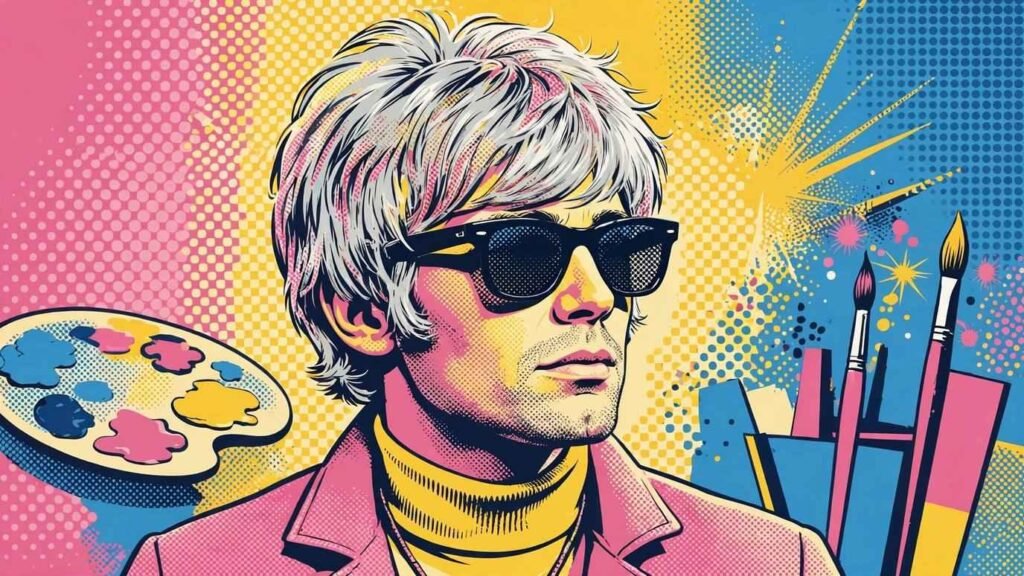
Walk into almost any museum of modern art, and you will know an Andy Warhol before you read the label. The bright colors give him away. So does the subject: a soup can, a movie star, a repeated face staring back at you from four panels at once.
Warhol did not paint like the tortured geniuses people expected artists to be. He ran a studio like a factory, hired assistants, used photographs, and borrowed images straight from advertising and the news. Critics called it shallow. Audiences loved it. And over time, the art world caught up with him.
This guide tells the story plainly: where Warhol came from, how he changed art in the 1960s, what The Factory really was, and why his influence shows up everywhere today — from album covers to advertising to your social media feed.
The short answer: Andy Warhol (1928–1987) was an American artist who turned everyday consumer products and celebrity photographs into fine art. Working from his New York studio, The Factory, he used silkscreen printing to repeat images of soup cans, movie stars, and political figures in bold, flat colors. His work made pop art famous worldwide, blurred the line between art and commerce, and helped shape how modern culture treats fame itself.
Who Was Andy Warhol?
Andy Warhol was born Andrew Warhola on August 6, 1928, in Pittsburgh, Pennsylvania. His parents were working-class immigrants from what is now Slovakia, and his father worked in construction and coal mining. The family lived modestly, and young Andy was often sick as a child, spending long stretches in bed.
Those sick days mattered more than they might seem. Confined indoors, he drew, cut out pictures from magazines, and collected photographs of movie stars. He was already learning to look closely at celebrity images — the same images he would later turn into art.
Warhol was also a serious student. He studied commercial art at the Carnegie Institute of Technology in Pittsburgh, now Carnegie Mellon University, and graduated in 1949. He was trained to make art that communicated clearly and quickly. That training never left him.
A shy kid with a sharp eye
People who knew Warhol often described him as quiet, watchful, and funny in a dry way. He was not a loud personality. He listened. He collected. He noticed what people were buying, watching, and talking about — and he filed it all away.
That habit became his artistic method. While other artists looked inward for inspiration, Warhol looked outward, at shop windows, newspapers, and television screens.
Why Did Warhol Move to New York?
Warhol moved to New York City in 1949, right after graduating. He wanted work, and New York was where the magazines, advertisers, and publishers were.
He found it fast. Within a few years, he was one of the city’s most successful commercial illustrators, drawing shoe advertisements, book covers, and magazine illustrations. His whimsical, blotted-line drawings for shoe ads were especially popular, and he won awards for his commercial work.
But commercial success was not enough for him. He wanted to be taken seriously as a fine artist, and in the late 1950s, that meant painting. The problem was that the art world already had its heroes — the Abstract Expressionists — and Warhol’s neat, commercial style did not fit in.
So he changed direction. Instead of fighting the art world on its own terms, he brought the outside world in: products, celebrities, and mass media.
From illustrator to fine artist
Three things from his advertising career shaped his fine art:
- He understood repetition. An ad works because you see it again and again. Warhol’s repeated images work the same way.
- He understood branding. A soup can is recognizable in a second. So is a famous face.
- He understood production. Commercial art is made efficiently, often by a team. Warhol’s studio would work the same way.
What Made Campbell’s Soup Cans So Important?
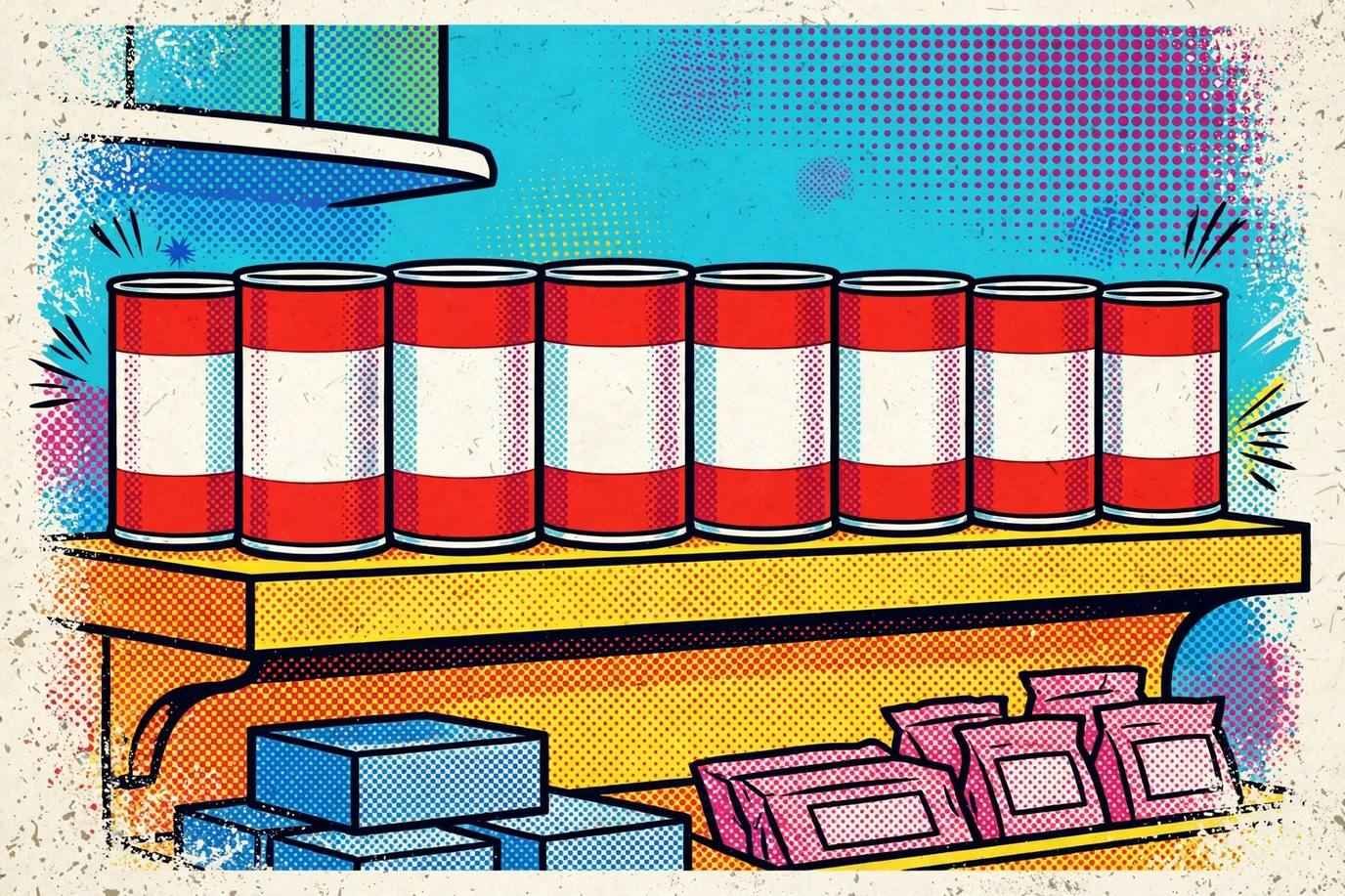
In 1962, Warhol exhibited 32 paintings of Campbell’s soup cans at the Ferus Gallery in Los Angeles. Each canvas showed a single flavor, arranged on shelves like products in a grocery store. Visitors were baffled. Some people thought it was a joke. A nearby gallery reportedly displayed real soup cans in its window as a gag.
But the joke landed seriously. Here is why the soup cans mattered:
- They treated ordinary life as worthy of art. Before Warhol, a soup can belonged in a kitchen, not a gallery.
- They were deliberately flat and mechanical. The paintings looked like the products themselves — no brushy emotion, no visible struggle.
- They asked a real question. If art can be mass-produced like soup, what makes it art at all?
Warhol liked soup. He reportedly said he ate it for lunch most days for years. Whether that is literally true or not, the point stands: he painted what was familiar, not what was grand.
| Feature | Traditional fine art (1950s) | Warhol’s pop art |
|---|---|---|
| Subject | Myth, emotion, abstract form | Soup cans, celebrities, newspapers |
| Technique | Visible brushwork, unique canvas | Silkscreen, photography, repetition |
| Attitude | Art as personal expression | Art as product and media image |
| Audience reaction | Admiration or confusion | Instant recognition — and argument |
That argument was the point. Warhol wanted people to talk, and they did.
How Did the Marilyn Screen Prints Change Portraiture?
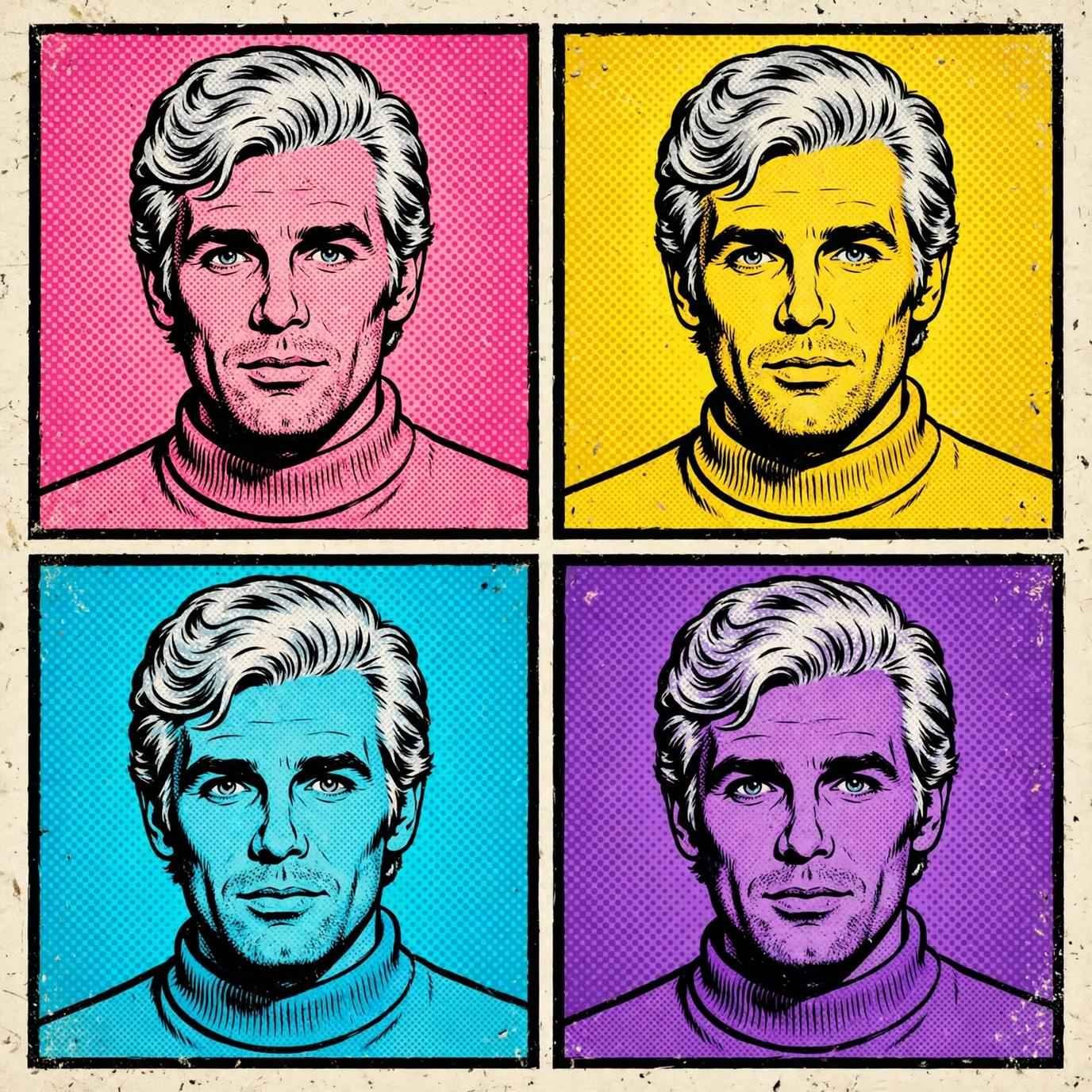
Later in 1962, after the death of Marilyn Monroe, Warhol began his famous Marilyn screen prints. He took a publicity photograph of the actress and repeated it in different color combinations — pink face, yellow hair, blue eyeshadow, again and again.
The effect is strange and powerful. The more you look at the repeated Marilyn, the less she looks like a person and the more she looks like a product: a face you recognize instantly but cannot quite reach. That was Warhol’s insight about fame. Celebrities, he suggested, are images first and people second.
The technique mattered too. Silkscreen printing let Warhol transfer a photograph onto canvas and print it many times, changing the colors each time. Assistants could help. Mistakes — a smudge, a misaligned layer — became part of the look. It was fast, repeatable, and modern in a way that traditional oil painting was not.
He went on to apply the same treatment to other famous faces: Elvis Presley, Elizabeth Taylor, Jackie Kennedy, and later, political figures such as Mao Zedong. Each portrait works the same way. You know the face before you know anything else about the picture.
Why repetition works
Repetition does two things at once. First, it mimics how fame actually feels: you see the same face on magazine covers, posters, and screens until it feels everywhere. Second, it empties the image out. After the tenth Marilyn, you stop seeing a woman and start seeing a pattern.
That tension — between recognition and emptiness — is what makes the prints so hard to forget.
What Was The Factory?
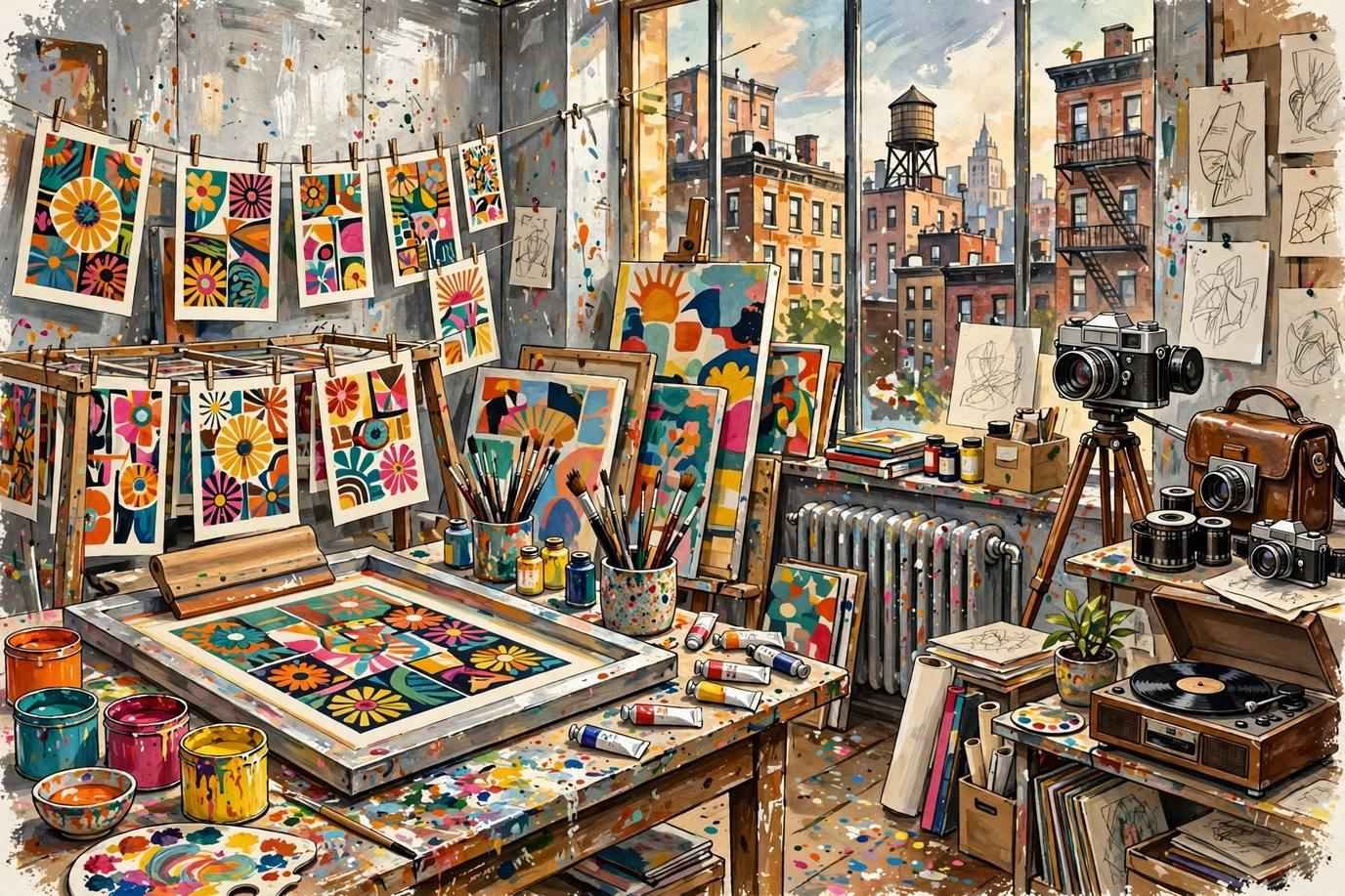
The Factory was Warhol’s studio in New York, and it was much more than a place to paint. The first Factory, on East 47th Street, was famously covered in silver paint and foil. It became a gathering place for artists, musicians, actors, writers, and hangers-on.
Warhol worked there, but he also filmed there, held parties there, and let other people create there. The atmosphere was chaotic and creative in equal measure. Some visitors came to work. Some came to be seen. Many came simply because it was the most interesting room in New York.
The name was deliberate. Warhol called his studio a factory because art, in his hands, was produced — not just inspired. Assistants stretched canvases, mixed inks, and pulled screens. Warhol directed, chose colors, and approved the results. That working method scandalized traditionalists, but it also predicted how much creative work is done today, in teams and studios rather than by a lone genius.
The Factory’s daily life
A typical day at The Factory might include:
- Silkscreen printing sessions for portraits or new series
- Filming for one of Warhol’s experimental movies
- Visitors dropping in: musicians, models, journalists, curious strangers
- Planning for exhibitions, magazine work, or parties
It was messy, social, and productive. It was also, at times, difficult and unstable. Warhol’s openness to strangers brought energy, but it also brought risk — something that became tragically clear in 1968.
How Did Warhol Shape Music Through the Velvet Underground?
Warhol’s influence went beyond painting. In the mid-1960s, he became the manager and producer of the Velvet Underground, a New York rock band fronted by Lou Reed. Warhol designed the cover of their debut album, The Velvet Underground & Nico (1967), featuring a banana illustration that listeners could peel.
The band was not commercially successful at first. Their music was dark, droning, and unlike anything on the radio. But their influence grew enormously over time. The famous line about them — that almost everyone who bought their first album started a band — captures how deeply they shaped later rock, punk, and alternative music.
Warhol’s role was typical of him: he did not play an instrument, but he saw something interesting, gave it a stage, and connected it to his world. He also brought the German singer Nico into the band’s orbit and filmed many of the era’s musicians and performers at The Factory.
Art and music, side by side
For Warhol, art, film, and music were not separate worlds. They were all part of the same culture machine. A band could be a work of art. A film could be a portrait. A party could be a happening. That cross-pollination is normal now, but in the 1960s, it felt radical.
Why Were Warhol’s Films So Strange?
Warhol also made experimental films, and many of them deliberately tested the audience’s patience. Sleep (1964) shows a man sleeping for hours. Empire (1964) shows the Empire State Building in a single, nearly unmoving shot for over eight hours. Chelsea Girls (1966) splits the screen and follows various characters in New York’s Chelsea Hotel.
These films were not meant to entertain in the usual sense. They were experiments in looking. Warhol wanted to see what happened when the camera just kept running — when nothing was edited, nothing was hurried, and the audience had to decide for itself what mattered.
Most people will never watch Empire all the way through, and that is fine. Its importance is in the idea: film as duration, as observation, as a record of real time. Later artists and filmmakers borrowed that idea freely, and today’s slow cinema, livestreams, and surveillance-style video all owe something to Warhol’s willingness to let the camera simply stay.
| Work | Year | What it does |
|---|---|---|
| Campbell’s Soup Cans | 1962 | Turns 32 grocery products into gallery paintings |
| Marilyn Diptych | 1962 | Repeats Monroe’s face in bright and fading color |
| The Velvet Underground & Nico cover | 1967 | Banana artwork for a landmark rock album |
| Empire | 1964 | Films one building for over eight hours |
What Happened in Warhol’s Later Career?
In 1968, Warhol was shot and seriously wounded by Valerie Solanas, a writer who had been part of the Factory scene. He survived, but the experience changed him. The Factory became more controlled and businesslike afterward, and Warhol himself became more cautious.
His later career was busy and commercially successful, but critics were divided. He made commissioned portraits of wealthy clients, celebrities, and socialites, using the same silkscreen method. Some saw this as selling out. Others saw it as the logical conclusion of his ideas: if fame is a product, why not paint the people who can pay for it?
He also founded Interview magazine in 1969, a publication built around celebrity conversations and photographs. It fit his interests perfectly: fame, image, and talk, all in one place. He continued to paint, including series based on historical and religious subjects, and he remained a fixture of New York cultural life through the 1970s and 1980s.
One of his most quoted lines — that in the future, everyone will be famous for 15 minutes — is widely attributed to him, and whether he said it in exactly those words or not, it describes our era with uncomfortable accuracy. Social media has made brief, intense fame available to almost anyone, exactly as Warhol seemed to predict.
The business of being Warhol
Warhol never pretended that art and money were separate. He liked money, he liked parties, and he liked being famous. He also kept working, experimenting, and producing until the end of his life. That combination — serious ideas plus open commercialism — confused people then, and it still confuses people now. It is also why he remains so relevant.
How Did Andy Warhol Die, and What Is His Legacy?
Andy Warhol died in New York on February 22, 1987, at the age of 58, following complications after gallbladder surgery. His death shocked the art world, partly because he had seemed almost indestructible — a permanent fixture of New York life.
His legacy is enormous, and it shows up in places that have nothing to do with galleries:
- Advertising borrows his look constantly. Bright, repeated product images are now standard marketing language.
- Celebrity culture runs on his logic. Fame today is visual, repeatable, and instant — exactly what his portraits described.
- Contemporary artists still answer him. Whether they embrace mass media or push against it, they work in a world Warhol helped create.
- Museums treat pop art as essential. What once seemed like a joke is now a central chapter in art history.
The Andy Warhol Museum in his hometown of Pittsburgh, which opened in 1994, holds the largest collection of his work and archives. It is a fitting home: the shy Pittsburgh kid who collected movie star pictures became the artist whose pictures now fill a museum.
Where Can You See Warhol’s Work Today?
You do not need to travel far to encounter Warhol. His work appears in major museums around the world, including the Museum of Modern Art in New York, the Tate in London, and the Andy Warhol Museum in Pittsburgh. Traveling exhibitions regularly bring his prints and paintings to new audiences.
But you can also see his influence without entering a museum at all. Look at a fashion campaign that repeats one image in different colors. Look at a social media profile built around a single, recognizable face. Look at an album cover that treats a photograph like a logo. Warhol is there, in the background, smiling quietly.
If you want to understand modern visual culture, Warhol is a good place to start. He did not just paint the world he lived in — he showed us how that world works. For readers who enjoy tracing how one era’s culture shapes the next, browsing the latest cultural commentary on The Modern Post is a natural next step, and fans of wide-ranging everyday features will also find plenty to explore on Daily Orvix.
Frequently Asked Questions
What is Andy Warhol most famous for?
Warhol is most famous for his pop art silkscreen prints, especially the Campbell’s Soup Cans series from 1962 and his repeated portraits of Marilyn Monroe. Both turned familiar, mass-produced images into fine art.
Why is Warhol considered the father of pop art?
He was not the only pop artist, but he became its most visible figure. His soup cans, celebrity portraits, and Factory studio made pop art famous worldwide and gave the movement its clearest public image.
What technique did Warhol use?
Warhol mainly used silkscreen printing. He transferred photographic images onto screens, then printed them onto canvas in different color combinations, often with help from assistants. The process was fast, repeatable, and deliberately mechanical.
What was The Factory?
The Factory was Warhol’s New York studio and social hub. Artists, musicians, actors, and visitors gathered there to work, film, and socialize. The first Factory was famously decorated in silver.
Did Warhol really paint soup cans?
Yes. In 1962, he exhibited 32 paintings of Campbell’s soup cans, one for each flavor then available. The series became one of the most famous works of twentieth-century art.
How did Warhol die?
Warhol died in New York on February 22, 1987, at age 58, after complications following gallbladder surgery.
Where is the Andy Warhol Museum?
The Andy Warhol Museum is in Pittsburgh, Pennsylvania, Warhol’s hometown. It opened in 1994 and holds the largest collection of his work.
Final Thoughts
Andy Warhol started as a sickly kid in Pittsburgh who loved movie magazines, and he ended as one of the most influential artists of the twentieth century. He did it not by painting grander or more emotional pictures than anyone else, but by looking honestly at the world around him: the products, the celebrities, the advertisements, the endless images.
His great insight was simple. In a world full of mass-produced images, the image itself becomes the story. Fame is a picture before it is a person. A product is a symbol before it is a thing. And art does not have to hide from that world — it can hold it up and ask us to look again.
That is why Warhol still matters. Every time you scroll past a repeated face, a branded image, or a fifteen-second burst of fame, you are living in the world he pictured first.
Read Also: Shoulder Pain Relief That Actually Works (2026 Guide)

1 Comment