
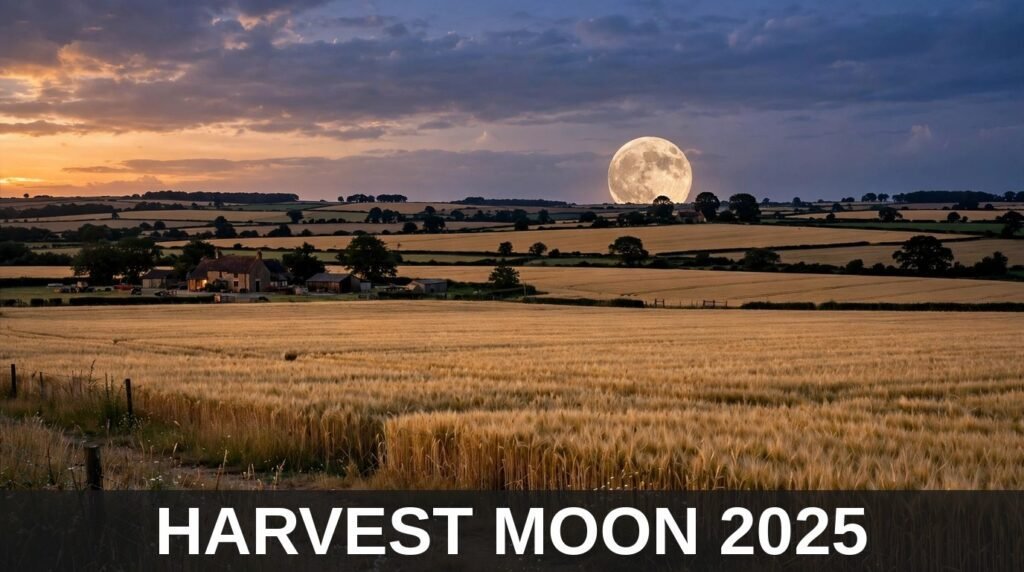
The Harvest Moon 2025 reached its peak on Sunday, 7 September 2025 — and for roughly half the planet, it did something no ordinary full moon does. A few hours before the moment of greatest fullness, the Moon slid into Earth’s shadow and turned a deep, coppery red. It was a total lunar eclipse riding on the year’s most famous full moon, and it gave skywatchers across Asia, Australia, Europe and Africa a harvest moonrise they will not forget in a hurry.
Below you will find the exact date and peak time, a full breakdown of the eclipse and who could see it, the story behind the Harvest Moon name, and one honest complication: 2025 was a rare year in which two different full moons had a claim to the title. We will walk through that too, because it is part of what made this moon so talked about.
| Date | Sunday, 7 September 2025 |
| Peak illumination | 2:09 p.m. ET (18:09 UTC) |
| Special event | Total lunar eclipse (a “Blood Moon”) |
| Totality | 17:30–18:52 UTC — 82 minutes |
| Eclipse visible from | Asia, Australia, Europe, Africa and parts of South America |
| Autumn equinox 2025 | 22 September 2025 |
| Next Harvest Moon | 26 September 2026 |
When Was the Harvest Moon in 2025?
The Harvest Moon 2025 fell on 7 September 2025, reaching peak illumination at 2:09 p.m. Eastern Time (18:09 UTC). A full moon is technically an instant — the moment the Moon sits exactly opposite the Sun in the sky — but nobody experiences it as an instant. The Moon looked completely full on the evenings of 6, 7 and 8 September, and for most viewers the finest sight came at moonrise on the 7th, when the round disc climbed over the eastern horizon just as the Sun was setting in the west.
That timing is the Harvest Moon’s signature. A full moon always rises at around sunset, because it sits opposite the Sun, but around the September equinox the effect is at its most dramatic in northern latitudes: the Moon pops up in a still-glowing sky, huge-looking and golden, night after night. In London, the peak moment arrived at 7:09 p.m. BST, almost exactly as the Moon was rising — and, as we will see, it rose already in eclipse. In New York the peak fell in the early afternoon, with the Moon below the horizon, so American viewers got their best look at the full disc the evening before and the evening after.
A Total Lunar Eclipse on the Same Night
What lifted the Harvest Moon 2025 far beyond a pretty moonrise was the eclipse. On the same date, the Sun, Earth and Moon lined up so precisely that the Moon passed through the darkest part of Earth’s shadow, the umbra. For 82 minutes it sat fully inside that shadow, lit only by sunlight that had filtered around the edges of our planet — and that light is red.
The eclipse timings
The eclipse unfolded on 7 September 2025 between 15:28 and 20:55 UTC, counting the faint penumbral stages at the beginning and end. The main event, totality, ran from 17:30 to 18:52 UTC — a generous 82 minutes, making it one of the longer total lunar eclipses of the decade. This was the second total lunar eclipse of 2025, following the one on 14 March. There was a helpful bonus, too: the full moon occurred just 2.7 days before the Moon reached perigee, its closest point to Earth, so the eclipsed Moon appeared slightly larger than an average full moon.
Who could see it
This eclipse belonged to the Eastern Hemisphere. Asia and western Australia had the prime seats, with the entire eclipse visible from start to finish under dark skies. Europe and Africa caught the action in the evening, and parts of South America saw the closing stages. According to timeanddate, around 77 percent of the world’s population — some 6.2 billion people — were positioned to see at least the total phase. The Americas, by contrast, missed out entirely: for North and South America the eclipse happened during daylight hours with the Moon below the horizon.
British viewers got a particularly theatrical version. Because the eclipse was already under way at moonrise, the Moon came up over the horizon already darkened and reddened, with totality in progress — a red moon rising out of the twilight rather than turning red overhead.
Why the eclipsed Moon turns red
During totality the Moon does not go black. Earth’s atmosphere acts like a lens and a filter at the same time: it bends sunlight around the planet and into the shadow, but on the way through, air molecules scatter the blue part of that light away. What survives the journey is the red and orange end of the spectrum — effectively, the light of every sunrise and sunset on Earth projected onto the lunar surface at once. The exact shade varies from eclipse to eclipse, from bright copper to deep brick red, depending on how much dust and cloud is in our atmosphere at the time.
What Is a Harvest Moon, Exactly?
The Harvest Moon is not a special kind of moon, and it is not tied to a fixed date. It is simply the full moon that falls closest to the autumn equinox — the moment, usually on 22 or 23 September, when the Sun crosses the celestial equator and day and night stand nearly equal. In 2025 the equinox fell on 22 September.
Because the lunar cycle is about 29.5 days long, it drifts against the calendar, so the full moon nearest the equinox usually lands in September but occasionally slips into early October. Whichever month it lands in, that moon takes the Harvest name, and the neighbouring monthly names shuffle around it. The full moon that follows the Harvest Moon is always the Hunter’s Moon. It is the only widely used full moon name defined by an astronomical event rather than by the calendar month — a small quirk that causes real confusion in years like 2025, as we will see below.
Why Is It Called the Harvest Moon?
The name is practical, not poetic — although it has become both. For farming communities in the Northern Hemisphere, September and October were the weeks when corn, pumpkins, squash, barley and wheat had to come in before the weather turned. Before electric light, the working day ended at sunset, except around this one full moon.
Here is the geometry that made it so useful. On most nights of the year, the Moon rises roughly 50 minutes later than it did the night before, so within a few days of full moon the early evening is dark again. But around the autumn equinox, the Moon’s path — the ecliptic — meets the evening horizon at a shallow angle at northern latitudes. The result is that moonrise advances by only about 20 to 30 minutes per night. For several evenings in a row, a bright, nearly full moon is already up at sunset, and farmers could keep working in the fields by its light. That run of gift evenings is what the name commemorates.
The names themselves come down through a blend of Native American and European farming traditions, later popularised by almanacs. September’s moon is also widely known as the Corn Moon, and in some traditions the Barley Moon — both nods to the crops being gathered under it.
The 2025 Twist: Two Moons Argued Over One Name
Now for the honest complication, because 2025 earned one. The September full moon fell on the 7th — a full 15 days before the equinox. The following full moon, on 6–7 October (peaking at 03:48 UTC on 7 October), fell about 14 days after it. Measured strictly by the “closest to the equinox” rule, the October moon was actually nearer — by a margin of less than a day.
That is why you may have seen the two moons labelled differently depending on where you looked. Many almanacs and most news coverage billed the 7 September moon as the Harvest Moon, and it was the one that carried the total lunar eclipse. Others, following the strict closest-to-the-equinox rule, gave the Harvest title to the October moon and called September’s moon the Corn Moon instead. The October moon had its own claim to fame: it was a supermoon, the first of three in a row to end the year, and October Harvest Moons are uncommon — the last was in 2020, the next will not arrive until 2028, and only 18 of them occur between 1970 and 2050.
Neither camp is inventing anything; they are applying the same tradition with slightly different strictness. What matters for anyone who watched the sky is this: September brought the eclipse, October brought the biggest-looking moon, and both arrived wrapped in that run of early, golden moonrises that makes this season special.
Why the Harvest Moon Looks So Big and Orange
Two separate effects greet anyone watching a harvest moonrise. The first is colour. When the Moon sits low on the horizon, its light travels through far more of Earth’s atmosphere than when it is overhead. The air scatters the blue light away and lets the warm tones through, so a rising full moon glows amber, gold or even deep orange until it climbs higher and whitens.
The second effect is size — or rather, the impression of size. The Moon does not physically change as it rises, and photographs taken through the evening show the same disc. But framed against rooftops, trees and hillsides, your brain judges it against familiar objects and reports it as enormous. Psychologists call this the Moon illusion, and it is at its strongest with a harvest moonrise, when the golden disc hangs over exactly the kind of landscape — fields, barns, hedgerows — that gives the eye the most to compare it with. In September 2025 the illusion had a little genuine help, with the Moon nearing perigee and therefore slightly larger in the sky than average.
When Is the Next Harvest Moon?
If 2025’s double act left you wanting a straightforward one, 2026 delivered it. The Harvest Moon of 2026 fell on Saturday, 26 September 2026, peaking at 12:49 p.m. EDT (16:49 UTC) — just four days after that year’s equinox, close enough that nobody argued about the name. The Hunter’s Moon followed on 26 October 2026. Looking further ahead, the next October Harvest Moon arrives in 2028, for those who enjoy the rare version.
Frequently Asked Questions
When was the Harvest Moon in 2025?
The full moon widely billed as the Harvest Moon 2025 fell on Sunday, 7 September 2025, peaking at 2:09 p.m. ET (18:09 UTC). Strictly by the closest-to-the-equinox rule, the full moon of 6–7 October was marginally nearer the 22 September equinox, which is why some almanacs gave the Harvest title to October and called September’s moon the Corn Moon.
Was the Harvest Moon 2025 also an eclipse?
Yes. The 7 September 2025 full moon coincided with a total lunar eclipse. Totality lasted 82 minutes, from 17:30 to 18:52 UTC, during which the Moon turned a deep red — a so-called Blood Moon.
Where was the September 2025 eclipse visible?
The eclipse was visible across Asia and western Australia in full, and in the evening from Europe and Africa, with parts of South America catching the later stages. Around 77 percent of the world’s population could see totality. The Americas missed it entirely, as it took place during their daytime.
Why is it called the Harvest Moon?
It is the full moon nearest the autumn equinox, and its name comes from farming. Around the equinox the Moon rises only 20 to 30 minutes later each night instead of the usual 50, giving several evenings of bright moonlight just after sunset — light farmers historically used to bring in the harvest after dark.
Why did the eclipsed Moon look red?
During a total lunar eclipse, the only sunlight reaching the Moon has passed through Earth’s atmosphere. The air scatters away the blue light and bends the remaining red and orange light into Earth’s shadow, so the Moon glows with the combined light of every sunrise and sunset on the planet.
When is the next Harvest Moon?
The Harvest Moon after 2025 fell on 26 September 2026, four days after that year’s autumn equinox. The next October Harvest Moon — the rarer variety — arrives in 2028.
Conclusion
The Harvest Moon 2025 will be remembered less for its name than for its timing: a full moon on 7 September that rose into a total lunar eclipse, hung red over four continents for 82 minutes, and still delivered the string of bright, harvest-lit evenings the name promises. Whether you file it as a Harvest Moon or a Corn Moon, it was one of the finest lunar shows of the year — and a reminder that this most traditional of moons still has surprises in it.
Read Also: Moon Tonight
1 Comment