
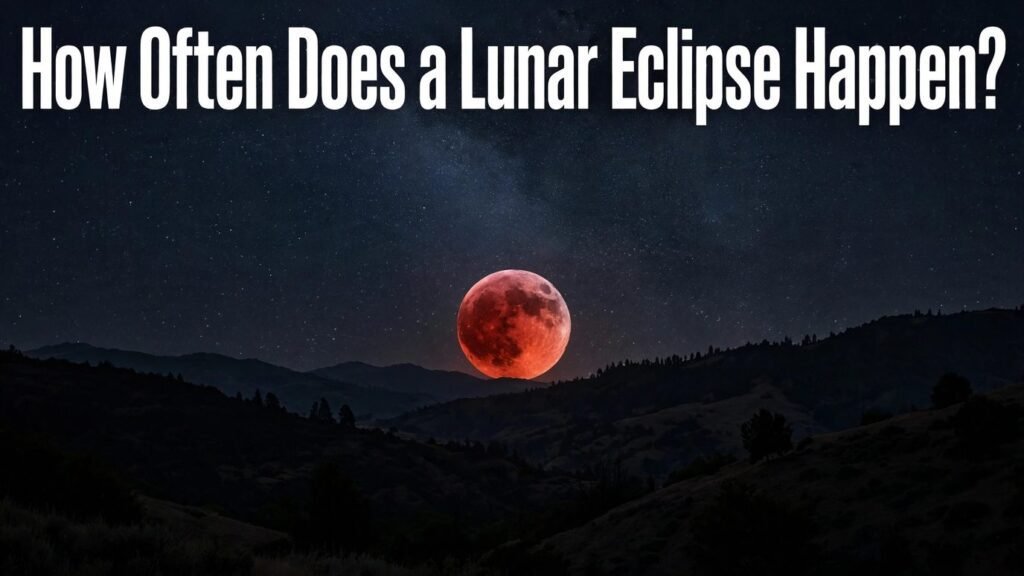
How often does a lunar eclipse happen? Have you ever stayed up late hoping to catch a lunar eclipse, only to realise you missed it by a few days? Or maybe you have heard someone say that lunar eclipses are rare, once-in-a-lifetime events, and wondered whether that is actually true. The good news is that you do not have to wait decades for the next one. Lunar eclipses happen far more often than most people expect, and when one does occur, it is usually visible to an enormous number of people at the same time.
The confusion is understandable. Solar eclipses get most of the attention, partly because a total solar eclipse is such a dramatic, daylight-turning-to-darkness spectacle, and partly because you have to be in exactly the right place to see one. Lunar eclipses work very differently. They are gentler, slower, and much more generous with their audience. If you know roughly how often they happen and why they cluster the way they do, you will never be caught by surprise again.
In this guide, we will answer the question simply and honestly: how often does a lunar eclipse happen, what counts as a lunar eclipse in the first place, and why some years bring several while others bring fewer. We will also look at why the Moon turns red, why total eclipses are less common than partial ones, and how ancient astronomers learned to predict eclipses centuries in advance.
The short answer: Lunar eclipses happen about two to three times per year on average, counting all types. In some years there can be as many as five, while in other years there may be only two. Total lunar eclipses, the dramatic kind where the whole Moon turns deep red, happen less often — roughly once every two and a half years on average for any given location, though the exact wait varies. The key reason lunar eclipses feel common is that when one happens, it is visible from an entire hemisphere of Earth at once, so your chances of seeing one are far better than for a solar eclipse.
Why Does a Lunar Eclipse Happen at All?
A lunar eclipse happens when the Earth passes directly between the Sun and the Moon, casting its shadow onto the lunar surface. For this to occur, the three bodies need to line up in a fairly straight line, with the Earth in the middle. The Moon does not produce its own light; it shines because sunlight reflects off its surface. So when Earth blocks that sunlight, the Moon darkens, sometimes dramatically.
This sounds simple, but it raises an obvious question. The Moon orbits the Earth roughly once a month, so why does it not pass through Earth’s shadow every single month at full Moon? The answer lies in the tilt of the Moon’s orbit.
The Tilt That Saves Us From Monthly Eclipses
The Moon’s orbit around Earth is tilted by about five degrees relative to Earth’s orbit around the Sun. That may not sound like much, but over the distance between the Earth and the Moon, it is enough to make a big difference. Most months at full Moon, the Moon passes slightly above or slightly below Earth’s shadow, missing it entirely. Only when the alignment is close enough, and the Moon happens to be near one of the two points where its orbit crosses Earth’s orbital plane, does an eclipse occur.
Those crossing points are called nodes. Eclipses can only happen when the Moon is near a node at the same time as it is full. That combination does not happen every month, which is why lunar eclipses are special events rather than monthly occurrences, even though full Moons themselves happen twelve or thirteen times a year.
How Many Lunar Eclipses Happen Each Year?
On average, there are two to three lunar eclipses per year somewhere on Earth. That figure counts all three types of lunar eclipse, including the subtle penumbral kind that many casual skywatchers might not even notice. In some years, the total can climb to four or even five, while in quieter years it may drop to just two.
It is worth being clear about what this average means. It describes how many lunar eclipses occur globally in a calendar year, not how many you will personally see from your backyard. Clouds, your location, and the time of day all matter. An eclipse that happens while it is daytime where you live will not be visible to you, even though people on the night side of Earth are watching it. Still, because a lunar eclipse is visible from anywhere on the night side of the planet, your odds are far better than they are for a solar eclipse.
A Year With Several Eclipses Is Not Unusual
If you ever hear that a particular year will have three or four lunar eclipses, that is not a freak occurrence. It is simply how the geometry works out in that year. Eclipse seasons, which we will explain below, drift slowly through the calendar, and sometimes the timing lines up so that an extra eclipse squeezes into the same calendar year. The long-term average smooths out these ups and downs to roughly two or three per year.
The Three Types of Lunar Eclipse
Not all lunar eclipses look the same. Depending on how deeply the Moon enters Earth’s shadow, you will see one of three types. Understanding the difference helps explain why some eclipses make headlines while others pass almost unnoticed.
Total Lunar Eclipse
A total lunar eclipse happens when the entire Moon passes into Earth’s darkest shadow, the umbra. During totality, the Moon does not disappear completely. Instead, it glows a deep coppery red or orange, which is why total lunar eclipses are often called blood moons. Totality can last for well over an hour in some cases, giving skywatchers plenty of time to enjoy the view.
Partial Lunar Eclipse
In a partial lunar eclipse, only part of the Moon enters the umbra, while the rest stays in the lighter outer shadow or in direct sunlight. The result is a Moon that looks as though a dark bite has been taken out of it. Partial eclipses are more common than total ones, because the alignment does not have to be as precise. Even a small partial eclipse is easy to spot, since the darkened portion stands out clearly against the bright remainder of the Moon.
Penumbral Lunar Eclipse
A penumbral lunar eclipse is the subtlest kind. The Moon passes only through Earth’s outer shadow, the penumbra, and never enters the umbra at all. The effect is a slight dimming or shading on one side of the Moon, which can be hard to notice unless you are looking carefully or comparing photographs. Many penumbral eclipses go unnoticed by the general public, which is one reason the total number of lunar eclipses per year can sound higher than people’s personal experience suggests.
| Type | What happens | How obvious is it? |
|---|---|---|
| Total lunar eclipse | Whole Moon enters the umbra | Very obvious; Moon turns red |
| Partial lunar eclipse | Part of the Moon enters the umbra | Obvious; dark shadow creeps across the Moon |
| Penumbral lunar eclipse | Moon only enters the penumbra | Subtle; slight shading on one side |
Why Total Lunar Eclipses Are Rarer
If lunar eclipses happen two to three times a year, why do total lunar eclipses feel so much rarer? The answer is precision. For a total eclipse, the Sun, Earth, and Moon must line up almost exactly, so that the whole Moon fits inside the umbra. Even a small offset means only part of the Moon is covered, producing a partial eclipse instead, or the Moon may only graze the penumbra.
On average, a total lunar eclipse occurs somewhere on Earth roughly once every two and a half years. But that is a global average, and your personal experience may differ. Because total lunar eclipses are visible from a whole hemisphere, many people will have the chance to see one within a few years of looking. If clouds spoil one, another will come along sooner than you might think. The wait for a total lunar eclipse from a given location is measured in years, not decades, which is very different from the wait for a total solar eclipse from the same spot, which can be centuries.
Total vs Partial: A Quick Comparison
| Feature | Total lunar eclipse | Partial lunar eclipse |
|---|---|---|
| Frequency | Less common, roughly every couple of years | More common |
| Alignment needed | Very precise | Less precise |
| Appearance | Whole Moon dark red | Dark shadow over part of the Moon |
| Duration of main event | Totality can last over an hour | Varies; the partial phase can last a couple of hours |
| Visibility | Whole night-side hemisphere | Whole night-side hemisphere |
Why You Can See a Lunar Eclipse So Easily
One of the most delightful things about lunar eclipses is how easy they are to watch. You do not need special glasses, expensive equipment, or a trip to a remote location. You just need a clear sky, a view of the Moon, and to be on the night side of Earth at the right time.
The reason is scale. The Moon itself is the object being shadowed, and everyone on the night side of Earth sees the same Moon at the same time. Compare that with a solar eclipse, where the Moon’s shadow on Earth is only a narrow path, sometimes just tens of kilometres wide. To see a total solar eclipse, you must stand inside that narrow path. To see a total lunar eclipse, you simply need to be somewhere it is night.
Lunar eclipses are also slow. The whole event unfolds over several hours, from the first faint shading through the main eclipse and back to a normal full Moon. There is no brief moment of totality that you might blink and miss, as there is with a solar eclipse. You can step outside at various points during the evening and watch the shadow creep across the Moon at a leisurely pace. This relaxed timing is part of why lunar eclipses are such good events for families, schools, and first-time stargazers.
Eclipse Seasons: Why Eclipses Come in Pairs
Lunar eclipses do not arrive evenly spaced through the year. Instead, they tend to cluster in periods called eclipse seasons. An eclipse season lasts about five to six weeks and occurs roughly every six months, when the Sun is near one of the Moon’s nodes.
During an eclipse season, there is usually at least one solar eclipse and one lunar eclipse, roughly two weeks apart. That pairing makes sense when you think about the geometry: if the alignment is good enough for a lunar eclipse at full Moon, then about two weeks earlier or later, at new Moon, the alignment may also be good enough for a solar eclipse. Not every eclipse season produces both kinds, and not every eclipse in a season is total, but the clustering is a real pattern.
Because eclipse seasons shift slowly through the calendar, the dates of eclipses move earlier each year. Over time, this drift means that the pattern of eclipses in any given year is never quite the same as the year before, even though the underlying rhythm stays steady.
The Saros Cycle: Nature’s Eclipse Calendar
Ancient astronomers noticed something remarkable: eclipses repeat in a pattern. After a period of about eighteen years and eleven days, a very similar eclipse occurs again. This cycle is called the Saros cycle, and it was known to Babylonian astronomers thousands of years ago.
The Saros cycle works because three different lunar rhythms happen to line up after that period: the Moon returns to the same phase, to the same node, and to roughly the same distance from Earth. The result is an eclipse that closely resembles the one eighteen years earlier, though not exactly. Each eclipse belongs to a Saros series, a family of eclipses spaced about eighteen years apart, and each series lasts for many centuries, gradually evolving as the geometry shifts.
You do not need to memorise the Saros cycle to enjoy lunar eclipses, but it is a beautiful reminder of how predictable the sky really is. The same clockwork that produced the eclipse your grandparents watched will produce a similar one for your grandchildren, shifted slightly in time and place.
What Makes the Moon Turn Red?
Perhaps the most magical part of a total lunar eclipse is the colour. Instead of vanishing into darkness, the Moon turns a deep red, copper, or orange. This is not a trick of the imagination, and it is not the Moon changing colour on its own. It is Earth’s atmosphere at work.
During a total lunar eclipse, the Earth blocks direct sunlight from reaching the Moon. However, some sunlight passes through Earth’s atmosphere on its way to the Moon. As it does, the atmosphere scatters the shorter blue wavelengths of light away, in a process called Rayleigh scattering. This is the same process that makes our sky blue during the day and sunsets red in the evening. The remaining longer red and orange wavelengths are bent, or refracted, through the atmosphere and onto the Moon’s surface, giving it that eerie red glow.
Why Some Blood Moons Look Brighter Than Others
Not every total lunar eclipse looks the same shade of red. Some are bright copper, others are a deep, dark rust, and a few are so dark that the Moon nearly disappears. The difference comes down to conditions in Earth’s atmosphere at the time. Dust, clouds, and volcanic particles in the atmosphere can block more light and make the eclipse darker. A very clean atmosphere lets more red light through, producing a brighter eclipse. In that sense, every blood moon is also a quiet report on the state of our own planet’s air.
Why We Call It a Blood Moon
The term blood moon is a popular nickname for a total lunar eclipse, inspired by the Moon’s red appearance during totality. It is not a formal scientific term, but it has caught on because it captures the drama of the event so vividly. In recent years, you may also have heard phrases like super blood moon, which simply combine a total lunar eclipse with a supermoon, when the full Moon is near its closest point to Earth and appears slightly larger than usual.
It is worth noting that a blood moon is not a different kind of eclipse. It is just a colourful name for a total lunar eclipse. If you hear that a blood moon is coming, you are hearing about a total lunar eclipse, and everything in this guide about frequency and visibility applies.
How to Catch the Next One Without Missing Out
Since lunar eclipses happen a few times a year, the best strategy is simply to stay aware. Eclipse dates are published well in advance by astronomy organisations and observatories, and because lunar eclipses are visible across a whole hemisphere, you rarely need to travel to see one. A few simple habits will make sure you do not miss the next one.
First, keep an eye on astronomy news around the times of year when eclipse seasons fall. Second, check whether the eclipse will be visible from your location and whether it happens at night for you; an eclipse on the other side of the world will not help if it is midday where you live. Third, find a spot with a clear view of the Moon and as little light pollution as you can manage, though even from a city, a lunar eclipse is usually easy to see. Finally, be patient and dress warmly if it is a cold night, because the best part of the show unfolds slowly over hours.
You do not need a telescope to enjoy a lunar eclipse, although binoculars or a small telescope can make the colours and the edge of Earth’s shadow look even more striking. A camera on a tripod can also capture the changing phases nicely. But honestly, your own eyes are the best instrument for this event, and there is something special about simply standing outside and watching Earth’s shadow slide across the Moon.
Frequently Asked Questions
How often does a lunar eclipse happen?
On average, lunar eclipses happen two to three times per year, counting total, partial, and penumbral eclipses. Some years have as many as five, while others have only two. Total lunar eclipses are less frequent, occurring roughly once every two and a half years on average.
Why is there not a lunar eclipse every month?
Because the Moon’s orbit is tilted by about five degrees, the Moon usually passes above or below Earth’s shadow at full Moon. An eclipse can only happen when the full Moon occurs near one of the points where the Moon’s orbit crosses Earth’s orbital plane.
Can a lunar eclipse be seen from everywhere on Earth?
No, but it can be seen from everywhere on the night side of Earth at the time of the eclipse, which is roughly half the planet. That is a much larger audience than a solar eclipse gets, since a solar eclipse is only visible along a narrow path.
Is it safe to look at a lunar eclipse with the naked eye?
Yes. Unlike a solar eclipse, a lunar eclipse is completely safe to watch with the naked eye, binoculars, or a telescope. You are looking at the Moon, not the Sun, and the Moon’s light during an eclipse is actually dimmer than usual.
How long does a lunar eclipse last?
The entire event, from the first penumbral shading to the final return to a normal full Moon, can last several hours. The most dramatic part, totality for a total eclipse, can last for well over an hour, while the partial phases on either side add more time.
What is the difference between a blood moon and a total lunar eclipse?
There is no difference. Blood moon is simply a popular nickname for a total lunar eclipse, named for the deep red colour the Moon takes on during totality. It is not a separate scientific category.
Why do lunar eclipses happen in pairs with solar eclipses?
Lunar and solar eclipses often occur about two weeks apart during an eclipse season, because the same alignment conditions that allow a lunar eclipse at full Moon can also allow a solar eclipse at new Moon. The Sun must be near one of the Moon’s nodes for either type to occur.
Conclusion
So, how often does a lunar eclipse happen? More often than you probably thought. With two to three lunar eclipses per year on average, and total lunar eclipses coming along roughly every couple of years, you do not need to wait a lifetime to see one. The real trick is not rarity but awareness: knowing when eclipse seasons fall, checking whether an eclipse is visible from where you live, and stepping outside on a clear night.
Lunar eclipses are among the most accessible wonders in astronomy. They require no special equipment, no travel, and no protective glasses. They unfold slowly, they are visible to half the planet at once, and they paint the familiar Moon in colours you never see on an ordinary night. The next time you hear that a lunar eclipse is coming, make a plan to watch it. Chances are, you will not have to wait long for the one after that either.
Read Also: How Often Does a Solar Eclipse Happen? A Simple Guide
