How Old Is the Solar System? (Explained Simply) — Guide 2026
Awais
Founder & Chief Administrator
Published October 24, 2026 · Updated October 24, 2026
It is one of those questions that sounds almost too big to answer: how old is the solar system, exactly? How do you put a birthday on something that was around for billions of years before anyone existed to keep a calendar? And yet astronomers will tell you, with a straight face and surprising confidence, that the solar system is about 4.6 billion years old. Not 2 billion, not 10 billion — 4.6.
That number did not come from a guess or a philosophical argument. It came from actual rocks — rocks that fell out of the sky, rocks that have been floating through space almost untouched since before the Earth existed. Scientists measured how those rocks have aged, the same way you might read rings on a tree stump, except the “rings” here are atoms slowly transforming inside the rock.
If you have ever looked up at the night sky and wondered how long all of this has really been going on, you are asking exactly the right question. This guide walks through the answer the way a curious human would: what the number is, how scientists figured it out, why it is so precise, and what a 4.6-billion-year-old solar system actually means for us.
The short answer: The solar system is about 4.6 billion years old. The oldest solid materials ever dated — tiny mineral grains inside meteorites — come in at about 4.568 billion years, and every line of evidence, from the Sun’s life cycle to the age of the Moon, points to the same origin point. We know because atoms inside ancient meteorites act like clocks that started ticking the moment the solar system formed.
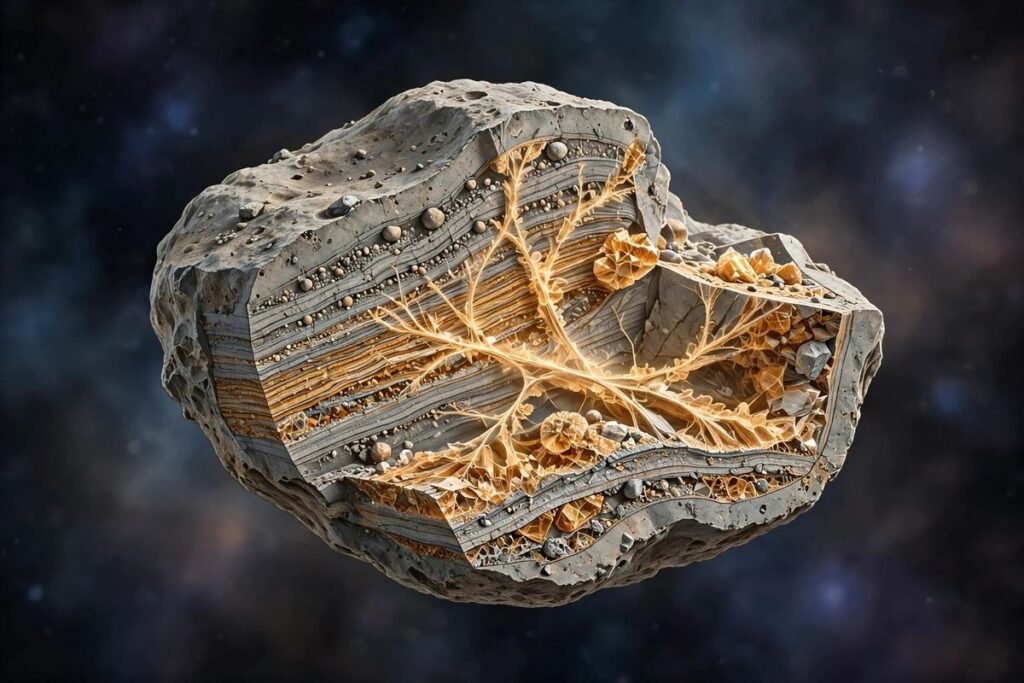
Meteorites are the oldest rocks we can touch — their radioactive clocks reveal how old the solar system is.
How Old Is the Solar System — And How Do We Actually Know?
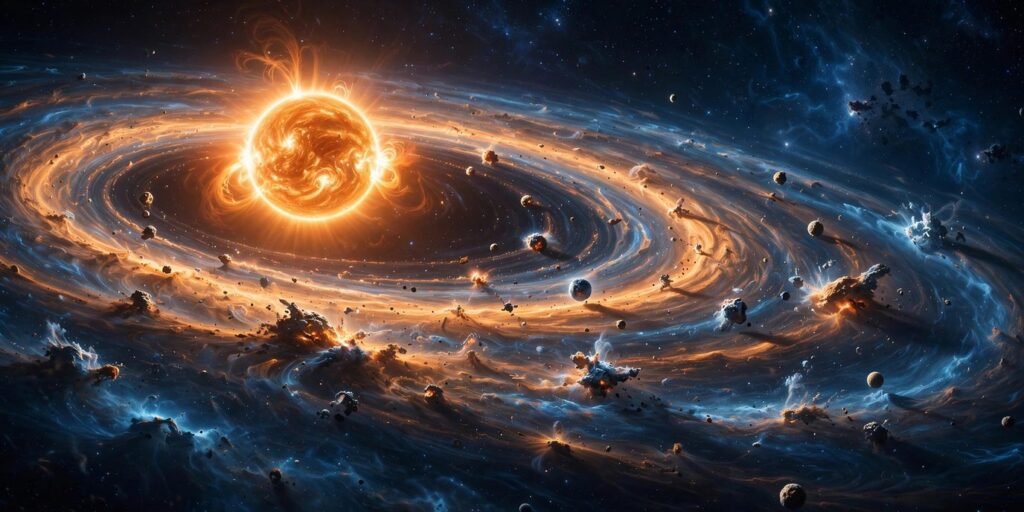
Before we get into the rocks, it helps to understand what “4.6 billion years old” even means. The solar system was not born in a single instant like a lightning strike. It formed gradually — a cloud of gas and dust collapsed, the Sun ignited, planets grew from pebbles into worlds. The whole process took tens of millions of years.
So when scientists say 4.6 billion years, they mean something specific: the time since the first solid materials in our solar system condensed out of that hot, swirling cloud. That is the birthday we can actually measure, because it left physical evidence behind. Everything else — the Sun lighting up, the planets assembling — happened shortly after that moment, and the clocks that record it all agree with each other.
This matters because it is not a philosophical answer; it is a forensic one. Scientists did not choose 4.6 billion years because it sounded right. They chose it because multiple independent measurements all point to the same stretch of time. When geology, astronomy, and physics all converge on one number, you can trust it.
What Is Radiometric Dating, and Why Do Astronomers Trust It?
Here is the core idea behind the whole age measurement, and it is beautifully simple. Certain atoms are unstable. Over time, they break down into different atoms at a steady, predictable rate. Physicists call the time it takes for half of a sample to transform its “half-life,” and once you know a half-life, you have a clock.
Take uranium-238, for example. It has a half-life of about 4.468 billion years — conveniently close to the age of the solar system itself. Over billions of years, uranium-238 decays step by step into lead-206. If you measure how much uranium and how much lead are inside a rock, and you know nothing about the rock’s history, you can work out how long the decay has been going on. More lead relative to uranium means more time has passed.
The beautiful thing is that these decay rates do not change. They are not affected by heat, pressure, chemistry, or time. An atom of uranium in a meteorite decays at exactly the same rate as an atom of uranium in a laboratory today. That is why astronomers trust radiometric dating the way they do — the physics is not up for debate, and the results are repeatable.
Scientists use several different decay systems and check them against each other:
Uranium-lead dating — the gold standard for very old samples, with half-lives measured in billions of years.
Potassium-argon dating — useful for somewhat younger rocks, down to hundreds of millions of years.
Rubidium-strontium dating — another long-timescale clock, commonly used on meteorites and lunar samples.
When three independent clocks all give you the same answer, you can be confident you are not fooling yourself. That is exactly what happened with the age of the solar system.
Why Are Meteorites the Key to the Solar System’s Age?
You might wonder: why not just date a rock from Earth? The problem is that the Earth is a geologically restless place. Our planet melts its crust, recycles its rocks through plate tectonics, and erodes everything through wind and water. The oldest Earth rocks we have found — in places like the Acasta Gneiss in Canada — are about 4.03 billion years old. That is ancient, but it is younger than the solar system, because those rocks formed after the Earth itself had already been around for a while, and everything older was destroyed or melted.
Meteorites, on the other hand, are time capsules. Many of them — especially the primitive, undifferentiated ones called chondrites — have barely changed since they formed in the early solar system. They are fragments of asteroids that never grew into planets, so they escaped the melting and reworking that erased Earth’s early history. When you hold a carbonaceous chondrite meteorite, you are holding material that condensed out of the solar nebula itself.
That is why astronomers treat meteorites as the most reliable witnesses to the solar system’s birth. Earth has amnesia about its own early years; meteorites remember.
What the Allende Meteorite Told Us
The most famous example is the Allende meteorite, which fell over Mexico in 1969. It is a carbonaceous chondrite packed with small, pale inclusions — and when scientists dated those inclusions with uranium-lead methods, they got one of the most important numbers in all of astronomy: about 4.568 billion years. This is currently our best measurement of when solid material first formed in the solar system. It is the number that anchors everything else.
What Are Calcium-Aluminum Inclusions, and Why Do They Matter So Much?
Those pale inclusions inside meteorites like Allende have a formal name: calcium-aluminum-rich inclusions, usually shortened to CAIs. They are tiny — often only millimeters across — but they are extraordinary. They are the oldest solid objects we know of anywhere in the solar system.
Here is why they formed first. As the solar nebula began to cool after its initial collapse, the elements with the highest melting points condensed into solids first. Calcium and aluminum minerals solidify at very high temperatures, so CAIs were literally the first solids to rain out of the hot nebula gas. Everything else — including the ingredients that would become Earth — condensed later, as things cooled further.
Dating CAIs is therefore dating the solar system’s birth in the most direct sense possible. When scientists report that the solar system is about 4.6 billion years old, they are rounding off that CAI date of about 4.568 billion years. The precision is remarkable — modern measurements pin it down to within a few hundred thousand years, which is essentially an instant on a 4.6-billion-year timescale.
CAIs are the oldest dated solids: ~4.568 billion years.
Chondrules (the round droplets in chondrites) formed a couple of million years later.
The planets assembled over the tens of millions of years after that.
That tight sequence is how we know the early solar system evolved fast. The whole construction project went from dust to planets in a cosmic blink.
How Old Is the Sun Compared to the Rest of the Solar System?
The Sun is almost exactly the same age as everything else — which makes sense, because it all formed together. Stellar evolution models, which describe how stars of the Sun’s mass live and die, indicate the Sun is about 4.6 billion years old, right in line with the meteorite dates.
But here is a subtlety worth appreciating. The Sun did not “turn on” at the same instant the CAIs formed. The sequence went roughly like this:
The solar nebula cloud began to collapse under its own gravity.
The first solids (CAIs) condensed in the hot inner regions.
A dense protostar formed at the center and began to glow as it contracted.
Nuclear fusion ignited in the Sun’s core — the true birth of the star.
Intense winds from the young Sun blew away leftover gas, ending planet formation.
Steps 1 through 4 happened within a few million years of each other — fast enough that “about 4.6 billion years” describes all of them accurately. For most purposes, the Sun, the planets, and the meteorites share a birthday.
Is the Earth Younger Than the Solar System?
Strictly speaking, yes — by a small but real amount. The Earth is generally dated to about 4.54 billion years old, roughly 30 million years younger than the oldest CAIs. That gap is exactly what you would expect: the first solids formed, then the Earth had to assemble from colliding planetesimals, differentiate into core and mantle, and cool enough to keep a solid crust.
The Moon is in a similar position. Dating of lunar rocks brought back by the Apollo missions, combined with the giant-impact hypothesis (the idea that the Moon formed from debris after a Mars-sized body struck the early Earth), puts the Moon at about 4.51 billion years old.
Here is a quick summary of how the ages line up:
Object
Approximate age
How we know it
Oldest meteorite materials (CAIs)
~4.568 billion years
Uranium–lead radiometric dating
The Sun
~4.6 billion years
Stellar evolution models + meteorite cross-checks
Earth
~4.54 billion years
Radiometric dating, cross-checked with meteorites
The Moon
~4.51 billion years
Dating of Apollo lunar samples
Oldest surviving Earth rocks (Acasta Gneiss)
~4.03 billion years
Direct radiometric dating
Notice how consistent the story is. Nothing is wildly out of place. Every object fits into a sequence that starts with the CAIs and moves forward — which is exactly why scientists are so confident. If you are someone who loves these long cosmic timelines, there are more big-picture deep dives on the universe over at 9bio.co.uk that put these ages into an even broader context.
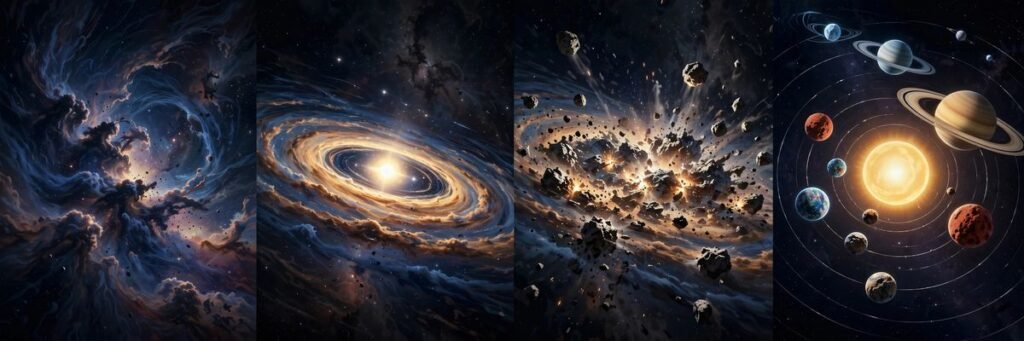
The solar system formed in stages: a collapsing cloud, a spinning disk, colliding planetesimals, and finally the planets we know today.
How Did the Solar System Actually Form, Step by Step?
Knowing the age is one thing; picturing what those 4.6 billion years contained is another. Here is the widely accepted story — the solar nebula hypothesis — broken into its main chapters.
The Cloud Collapses
About 4.6 billion years ago, a large cloud of gas and dust — the solar nebula — began to collapse under its own gravity. Something may have triggered it, possibly the shockwave from a nearby supernova, but the trigger is still debated. What is certain is that the cloud shrank and spun faster as it collapsed, flattening into a disk with a hot, dense center.
The Sun Ignites
The center of the disk became the protostar that would become our Sun. As it contracted, its core grew hotter and denser until hydrogen fusion ignited — the moment a star was born. That ignition flooded the young system with light and drove powerful stellar winds that began clearing away the leftover gas.
Planets Assemble from Dust
In the surrounding disk, dust grains stuck together into pebbles, pebbles into boulders, and boulders into planetesimals — kilometer-sized building blocks. Through countless collisions, the planetesimals grew into planetary embryos and then into the eight planets. Close to the young Sun, only rocky material could survive the heat, so the inner planets are rocky. Farther out, ice and gas were abundant, so the outer planets grew into giants.
The Early Chaos Settles
The first few hundred million years were violent. The Moon-forming impact happened around 4.51 billion years ago. Heavy bombardment scarred every solid surface. But gradually the collisions slowed, atmospheres formed, oceans filled on Earth, and the solar system settled into the calm, clockwork arrangement we see today — more or less where it has been for the last 4 billion years.
Time after the start
What was happening
0
Solar nebula begins to collapse; first CAIs condense
How Does 4.6 Billion Years Compare to the Age of the Universe?
One of the most mind-stretching things about the solar system’s age is how it fits into the bigger picture. The universe is about 13.8 billion years old, based on measurements of the cosmic microwave background and the expansion of the universe. That means the solar system is roughly one-third as old as the universe itself.
Put another way: by the time our Sun was born, the universe had already been around for about 9 billion years. Two full generations of stars had lived and died before ours. Those earlier stars forged the heavy elements — carbon, oxygen, iron, and everything heavier — in their cores and scattered them across space in supernova explosions. Our solar system formed from that enriched material.
That is a profound thought. The calcium in your bones and the iron in your blood were cooked inside stars that died billions of years before the Sun was born. The solar system’s “old” age of 4.6 billion years is, in cosmic terms, middle-aged — and we are latecomers built from recycled stardust. Science roundups covering these kinds of universe-scale stories appear regularly at themodernpost.co.uk, if you enjoy this angle on astronomy.
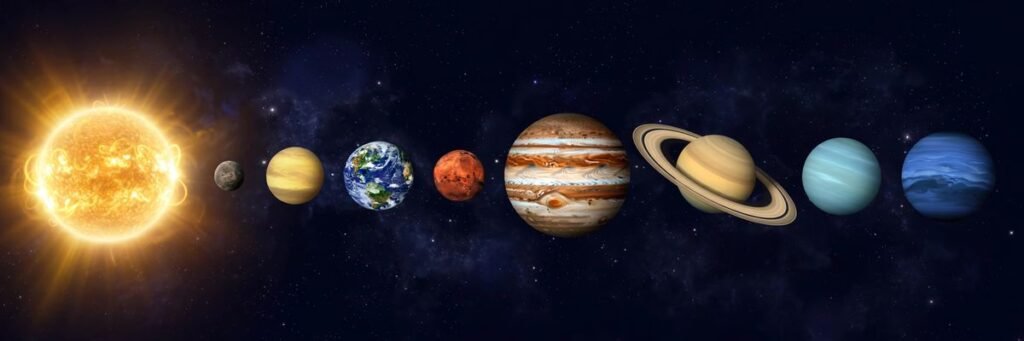
All eight planets formed from the same disk around the same time — which is why they share one birthday.
Could the Solar System Be Older Than We Think?
This is a fair question, and scientists have asked it too. Could the CAIs be younger than the true start? Could something predate them? Here is where the science stands.
It is possible — in principle — that the solar nebula began collapsing slightly before the oldest dated CAIs formed. The CAIs record the first solids, but the collapse itself may have started a bit earlier, perhaps by a few million years. On a 4.6-billion-year scale, a few million years is a rounding error, though, so it does not change the headline number.
What scientists are confident about is that the solar system is not dramatically older. There is no evidence for solid material older than the CAIs, and the stellar-evolution age of the Sun agrees with the meteorite age. If the solar system were secretly, say, 6 billion years old, the Sun’s life cycle and the decay clocks would disagree — and they do not. The consistency across independent methods is the strongest argument that 4.6 billion is right.
Frequently Asked Questions
Is the solar system 4.5 or 4.6 billion years old?
Both, depending on rounding. The commonly quoted figure is 4.6 billion years, which rounds up from the measured CAI age of about 4.568 billion years. Some sources say 4.5 billion, which rounds down. They are describing the same measurement; the difference is just rounding, not disagreement.
How do we know how old is the solar system if we cannot observe it forming?
We cannot watch the solar system form, but we do not need to. Radiometric dating measures how much radioactive decay has happened inside ancient rocks, and the decay rates are fixed by physics. It is like finding a stopwatch that was started 4.6 billion years ago and is still running — you just have to read it.
What is the oldest thing a person can actually hold in their hands?
A carbonaceous chondrite meteorite, such as a fragment of the Allende meteorite. Its calcium-aluminum-rich inclusions are about 4.568 billion years old — older than any rock native to Earth. Museums and universities hold pieces of these meteorites, and some private collectors do too.
Is the universe older than the solar system?
Yes, much older. The universe is about 13.8 billion years old, roughly three times the solar system’s age. Our Sun is a second- or third-generation star, formed from material enriched by earlier stars that had already lived and died.
Why do we not just date rocks on Earth to get the age?
Because Earth’s geology destroyed its earliest rocks. Plate tectonics, volcanism, and erosion have recycled or erased everything from the planet’s first few hundred million years. The oldest Earth rocks, at about 4.03 billion years, postdate the solar system’s formation. Meteorites escaped that fate, so they preserve the earlier record.
How much longer will the solar system last?
The Sun is about halfway through its roughly 10-billion-year lifespan as a stable, hydrogen-burning star. It has about 5 billion years left before it exhausts its core hydrogen, swells into a red giant, and eventually fades into a white dwarf. The solar system as a collection of planets will not survive that transformation intact.
Does “4.6 billion years” include the time before the planets formed?
The number marks the formation of the first solids, which is effectively the beginning of the planet-building process. The nebula may have begun collapsing slightly earlier, but any difference is tiny compared with 4.6 billion years. For all practical purposes, the number covers the full history from cloud to planets.
Final Thoughts
There is something quietly thrilling about the fact that we know this. Four and a half centuries ago, nobody knew what stars were. Now we can read the birth date of our entire solar system in the atoms of a rock that fell from the sky. The method is elegant — unstable atoms ticking away like clocks — and the answer it gives is consistent everywhere we check: the Sun, the Earth, the Moon, and the meteorites all point to about 4.6 billion years.
That number also puts us in our place, in the best possible way. We live on a planet that took tens of millions of years to assemble from cosmic dust, orbiting a middle-aged star in a universe three times older still. The atoms in our bodies were forged in stars that died before the Sun existed. When you look up at the night sky tonight and wonder how old is the solar system, remember: you are looking at a 4.6-billion-year-old system — and you are made of it.
Awais is the founder, chief administrator, and lead science curator of Astronomy 101 (astronomy101.co.uk). Dedicated to making space science and astronomical observing accessible to learners worldwide, Awais oversees the research, computational tools, and editorial integrity of all publications across the platform.
Explore This Topic
Solar System Hub
Dive into our complete collection of tutorials, observations, and deep dives for this subject.