
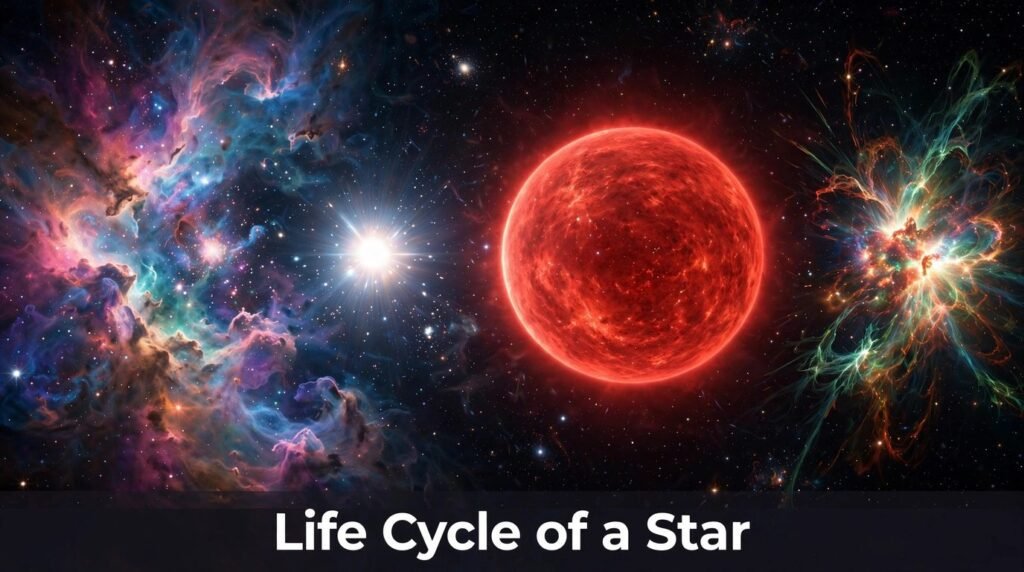
Every star you see in the night sky is living through the life cycle of a star. Some are newborns, still wrapped in the gas clouds that made them. Others are in the long, steady middle of their lives, shining calmly for billions of years. And a few are old giants, swelling and cooling as they run out of fuel, heading for a dramatic end.
The life cycle of a star is that story, from birth to death. It is one of the most elegant ideas in astronomy, because the same basic plot plays out for every star in the universe, yet the ending changes completely depending on a single factor: how much mass the star was born with.
In this guide, you will follow the life cycle of a star from its birth in a nebula to its final fate, whether that is a quiet fade into a white dwarf or a spectacular supernova. You will see how mass decides everything, how long each stage lasts, what will eventually happen to our own Sun, and what you can spot for yourself on a clear night. By the end, the life cycle of a star will read like one connected story.
The short answer: A star is born when a cloud of gas and dust called a nebula collapses under gravity and heats up enough for nuclear fusion to begin. It then spends most of its life steadily fusing hydrogen into helium on the main sequence. When the hydrogen runs out, it swells into a red giant or red supergiant. Low-mass stars like the Sun end quietly as white dwarfs, while massive stars explode as supernovae and leave behind a neutron star or a black hole. Mass decides the ending.
What Is the Life Cycle of a Star?
The life cycle of a star is the sequence of stages a star passes through from its formation to its end. Every star begins the same way, in a cold cloud of gas and dust, and every star spends most of its life in one long, stable stage. But from that point on, the paths split.
Think of it like a human life. There is a birth, a long adulthood, and then old age. The difference is the scale. A star’s “adulthood” can last millions of years or tens of billions of years. And its old age can end in a gentle fading away or in one of the most violent explosions in the universe.
The whole life cycle of a star is driven by a tug of war between two forces. Gravity constantly pulls the star’s material inward, trying to crush it. Nuclear fusion in the core pushes outward, as the energy released by fusing lighter elements into heavier ones holds gravity back. As long as those two forces balance, the star is stable. When the fuel runs low, gravity starts to win, and the star changes.
That balance, and how it breaks, explains every stage you are about to read.
How Are Stars Born in a Nebula?
Every star begins in a nebula, a vast, cold cloud of gas and dust floating between the stars. These clouds are mostly hydrogen, with some helium and a sprinkling of heavier elements left behind by earlier generations of stars. A nebula can stretch across many light-years, yet it is so thin that you could fly through it without noticing.
Something has to disturb the cloud before a star can form. It might be the shock wave from a nearby supernova, a collision between two clouds, or the gentle pull of a passing star. Whatever the trigger, a pocket of the cloud begins to collapse under its own gravity.
As the pocket shrinks, it heats up. The gas and dust fall inward, spinning faster as they contract, and the centre grows hotter and denser. This is the protostar stage: a warm, glowing ball of gas that is not yet a true star, because nuclear fusion has not started in its core.
The Protostar Stage
A protostar is a star in the making. It glows from the heat of contraction alone, and it is often hidden inside the dusty cloud that formed it, so you cannot see it with the naked eye. Infrared telescopes can peer through the dust and reveal these stellar nurseries, glowing warmly as hundreds of young stars take shape at once.
This stage in the life cycle of a star is short by stellar standards, lasting roughly a few hundred thousand years. During this time, the protostar keeps gathering material from the cloud around it. Jets of gas shoot out from its poles, and a disc of leftover material may swirl around it. That disc is important: it is the raw material from which planets can later form.
If the collapsing pocket does not gather enough mass, it never gets hot enough for fusion to start. It becomes a brown dwarf instead, a “failed star” that glows faintly and slowly cools. Brown dwarfs sit in the gap between the largest planets and the smallest stars, and they remind us that star birth has a minimum entry requirement.
When the core of a protostar reaches around 15 million degrees Celsius, something extraordinary happens. Hydrogen nuclei begin to fuse together to form helium, releasing a flood of energy. The outward push of that energy balances gravity, the contraction stops, and a true star is born.
What Happens on the Main Sequence?
The main sequence is the longest and most stable stage in the life cycle of a star. This is where a star spends around 90 percent of its life, steadily fusing hydrogen into helium in its core and shining with a steady light.
Our Sun is a main sequence star right now. It has been in this stage for about 4.6 billion years, and it has roughly another 5 billion years to go. That long, calm middle age is exactly what a solar system needs: billions of years of steady light and warmth for planets to form and, in Earth’s case, for life to develop. That long, steady stretch is the quiet middle chapter of the life cycle of a star.
Not all stars live equally long on the main sequence, though. The rule is wonderfully counterintuitive: the bigger the star, the shorter its life. Massive stars burn their fuel furiously, shining brilliantly but dying young, sometimes in just a few million years. Small red dwarf stars sip their hydrogen so slowly that they can keep shining for tens of billions of years, longer than the universe has existed so far.
Why Massive Stars Live Fast and Die Young
A massive star has far more hydrogen fuel than a small star, so you might expect it to live longer. It does not, because its enormous gravity squeezes its core to far higher temperatures and pressures. Fusion runs much faster, and the star burns through its fuel at a furious rate.
It is like comparing a candle to a bonfire. The bonfire has far more wood, but it burns it so much faster that it is gone in an evening, while the candle glows all night. In the same way, a star ten times the mass of the Sun might live only a few tens of millions of years, while a star half the Sun’s mass can live for tens of billions of years.
The Colours and Sizes of Main Sequence Stars
Main sequence stars come in a range of colours and sizes, and colour tells you temperature. The hottest stars shine blue-white, while cooler stars glow yellow, orange, or red. The Sun is a yellowish star with a surface temperature of around 5,500 degrees Celsius. The smallest main sequence stars, red dwarfs, are cool, dim, and red, but they are also the most common stars in the galaxy.
Astronomers sort stars on a chart called the Hertzsprung-Russell diagram, which plots brightness against temperature. Main sequence stars fall along a clear diagonal band on that chart, which is how the stage got its name. When a star leaves that band, you know its stable middle age is over.
What Happens When a Star Runs Out of Hydrogen?
Nothing lasts forever, and a star’s hydrogen fuel is no exception. The core burns hydrogen first, because it is the hottest and densest part of the star. When the hydrogen in the core runs out, fusion in the core stops, and the balance that held the star stable for so long begins to break down.
Gravity takes over and squeezes the core, making it hotter and denser. That extra heat ignites hydrogen fusion in a shell around the core, where hydrogen fuel still remains. The flood of energy from this shell pushes the star’s outer layers outward, and the star swells enormously.
At the same time, the surface cools as it spreads over a much larger area, and the star’s colour shifts toward red. The star has become a red giant, or, if it started life as a massive star, a red supergiant. This is the beginning of old age in the life cycle of a star, and what happens next depends entirely on the star’s mass.
How Does a Star Become a Red Giant?
A red giant is a star in its retirement years: huge, cool, and red. When the Sun reaches this stage, it will swell to more than a hundred times its current size, growing so large that it will swallow Mercury and Venus, and very likely Earth as well.
This is not a sudden change. The expansion takes hundreds of millions of years, and the star may pulse and shed material as it grows. Powerful stellar winds blow gas away from its surface, and the star loses a significant share of its mass into space. That lost material enriches the gas between the stars, seeding future generations of stars and planets with heavier elements.
Helium Fusion and the Final Burning Stages
As the core keeps contracting and heating, it eventually reaches around 100 million degrees Celsius, hot enough for a new kind of fusion to begin. Helium nuclei fuse together to form carbon and oxygen. This helium burning gives the star a new lease of life, but it is a short one.
For a star like the Sun, helium fusion lasts around 100 million years, a brief encore compared with its 10-billion-year main sequence life. Once the helium runs out, the core contracts again, but it can never get hot enough to fuse carbon. The star has reached the end of its nuclear fuel, and gravity wins the tug of war for the final time.
Massive stars go further. Their cores get hot enough to fuse carbon, then oxygen, then silicon, building up ever-heavier elements in layers, like the layers of an onion. Each stage burns faster than the one before, until the core is made of iron. Iron is the end of the line: fusing iron consumes energy instead of releasing it, so no new energy can hold the star up. When a massive star’s core turns to iron, collapse comes in seconds.
What Is the Difference Between a Red Giant and a Red Supergiant?
The names sound similar, but red giants and red supergiants are very different beasts, and the difference comes down to birth mass.
- Red giants form from low- and medium-mass stars, up to around eight times the mass of the Sun. They swell to tens or hundreds of times the Sun’s size and end their lives quietly.
- Red supergiants form from massive stars, more than eight times the Sun’s mass. They swell far larger, sometimes to more than a thousand times the Sun’s size, and they are destined for a violent end.
If you placed a red supergiant where the Sun is, its surface would stretch out past the orbit of Jupiter. These are the largest stars known, and they are rare, because massive stars are rare and their lives are short.
The best-known red supergiant is Betelgeuse, the red shoulder star of Orion. It is only a few million years old, a baby by stellar standards, but it has already burned through its hydrogen and swollen to an enormous size. When it made headlines by dimming dramatically in late 2019, many people wondered whether it was about to explode. Astronomers now think the dimming was caused by a cloud of dust the star itself had thrown off, not by an imminent explosion. Betelgeuse will go supernova one day, but that day could be tomorrow or a hundred thousand years from now, and nobody can say which.
How Does a Low-Mass Star End as a White Dwarf?
For stars up to around eight times the mass of the Sun, the end is gentle, at least by cosmic standards. After the red giant phase, the star sheds its outer layers in a slow, glowing wind. The expelled gas forms a beautiful shell around the star called a planetary nebula. The name is misleading: it has nothing to do with planets. Early astronomers thought these round, glowing shells looked like planets through their telescopes, and the name stuck.
At the centre of the planetary nebula sits the exposed core of the star: a white dwarf. A white dwarf packs roughly the mass of the Sun into a sphere about the size of Earth. A single teaspoon of its material would weigh several tonnes. It no longer produces energy by fusion; it simply glows white-hot from its stored heat and slowly cools over billions of years.
The Fate of the White Dwarf
A white dwarf is a stellar ember at the end of the life cycle of a star. It will keep cooling and fading for far longer than the age of the universe so far, eventually becoming a cold, dark object called a black dwarf. No black dwarfs exist yet anywhere in the universe, because the universe, at around 13.8 billion years old, has not been around long enough for any white dwarf to cool that far.
There is a limit, though. A white dwarf cannot be heavier than about 1.4 times the mass of the Sun, a threshold known as the Chandrasekhar limit. If a white dwarf gains extra mass, for example by pulling material from a companion star, it can cross that limit and explode in a different kind of supernova, called a Type Ia supernova. Astronomers use these explosions as “standard candles” to measure distances across the universe, because they all reach roughly the same peak brightness.
What Is a Supernova?
A supernova is the explosive death of a massive star, and it is one of the most powerful events in the universe. For a few weeks, a single exploding star can outshine an entire galaxy, releasing more energy than the Sun will produce in its whole lifetime.
When a massive star’s iron core collapses, it does so in a fraction of a second. The core is crushed into an incredibly dense ball, and the outer layers crash inward and then rebound outward in a colossal explosion. The shock wave races through space, flinging the star’s outer layers outward at a significant fraction of the speed of light.
That explosion does more than end the life cycle of a star. It forges heavy elements, including the iron in your blood and the calcium in your bones, and scatters them into space. It also sends out shock waves that can squeeze nearby gas clouds and trigger the birth of new stars. In a very real sense, supernovae are how the universe recycles itself, and without them, rocky planets and life as we know it could not exist.
What Is Left After a Supernova: Neutron Star or Black Hole?
What remains after a supernova depends on how massive the star’s core was when it collapsed.
If the core was between roughly 1.4 and 3 times the mass of the Sun, it becomes a neutron star. A neutron star packs more mass than the Sun into a sphere only about 20 kilometres across, roughly the size of a city. Its material is so dense that a teaspoon of it would weigh around a billion tonnes. Many neutron stars spin rapidly and sweep beams of radiation across space like a lighthouse; these are called pulsars, and they are among the most precise clocks in nature.
If the core was heavier still, not even the pressure of tightly packed neutrons can hold it up. Gravity wins completely, and the core collapses into a black hole, a region where gravity is so strong that not even light can escape. The boundary around it, the event horizon, marks the point of no return. Black holes formed from dying stars are called stellar-mass black holes, and they are scattered throughout our galaxy.
How Does Mass Decide the Ending of a Star?
If there is one idea to take away from the life cycle of a star, it is this: mass decides everything. The same stages, birth, main sequence, and swelling into a giant, play out for every star, but the ending is written at birth, in the mass of the cloud that formed it.
| Starting mass | Main sequence lifetime | Final fate |
|---|---|---|
| Less than half the Sun | Tens of billions of years | Red dwarf, then white dwarf |
| Around the Sun’s mass | Around 10 billion years | Red giant, then white dwarf |
| 1 to 8 times the Sun | Billions of years | Red giant, planetary nebula, white dwarf |
| 8 to 20 times the Sun | Tens of millions of years | Red supergiant, supernova, neutron star |
| More than 20 times the Sun | A few million years | Red supergiant, supernova, black hole |
The boundaries between these groups in the life cycle of a star are approximate, and astronomers still refine them as models improve. But the pattern is clear: small stars live long and die quietly, while big stars live fast and die spectacularly.
How Long Does Each Stage of the Life Cycle of a Star Last?
The timescales of the life cycle of a star are hard to grasp, because they are so far beyond human experience. The table below gives a sense of the proportions, using a star like the Sun as the example.
| Stage | How long it lasts (Sun-like star) |
|---|---|
| Nebula collapse and protostar | A few hundred thousand years |
| Main sequence | Around 10 billion years |
| Red giant | Around 1 billion years |
| Planetary nebula | Tens of thousands of years |
| White dwarf cooling | Trillions of years |
Notice how the pattern runs: the stable middle of the life cycle of a star is enormously long, while the beginning and the end are brief by comparison. A massive star compresses the whole story into a few million years, while a small red dwarf stretches its main sequence life out for far longer than the current age of the universe.
What Will Happen to Our Sun?
The Sun is about 4.6 billion years old, roughly halfway through the life cycle of a star. It has about 5 billion years of steady hydrogen burning left, so there is no need to worry on any human timescale. But its future is well understood, and it is worth knowing.
In about 5 billion years, the Sun will run out of hydrogen in its core and begin to swell into a red giant. Over the following billion years or so, it will grow to more than a hundred times its current size, shining thousands of times brighter than it does today. Mercury and Venus will be swallowed, and Earth will most likely be swallowed too, though some models leave room for doubt. Either way, Earth will have become uninhabitable long before then, as the Sun slowly brightens by about 10 percent every billion years and boils away the oceans within roughly a billion years from now.
After the red giant phase, the Sun will shed its outer layers, briefly lighting them up as a planetary nebula, and settle down as a white dwarf about the size of Earth. It will then cool and fade over trillions of years, a quiet ending for the star that made life on Earth possible.
What Can Stargazers See of the Life Cycle of a Star?
You do not need a telescope to see the life cycle of a star in action. The night sky is full of stars at different stages, and once you know what to look for, you can read their stories by colour and brightness alone.
Start with Orion, the most recognisable winter constellation. Its shoulder star, Betelgeuse, glows a deep orange-red: a red supergiant nearing the end of its life. At the opposite corner, Rigel shines brilliant blue-white: a hot, massive, young star still burning fiercely. Two stars in the same constellation, at opposite ends of the stellar story.
Look for the Orion Nebula, the fuzzy patch in Orion’s sword, below the three stars of his belt. That glowing cloud is a stellar nursery, a place where new stars are being born right now, and it is visible to the naked eye from a dark sky. A pair of binoculars turns it into a glowing, cloudy jewel.
In Taurus, you can find the Crab Nebula, the expanding remains of a supernova seen by astronomers in 1054. It is faint and needs a telescope to see well, but it is a direct look at the aftermath of a massive star’s death, with a rapidly spinning neutron star at its heart.
In the summer sky, the Ring Nebula in Lyra is a classic planetary nebula, the glowing shell thrown off by a dying Sun-like star, with a white dwarf at its centre. Through a small telescope it looks like a tiny smoke ring floating in space.
Tips for Observing Stellar Life Stages
- Use a dark sky. Even a short drive away from town lights makes faint nebulae far easier to see.
- Let your eyes adapt. Give yourself at least 20 minutes in the dark before expecting to see faint objects.
- Start with binoculars. The Orion Nebula, star clusters, and the colours of bright stars all show up beautifully in ordinary binoculars.
- Compare colours. Look at Betelgeuse and Rigel side by side in Orion and notice how colour reveals temperature and age.
- Be patient with nebulae. They are faint, ghostly objects. Use averted vision, looking slightly to one side of the object, to catch more detail.
Every star you look at is somewhere in the life cycle of a star, and the light reaching your eyes tonight left some of those stars centuries or millennia ago. When you look at Betelgeuse, you are seeing a star that may already have exploded, its light still on its way to us across more than 600 light-years.
Frequently Asked Questions
How long does the life cycle of a star take?
It depends entirely on the star’s mass. A massive star can complete the life cycle of a star in just a few million years, while a star like the Sun takes around 10 billion years on the main sequence alone. Small red dwarf stars live the longest of all, potentially for trillions of years, far longer than the universe has existed so far.
What is a star made of?
A star is mostly hydrogen, with about a quarter of its mass as helium and a small amount of heavier elements. That recipe changes slowly over its life, as fusion in the core turns hydrogen into helium, and later stages build heavier elements such as carbon, oxygen, and, in massive stars, iron.
Do all stars become supernovae?
No. Only massive stars, more than about eight times the mass of the Sun, end their lives as supernovae. Most stars, including the Sun, are too small for that ending. They swell into red giants, shed their outer layers, and fade away as white dwarfs instead.
What is the difference between a nova and a supernova?
A nova is a sudden brightening of a white dwarf in a binary star system, when it pulls hydrogen from its companion star and the gas ignites in a flash on its surface. The star survives and the event can repeat. A supernova is far more powerful and destroys the star, either blowing it apart completely or leaving only a neutron star or black hole behind.
Will the Sun become a black hole?
No. The Sun is far too small to become a black hole. It will end its life as a white dwarf, after passing through a red giant phase and shedding its outer layers as a planetary nebula. Only stars born with more than about 20 times the Sun’s mass leave behind black holes.
What is a nebula?
A nebula is a cloud of gas and dust in space. Some nebulae are stellar nurseries where new stars are born, like the Orion Nebula. Others are the remains of dying stars, such as planetary nebulae and supernova remnants like the Crab Nebula. The same word covers both the beginning and the end of a star’s life.
Can we see a star being born?
Not directly with the naked eye, because newborn stars are hidden inside thick clouds of dust. But infrared telescopes can see through the dust and reveal protostars glowing as they heat up, and visible-light telescopes show the glowing gas of stellar nurseries like the Orion Nebula, where star birth is happening right now.
Final Thoughts
The life cycle of a star is a story of balance and change. A star is born when gravity squeezes a cold cloud of gas until it is hot enough for fusion to ignite. It spends most of its life in a long, stable balance between gravity pulling in and fusion pushing out. And when the fuel runs low, it changes: swelling into a giant, shedding its outer layers, and ending as a white dwarf, a neutron star, or a black hole, depending on the mass it was born with.
What makes the life cycle of a star so powerful is that it is also our story. The carbon in your body, the oxygen you breathe, and the iron in your blood were all forged in the cores of stars that lived and died long before the Sun was born. Their supernovae scattered those elements into space, where they gathered into new stars, new planets, and eventually, us. That is why the life cycle of a star is worth knowing, since it is the story of where everything around us came from.
So the next time you look up at a clear night sky, remember that you are not just looking at distant lights. You are looking at stars at every stage of the life cycle of a star: newborns in glowing nebulae, steady middle-aged stars like the Sun, and old giants approaching their final act. Each one is living out the same great cycle, and each one is part of the story that made us possible.
Read Also: Order of the Planets: From Mercury to Neptune Explained
