
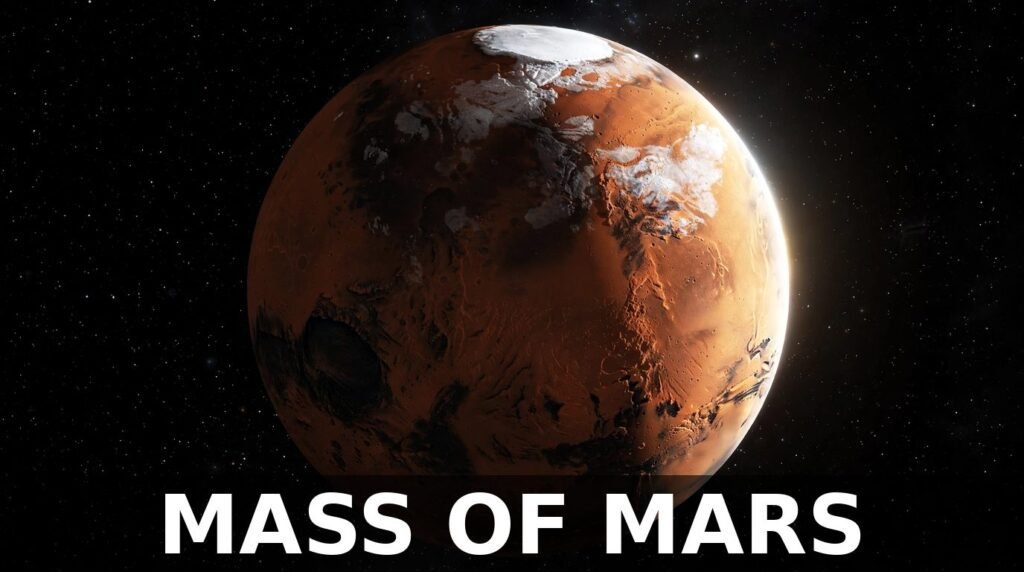
The mass of Mars is 6.4171 × 10^23 kilograms. That is about 0.107 times the mass of Earth, or roughly 11% of what our own planet weighs. You would need about nine and a third Mars-sized planets to add up to one Earth.
It sounds like a simple number, but it sits behind almost everything that makes Mars the way it is: its weak gravity, its thin atmosphere, and why Mars never grew into a second Earth.
The Short Answer: What Is the Mass of Mars?
The mass of Mars is 6.4171 × 10^23 kg. Written out in full, that is about 641,710,000,000,000,000,000,000 kilograms — 641 sextillion kilograms, if you like your numbers with names attached.
Most people find the comparison with Earth easier to hold on to. Mars has 10.7% of Earth’s mass. If Earth weighed 100 kilograms, Mars would weigh just under 11.
There is a second number worth knowing alongside it. Mars has about 15.1% of Earth’s volume. So Mars is a little more than one-tenth as heavy as Earth, but it takes up about one-seventh of the space. That mismatch tells you something important: Mars is not just smaller than Earth, it is also less dense. Its average density is 3.93 grams per cubic centimetre, compared with Earth’s 5.51. Earth packs more heavy material, especially iron, into every cubic metre.
| Property | Mars | Earth | Mars as a share of Earth |
|---|---|---|---|
| Mass | 6.4171 × 10^23 kg | 5.972 × 10^24 kg | 10.7% |
| Mean diameter | 6,779 km | 12,742 km | 53% |
| Mean radius | 3,389.5 km | 6,371 km | 53% |
| Volume | 1.631 × 10^11 km³ | 1.083 × 10^12 km³ | 15.1% |
| Mean density | 3.93 g/cm³ | 5.51 g/cm³ | 71% |
| Surface gravity | 3.71 m/s² | 9.81 m/s² | 38% |
| Escape velocity | 5.0 km/s | 11.2 km/s | 45% |
How Do Scientists Know the Mass of Mars?
Nobody has ever weighed Mars. There is no scale big enough, and there never will be. Instead, astronomers work out the mass of a planet by watching how its gravity pulls on other things. The method rests on work done centuries ago, and modern spacecraft have refined it to remarkable precision.
Watching the moons
Mars has two small moons, Phobos and Deimos. Phobos circles the planet once every 7 hours and 39 minutes, at a distance of about 9,376 kilometres from the centre of Mars. Deimos is farther out, about 23,463 kilometres away, and takes about 30 hours and 18 minutes to complete one orbit.
Those two sets of numbers — how far away each moon is, and how long it takes to go around — are enough to calculate the mass of Mars. The link is Kepler’s third law of planetary motion, combined with Newton’s law of universal gravitation. In plain terms, a heavier planet pulls its moons around faster at a given distance. Measure the orbit carefully, and the mass falls out of the maths.
This trick is not unique to Mars. Before spacecraft visited the outer planets, astronomers weighed Jupiter by timing its moons, Saturn by timing Titan, and Neptune by timing Triton. The moons act like natural measuring instruments, circling their planets on a schedule set by gravity alone.
Tracking spacecraft
The moons gave astronomers a good value for the mass of Mars long ago, but spacecraft made it far more precise. When a probe flies past Mars or goes into orbit around it, its path bends by an amount that depends on the planet’s gravity. Engineers on Earth track the spacecraft’s radio signal and measure tiny shifts in its frequency — the Doppler effect — as it speeds up and slows down. Those shifts reveal the strength of Mars’s gravitational pull to many decimal places.
The standard gravitational parameter of Mars, written as GM, is now measured at 42,828.375662 cubic kilometres per second squared. Divide that by the gravitational constant G and you get the mass: 6.4171 × 10^23 kg. Missions such as Mars Global Surveyor, Mars Odyssey, Mars Express, and the Mars Reconnaissance Orbiter have all contributed tracking data, and each one tightened the number a little further.
Why Is Mars So Much Less Massive Than Earth?
Mars and Earth are neighbours, formed from the same cloud of gas and dust around the young Sun about 4.5 billion years ago. Both are rocky planets. So why did one end up nine times heavier than the other? The short answer is that Mars stopped growing early, while Earth kept going.
It formed in a poorer neighbourhood
In the early solar system, the inner planets grew by sweeping up rock and dust as they orbited the Sun. Earth sat in a dense, material-rich part of the disc and kept collecting debris for tens of millions of years. Mars sat farther out, near the edge of the inner disc, where there was simply less material to gather.
There is also good evidence that Jupiter played a part. As the giant planet moved inward early in solar system history and then back outward — a migration described by the Grand Tack model — its gravity stirred up and scattered much of the material that might otherwise have gone into Mars. Mars was left half-built. Some planetary scientists describe it as an embryo of a planet, a world that never finished growing.
It is smaller, and its insides are lighter
Mass depends on two things: how big something is, and how dense it is. Mars loses on both counts. Its diameter is only about 53% of Earth’s, and its volume is just 15% of Earth’s. On top of that, its average density is only 71% of Earth’s.
The density gap matters. Earth’s core is large, about 55% of the planet’s radius, and made mostly of iron and nickel. That heavy core accounts for roughly a third of Earth’s total mass. Mars has a core too, but it is proportionally smaller — about 1,700 kilometres in radius against a planetary radius of about 3,390 kilometres — and it holds a larger share of lighter elements such as sulphur.
Mars also lacks the crushing pressure found deep inside Earth. On Earth, the weight of the rock above compresses the interior, raising the average density. On a smaller planet, that self-compression is weaker, so the same rock ends up slightly less dense. Size and density feed into each other.
Mass vs Weight: What Would You Weigh on Mars?
Mass and weight are not the same thing, and Mars is the perfect place to see why. Your mass is the amount of matter in your body. It does not change when you travel. Your weight is the force gravity exerts on that mass, and it changes with every planet you stand on.
On Mars, surface gravity is 3.71 metres per second squared, about 38% of Earth’s 9.81. So a person who weighs 80 kilograms on Earth would weigh only about 30 kilograms on Mars. Their mass would still be 80 kilograms. The bathroom scale would just read a smaller number.
| Object | Weight on Earth | Weight on Mars |
|---|---|---|
| Adult person | 80 kg | 30.4 kg |
| Child | 30 kg | 11.4 kg |
| Large dog | 40 kg | 15.2 kg |
| Suitcase | 23 kg | 8.7 kg |
| Car | 1,500 kg | 570 kg |
The practical effect is easy to picture. You could jump roughly two and a half to three times higher on Mars than on Earth, and a heavy backpack would feel light. But do not be fooled into thinking everything would be easy. Your mass is unchanged, so your inertia is unchanged too. Stopping a moving object, or changing direction quickly, takes just as much effort as it does on Earth.
How the Mass of Mars Compares to the Other Planets
Mars is the second-smallest planet in the solar system by mass; only Mercury is lighter. Jupiter alone weighs nearly 3,000 times as much as Mars, and even Venus, Earth’s near-twin, is more than seven times heavier.
| Planet | Mass (kg) | Mass in Earth masses | Compared with Mars |
|---|---|---|---|
| Jupiter | 1.898 × 10^27 | 317.8 | about 2,959× Mars |
| Saturn | 5.683 × 10^26 | 95.2 | about 885× Mars |
| Neptune | 1.024 × 10^26 | 17.1 | about 160× Mars |
| Uranus | 8.681 × 10^25 | 14.5 | about 135× Mars |
| Earth | 5.972 × 10^24 | 1.0 | about 9.3× Mars |
| Venus | 4.867 × 10^24 | 0.815 | about 7.6× Mars |
| Mars | 6.417 × 10^23 | 0.107 | 1× |
| Mercury | 3.301 × 10^23 | 0.055 | about 0.51× Mars |
Note that mass and size rankings differ: Saturn is the second-heaviest planet yet less dense than water, while Mars is one of the densest planets, beaten only by Earth and Mercury.
What the Low Mass Means for Mars
The mass of Mars is not an abstract figure. It shapes the planet’s gravity, its air, and its climate.
A planet holds on to its atmosphere with gravity. Mars’s gravity is weak, and its escape velocity is low, so light gases drift away into space over time. Today the surface pressure on Mars is less than 1% of Earth’s — about 0.6% on average. You could stand on Mars in daylight and still need a pressurised suit, because the air is far too thin to breathe and too thin to keep liquid water stable on the surface.
Earth’s magnetic field comes from its large, hot, liquid iron core, stirred by convection. Mars’s smaller core cooled long ago and largely solidified, and its magnetic dynamo shut down billions of years ago. Without that shield, the solar wind strips the upper atmosphere particle by particle. The low mass and the dead dynamo are connected: a smaller planet cools faster, and a cooled core cannot sustain a magnetic field.
Common Mistakes About the Mass of Mars
A few misunderstandings come up again and again, and they are worth clearing up.
First, Mars is not half the mass of Earth. It is half the diameter of Earth, and people often assume the mass follows. It does not. Mass grows with volume, and volume grows with the cube of the diameter. Half the diameter means roughly one-eighth of the volume, and Mars’s lower density pushes the mass down further, to about one-ninth of Earth’s.
Second, weight and mass are not interchangeable. Saying “Mars weighs less than Earth” is fine in everyday speech, but strictly speaking, weight is a force that depends on where you measure it. The mass of Mars is a fixed property of the planet. Your weight on Mars is a different number from your weight on Earth, but your mass is the same on both.
Conclusion
The mass of Mars is 6.4171 × 10^23 kilograms, about 11% of Earth’s mass and about 8.7 times the mass of the Moon. Scientists worked it out by timing the orbits of Phobos and Deimos and then refined it by tracking spacecraft, using the same laws of gravity that Newton described more than three centuries ago.
That one number explains a lot: the weak gravity, the thin air, the giant volcanoes, and the reason Mars never grew into a second Earth. It is a small planet with an outsized place in our imagination, and knowing how much it weighs is the first step to understanding why it turned out the way it did.
Frequently Asked Questions
What is the mass of Mars in kilograms?
The mass of Mars is 6.4171 × 10^23 kg, which is about 641,710,000,000,000,000,000,000 kilograms. In simpler terms, it is roughly 0.107 times the mass of Earth, or about 11% of Earth’s mass.
How much does Mars weigh compared to Earth?
Mars weighs about 11% as much as Earth. You would need around 9.3 planets the mass of Mars to equal the mass of one Earth. Mars is also about half the diameter of Earth, but because mass depends on volume and density, the mass gap is much larger than the size gap.
How was the mass of Mars measured?
Astronomers measured it by observing the orbits of Mars’s two moons, Phobos and Deimos. Using Kepler’s third law and Newton’s law of gravitation, the moons’ orbital periods and distances reveal the planet’s mass. Spacecraft tracking has since refined the figure: as probes orbit Mars, tiny changes in their radio signals show exactly how strongly the planet’s gravity pulls them.
Why is Mars less massive than Earth?
Mars formed farther from the Sun, in a region with less material to collect, and Jupiter’s early migration likely scattered much of the material that could have gone into it. Mars is also smaller — about 53% of Earth’s diameter — and less dense, with a smaller iron core. Together, the smaller size and lower density leave it with only about 11% of Earth’s mass.
How much would I weigh on Mars?
You would weigh about 38% of your Earth weight on Mars. A person who weighs 80 kg on Earth would weigh about 30 kg on Mars. Your mass stays the same — only your weight changes, because Mars’s surface gravity is 3.71 m/s² compared with Earth’s 9.81 m/s².
Is Mars heavier than the Moon?
Yes, Mars is about 8.7 times heavier than the Moon. The Moon’s mass is 7.342 × 10^22 kg, while Mars’s mass is 6.4171 × 10^23 kg. Mars is also about twice the Moon’s diameter, and its surface gravity is more than twice as strong.
For everyday living tips, home ideas and practical guides, DailyOrvix is a handy place to browse.
Read Also: Little Dipper Dipper: Finding the Little Dipper in the Night Sky