
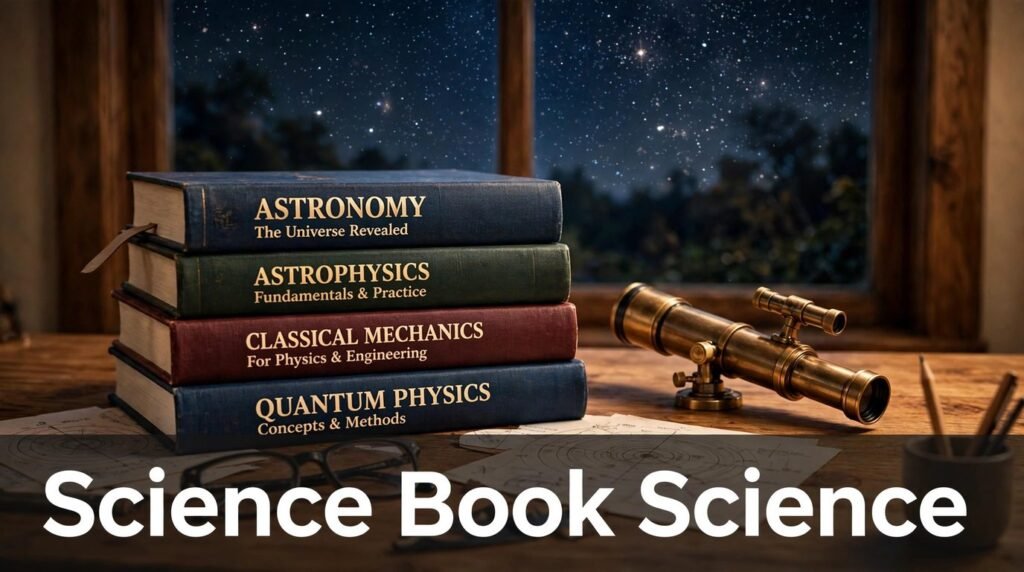
Science books have a strange power, and that power is at the heart of science book science. A single well-written book can take a subject that felt closed off at school — black holes, evolution, quantum physics — and turn it into something you genuinely want to read about late at night. The right book does not lecture you. It invites you in, one clear idea at a time, until a topic you once avoided starts to feel like yours.
That is exactly what this guide to science book science is for. Whether you are starting from scratch, returning to science after years away, or looking for a gift for a curious teenager, the shelves are full of brilliant options — and a few duds. The trick is knowing which books match your level, your interests, and the way you like to learn.
Below, in this science book science guide, you will find honest recommendations of real, widely loved science books, grouped by subject and by reader. Every book named here is a genuine published title by a real author. Nothing is invented, and nothing here is a textbook in disguise.
The short answer: If you are new to science book science, start with A Short History of Nearly Everything by Bill Bryson or Astrophysics for People in a Hurry by Neil deGrasse Tyson — both are friendly, funny, and assume no background knowledge. From there, follow your curiosity: Cosmos by Carl Sagan for astronomy, A Brief History of Time by Stephen Hawking for physics, and The Selfish Gene by Richard Dawkins for biology. Pick one book, finish it, and let it point you to the next.
How Do You Choose the Right Science Book?
Choosing a science book in science book science is less about finding the “best” one and more about finding the right one for you right now. A book that thrills a physics graduate can frustrate a complete beginner, and a book written for children can bore an adult — even when both are excellent in their own lane.
Start with your honest starting point. Have you read any popular science before, or is this your first book on the subject? If it is your first, favour books written for general readers. Look for phrases on the cover or in the description like “for the general reader”, “no mathematical background required”, or “an introduction”. These are signals that the author has done the hard work of translation for you.
Next, match the book to your interest, not to a sense of duty. If you love the night sky, an astronomy book will hold your attention far better than a general biology book you picked because someone told you it was important. Curiosity is the fuel that gets you through the harder chapters, so spend it on what genuinely excites you.
Check the Author Before You Buy
A quick check of the author tells you a lot. Is the writer a working scientist, a science journalist, or a science communicator with a track record? Authors like Carl Sagan, Stephen Hawking, Neil deGrasse Tyson, and Richard Dawkins built their reputations by explaining difficult ideas clearly. A science journalist such as Bill Bryson or Siddhartha Mukherjee brings a different strength: the skill of interviewing experts and shaping their knowledge into a story.
Also check the publication date. Science moves fast. A book about the solar system written in 1980 will miss entire worlds of discovery, from exoplanets to the images returned by modern space telescopes. That does not make older books useless — Darwin’s On the Origin of Species, first published in 1859, is still worth reading — but for fast-moving fields like astronomy and genetics, a recent edition or a modern author is usually the safer choice.
Read the First Pages First
If you can, read the first few pages before committing. A good popular science book should be clear in its opening chapter. If you have to re-read every paragraph twice on page one, the book is probably written above your current level, and there is no shame in setting it aside for later. The best science book is the one you actually finish.
What Are the Best Science Books for Beginners?
If you are new to science book science, these are the safest and most rewarding places to start. Each one assumes almost no background knowledge and rewards the reader with genuine understanding rather than a pile of facts to memorise.
- A Short History of Nearly Everything — Bill Bryson. Bryson, a travel writer with no science degree, set out to understand the science he felt he should know and wrote the book he wished he had read. It covers the Big Bang, atoms, geology, evolution, and more, in warm, funny, plain English. It is probably the single best first science book ever written for a general reader.
- Astrophysics for People in a Hurry — Neil deGrasse Tyson. A slim book of short essays that explains the universe in bite-size chapters: the Big Bang, dark matter, black holes, and why the elements in your body were forged in stars. You can read a chapter in ten minutes, which makes it perfect for busy readers.
- Cosmos — Carl Sagan. First published in 1980 and still in print, Cosmos is part astronomy, part history, part philosophy. Sagan writes with a sense of wonder that has inspired generations of readers, and the book moves gracefully from the ancient Greeks to the search for life on other worlds.
- What If? — Randall Munroe. The creator of the xkcd webcomic answers absurd hypothetical questions — what would happen if you tried to hit a baseball at nearly the speed of light? — with real science, real maths, and stick-figure diagrams. It is funny, but the science underneath is serious.
- The Demon-Haunted World — Carl Sagan. A book about thinking clearly as much as about science itself. Sagan explains the scientific method, why superstition persists, and how to tell good evidence from bad. It is the best book on this list for building a sceptical, curious mind.
| Book | Author | Best for | Length and feel |
|---|---|---|---|
| A Short History of Nearly Everything | Bill Bryson | First-ever science book | Long, warm, story-driven |
| Astrophysics for People in a Hurry | Neil deGrasse Tyson | Busy readers, space lovers | Short, quick chapters |
| Cosmos | Carl Sagan | Wonder and big ideas | Rich, poetic, classic |
| What If? | Randall Munroe | Fun questions, light reading | Funny, visual, surprising |
| The Demon-Haunted World | Carl Sagan | Critical thinking | Thoughtful, persuasive |
Which Astronomy Books Should You Start With?
Astronomy is the most popular entry point into science book science, and for good reason. The questions are enormous — how did the universe begin, are we alone, what happens inside a black hole — and the answers keep getting better as telescopes improve.
Cosmos by Carl Sagan remains the classic starting point, and its follow-up in spirit, Pale Blue Dot, also by Sagan, reflects on our place in the vastness of space and on the famous photograph of Earth taken from billions of miles away. Both books are as much about the human side of exploration as they are about the science. For many readers, Cosmos is the book that defines science book science.
For a modern, quick introduction, Astrophysics for People in a Hurry by Neil deGrasse Tyson is hard to beat. Tyson also wrote Death by Black Hole, a collection of essays that covers everything from the fate of the universe to the science of movie special effects, in an entertaining, conversational style.
If you want to go deeper, A Brief History of Time by Stephen Hawking is the famous next step. It tackles the Big Bang, black holes, and the nature of time itself. Be honest with yourself: it is denser than the books above, and many readers take it slowly, a chapter at a time. That is fine. There is also The Universe in a Nutshell, Hawking’s illustrated follow-up, which many readers find easier because of its pictures and diagrams.
Books About the Night Sky Itself
Some readers want less theory and more practical stargazing. For that, a good field guide to the constellations or a monthly sky guide is worth owning alongside a popular science book. These guides help you find what you have been reading about — the planets, the constellations, the Milky Way — with your own eyes, and that experience makes the science stick in a way reading alone cannot.
What Are the Best Physics Books for Curious Readers?
Physics has a reputation for being the hardest science to read about, but in science book science the best physics books for general readers avoid heavy mathematics and lean on analogy, story, and thought experiment instead.
- A Brief History of Time — Stephen Hawking. The most famous popular physics book ever published. It explains the Big Bang, black holes, and the arrow of time without requiring the reader to follow equations.
- Seven Brief Lessons on Physics — Carlo Rovelli. Seven short, beautifully written essays on relativity, quantum mechanics, and the structure of the universe. At under a hundred pages, it is the shortest serious physics book on this list, and one of the most poetic.
- The Elegant Universe — Brian Greene. A clear and enthusiastic tour of string theory and the search for a single theory that unites all of physics. Greene is a gifted explainer, and the book is best read after you have some basic familiarity with relativity and quantum ideas.
- Surely You’re Joking, Mr. Feynman! — Richard P. Feynman. Not a textbook at all, but a collection of stories from the life of one of the great physicists of the twentieth century — lock-picking, drumming, and working on the atomic bomb, told with humour and honesty. It shows how a physicist thinks, which is just as valuable as what a physicist knows.
- The Structure of Scientific Revolutions — Thomas S. Kuhn. A more challenging read, but an important one. Kuhn explains how science actually changes — not in a smooth line, but in sudden shifts when old ideas break down. Best saved for when you already enjoy science reading and want to understand how science itself works.
Which Biology Books Explain Life Best?
In science book science, biology books tend to be the most story-rich of all science books, because life itself is a story — of evolution, of survival, of the invisible machinery inside every cell.
The Selfish Gene by Richard Dawkins, first published in 1976, explains evolution from the point of view of the gene rather than the individual animal. It introduced the word “meme” and changed how many people think about natural selection. It is persuasive, clear, and still widely read, though some of its ideas are debated by biologists today — which is itself a useful lesson in how science works.
The Double Helix by James Watson tells the story of the discovery of the structure of DNA in 1953, from the inside, by one of the scientists involved. It is fast, gossipy, and sometimes controversial in its portrayal of colleagues, but it captures the excitement and rivalry of real discovery better than almost any other book.
For a modern classic, The Gene: An Intimate History by Siddhartha Mukherjee traces the history of genetics from Mendel’s pea plants to modern gene therapy, weaving in the story of mental illness in the author’s own family. It is long, but it reads like a novel and explains the science as it goes.
Silent Spring by Rachel Carson, published in 1962, is the book that launched the modern environmental movement. Carson documented the harm caused by pesticides with careful evidence and lyrical writing, and the book remains a model of how science writing can change the world.
Evolution for the Curious
If evolution is your particular interest, On the Origin of Species by Charles Darwin is still readable — more readable than most people expect — and there are many modern editions with helpful introductions. Reading Darwin in his own words gives you a direct sense of how the theory was built, observation by observation, long before DNA was understood.
Are There Good Science Books for Kids?
Yes — and in science book science, choosing well matters, because a child’s first science book can shape their attitude to the subject for years. The best children’s science books share the same qualities as the best adult ones: clear explanations, genuine wonder, and respect for the reader’s intelligence.
- George’s Secret Key to the Universe — Lucy and Stephen Hawking. A storybook adventure through space, written by Stephen Hawking with his daughter Lucy, with real science woven into the plot. It is aimed at readers around nine and up.
- National Geographic Kids science titles. The National Geographic Kids range covers space, animals, the human body, and the Earth, with big photographs and short, punchy facts. They are ideal for younger readers and reluctant readers alike.
- The Way Things Work — David Macaulay. A beautifully illustrated guide to machines, from levers and pulleys to computers and jet engines. It has introduced generations of children — and plenty of adults — to engineering.
- Horrible Science series — Nick Arnold. Funny, gross, and genuinely informative, this series covers blood, guts, volcanoes, space, and more. It works best for children who like their facts with a side of jokes.
| Reader | Good first picks | Why they work |
|---|---|---|
| Ages 6–9 | National Geographic Kids titles | Big pictures, short facts, easy dipping in |
| Ages 9–12 | George’s Secret Key to the Universe | Story plus real astronomy |
| Ages 9–12 | Horrible Science series | Humour keeps reluctant readers going |
| Ages 10+ | The Way Things Work | Pictures explain what words cannot |
| Teens | Astrophysics for People in a Hurry | Short chapters, no dumbing down |
One caution in science book science: avoid books that talk down to children or that are packed with facts but no explanation. A child who learns why the Moon changes shape will remember it; a child who only memorises the names of the phases will forget them by next week.
How Do You Read a Science Book So It Actually Sticks?
In science book science, buying a book is easy. Finishing it — and remembering what it said — is the real skill. A few simple habits make a large difference.
First, read actively. Keep a pencil or a notes app nearby and jot down the one idea from each chapter that surprised you most. You do not need detailed notes. A single sentence per chapter is enough to anchor the memory.
Second, explain it to someone else. The moment you try to describe a black hole or natural selection in your own words, you discover which parts you actually understood and which parts you only thought you understood. If there is nobody nearby, explain it out loud to yourself. It sounds odd, and it works.
Third, slow down for the hard chapters and speed up for the easy ones. Popular science books are not novels; nobody will mind if you spend three evenings on one chapter about quantum mechanics and then read the next three chapters in a single sitting. The goal is understanding, not finishing quickly.
Fourth, pair reading with looking. If you are reading about the planets, step outside and find one. If you are reading about evolution, visit a natural history museum. If you are reading about the human body, look at a good anatomy diagram. Science is about the real world, and connecting words to things you can see makes the words last.
Finally, accept that you will forget some of it. Forgetting is normal, even for scientists. The value of a good science book in science book science is not that you remember every fact, but that it changes how you think — so that the next time you hear about a discovery in the news, you have a framework to fit it into. That lasting framework is the real return on science book science.
Where Can You Get Science Books for Free or Cheap?
You do not need to spend a fortune to build a good science book science reading habit. Many of the best options cost little or nothing.
- Your local library. Most libraries carry popular science titles, including recent ones, and can order books they do not hold. A library card is the cheapest way to try many authors before buying the ones you love.
- Second-hand bookshops and charity shops. Science books appear in second-hand shops constantly, often in excellent condition, for a fraction of the cover price. Older editions are fine for timeless subjects, though for fast-moving fields like astronomy, check the publication date.
- E-book deals and library apps. Many libraries lend e-books and audiobooks for free through their apps. Audiobooks are a good option for science reading too — a well-narrated popular science book works surprisingly well on a walk or a commute.
- Free classic texts. Older works whose copyright has expired, including Darwin’s On the Origin of Species, are freely available to read online through public archives such as Project Gutenberg. They are not always the easiest starting point, but they cost nothing to try.
- Book swaps and friends. Science readers love to recommend books. Asking a friend what they read last is often the fastest route to a book you will actually enjoy, and swapping copies costs nothing.
If you do buy, consider buying the paperback of a science book science favourite you have already read and loved from the library. A small shelf of favourite science books that you return to is worth more than a large shelf of books you never opened.
What Mistakes Do People Make When Picking Science Books?
Most disappointments in science book science come from a handful of avoidable mistakes.
Starting too advanced. The most common error is picking a book written for university students or specialists when you wanted a friendly introduction. Check the intended audience before you buy, and do not be embarrassed to start with the simplest book on the shelf in science book science. Everyone starts somewhere.
Judging by the cover alone. A dramatic cover and a bold claim — “the book that changes everything” — tell you about marketing, not about quality. Read a page or two first, check the author, and look at what other readers actually say about the explanations, not just the topic.
Trying to read five books at once. Enthusiasm is good, but five half-finished science books teach less than one finished book. Pick one, finish it, and then choose the next based on what it made you curious about.
Treating every book as equally current. A book about the planets written before the first exoplanets were confirmed will be out of date in places, and a genetics book written before modern gene-editing techniques existed will miss a major part of the story. Check the date, especially for astronomy, genetics, and medicine.
Reading only within one subject. It is natural to go deep on one topic, but some of the most enjoyable science reading happens at the edges — where astronomy meets geology, or biology meets chemistry. Once you have a favourite subject, try one book just outside it. You may find a second favourite.
Frequently Asked Questions About Science Book Science
What is the best science book for a complete beginner?
A Short History of Nearly Everything by Bill Bryson is the most commonly recommended starting point, because it covers many fields in plain, entertaining English and assumes no background knowledge. It is a classic of science book science for good reason. If you prefer short chapters and a focus on space, Astrophysics for People in a Hurry by Neil deGrasse Tyson is the best alternative.
Which science book should I read first if I love astronomy?
Start with Cosmos by Carl Sagan for a broad, inspiring tour of the universe, then move to Astrophysics for People in a Hurry by Neil deGrasse Tyson for a modern, bite-size update. If you want to go deeper afterwards, A Brief History of Time by Stephen Hawking is the natural next step. That path is a well-trodden one in science book science.
Are popular science books accurate?
The best ones are, within the limits of what was known when they were written. Good authors distinguish between settled science, active debate, and speculation, and they say so when an idea is unproven. Always check the publication date, and remember that a book is a snapshot of knowledge at the time it was written, not the final word.
Can children read the same science books as adults?
Some teenagers can and do enjoy adult popular science, especially short, friendly books like Astrophysics for People in a Hurry. For younger children, though, books written for their age group work better, because they use shorter chapters, more pictures, and examples from a child’s own world.
How long does it take to read a popular science book?
Most popular science books run between 200 and 400 pages. At a relaxed pace of 20 to 30 pages a day, that means roughly one to three weeks. Shorter books like Seven Brief Lessons on Physics can be finished in a weekend, while longer books like A Short History of Nearly Everything may take a month of steady reading. There is no rush — understanding matters more than speed.
Is it better to read science books or watch science videos?
Both have their place, and they work well together. Books go deeper, let you pause and re-read, and build understanding step by step. Videos are better for showing things — the surface of Mars, the inside of a cell, the scale of the solar system. Many readers watch a documentary first to get interested, then read a book to go deeper.
Do I need a science background to enjoy these books?
No. Every book recommended in this guide was written for general readers, and none of them assumes a science degree or any mathematical background. If a book makes you feel that you needed a degree to read it, it is the wrong book for a beginner — put it aside and try an easier one first.
Final Thoughts
The best science book is not the most famous one or the most difficult one. It is the one that matches where you are now, answers a question you actually care about, and leaves you wanting to read the next one. That is science book science at its best.
A single shelf of well-chosen science book science titles can change how you see the night sky, how you understand your own body, and how you judge claims you hear in the news. That is a remarkable return on a few evenings of reading. Pick one book from this guide, start tonight, and see where it takes you. That is the quiet payoff of science book science, one finished book leading to the next.
Read Also: Order of the Planets: From Mercury to Neptune Explained
