
Most people who fall for astronomy don’t start in a classroom. They start with a moment: a meteor streaking over a campsite, the Moon’s craters snapping into focus through a borrowed telescope, or simply a sky so full of stars it stops feeling real. The question arrives right after the wonder fades a little. How do I actually learn this properly?
Studying astronomy is more accessible than most beginners assume. You don’t need a university enrollment, a giant telescope, or a physics degree to begin. What you need is a sensible learning order, a few trustworthy resources, and the simple habit of looking up regularly.
This guide walks you through exactly how to study com astronomy from zero — the topics that matter, the best ways to learn online, how to practice under the real sky, and the gear you actually need (spoiler: far less than the ads suggest).
The short answer: Start with the naked-eye sky and a free planetarium app, work through the core topics in order — solar system, stars, galaxies, cosmology — and only buy a telescope once you can find your way around the constellations. With consistent study, most people can hold confident conversations about astronomy within a few months.
What Does It Really Mean to Study Astronomy?
Astronomy is the scientific study of everything beyond Earth’s atmosphere: the Moon and planets, stars and galaxies, and the universe as a whole — how it began, how it behaves, and where it’s headed.
But “studying” astronomy has two halves, and beginners often discover only one of them. The first half is theory: learning how stars burn, why galaxies have shapes, what a light-year really means. The second half is practice: stepping outside, finding Jupiter with your own eyes, and watching the Moon’s terminator creep across its craters night after night. Both halves feed each other. Theory tells you what you’re looking at; practice makes the theory unforgettable.
Astronomy vs. Astrophysics: What’s the Difference?
You’ll see both terms used, and they’re related but not identical. Astronomy is the broader field — it includes observing, cataloging, and describing what’s out there. Astrophysics leans into the physics: using equations to explain why stars shine or how black holes bend spacetime. Most beginner courses blend the two, starting with descriptive astronomy and introducing the physics gently as you go. You don’t need to choose a lane on day one.
What Topics Do You Actually Study in Astronomy?
Astronomy covers an enormous range, from the Moon next door to the edge of the observable universe. Nearly every beginner course, online or in person, works through the same logical sequence. Here’s the map:
| Topic Area | What You’ll Learn | Beginner Friendliness |
|---|---|---|
| Naked-eye astronomy | Constellations, the Moon’s phases, planets you can spot without equipment | Very easy — start here |
| The solar system | Planets, moons, asteroids, comets, and how the system formed | Easy and visual |
| Light and telescopes | How we gather information from light, and how telescopes work | Easy with the right explanation |
| The Sun and stars | How stars are born, live, and die; the Sun as a typical star | Moderate — introduces real physics |
| Galaxies and deep space | The Milky Way, other galaxies, nebulae, star clusters | Moderate; very rewarding |
| Cosmology | The Big Bang, dark matter, dark energy, the fate of the universe | Conceptually big — save for later |
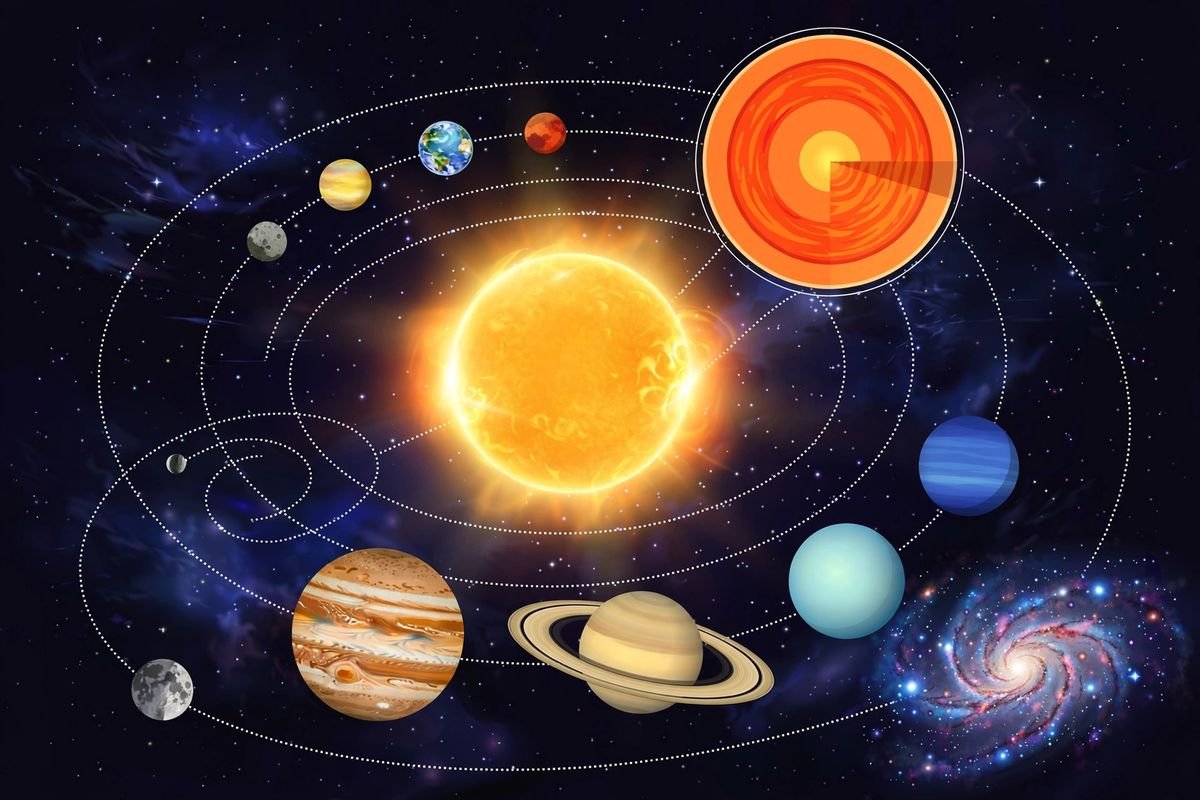
Astronomy’s core topics build on each other: the solar system and stars come first, then galaxies, and finally cosmology. Working through them in order makes each new idea easier to grasp.
Notice the order. It goes outward: from things you can see with your eyes, to things you need a telescope for, to things you can only detect with instruments. That outward journey is the single best study strategy in astronomy. When a concept feels hard — say, stellar evolution — it almost always becomes easier once you’ve actually seen a few of the objects involved through binoculars or a small telescope.
How Do You Start Studying Astronomy as a Complete Beginner?
Forget the telescope for now. Here’s a practical starting sequence that works for nearly everyone:
- Learn the sky with your eyes first. Spend a few evenings identifying a handful of bright constellations and watching the Moon’s phase change. A free planetarium app makes this far easier than a paper chart — just hold your phone up.
- Pick one beginner book and actually finish it. One well-chosen book beats ten half-read ones. Look for guides written for stargazers rather than textbooks, with plenty of diagrams.
- Follow a structured course. A course forces an order on the material and fills gaps you’d leave on your own. Online introductory courses are ideal here (more on those below).
- Keep an observing log. A cheap notebook where you record the date, what you saw, and what surprised you. This single habit separates casual readers from real students of the sky.
- Find people. A local astronomy club’s beginner night will teach you more in two hours than two weeks of reading. Experienced amateurs love showing newcomers around the sky.
The underlying principle comes from how science courses actually work: hunt for the main ideas — the theories, methods, and processes — and let the facts attach themselves to those ideas. If you understand why the Moon has phases, the phase names become impossible to forget. If you only memorize the names, they slip away within a week.
What Are the Best Ways to Study Com Astronomy Online?
Online learning is where most modern beginners start, and the options are genuinely good. They fall into a few categories, each with a different flavor:
| Format | Best For | What to Watch For |
|---|---|---|
| University-style MOOCs | Learners who want a structured, lecture-like course with quizzes | Some charge for certificates; audit tracks are usually free |
| Open courseware (recorded university lectures) | Self-motivated students who like real classroom depth | No hand-holding or feedback; pacing is up to you |
| Short video series and explainers | Quick overviews of single topics like eclipses or black holes | Depth varies wildly — check who’s behind the channel |
| Paid structured courses | Learners who want quizzes, study guides, and a clear path to a certificate | Compare syllabi before paying; course catalogs change |
Whichever route you take, look for three quality signals: an instructor or institution with real astronomy credentials, a syllabus that follows the outward sequence (solar system → stars → galaxies → cosmology), and practice questions or quizzes so you’re testing yourself, not just watching. If you prefer a fully guided path, you can study com astronomy through Study.com’s structured video courses, which bundle lessons, quizzes, and certificates into one syllabus. A course that jumps straight to black holes before covering the Moon is a red flag — it may be entertaining, but it won’t build understanding.
And keep your expectations honest: an introductory course makes you literate in astronomy, not an astronomer. That’s exactly the right goal for a beginner. Literacy means you can read space news with understanding, know what’s actually visible in tonight’s sky, and ask good questions — which is where all deeper learning starts.
Do You Need Math or Physics to Study Astronomy?
This is the question that stops more beginners than any other, so let’s settle it: no — not to start. You can learn constellations, follow the solar system, understand how stars work conceptually, and observe for years without touching an equation. The history of astronomy itself was built by people who mostly watched and reasoned.
Math enters the picture only when your goals demand it. Here’s the honest breakdown:
| Your Goal | Math You’ll Meet | How to Handle It |
|---|---|---|
| Enjoy and understand the sky | Almost none — basic arithmetic at most | Nothing to worry about |
| Understand popular science deeply | Simple algebra in some explanations | Learn formulas as recipes, not proofs |
| Take university-level courses | Algebra, geometry, basic calculus | Refresh math alongside the astronomy |
| Professional research or astrophysics | Calculus, differential equations, statistics | This is a degree path, not casual study |
A useful trick for math-shy beginners: when an explanation uses an equation, read the sentence around it. Good writers always translate the math into words — the equation is just shorthand. If a book never explains what its formulas mean, that’s a book problem, not a you problem. Find a better book.
Which Books and Resources Help Beginners Most?
Books remain the backbone of self-study because they’re structured, fact-checked, and written to be re-read. For pure beginners, observing guides beat textbooks. Turn Left at Orion by Guy Consolmagno and Dan Davis is the classic recommendation for a reason: it shows you what’s actually visible through small telescopes, season by season, and explains each object as you find it. Carl Sagan’s Cosmos remains the best pure inspiration — read it when your motivation dips, and it won’t.
Beyond books, assemble a small toolkit of free resources:
- A planetarium app. Stellarium is free, open-source, and remarkably accurate — it shows exactly what’s above you tonight, including satellites. Spend fifteen minutes with it before every observing session.
- Monthly sky guides. Astronomy magazines and established astronomy websites publish “what’s up this month” guides. Following one turns random stargazing into a curriculum.
- A star chart or planisphere. Paper charts work when your phone dies or you want to preserve your night vision (screens ruin it).
- NASA’s public archives. The images are spectacular, but more importantly, the captions teach — every image of the day comes with an explanation written by working astronomers.
If you enjoy reading plain-language science explainers, the science stories on Daily Scope 67 make a good companion habit — short, jargon-free explainers that keep your curiosity topped up between study sessions.
How Do You Practice Astronomy Under the Real Sky?
Reading about astronomy without observing is like studying music without listening. The good news: the most valuable observing needs no equipment at all. Here’s how to make your first sessions count:
- Give your eyes time. True night vision takes 20–30 minutes to develop. Avoid phone screens during that window — one glance at a bright screen resets the clock.
- Start with the Moon. It’s the single best beginner target. Watch it over a month and you’ll see phases, craters, and shadows change in real time — the whole geometry of sunlight and orbits, visible to the naked eye.
- Learn five constellations deeply rather than fifty shallowly. Pick ones visible in your current season, learn their bright stars by name, and note what else sits nearby. Depth beats breadth under the sky.
- Use a red flashlight. Red light preserves your night vision while letting you read charts. Cheap red LED flashlights are sold for exactly this purpose.
- Dress warmer than you think. Standing still under a clear sky gets cold fast, even in summer. Half of all abandoned observing sessions end because someone got chilly, not because the sky was bad.
- Write it down. Date, time, what you saw, conditions, what surprised you. Six months later, that notebook becomes the most motivating thing you own.
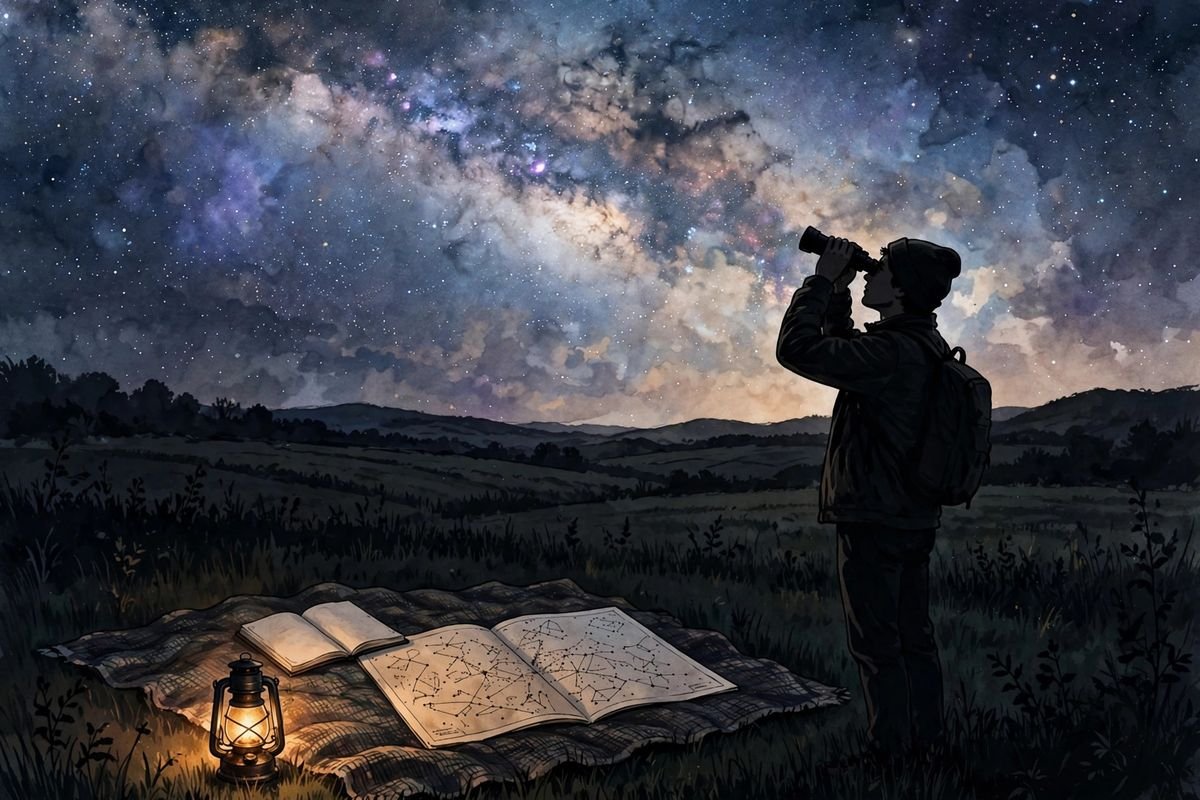
Your first observing sessions need nothing but dark skies, a little patience, and a plan. Learning the constellations by eye is the foundation every telescope owner wishes they’d built first.
Should You Buy a Telescope When Starting Out?
Short answer: not yet. The classic beginner mistake is buying a telescope before knowing the sky, then pointing it at random patches of darkness and concluding astronomy is boring. The telescope wasn’t the problem — the missing star knowledge was.
The recommended upgrade path, used by astronomy clubs for decades, looks like this:
- Binoculars first. A pair of 7×50 or 10×50 binoculars shows the Moon’s craters, Jupiter’s four largest moons, star clusters, and even bright galaxies — for a fraction of a telescope’s price. They’re also far easier to use.
- Learn the sky for a few months. If you can find a dozen constellations and several planets on demand, you’re ready for step three.
- Then buy a telescope — the right kind. For most beginners, that means a Dobsonian reflector: the most aperture (light-gathering power) per dollar, simple to use, no electronics to fight with.
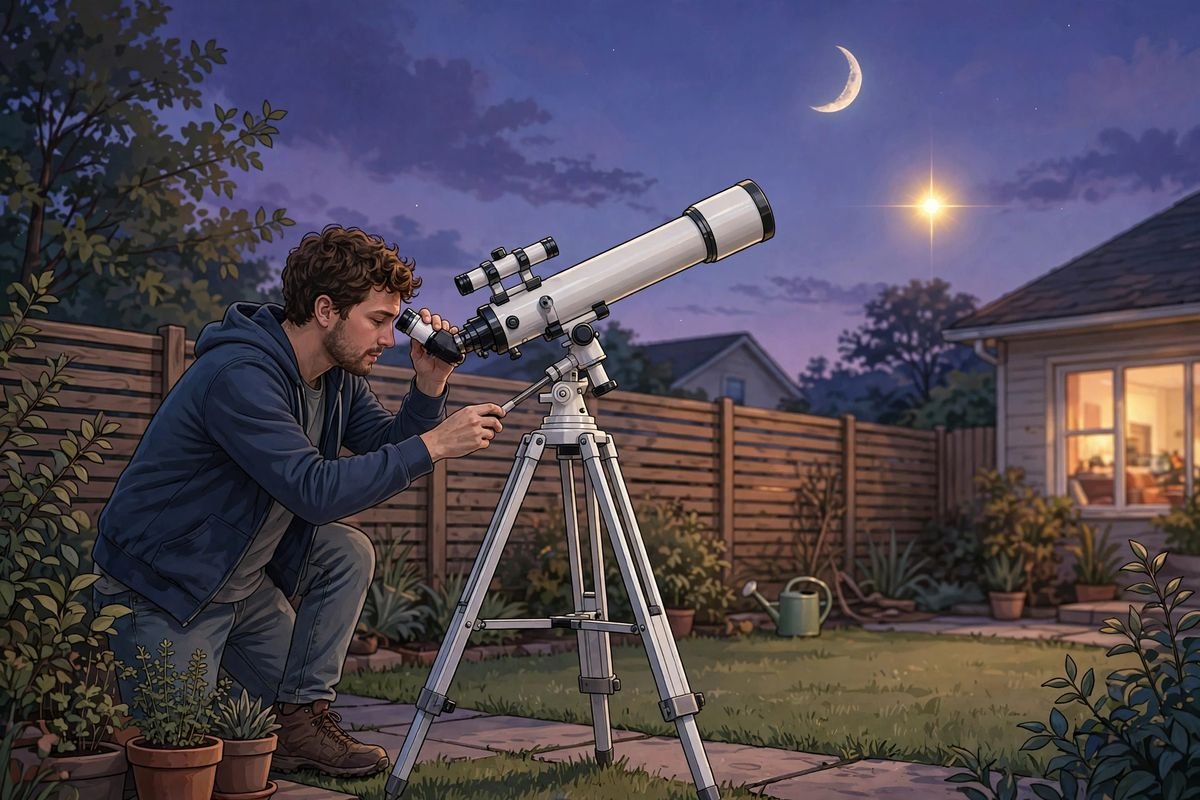
A beginner telescope in the backyard is at its best when you already know the sky. Learn a few constellations first, and every object you point at becomes a small victory instead of a frustrating search.
What about those cheap telescopes in department stores and online marketplaces? Be cautious. Extremely low-priced telescopes usually combine shaky mounts with exaggerated magnification claims, and the wobbling image they produce turns beginners away from the hobby. A decent pair of binoculars genuinely outperforms a bad telescope. When you do buy, get advice from a local club first — members have strong opinions about starter scopes, and they’re usually right.
How Much Time Does It Take to Learn Astronomy?
Set honest expectations and you’ll enjoy the process far more. Roughly: within a few weeks of regular evenings outside, you’ll know the major constellations of your season and the Moon’s cycle. Within a few months of steady study — a course plus observing — the core ideas (how stars work, what galaxies are, how the solar system formed) will feel familiar rather than foreign.
Beyond that, astronomy is wonderfully bottomless. Professional astronomers spend careers on single questions. But here’s the encouraging part: the learning curve is front-loaded with wonder. The first year gives you the constellations, the planets, the Moon in detail, the bright deep-sky objects, and a working understanding of the universe’s story. Later years deepen rather than replace that foundation.
Aim for consistency over intensity. Twenty minutes under the sky three times a week beats a single six-hour marathon once a month. Astronomy rewards the regular observer — the sky changes nightly, and noticing those changes is the whole game.
How Can You Take Your Astronomy Studies Further?
Once the basics feel solid, several doors open — and they suit different temperaments:
- Join a club and attend star parties. You’ll look through telescopes you’d never afford, learn from people who’ve observed for decades, and make friends who get excited about the same faint smudges you do.
- Try citizen science. Real research projects invite volunteers to classify galaxies, hunt exoplanets in telescope data, or track variable stars. Your beginner skills are genuinely useful there.
- Attempt astrophotography. Start with a tripod and a phone pointed at the Milky Way before buying dedicated gear. It teaches patience and sky knowledge simultaneously.
- Go formal. If the pull is strong, community college astronomy courses and then a physics or astronomy degree turn the hobby into a profession. Many working astronomers started exactly where you are now — curious, outside, looking up.
Frequently Asked Questions
Can I study astronomy online for free?
Yes. Free planetarium apps, open university lecture recordings, free video series, and public archives from space agencies cover the full beginner curriculum at no cost. Paid courses mainly add structure, quizzes, and certificates — useful, but not required to learn. For example, you can study com astronomy through Study.com’s structured video courses if you want a guided path with a certificate.
What’s the easiest way to study com astronomy as a beginner?
Learn the naked-eye sky first with a planetarium app, read one good beginner observing guide, and follow a structured introductory course. That combination — observe, read, study — covers what any single method misses.
Do I need a telescope to study astronomy?
No. The Moon, planets, constellations, meteors, and even bright galaxies and star clusters are visible without one — binoculars extend that range enormously. Buy a telescope only after you know the sky well enough to point it with purpose.
What math do I need for astronomy?
None to start. Casual study and stargazing need almost no math. University-level astronomy introduces algebra and calculus, and professional astrophysics is math-heavy. Match the math to your goals, not the other way around.
How long does it take to learn the basics of astronomy?
Most consistent beginners know their way around the sky and understand the core concepts within a few months. You’ll keep learning for years — but the foundational literacy that makes astronomy enjoyable arrives faster than people expect.
Can I make a career out of astronomy?
Yes, but it runs through formal education: typically a physics or astronomy degree followed by graduate study. Related careers — science writing, planetarium education, telescope operation, data science for observatories — offer more entry points with varied backgrounds.
Is astronomy the same as astrology?
No. Astronomy is the scientific study of celestial objects and the universe. Astrology is a belief system claiming celestial positions influence human affairs, with no scientific support. They share historical roots but are entirely different pursuits today.
Final Thoughts
Studying astronomy is one of the rare pursuits where the beginner phase is as joyful as mastery. The same sky that delights a child with the Moon’s craters rewards a professional with dark-energy measurements — it’s all the same sky, just deeper.
Start tonight if the sky is clear. Step outside, find one constellation, and look at the Moon for five unhurried minutes. Then come back inside and learn what you just saw. Repeat that loop — observe, learn, observe — and you’ll truly know how to study com astronomy long before you ever touch a telescope.
Read Also: Toyota Highlander Hybrid (2026): Complete Buyer’s Guide to MPG, Trims, Price & Reliability

1 Comment